

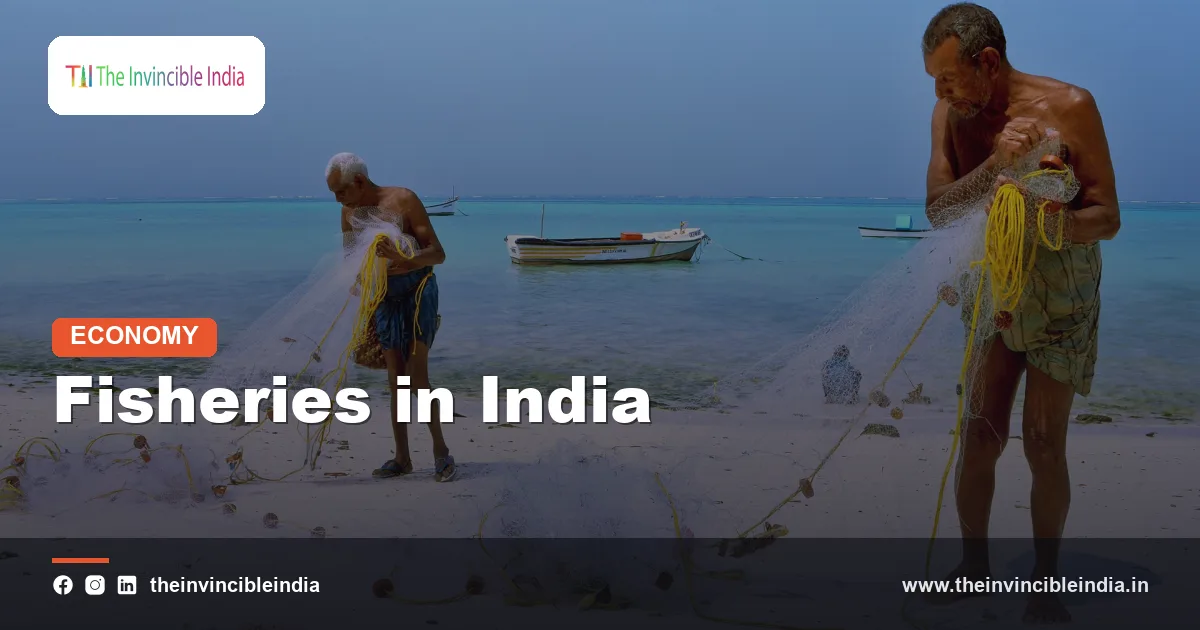
The Blue Revolution is the name given to India’s rapid expansion of fish production through scientific aquaculture, better marine fishing and stronger post-harvest systems. Over the past few decades, a sector that was once dominated by small boats and village ponds has grown into a major source of food, jobs and foreign exchange, placing India among the world’s leading fish-producing countries and second only to China in total output.
This explainer covers the history, geography and institutions behind the Blue Revolution: how inland and marine fisheries differ, what aquaculture added, how schemes such as the Fish Farmers’ Development Agencies and the Pradhan Mantri Matsya Sampada Yojana (PMMSY) work, why shrimp became the star of seafood exports, and what sustainability challenges lie ahead.
| Topic | Fisheries and aquaculture in India |
|---|---|
| Term “Blue Revolution” | Used for the post-1970s growth of fish production, formalised as a central scheme in 2015-16 |
| Early institutional step | Fish Farmers’ Development Agencies (FFDAs), begun in the mid-1970s |
| Induced breeding of carps | Achieved in 1957 at Cuttack; celebrated as National Fish Farmers’ Day on 10 July |
| Export promotion body | Marine Products Export Development Authority (MPEDA), set up in 1972 |
| Separate department | Department of Fisheries, created in 2019 within a Ministry of Fisheries, Animal Husbandry and Dairying |
| Flagship scheme | Pradhan Mantri Matsya Sampada Yojana, launched in 2020 |
| Top export item | Frozen shrimp |
What Is the Blue Revolution?
The phrase draws on earlier agricultural transformations. The Green Revolution of the 1960s lifted wheat and rice yields, and the White Revolution of the 1970s, driven by Operation Flood, turned India into a milk-surplus country. The Blue Revolution applies the same logic to water: improve breeding, feed, technology and marketing so that fish output increases steadily while incomes of fishers and farmers rise.
It is not a single event. Experts often speak of an early phase, when freshwater carp culture was perfected and extension agencies were set up, and a later phase, when brackishwater shrimp farming, deep-sea fishing, cold chains and exports took off. In 2015, the Government of India integrated several existing programmes into a scheme called the Neel Kranti Mission, which gave the term formal recognition in policy documents.
Why Fisheries Matter
- Fish is an affordable, protein-rich food, especially in coastal states, Bengal, the north-east and Kerala.
- The sector employs tens of millions of people along the value chain, from fishers and farmers to processors, traders and boat builders.
- Seafood is a significant agricultural export and a source of foreign exchange.
- Fisheries are central to the idea of the “blue economy”, which covers sustainable use of ocean and inland water resources.
India’s Water Resources: Where Fish Come From
India’s fishery potential rests on a rich variety of water bodies. The mainland coastline is several thousand kilometres long, the exclusive economic zone extends to roughly two million square kilometres, and the country also has extensive rivers, canals, reservoirs, ponds, tanks, lakes and floodplain wetlands.
These resources fall into three broad categories:
- Marine waters: the Arabian Sea, the Bay of Bengal and the Indian Ocean, including waters around the Andaman and Nicobar Islands and Lakshadweep.
- Brackishwater areas: estuaries, lagoons, backwaters and coastal salt-affected lands, such as Chilika in Odisha and the Kerala backwaters.
- Freshwater areas: the Ganga, Brahmaputra, Godavari, Krishna and other river systems, plus large reservoirs and countless village ponds.
Different regions have specialised in different species. Andhra Pradesh and Bengal are known for carp and shrimp farming, Kerala and Gujarat for marine catch, Odisha for brackishwater and riverine resources, and the north-east for small indigenous fish and cold-water species such as mahseer and trout in the hills.
Inland versus Marine Fisheries
For many years, marine capture fisheries accounted for most of India’s fish output. This changed as aquaculture expanded. Today, inland fisheries produce the larger share of the total, while marine catch has grown more slowly because many coastal stocks are already heavily exploited.
| Feature | Inland fisheries | Marine fisheries |
|---|---|---|
| Main source | Ponds, tanks, reservoirs, rivers, wetlands | Coastal and deep-sea waters |
| Mode | Mostly culture (aquaculture), some capture | Mostly capture, with growing mariculture |
| Typical species | Rohu, catla, mrigal, tilapia, pangasius, freshwater prawn | Sardine, mackerel, pomfret, tuna, shrimp, squid |
| Growth driver | Better seed, feed and farm management | Mechanised boats, expanded ranges, better ports |
| Main concern | Water quality, disease, input costs | Overfishing, bycatch, climate change |
Who Regulates What
Under the Constitution, fisheries within territorial waters are largely a state subject, and coastal states pass their own Marine Fishing Regulation Acts, which typically reserve near-shore waters for small, traditional craft. Beyond territorial waters, the Union government manages the exclusive economic zone, issues licences for deep-sea vessels and coordinates with the Coast Guard for monitoring and safety.
The Rise of Aquaculture
Aquaculture, meaning the farming of fish, shrimp and other aquatic organisms, is the engine of the Blue Revolution. A key breakthrough came in 1957, when scientists at Cuttack succeeded in the induced breeding of Indian major carps by using pituitary hormones, a technique known as hypophysation. The pioneers, Dr H. L. Chaudhuri and Dr K. H. Alikunhi, made it possible to produce fish seed on demand rather than rely on river collections. National Fish Farmers’ Day is observed on 10 July to mark the occasion.
The Indian major carps, namely catla, rohu and mrigal, still form the backbone of freshwater farming, often raised together in “composite fish culture” systems that use different feeding zones of a pond. Over time, farmers added species such as common carp, silver carp, grass carp, tilapia and, in some areas, pangasius.
Modern Techniques
- Hatcheries and nurseries that supply quality fish seed.
- Pelleted feed, aeration and water-quality management to raise stocking density.
- Cage culture in reservoirs and sea cages for marine species.
- Biofloc and recirculating aquaculture systems, which save water and land.
- Seaweed farming along the coasts of Tamil Nadu and Gujarat as a supplementary livelihood.
From FFDA to Neel Kranti: A Short History
The institutional journey of the Blue Revolution can be summarised through a few stages.
- 1947 onwards: Research bodies were set up, including the Central Marine Fisheries Research Institute at Kochi, established in 1947.
- 1950s: Induced breeding techniques developed at Cuttack.
- 1970s: Marine Products Export Development Authority formed in 1972; Fish Farmers’ Development Agencies created in the mid-1970s to provide training, loans and technical advice to village-level farmers.
- 1980s and 1990s: Brackishwater Fish Farmers’ Development Agencies introduced to promote coastal shrimp culture; mechanised boats multiplied.
- 2006: National Fisheries Development Board established in Hyderabad to coordinate development activities.
- 2015-16: Blue Revolution scheme, also called the Neel Kranti Mission, merged multiple programmes under one umbrella.
- 2018-19: Fisheries and Aquaculture Infrastructure Development Fund introduced, and Kisan Credit Card facilities extended to fishers and fish farmers.
- 2019-2020: A separate Department of Fisheries and, later, the Pradhan Mantri Matsya Sampada Yojana.
Government Structure and Institutions
For much of independent India’s history, fisheries sat inside the agriculture ministry as a small division. As the sector grew in importance, policymakers felt that it needed focused attention. In 2019, the Government created a Department of Fisheries under a new Ministry of Fisheries, Animal Husbandry and Dairying, which brought three allied sectors of the rural economy under one ministry.
Key Bodies
- Department of Fisheries: formulates policy, runs central schemes and coordinates with state fisheries departments.
- Indian Council of Agricultural Research (ICAR) institutes: including the Central Marine Fisheries Research Institute (Kochi), the Central Institute of Freshwater Aquaculture (Bhubaneswar), the Central Institute of Fisheries Technology (Kochi) and others.
- National Fisheries Development Board: promotes fisheries and aquaculture and supports training and infrastructure.
- MPEDA: registers exporters, supports processing units and promotes Indian seafood overseas.
- Coastal Aquaculture Authority: regulates coastal shrimp farming under the Coastal Aquaculture Authority Act of 2005, to protect the environment.
- Export Inspection Council and its agencies: certify seafood quality for foreign buyers.
The PMMSY: India’s Flagship Fisheries Scheme
The Pradhan Mantri Matsya Sampada Yojana was launched in 2020 as a multi-year scheme with a substantial central outlay, intended to bring about what policymakers call a “sustainable and responsible” Blue Revolution. It is implemented through central and state departments, with special support for women, scheduled castes and scheduled tribes.
Main Objectives
- Raise fish production and productivity through better seed, feed and technology.
- Strengthen infrastructure such as fishing harbours, landing centres, cold storage and processing plants.
- Modernise fishing craft, promote deep-sea fishing and install safety and tracking devices.
- Improve fish marketing, including retail outlets, fish kiosks and e-commerce linkages.
- Offer insurance and welfare support to fishers, with a focus on safety at sea.
- Support the formalisation of the sector so that more enterprises have access to credit.
Later additions have supported micro and small enterprises in the sector and encouraged digital registration of fishers and fish farmers. The idea is to move from subsidy-heavy support towards cooperative, market-linked growth.
Seafood Exports and the Shrimp Story
Seafood exports are among India’s most visible agricultural success stories. Frozen shrimp is the single largest item by value, followed by frozen fish and other marine products. India ships to a wide set of markets, including the United States, China, Southeast Asia, Japan and the European Union.
The shrimp boom has several ingredients. Coastal states, particularly Andhra Pradesh, Odisha, Gujarat, West Bengal and Tamil Nadu, have extensive brackishwater areas. In the early phase, farmers cultured the native black tiger shrimp, but disease outbreaks led to a shift. India approved the culture of the Pacific white shrimp (Litopenaeus vannamei) after trial work in the 2000s, and it has since dominated production because of its faster growth and hardiness.
Challenges for Exporters
- Strict residue limits, especially for antibiotics, in importing countries.
- Anti-dumping or countervailing duty actions in some markets.
- Competition from Ecuador, Vietnam, Indonesia and Thailand.
- Dependence on a few buyers and exposure to currency and shipping fluctuations.
MPEDA’s traceability and certification efforts aim to reassure buyers and reduce rejections at foreign ports.
Livelihoods and the Social Dimension
The sector’s workforce is spread across villages, harbours and market towns. Traditional marine fishing communities, such as the Koli of Maharashtra, the Mukkuvar of Kerala and the Pattinavar of Tamil Nadu, have depended on the sea for generations. Inland, farmers in Bengal, Andhra Pradesh, Bihar, Odisha, Assam and Punjab combine fish culture with rice, livestock or horticulture.
Women play major roles in post-harvest tasks, including sorting, drying, curing, processing, net making and retail. Self-help groups and cooperatives have entered fish marketing and value addition, but access to credit, insurance and storage still shapes how much of the final price reaches the primary producer.
Welfare Concerns
- Safety at sea during cyclones and in crowded fishing grounds.
- Seasonal income gaps during the monsoon fishing ban.
- Indebtedness to middlemen who finance boats and gear.
- Conflicts between traditional fishers and mechanised trawlers over near-shore waters.
- Cross-border detentions of fishers near maritime boundaries.
Sustainability and Environmental Challenges
A revolution that relies on natural water bodies must address ecological limits. Several coastal fish stocks show signs of heavy exploitation, and destructive practices such as bottom trawling in shallow waters, fishing of juvenile fish and bycatch of turtles and dolphins have attracted regulatory responses. A uniform fishing ban of about two months during the monsoon, applied on both coasts at different times, protects breeding seasons.
In aquaculture, unplanned expansion has led to disease outbreaks, such as white spot syndrome in shrimp, loss of mangroves, salinisation of farmland and pollution from feed and effluents. Lakes such as Kolleru in Andhra Pradesh have faced pressure from intensive pond culture.
Responses
- Better seed certification, health management and biosecurity.
- Zoning of coastal aquaculture and licensing under the Coastal Aquaculture Authority.
- Promotion of artificial reefs, sea ranching and mariculture as alternatives to overfishing.
- Use of satellite data and vessel tracking to improve safety and monitoring.
- Commitment to international agreements on subsidies, including a fisheries subsidies deal agreed at the WTO in 2022.
Conclusion
The Blue Revolution shows how scientific breakthroughs, institutional support and market access can transform a traditional sector. Its next chapter depends on sustainability: ensuring that fish stocks, mangroves and rivers remain healthy while fishers and farmers earn secure incomes. A dedicated department, a flagship scheme and a strong export machinery give India the tools to do this, but their success will rest on good local governance and community participation.
Frequently Asked Questions
What is the Blue Revolution in India?
The Blue Revolution refers to the large increase in India’s fish production through aquaculture, modern fishing and better infrastructure. A central scheme by this name, also called the Neel Kranti Mission, was launched in 2015-16 to bring existing fisheries programmes under one umbrella.
When were the Fish Farmers’ Development Agencies started?
Fish Farmers’ Development Agencies were introduced in the mid-1970s to give small farmers training, technical support and credit for freshwater fish culture. Brackishwater counterparts were added later to promote coastal shrimp farming.
What is the PMMSY?
The Pradhan Mantri Matsya Sampada Yojana, launched in 2020, is the flagship central scheme for the sector. It supports higher production, harbour and cold-chain infrastructure, deep-sea fishing, insurance for fishers, marketing and the formalisation of the industry.
Is India’s fish production mostly inland or marine?
Inland fisheries, driven largely by aquaculture in ponds, tanks and reservoirs, now contribute the larger share of India’s fish production. Marine catch remains important for coastal communities and exports, but its growth is limited by pressure on coastal stocks.
Why is shrimp so important for India’s seafood exports?
Frozen shrimp is the largest seafood export item by value because of high global demand and extensive brackishwater areas along the coasts. The culture of Pacific white shrimp in particular has boosted output, though exporters must comply with strict food-safety rules in buyer countries.
Which ministry looks after fisheries in India?
Fisheries are handled by the Department of Fisheries, which functions under the Ministry of Fisheries, Animal Husbandry and Dairying. The department was created in 2019, and state fisheries departments implement many schemes on the ground.


