

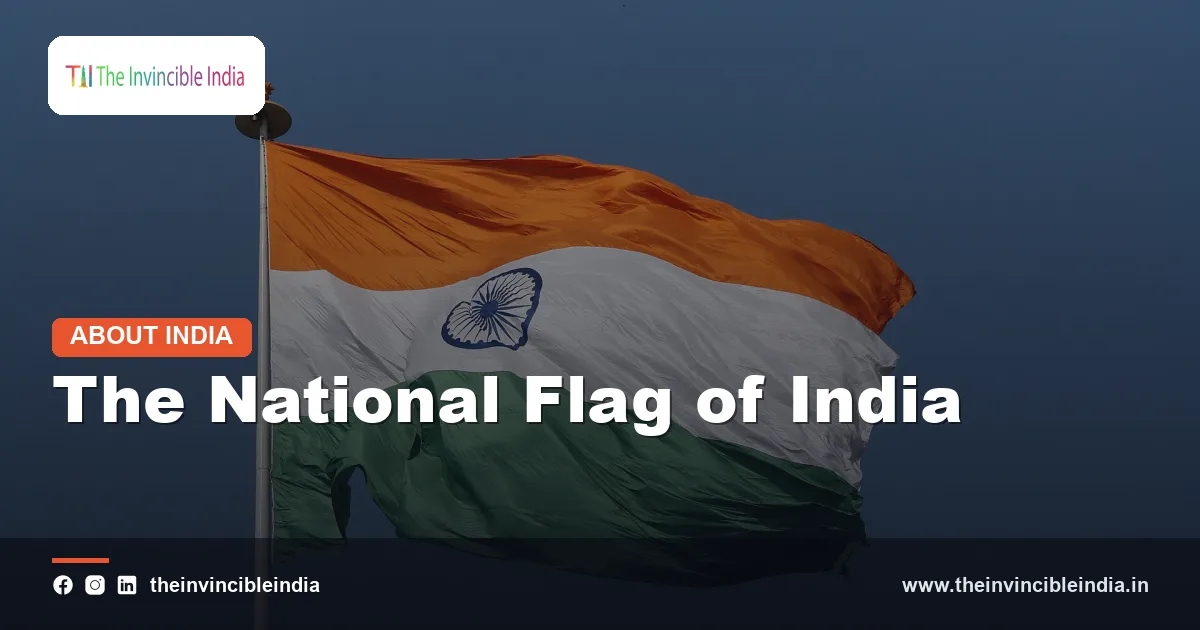
The National Flag of India, popularly called the Tiranga or tricolour, is a horizontal rectangular banner of deep saffron at the top, white in the middle and India green at the bottom, with a navy-blue wheel of 24 spokes at the centre of the white band. It is one of the most recognisable national symbols in the world and a living reminder of the struggle for independence, the values of the Constitution and the diversity of the country.
The design that flies today was adopted by the Constituent Assembly of India on 22 July 1947, only weeks before the country became free. Behind it lies a long evolution of flags, from early nationalist banners to the charkha flag of the Indian National Congress. This explainer covers the history, the symbolism, the technical specifications, the rules of the Flag Code of India and the way the public relationship with the flag has changed in recent years. Last reviewed: 2 October 2026.
Quick Facts
| Item | Details |
|---|---|
| Common names | Tiranga (tricolour); Teen Rangaa |
| Colours | Saffron (top), white (middle), green (bottom) |
| Emblem at centre | Navy-blue Ashoka Chakra with 24 spokes |
| Proportion | Length to width ratio of 3:2 |
| Adopted | 22 July 1947 by the Constituent Assembly |
| First flown as the flag of free India | 15 August 1947 |
| Associated designer | Pingali Venkayya |
| Governing rules | Flag Code of India, 2002; Prevention of Insults to National Honour Act, 1971 |
| Manufacturing standard | Bureau of Indian Standards specifications |
The Road to the Tricolour: Early Flags
India did not have a single national flag before the freedom movement. Kingdoms and empires had their own banners, but the idea of a flag for the whole nation grew out of the nationalist movement of the early twentieth century. One of the earliest flags associated with the cause is often said to have been hoisted at Parsi Bagan Square in Calcutta on 7 August 1906. It used horizontal bands of green, yellow and red with symbols such as lotuses, a sun and a crescent.
In 1907, Madame Bhikaiji Cama unfurled a flag at the International Socialist Congress in Stuttgart, Germany, a moment remembered as one of the first displays of an Indian flag on foreign soil. Her design used saffron, a middle band and green, with symbols including the words “Vande Mataram”. Later, during the Home Rule movement in 1917, Annie Besant and Bal Gangadhar Tilak introduced yet another flag, with red and green stripes, seven stars and the Union Jack in one corner.
A flag with many experiments
- 1906: Calcutta flag with three coloured bands and religious and natural symbols.
- 1907: flag unfurled by Madame Cama in Stuttgart.
- 1917: Home Rule flag with stripes, stars and a British emblem.
- 1921: flag proposed at the Congress session at Bezwada, now Vijayawada.
- 1931: tricolour with a charkha adopted by the Congress.
Pingali Venkayya and the 1921 Design
Pingali Venkayya, born in 1876 in what is now Andhra Pradesh, is the name most closely linked to the Indian flag. He was an educationist, agriculturist and freedom fighter who spent years studying the flags of other countries and thinking about a flag for India. At the Congress session in Bezwada in 1921 he presented a design to Mahatma Gandhi, using two bands of red and green to represent the two major communities.
Gandhi suggested adding a white band for the other communities and for peace, and a spinning wheel, or charkha, to symbolise self-reliance and the Swadeshi movement. The resulting flag became widely used at Congress gatherings and rallies. Venkayya’s contribution was formally honoured in later years, and a commemorative postage stamp was issued in his memory in 2009.
Why the charkha mattered
The spinning wheel stood for the revival of hand-spun cloth and economic independence from imported textiles. It connected the flag directly with the day-to-day life of ordinary Indians, who were encouraged to spin yarn at home.
The 1931 Tricolour
In 1931 the Indian National Congress, meeting at Karachi, adopted a resolution on the flag after concerns that communal interpretations of the colours had caused disagreement. The new flag dropped the red and used saffron, white and green, with the charkha in blue on the white band. A committee had recommended that the colours should not carry sectarian meaning. The flag was explained in a neutral way that tied saffron to courage and sacrifice, white to truth and peace, and green to faith and chivalry.
This flag was carried through the later phases of the freedom struggle, including the Quit India Movement of 1942. Soldiers of the Indian National Army under Subhas Chandra Bose also used a tricolour with a springing tiger in place of the wheel. By the time of independence, the tricolour was already deeply associated with the aspirations of the people.
Adoption by the Constituent Assembly on 22 July 1947
As independence approached, a committee was formed to recommend a national flag. On 22 July 1947, Jawaharlal Nehru moved a resolution in the Constituent Assembly that the National Flag of India be a horizontal tricolour of deep saffron, white and dark green in equal proportion. The ratio of width to length was to be 2:3, and in the centre of the white band would be a wheel in navy blue.
The key change was in the emblem. The charkha of the Congress flag was replaced with the Dharma Chakra, or Ashoka Chakra, taken from the Lion Capital of Ashoka at Sarnath. This allowed the flag to represent the entire nation rather than one political party. The wheel was drawn to resemble the one on the abacus of the Sarnath capital, and its design is credited in popular accounts to a team that included Surayya Tyabji.
Key points of the resolution
- Three equal bands in saffron, white and green.
- The wheel in navy blue, with a diameter roughly equal to the width of the white band.
- A 3:2 ratio of length to width.
- The wheel to replace the spinning wheel of the earlier flag.
The first flag of the independent nation was raised in the days that followed. After the Dominion became a Republic on 26 January 1950, the same flag continued unchanged as the national flag.
Colours and Their Meaning
The Constituent Assembly did not fix a single official meaning for each colour, and interpretations have been offered by various leaders. The most commonly cited explanation, associated with Dr Sarvepalli Radhakrishnan, is summarised below.
| Element | Commonly cited meaning |
|---|---|
| Saffron | Courage, sacrifice and selfless service |
| White | Truth, purity and peace |
| Green | Faith, fertility, growth and the richness of the land |
| Ashoka Chakra | The wheel of law (dharma) and continuous progress |
The message of movement
Radhakrishnan explained that the wheel represents the dharma of truth and virtue as guiding principles for those who work under the flag. It also signifies motion. In his words as widely paraphrased, there is death in stagnation and life in movement. For this reason the flag is read as a symbol of an India that keeps changing and moving forward.
The Ashoka Chakra and Its 24 Spokes
The Ashoka Chakra is a navy-blue wheel with 24 evenly spaced spokes. It is printed or woven so that it appears the same on both sides of the flag. The wheel comes from the Lion Capital of Ashoka, which was also adopted as the State Emblem of India. In the capital, the wheel appears on the abacus beneath the lions, flanked by a bull and a horse.
The number 24 is often connected with the hours of the day, representing the idea that progress continues throughout day and night. Others read the spokes as virtues. There is no single official list, but the spokes are generally understood to stand for the many qualities that sustain a just society. Emperor Ashoka’s use of the wheel in his edicts and monuments linked it with the idea of dharma, or righteous governance, which is why it fits a modern republic.
Where else the chakra appears
- On the national flag, in navy blue at the centre of the white band.
- On the State Emblem, beneath the lions of Sarnath.
- On many official insignia, coins and government stationery.
Proportions, Sizes and Materials
The Indian flag follows strict technical specifications. The ratio of length to width is 3:2, and the three bands are of equal width. The Chakra is centred in the white band and its diameter is approximately the width of that band. The Bureau of Indian Standards has laid down detailed specifications for the cloth, the dyes, the thread count and the shades of colour so that every flag looks the same, whether it hangs in a village school or in Parliament.
Standard sizes
There are nine standard sizes of the flag, ranging from very large flags used on important buildings to tiny ones meant for vehicles or tables. Larger sizes are reserved for the highest government buildings and ceremonial occasions, while smaller flags are used for cars, desks and conferences.
Khadi and the rules of manufacture
Traditionally, the flag has been made of khadi, a hand-spun and hand-woven fabric of cotton, silk or wool. The use of khadi follows from the link between the freedom movement and homespun cloth, as promoted by Mahatma Gandhi. The Khadi Development and Village Industries Commission licenses the production, and for many years only a handful of authorised units were permitted to make the official khadi flag, most famously a cooperative unit in Karnataka. Flags are tested for the right shade, size and quality before being sold.
The Flag Code of India, 2002
For many years the display of the flag was guided by a patchwork of laws, conventions and instructions. The Flag Code of India, 2002, brought these together into a single document that came into effect on 26 January 2002. It has three parts. The first gives a general description of the flag, the second deals with display by the public, private organisations and educational institutions, and the third covers the display by central and state governments and their agencies.
The Code works alongside two laws, the Emblems and Names (Prevention of Improper Use) Act, 1950, and the Prevention of Insults to National Honour Act, 1971. The 1971 Act makes it an offence to publicly burn, mutilate, deface or show disrespect to the flag or the Constitution. The Supreme Court of India held in 2004, in a case brought by an industrialist, that the right to fly the national flag with respect and dignity is part of the freedom of expression under Article 19(1)(a), subject to reasonable restrictions.
Why the Code was needed
Earlier, ordinary citizens could display the flag only on a few national days. The 2002 Code opened the flag to the public on all days, as long as its dignity was preserved.
Rules of Respect: Dos and Don’ts
The Code sets out the proper way to treat the flag. The general principle is that the flag should always be treated with respect, never touching the ground or water, and never used as drapery, a tablecloth or a costume.
Common rules
- The saffron band must always be at the top when the flag is displayed horizontally.
- A damaged or soiled flag should not be displayed.
- No other flag should be placed higher than, or above, the national flag.
- The flag should not be used to cover statues, monuments or podiums, or be written on.
- When a flag becomes torn or worn out, it should be disposed of privately and with dignity, such as by burning or burying it.
- The flag is flown at half-mast during periods of national mourning as directed by the government.
Hoisting and unfurling
On Independence Day, the Prime Minister hoists the flag, pulling it up the mast from the base, which symbolises the birth of the free nation. On Republic Day, the President unfurls the flag already tied at the top, in line with its status as the head of state. Both are performed with the national anthem and a gun salute.
Changes in the Rules and Har Ghar Tiranga
In recent years the rules have been relaxed to encourage wider display. In December 2021, the Flag Code was amended to permit the use of machine-made and polyester flags in addition to hand-spun and hand-woven khadi. In July 2022 it was amended again, so that a flag displayed in the open or on a house could be flown both day and night, rather than only between sunrise and sunset.
These changes supported the Har Ghar Tiranga campaign, launched in 2022 as part of the celebrations of 75 years of independence, called Azadi Ka Amrit Mahotsav. Citizens were encouraged to bring the flag home and fly it around Independence Day. The campaign has since become an annual feature and has made the display of the flag a mass, community-level activity. Supporters point to the strong sense of participation, while others have raised questions about the move away from the khadi tradition. Whatever the debate, the rule that the flag must always be treated with dignity remains in force.
The Flag in Public Life
The tricolour is part of daily life beyond official ceremonies. It flies on Parliament, state legislatures, courts, schools and government offices. It is used on military uniforms and at the borders. It is draped over the coffins of soldiers and certain high dignitaries as a mark of honour, and is removed before the final rites. Athletes carry it at the Olympic Games and other competitions, and it appears at international forums, ships and diplomatic missions.
Schools commonly hoist it on Independence Day and Republic Day, with students taking part in parades and songs. Over time, the flag has also become a symbol that brings together people of many languages, faiths and regions. This is perhaps the most enduring result of the Constituent Assembly’s decision to place a neutral wheel of law at the centre rather than a party emblem.
Conclusion
The National Flag of India distils decades of struggle and debate into a simple design of three colours and a wheel. From the early experiments of 1906 to the Congress flag of 1921 and the adoption on 22 July 1947, every stage reflected the aspirations of its time. Today, the Flag Code of India sets out how to honour it, while campaigns such as Har Ghar Tiranga invite ordinary citizens to feel a personal connection with it.
Frequently Asked Questions
When was the National Flag of India adopted?
The present design was adopted by the Constituent Assembly of India on 22 July 1947. It was first flown as the flag of independent India on 15 August 1947 and has remained unchanged after India became a Republic in 1950.
What do the colours and the Ashoka Chakra stand for?
Saffron is commonly linked with courage and sacrifice, white with truth and peace, and green with faith and growth. The navy-blue Ashoka Chakra with 24 spokes represents the wheel of law and the idea of continuous progress.
Who designed the Indian flag?
Pingali Venkayya of Andhra Pradesh is credited with the original design presented in 1921. The flag was later modified, with the charkha replaced by the Ashoka Chakra, before its adoption in 1947.
What is the ratio of the Indian flag?
The ratio of length to width is 3:2. The three bands of saffron, white and green are of equal width, and the Ashoka Chakra is centred on the white band.
What is the Flag Code of India?
The Flag Code of India, 2002 is a set of rules that govern the display and use of the national flag by the public, organisations and the government. It came into effect on 26 January 2002 and has been amended from time to time.
Can citizens fly the flag at night or use polyester flags?
Yes. Amendments made in December 2021 and July 2022 allow machine-made and polyester flags and permit the flag to be flown day and night in the open or on houses, as long as it is treated with respect and the other provisions of the Code are followed.


