

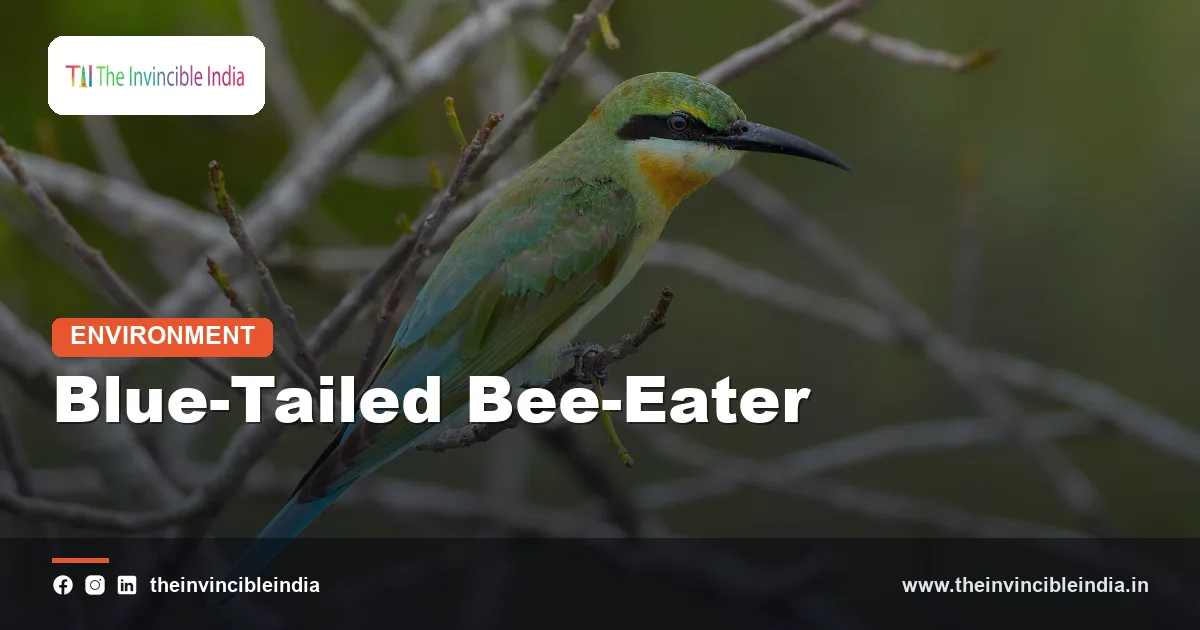
The blue-tailed bee-eater (Merops philippinus) is a large, slender, mostly green bee-eater with a blue rump and tail, a chestnut throat and a black eye-stripe, and it is best known in India as a bird of rivers, lakes, paddy fields and coasts that hawks flying insects over water and nests in colonies in sandy banks. In much of India the blue-tailed bee-eater is seasonal, arriving in many regions to breed in the warmer months and moving to other areas, especially in the south and along the coasts, outside the breeding season.
Its elongated central tail feathers, rich colours and noisy flocks make the blue-tailed bee-eater one of the more eye-catching birds along Indian waterways. This explainer covers how to identify the blue-tailed bee-eater, what it eats, where it lives, how its colonies dig nest tunnels, how it differs from other bee-eaters and what conservation issues affect it.
| Quick Facts: Blue-Tailed Bee-Eater | |
|---|---|
| Common name | Blue-tailed bee-eater |
| Scientific name | Merops philippinus |
| Family and order | Meropidae (bee-eaters), order Coraciiformes |
| Size | Roughly 23-26 cm including the tail streamers, larger than the green bee-eater |
| Key field marks | Green body, blue rump and tail, chestnut throat, black eye-stripe, long central tail feathers |
| Diet | Flying insects such as bees, wasps, dragonflies, flies and beetles |
| Nesting | Colonial; tunnels dug into sandy banks and flat sandy ground, often near water |
| Movement | Partly migratory, with seasonal movements in India and wider Asia |
| Conservation status | Least Concern on the IUCN Red List |
Key Takeaways
- The blue-tailed bee-eater is a large, green bee-eater with a blue rump and tail and a chestnut throat, and it is commonly found near rivers, lakes, marshes and coasts in India.
- The blue-tailed bee-eater catches flying insects, including bees and dragonflies, in sweeping aerial sallies, and it often feeds in groups over water.
- The blue-tailed bee-eater breeds in colonies, with each pair digging its own tunnel into a sandy bank or flat sandy ground.
- The blue-tailed bee-eater moves seasonally in India, with many birds breeding in the north and centre and others wintering in the south and near coasts.
- The blue-tailed bee-eater is easily confused with the blue-cheeked bee-eater, which has a green rather than blue tail, and with the smaller green bee-eater.
- The IUCN lists the blue-tailed bee-eater as Least Concern, though sand mining and the disturbance of riverbanks can harm local breeding colonies.
What is the blue-tailed bee-eater?
The blue-tailed bee-eater is a medium-sized, brightly coloured insect-eating bird of the bee-eater family Meropidae, found across South and Southeast Asia, from the Indian subcontinent through to the Philippines and New Guinea region. The species name philippinus reflects one of the places where the type specimens were first described, and the bird is now known across a wide arc of Asia.
Like other bee-eaters, the blue-tailed bee-eater belongs to the order Coraciiformes, which also includes kingfishers, rollers and hoopoes. It spends most of its day on the wing or perched on a wire or branch, scanning for flying insects. The species is social, so groups of a dozen or more birds are common, particularly at roosts and breeding colonies.
How can you identify a blue-tailed bee-eater?
A blue-tailed bee-eater is identified by its green upper body, bright blue lower back, rump and tail, a rich chestnut to rufous throat, a thin yellow patch above the chestnut, a black eye-stripe and a slim black curved bill. In flight it shows rusty underwing linings and a streamlined shape, and the two central tail feathers extend as thin streamers.
- Tail: The tail looks distinctly blue, which gives the bird its name and separates it from the blue-cheeked bee-eater, whose tail is green.
- Throat: The chestnut throat contrasts with a yellowish chin and a green or blue-green breast.
- Eye-stripe: A black mask runs through the eye and is a feature shared with other bee-eaters.
- Underwing: The wings look rufous or coppery from below as the bird glides, which is a useful field mark at a distance.
- Juveniles: Young birds are duller, with a paler throat and shorter tail streamers.
What does the blue-tailed bee-eater eat?
The blue-tailed bee-eater eats flying insects, mainly bees, wasps, hornets, dragonflies, damselflies, flies, beetles, moths and winged ants, which it catches in the air with a sweep of its bill. It is a typical aerial hunter, and it takes most of its prey while flying rather than from the ground.
Many birds hunt together over water, reed beds, paddy fields and forest clearings, where insects gather in large numbers. A bird may take off from a wire, dive after an insect, turn sharply and then return, or it may keep flying and feed continuously, particularly at dusk when insects swarm. After capturing a stinging insect, the bird strikes it repeatedly on a perch to remove the venom and the sting, then swallows it. This ability to handle venomous prey gives it access to food that many other birds avoid.
Where does the blue-tailed bee-eater live in India?
The blue-tailed bee-eater lives near water across much of India, including riverbanks, tanks, lakes, estuaries, marshes, mangroves, paddy fields and open forest clearings, with the largest numbers usually in the plains and coastal belts. It tends to be less common in very dry country and at high altitude.
The species is a partial migrant. Many birds breed in the northern and central plains in the warm months, then move to the south, the coasts, Sri Lanka and nearby regions in winter, while some populations in the south and east are present for longer parts of the year. Exact patterns vary by region and year, and observers should treat any local dates as approximate. Large winter roosts can form in trees near wetlands, where birds gather in the late afternoon.
A typical day for a blue-tailed bee-eater follows the rhythm of insect activity. Birds leave the roost soon after sunrise, feed over water and fields through the morning, rest and preen on exposed perches during the hot midday hours, and feed again in the late afternoon and dusk, when swarming insects peak. Between feeding bouts, the birds sunbathe, dust-bathe and sometimes dip briefly into water to bathe by skimming the surface in flight.
Flocks often include birds at different stages of the year, such as pairs forming, young birds learning to hunt and non-breeding visitors. The social nature of the species means that finding one bird usually leads to many more nearby, and the sight of a line of birds along an electric wire above a canal is a familiar one in many parts of India.
Why is the blue-tailed bee-eater called a colonial nester?
The blue-tailed bee-eater is called a colonial nester because many pairs dig their nest tunnels close together in the same sandy bank or patch of flat soil, forming a colony that can hold dozens of burrows. The cluster offers some safety in numbers and uses a limited supply of suitable soil.
Colonies are often placed in vertical riverbanks, canal sides, cut banks, quarry faces or even level sandy ground with scattered vegetation. Birds dig with the bill and push the loose soil out with the feet. Tunnels can extend for a metre or more, ending in an enlarged chamber without a formal nest, where several white eggs are laid. Both parents share incubation and feeding, and chicks are fed with a steady supply of insects.
When does the blue-tailed bee-eater breed?
The blue-tailed bee-eater breeds in India mainly in the warmer, drier months before and around the monsoon, roughly from March or April to June, although the timing varies with region and local conditions. Pairs return to colonies that have suitable banks, and colonies in the north and centre are active when river levels are low and sandy banks are exposed.
Breeding depends heavily on bank condition. When monsoon floods rise, burrows can be inundated, which is why birds need to complete their nesting cycle early. Where a bank is stable and free from disturbance, a colony can be reused in successive years. Where sand is dug out or the bank is cut away, birds lose their nests quickly.
After the eggs hatch, the chicks are naked and helpless. They grow quickly on a diet of insects brought by both parents, and the young leave the tunnel after several weeks, able to fly but still dependent on adults for a short time. Parents continue to feed fledglings near the colony until they can hunt for themselves, and families often join larger flocks soon afterwards.
How is the blue-tailed bee-eater different from other bee-eaters?
The blue-tailed bee-eater differs from other common Indian bee-eaters mainly in its tail colour, throat colour and size: it is larger than the green bee-eater, has a blue tail instead of the blue-cheeked bee-eater’s green tail, and lacks the chestnut crown of the chestnut-headed bee-eater.
| Feature | Blue-tailed bee-eater | Blue-cheeked bee-eater | Green bee-eater |
|---|---|---|---|
| Scientific name | Merops philippinus | Merops persicus | Merops orientalis |
| Tail colour | Blue | Green | Green |
| Throat | Chestnut with a yellow chin | Chestnut with a yellow chin and a blue cheek | Green to bluish, thin black necklace |
| Size | Large | Large | Small |
| Movement in India | Partial migrant, often near water | Mostly seasonal visitor, often on dry or open country | Largely resident |
What sounds does the blue-tailed bee-eater make?
The blue-tailed bee-eater makes a liquid, rolling “tiri-tiri” or “teerp” call that carries well across water, and it is often heard before the birds are seen as a flock passes overhead. The call is richer and louder than the thin trill of the smaller green bee-eater.
Calls are frequent during flight, at the colony and at roosts, and they help birds keep in contact while they feed over open areas. When many birds call together at dusk, the effect is a cheerful chorus, which is one of the sounds associated with Indian wetlands in the evening.
Calls are one of the best tools for finding migrants, because flocks passing high overhead can be recognised by sound alone. Birders who learn the call often notice how many more blue-tailed bee-eaters pass through a region than they realised, especially during seasonal movements when birds travel in loose groups that may be spread across the sky.
Why does the blue-tailed bee-eater matter?
The blue-tailed bee-eater matters because it controls flying insects, serves as an indicator of healthy riverbanks and wetlands, and attracts nature tourism and birdwatching interest. A flock feeding over a paddy field can consume a large number of insects in a day, which can reduce some insect pest numbers.
The species also shows how natural features such as undisturbed sand banks support wildlife. Colony sites are often small, and the whole breeding group depends on one stretch of bank. For this reason, conservation of riverbanks, even short stretches, can have a large effect on local numbers of the blue-tailed bee-eater.
Bee-eaters also have a cultural footprint in India. Their bright colours and graceful flight appear in photography, nature writing and school birdwatching programmes, and they are among the species that introduce children and first-time visitors to the idea that ordinary riverbanks and farmland are full of wildlife. Local bird walks, wetland visits and school nature clubs often use the bird as an easy, rewarding target.
What threatens the blue-tailed bee-eater?
The main local threats to the blue-tailed bee-eater are sand mining, bank erosion control that removes natural cuts, pesticide use that reduces insect prey, human disturbance at colonies and the loss of wetlands. Because the species gathers in colonies, a single act of disturbance can affect many nests at once.
- Sand and soil extraction: Digging at river and canal banks can destroy active burrows during the breeding season.
- Habitat change: Draining or filling wetlands lowers insect abundance and removes roosting trees.
- Pesticides: Heavy spraying cuts the supply of flying insects that adults need to feed chicks.
- Disturbance: Repeated visits to nest banks can make birds abandon eggs or young.
Globally, the IUCN classes the blue-tailed bee-eater as Least Concern because of its large range, and no firm national population figure for India is widely accepted. India’s Wildlife (Protection) Act, 1972 gives general legal protection to native wild birds, so capturing or trading them is not permitted.
How can you watch blue-tailed bee-eaters responsibly?
The best way to watch blue-tailed bee-eaters is to visit a riverbank, lake edge or wetland in the early morning or late afternoon, use binoculars from a distance and avoid walking on or near nest banks. Wires and bare branches near water are good places to look for perched birds.
- Keep well back from active colonies and do not approach burrow entrances.
- Avoid flushing roosting flocks in the evening.
- Do not play recorded calls near colonies in the breeding season.
- Share sightings on a citizen-science platform so that local migration timing can be recorded.
Bottom Line
The blue-tailed bee-eater is a large, colourful, water-loving bee-eater whose blue tail, chestnut throat and rolling call make it easy to recognise, and its colony-nesting habit ties it closely to undisturbed sandy banks. Protecting riverbanks, wetlands and insect-rich farmland is the most practical way to keep this bird common across India.
Frequently Asked Questions
What is the difference between a blue-tailed and a green bee-eater?
The blue-tailed bee-eater is larger than the green bee-eater and has a blue rump and tail with a chestnut throat. The green bee-eater is smaller, mostly green all over and has a thin black necklace. The blue-tailed bee-eater is also more closely tied to water and shows more seasonal movement.
Is the blue-tailed bee-eater a migratory bird?
The blue-tailed bee-eater is a partial migrant, so some birds move seasonally while others stay in one region. In India many breed in the northern and central plains in the warmer months and move to the south and coasts in winter. Exact movements vary by region and year.
Where do blue-tailed bee-eaters nest?
Blue-tailed bee-eaters nest in tunnels dug into sandy riverbanks, canal sides, cut banks or flat sandy ground, usually near water. Many pairs nest close together in a colony. Each tunnel ends in a small chamber where several white eggs are laid.
What does the blue-tailed bee-eater eat?
The blue-tailed bee-eater eats flying insects, including bees, wasps, dragonflies, flies, beetles and winged ants. It catches them in the air and often feeds in groups over water and paddy fields. Stinging insects are struck on a perch to remove the sting before they are swallowed.
How can you tell a blue-tailed bee-eater from a blue-cheeked bee-eater?
The easiest sign is the tail, which is blue in the blue-tailed bee-eater and green in the blue-cheeked bee-eater. The blue-cheeked bee-eater also shows a pale blue patch above and below the eye-stripe. Habitat and season can help too, since the blue-cheeked bee-eater is mostly a seasonal visitor in India.
Is the blue-tailed bee-eater endangered?
The blue-tailed bee-eater is not endangered, as the IUCN lists it as Least Concern because of its large range. Local colonies can still suffer from sand mining, bank disturbance, wetland loss and pesticide use. It is protected as a native wild bird under India’s Wildlife (Protection) Act, 1972.
{“@context”:”https://schema.org”,”@graph”:[{“@type”:”FAQPage”,”mainEntity”:[{“@type”:”Question”,”name”:”What is the difference between a blue-tailed and a green bee-eater?”,”acceptedAnswer”:{“@type”:”Answer”,”text”:”The blue-tailed bee-eater is larger than the green bee-eater and has a blue rump and tail with a chestnut throat. The green bee-eater is smaller, mostly green all over and has a thin black necklace. The blue-tailed bee-eater is also more closely tied to water and shows more seasonal movement.”}},{“@type”:”Question”,”name”:”Is the blue-tailed bee-eater a migratory bird?”,”acceptedAnswer”:{“@type”:”Answer”,”text”:”The blue-tailed bee-eater is a partial migrant, so some birds move seasonally while others stay in one region. In India many breed in the northern and central plains in the warmer months and move to the south and coasts in winter. Exact movements vary by region and year.”}},{“@type”:”Question”,”name”:”Where do blue-tailed bee-eaters nest?”,”acceptedAnswer”:{“@type”:”Answer”,”text”:”Blue-tailed bee-eaters nest in tunnels dug into sandy riverbanks, canal sides, cut banks or flat sandy ground, usually near water. Many pairs nest close together in a colony. Each tunnel ends in a small chamber where several white eggs are laid.”}},{“@type”:”Question”,”name”:”What does the blue-tailed bee-eater eat?”,”acceptedAnswer”:{“@type”:”Answer”,”text”:”The blue-tailed bee-eater eats flying insects, including bees, wasps, dragonflies, flies, beetles and winged ants. It catches them in the air and often feeds in groups over water and paddy fields. Stinging insects are struck on a perch to remove the sting before they are swallowed.”}},{“@type”:”Question”,”name”:”How can you tell a blue-tailed bee-eater from a blue-cheeked bee-eater?”,”acceptedAnswer”:{“@type”:”Answer”,”text”:”The easiest sign is the tail, which is blue in the blue-tailed bee-eater and green in the blue-cheeked bee-eater. The blue-cheeked bee-eater also shows a pale blue patch above and below the eye-stripe. Habitat and season can help too, since the blue-cheeked bee-eater is mostly a seasonal visitor in India.”}},{“@type”:”Question”,”name”:”Is the blue-tailed bee-eater endangered?”,”acceptedAnswer”:{“@type”:”Answer”,”text”:”The blue-tailed bee-eater is not endangered, as the IUCN lists it as Least Concern because of its large range. Local colonies can still suffer from sand mining, bank disturbance, wetland loss and pesticide use. It is protected as a native wild bird under India’s Wildlife (Protection) Act, 1972.”}}]}]}


