

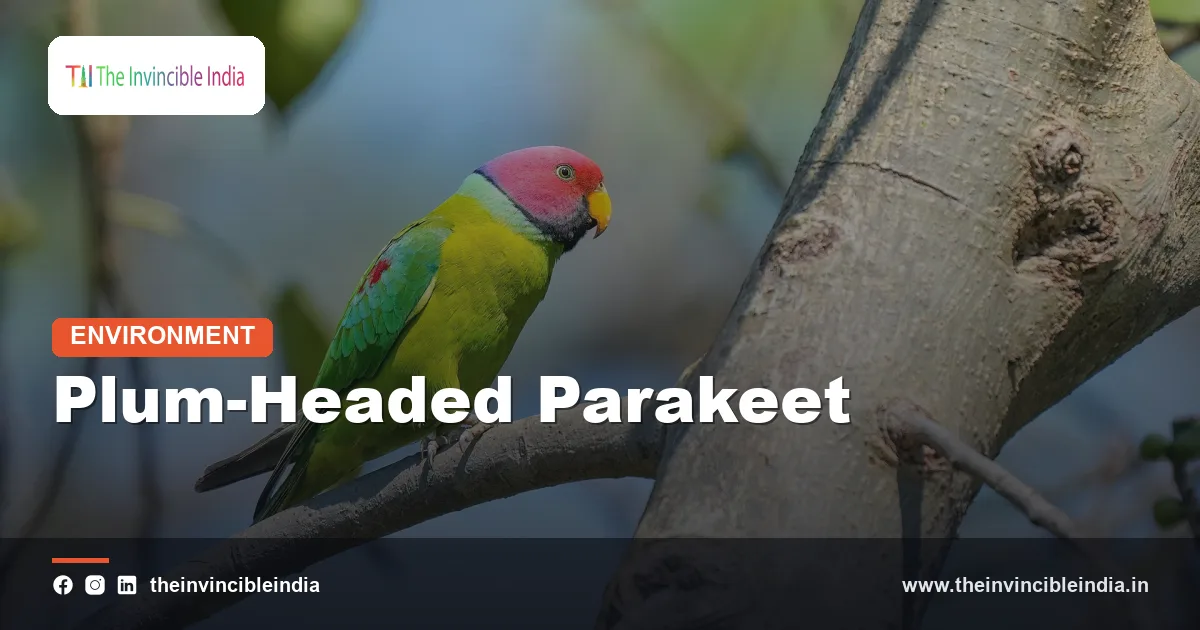
The plum-headed parakeet (Psittacula cyanocephala) is a small, slender, green parakeet of the Indian subcontinent in which the adult male has a plum-red to purplish head bordered by a black chin and a thin black-and-blue collar, while the female has a dull blue-grey head. It is a fast, noisy flier of forest edges, wooded farmland, groves and gardens, and it feeds mainly on fruits, seeds, blossoms and grain.
The plum-headed parakeet is a native Indian bird and is protected by law, so wild birds may not be caught or kept as pets. This explainer covers how to identify the plum-headed parakeet, how males and females differ, what it eats, where it lives, how it nests in tree holes, how it compares with similar parakeets and what its conservation status is.
| Quick Facts: Plum-Headed Parakeet | |
|---|---|
| Common name | Plum-headed parakeet |
| Scientific name | Psittacula cyanocephala |
| Family and order | Psittaculidae (Old World parrots), order Psittaciformes |
| Size | Roughly 33 cm, including a long tapering tail |
| Key field marks | Male: plum-red head, black chin and collar; female: bluish-grey head; both: green body, maroon shoulder patch, pale-tipped tail |
| Diet | Fruits, seeds, grains, flower buds and nectar |
| Nesting | Tree holes, often old woodpecker or barbet cavities |
| Range | Native to the Indian subcontinent, including India and Sri Lanka |
| Conservation status | Least Concern on the IUCN Red List; wild capture and trade are prohibited in India |
Key Takeaways
- The plum-headed parakeet is a small green parakeet native to the Indian subcontinent, and the adult male is named for his plum-red to purplish head.
- The female plum-headed parakeet has a bluish-grey head, and young birds of both sexes have a pale green head that colours up with age.
- The plum-headed parakeet feeds mainly on fruits, seeds, grains, buds and nectar, and it often visits fruiting trees and farm crops in fast-moving flocks.
- The plum-headed parakeet nests in tree cavities, frequently using holes made by woodpeckers and barbets, and a clutch is usually a few white eggs.
- The IUCN lists the plum-headed parakeet as Least Concern, but capturing, keeping and trading wild parakeets is prohibited in India under the Wildlife (Protection) Act, 1972.
- The plum-headed parakeet can be confused with the blossom-headed parakeet and other parakeets, but its plum-coloured head, dark collar and small size set it apart.
What is the plum-headed parakeet?
The plum-headed parakeet is a small parrot of the genus Psittacula, native to the Indian subcontinent, in which males have a purplish-red head and females a bluish-grey head. The genus Psittacula also includes the rose-ringed, Alexandrine, blossom-headed and Himalayan parakeets, which are all slender, long-tailed Old World parrots.
The plum-headed parakeet is one of the more delicate-looking members of the group, with a light build and a long, pointed tail tipped in yellowish white. It is a social bird that often lives in pairs or small flocks, and it is mostly seen in or near trees. In India, it is most at home in areas where fruiting trees, farmland and patches of woodland occur together.
How can you identify a plum-headed parakeet?
A plum-headed parakeet is identified by its grass-green body, a long tapering tail with a whitish or yellowish tip, a maroon-red patch on the shoulder and, in the adult male, a plum-coloured head with a black chin and a narrow black collar edged with blue-green. The upper bill is yellowish-orange in males, while the female’s bill is duller yellow.
- Adult male: The head looks deep rose or plum in good light, shading to bluish-purple on the nape, and a black chin line curves into a thin black necklace.
- Adult female: The head is grey with a bluish wash and lacks the black collar, which makes females easy to mistake for a different parakeet at first glance.
- Juveniles: Young birds have a pale green head and show little or no collar, so a flock may look all-green from a distance.
- Tail: The long, tapered tail is a good identification feature and gives the bird a slim silhouette in flight.
What does the plum-headed parakeet eat?
The plum-headed parakeet eats fruits, seeds, flower buds, blossoms, nectar and cultivated grains, and it forages mainly in trees. Wild figs, berries, flowers of silk-cotton and coral trees, and ripening cereal heads are all taken, depending on the season and the area.
Flocks move between feeding trees and roosts, often at dawn and dusk, flying fast and low over the canopy. Birds clamber about branches using the beak as a third foot and hold food in one foot while they eat. In farmland, flocks may feed on millet, sorghum, rice and sunflower, and in orchards they can sample ripening fruit, which sometimes causes conflict with farmers. Such damage is usually local and seasonal, and the species is not regarded as a major national agricultural pest.
Parakeets also play a role as seed dispersers and sometimes as pollinators. When they feed on nectar they transfer pollen between flowers, and when they drop partly eaten fruits they help scatter seeds beneath and beyond the parent tree.
Where does the plum-headed parakeet live?
The plum-headed parakeet lives in forests, forest edges, wooded farmland, large gardens, groves and plantations across the Indian subcontinent, with strong populations in India’s peninsular, central, eastern and Himalayan foothill regions. It is also found in Sri Lanka, Nepal, Bangladesh and Bhutan, and it has an uneven, patchy range in the north-west.
It generally prefers moister, better-wooded country than the adaptable rose-ringed parakeet, and it is often found in hill forests, sacred groves and mixed deciduous woodland. It does appear in towns where large fruiting trees remain, and it is sometimes seen in cities with old tree cover. Some local movement follows food supply, with birds shifting to areas where fig and other fruit trees are ripe.
Outside the breeding season the plum-headed parakeet is more social. Pairs tend to stay together, and they join flocks that may number from a handful to a few dozen birds at food trees. In the evening, groups gather at communal roosts in dense trees or bamboo clumps, and birds often arrive in waves, calling as they settle.
Within a flock, birds keep contact with soft calls and show close pair bonds, such as perching side by side and preening each other. Young birds stay with their parents for a while after leaving the nest and then join other juveniles. Because plumage takes time to develop, a mixed flock can contain green-headed youngsters, grey-headed females and plum-headed males together.
How does the plum-headed parakeet nest and breed?
The plum-headed parakeet nests in tree hollows, laying a small clutch of white eggs on bare wood chips inside a cavity that is usually dug by woodpeckers or barbets, or enlarged from a natural hole. Breeding in much of India falls roughly between the late winter and early summer, around February to May, though timing varies by region.
The female incubates the eggs while the male brings food, and both parents feed the chicks. Nest holes are limited, so competition for hollows with other birds, mynas and squirrels is common. Old trees with natural cavities are therefore valuable, and removing dead or decaying trees from gardens and farms reduces breeding chances for hole-nesting birds.
How is the plum-headed parakeet different from similar parakeets?
The plum-headed parakeet differs from similar Indian parakeets in the colour of the head, the size of the body and the shape of the collar: it is smaller than the Alexandrine and rose-ringed parakeets, and its plum-red head sets it apart from the blossom-headed parakeet’s pinker head and the Himalayan parakeet’s slaty-grey head.
| Species | Scientific name | Distinguishing feature | Relative size |
|---|---|---|---|
| Plum-headed parakeet | Psittacula cyanocephala | Male: plum-red head with black chin and collar; female: bluish-grey head | Small |
| Blossom-headed parakeet | Psittacula roseata | Pinker head, with a rose-tinged cheek and an orange-red upper bill in males | Small |
| Rose-ringed parakeet | Psittacula krameri | All green with a red bill; male has a black and pink neck ring | Medium |
| Alexandrine parakeet | Psittacula eupatria | Large bill, maroon shoulder patch, male with pink collar | Large |
| Himalayan (slaty-headed) parakeet | Psittacula himalayana | Slaty-grey head, mostly in the Himalayan foothills | Medium |
Birdwatchers can improve their chances of seeing the species by learning the typical habitats and times of day. Early mornings near fruiting figs, flowering silk-cotton trees and forest edges are especially productive. A good approach is to stand quietly beneath a food tree, listen for the high calls and scan the upper branches, where the green birds can be hard to see among leaves.
What sounds does the plum-headed parakeet make?
The plum-headed parakeet makes a high, musical, two-note call often written as “tooi-tooi” or “tsui-tsui”, which it gives frequently in flight. The call is softer and more melodious than the harsh screech of the larger parakeets, and flocks call constantly as they pass overhead.
Birds in flocks also make chattering sounds at roosts and while feeding. In the breeding season, pairs call near their hole, and the soft calls are part of courtship and nest defence. Learning the call is the easiest way to detect this species, since flocks usually pass quickly and are partly hidden by foliage.
How does the plum-headed parakeet fly?
The plum-headed parakeet flies with rapid, direct wingbeats that carry flocks quickly across a canopy or open field, and the bird is often noted as one of the faster parakeets, showing a darting, swift flight with a streaming tail. Flocks may twist and turn together as they move to a feeding tree or a roost.
The bird is most active in the early morning and again before sunset. Small groups collect at traditional roosts, sometimes combined with other parakeets and mynas, and then disperse at dawn. Flight is also a good way to separate the plum-headed parakeet from the heavier flight of larger parrots such as the Alexandrine parakeet.
Why does the plum-headed parakeet matter to forests and gardens?
The plum-headed parakeet matters because it takes part in the forest food web as a fruit-eater, a seed disperser, an occasional pollinator and a prey species for raptors, and because its presence suggests that mature trees and fruiting plants remain in a landscape. Birds that need both food trees and nest holes are good indicators of older, varied vegetation.
In gardens and campuses, the bird adds colour and sound, and it often draws first-time birdwatchers. In many Indian cities, fig, neem, banyan and other native trees provide food for parakeets, mynas, barbets and bulbuls together. Planting native fruiting trees, rather than only ornamental species, is a practical way to support birds like the plum-headed parakeet.
- Seed dispersal: Parakeets drop or carry fruits and seeds, and some of them germinate away from the parent tree.
- Pollination: Birds feeding on nectar may carry pollen on their faces and bills.
- Prey base: Raptors such as shikras and falcons take parakeets, which makes them part of the predator food chain.
- Cavity sharing: Old nest holes used by parakeets are later reused by other birds and small mammals.
Is the plum-headed parakeet legally protected, and can it be kept as a pet?
The plum-headed parakeet cannot be legally caught, traded or kept as a pet in India, because native wild birds are protected under the Wildlife (Protection) Act, 1972, which prohibits hunting, capture and trade in species listed in its schedules. People should not buy wild-caught parakeets, and if someone offers a native bird for sale, it should be reported to the local forest department.
The pet trade has historically involved trapping parrots, often as nestlings taken from tree holes, and this practice damages populations and reduces breeding success. It also causes high mortality in transit. Public awareness, enforcement and the protection of nest trees are the main tools used against illegal trade. Anyone who finds an injured parakeet should contact a wildlife rescue group or the forest department rather than keeping the bird.
Anyone who wants a parrot companion should look at the legal pet-bird options rather than wild native species, and should avoid any seller who cannot show a legal source. Buying wild-caught birds keeps the illegal trade alive, even when the purchase seems harmless.
What is the conservation status of the plum-headed parakeet?
The plum-headed parakeet is classed as Least Concern on the IUCN Red List, which means it is not considered globally threatened, though exact population figures are uncertain and numbers may vary locally. The species is still fairly widespread in India.
Local pressures include the loss of old trees and nest holes, forest clearing, pesticide use, illegal trapping for the cage-bird market and occasional persecution in orchards and fields. Conservation groups encourage the retention of fruiting trees, sacred groves and large, mature trees, which help the species and many other birds that depend on holes and fruits.
Bottom Line
The plum-headed parakeet is a slender, fast-flying and melodious Indian parakeet that depends on fruiting trees and tree holes, and its colourful male and softly coloured female are a familiar sight in woodlands and gardens. Protecting mature trees, leaving wild birds in the wild and reporting illegal trade are the most effective ways to keep the species common.
Frequently Asked Questions
Why is it called a plum-headed parakeet?
The plum-headed parakeet is named for the adult male’s plum-red to purplish head. The female has a bluish-grey head, and young birds have a pale green head. The name helps to separate it from the rose-ringed and Alexandrine parakeets.
What is the difference between the male and female plum-headed parakeet?
The male plum-headed parakeet has a plum-red head, a black chin and a narrow black collar. The female has a bluish-grey head and no black collar. Both sexes have green bodies, a maroon shoulder patch and a long tail with a pale tip.
What does the plum-headed parakeet eat?
The plum-headed parakeet eats fruits, seeds, flower buds, blossoms, nectar and cultivated grains such as millet and sorghum. It feeds mostly in trees and moves between food sources in fast flocks. It may also visit orchards and crop fields, but damage is usually local.
Where does the plum-headed parakeet nest?
The plum-headed parakeet nests in tree holes, often using cavities made by woodpeckers or barbets. The female lays a small clutch of white eggs on bare wood in the hollow. Breeding in much of India happens roughly from February to May.
Can you keep a plum-headed parakeet as a pet in India?
No, keeping a wild plum-headed parakeet as a pet is not legal in India. Native wild birds are protected under the Wildlife (Protection) Act, 1972, which prohibits capture and trade. Anyone who finds a bird for sale should report it to the forest department.
Is the plum-headed parakeet endangered?
The plum-headed parakeet is not endangered, as the IUCN lists it as Least Concern. Local populations can still decline because of tree loss, nest-hole shortage and illegal trapping. Protecting old fruiting trees and avoiding the purchase of wild birds helps the species.
{“@context”:”https://schema.org”,”@graph”:[{“@type”:”FAQPage”,”mainEntity”:[{“@type”:”Question”,”name”:”Why is it called a plum-headed parakeet?”,”acceptedAnswer”:{“@type”:”Answer”,”text”:”The plum-headed parakeet is named for the adult male’s plum-red to purplish head. The female has a bluish-grey head, and young birds have a pale green head. The name helps to separate it from the rose-ringed and Alexandrine parakeets.”}},{“@type”:”Question”,”name”:”What is the difference between the male and female plum-headed parakeet?”,”acceptedAnswer”:{“@type”:”Answer”,”text”:”The male plum-headed parakeet has a plum-red head, a black chin and a narrow black collar. The female has a bluish-grey head and no black collar. Both sexes have green bodies, a maroon shoulder patch and a long tail with a pale tip.”}},{“@type”:”Question”,”name”:”What does the plum-headed parakeet eat?”,”acceptedAnswer”:{“@type”:”Answer”,”text”:”The plum-headed parakeet eats fruits, seeds, flower buds, blossoms, nectar and cultivated grains such as millet and sorghum. It feeds mostly in trees and moves between food sources in fast flocks. It may also visit orchards and crop fields, but damage is usually local.”}},{“@type”:”Question”,”name”:”Where does the plum-headed parakeet nest?”,”acceptedAnswer”:{“@type”:”Answer”,”text”:”The plum-headed parakeet nests in tree holes, often using cavities made by woodpeckers or barbets. The female lays a small clutch of white eggs on bare wood in the hollow. Breeding in much of India happens roughly from February to May.”}},{“@type”:”Question”,”name”:”Can you keep a plum-headed parakeet as a pet in India?”,”acceptedAnswer”:{“@type”:”Answer”,”text”:”No, keeping a wild plum-headed parakeet as a pet is not legal in India. Native wild birds are protected under the Wildlife (Protection) Act, 1972, which prohibits capture and trade. Anyone who finds a bird for sale should report it to the forest department.”}},{“@type”:”Question”,”name”:”Is the plum-headed parakeet endangered?”,”acceptedAnswer”:{“@type”:”Answer”,”text”:”The plum-headed parakeet is not endangered, as the IUCN lists it as Least Concern. Local populations can still decline because of tree loss, nest-hole shortage and illegal trapping. Protecting old fruiting trees and avoiding the purchase of wild birds helps the species.”}}]}]}


