

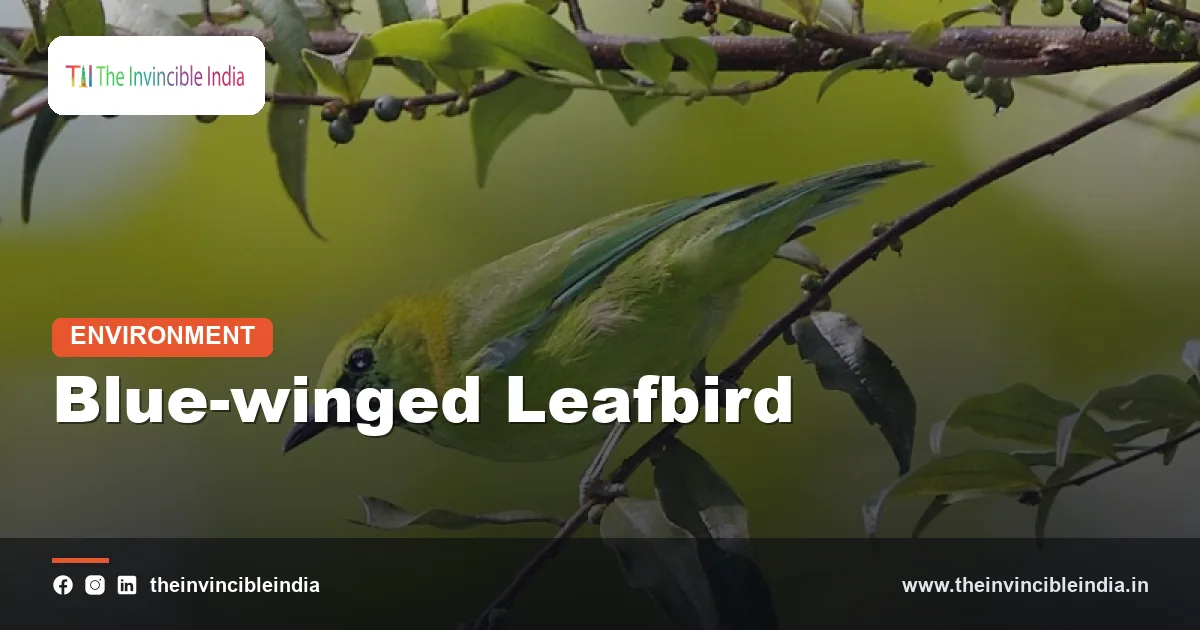
The blue-winged leafbird (Chloropsis cochinchinensis) is a leaf-green songbird with blue-edged wings, found in hill and lowland forests of north-east India and South-East Asia, and noted for its sweet nectar-and-insect diet and its skill at mimicking other birds. Its bright green plumage hides it so well among the foliage that the bird is more often heard than seen.
This guide explains how to recognise the blue-winged leafbird, where it lives in India, what it eats, how it breeds and why it is valued in forests. It relies on stable, well-documented facts about the species.
Quick Facts
| Common name | Blue-winged leafbird |
|---|---|
| Scientific name | Chloropsis cochinchinensis |
| Family | Chloropseidae (leafbirds) |
| Size | About 16 to 18 cm long, a slim, medium-small songbird |
| Range and habitat in India | Broadleaf evergreen and semi-evergreen forest, secondary growth and plantations in the Himalayan foothills and north-east India, mainly at low and middle altitudes |
| Diet | Insects, nectar, berries and small fruits |
| Breeding | Builds a small cup nest on a slender outer branch; usually lays two or three eggs in the warmer months |
| Conservation status | Least Concern (IUCN); protected under the Wildlife (Protection) Act, 1972 |
Key Takeaways
- The blue-winged leafbird is a small songbird in the family Chloropseidae, named for its leaf-green body and the blue colour on its wings and tail.
- The blue-winged leafbird is found in the forests of north-east India and the eastern Himalayan foothills, and it also ranges across South-East Asia.
- A blue-winged leafbird feeds on insects, flower nectar and small fruits, and it helps to pollinate flowers and spread seeds as it feeds.
- The blue-winged leafbird is an accomplished mimic that can imitate the songs and calls of many other forest birds.
- Male and female blue-winged leafbirds look different, with the male showing a black face and throat and the female being mostly green with a blue moustache stripe.
- The blue-winged leafbird is classed as Least Concern globally, but it depends on forest cover and is sensitive to forest clearance.
What is the blue-winged leafbird?
The blue-winged leafbird is a small, bright green forest songbird of the family Chloropseidae, known for its blue-edged wings, its curved bill and its talent for mimicry. Its scientific name is Chloropsis cochinchinensis, and the name cochinchinensis refers to Cochinchina, a historical name for southern Vietnam, where the species was first described.
Leafbirds are a small family of Asian songbirds that live in forest canopies. They are closely associated with flowers and fruit, and they have slightly curved bills and brush-tipped tongues for taking nectar. The blue-winged leafbird is one of several species found in India, along with the golden-fronted, orange-bellied and Jerdon’s leafbirds.
The bird’s green plumage is an excellent camouflage in dense leaves. Even a bold, vocal bird can be difficult to spot, especially if it sits still high in a tree. As a result, many birders find the species by its voice before they see its colours.
Several subspecies of the blue-winged leafbird are recognised across its range, with small differences in the shade of green, the extent of black on the male’s face and the amount of blue on the wing.
How can you identify the blue-winged leafbird?
The blue-winged leafbird can be identified by its bright leaf-green body, blue edges to the wings and tail, a slender curved bill, and, in males, a black face and throat bordered by a blue moustache. The female lacks the black face and is mostly green with a bluish moustache stripe.
Male
The male has a green crown, back and underparts, with a black mask that covers the lores, face and throat. A bright blue line, or malar stripe, runs along the lower edge of the black. The shoulders and wing edges show blue, and the tail is green above. In good light, the contrast between the black throat and the surrounding green is striking.
Female and young
The female is a uniform green, lacking the black throat, but with a faint bluish moustache and a pale blue tint on the wing. Young birds look like the female and acquire the adult male pattern gradually. This makes identification of immature birds easier by comparing the bill shape, size and the blue edge of the wing.
Similar leafbirds in India
| Species | Main distinguishing feature |
|---|---|
| Blue-winged leafbird | Green with blue wing edges; male has a black face and throat with a blue moustache |
| Golden-fronted leafbird | Golden-orange forehead and a black face with a blue throat patch in the male |
| Orange-bellied leafbird | Orange belly and blue on the shoulder and tail, with a blue moustache |
| Jerdon’s leafbird | Peninsular species with a green body and a black mask; the male has a black face and a blue moustache |
Where does the blue-winged leafbird live in India?
The blue-winged leafbird lives in India mainly in broadleaf evergreen and semi-evergreen forest of north-east India and the eastern Himalayan foothills, generally at low and middle elevations. It also uses secondary forest, forest edges and plantations that retain tall trees.
Beyond India the species ranges widely through South-East Asia, from Myanmar and Thailand through the Malay Peninsula and into Indonesia and Indochina. This large distribution is one reason it is considered safe globally.
The bird is a resident, though it may move locally to follow flowering and fruiting trees. It generally keeps to the canopy and middle storey of the forest, where it moves among leaves and flowers. It may come lower into flowering shrubs and fruiting trees, particularly along forest edges and roads.
- Typical habitats: evergreen and semi-evergreen forest, bamboo mixed forest, old plantations and forest edges.
- Typical Indian regions: Assam, Arunachal Pradesh, Nagaland, Manipur, Mizoram, Meghalaya, Tripura and the nearby foothills.
- Typical altitude: lowlands and hills, mostly below the higher mountain zones.
What does the blue-winged leafbird eat?
The blue-winged leafbird eats insects, flower nectar, berries and small fruits, which it takes by gleaning leaves, probing blossoms and plucking fruit from branches. This mixed diet of animal protein and plant sugars makes it both a predator of small insects and a minor pollinator.
Leafbirds are strongly attracted to flowering trees, particularly those that produce abundant nectar. They push their bills into blossoms, and pollen sticks to their feathers and is carried to the next flower. In this way the birds take part in pollination. When feeding on fruits, they swallow small seeds, which are later dropped elsewhere in the forest.
Foraging habits
- Searches the undersides of leaves for caterpillars, bugs and beetles.
- Visits flowering trees such as coral trees, silk-cotton and other nectar-rich species.
- Feeds on figs and other small, soft fruits.
- Often joins mixed hunting flocks of small forest birds.
The brush-tipped tongue is a special adaptation that helps the leafbird gather nectar efficiently, in the way that sunbirds do, although the two groups are not close relatives.
Why is the blue-winged leafbird a mimic?
The blue-winged leafbird is a mimic because its song often includes imitations of the calls and songs of other forest birds, a habit shared with other leafbirds. Mimicry makes the song complex and may help a male advertise his skill to females and rivals.
A male blue-winged leafbird may weave the notes of drongos, bulbuls, babblers or other birds into his song, switching rapidly from one imitation to the next. This can be confusing for birdwatchers, since a patch of forest seems to hold many species when only one leafbird is singing. Noticing that the sounds come from a single bird sitting in the canopy usually solves the puzzle.
Scientists think that mimicry may serve several purposes. It may signal the male’s age and experience, since a larger repertoire could indicate a healthier or older bird. It may also help in defending territory or in confusing predators. The exact role is still under study, and the explanation may vary between species.
- The song is varied, fast and musical, with many borrowed phrases.
- The bird often sings from an exposed perch high in a tree.
- Singing is most frequent in the breeding season and early in the morning.
How does the blue-winged leafbird breed?
The blue-winged leafbird breeds by building a small, neat cup nest of fine fibres, grass and moss on a slender branch high in a tree, where the female typically lays two or three eggs. In India, nesting usually takes place in the warmer months from spring into the early monsoon.
The nest is placed well out on a thin outer branch, where it is hidden among leaves and difficult for climbing predators to reach. It is often bound with spider silk and lined with softer material. The female does most of the building and incubation, while the male defends the territory and sings nearby.
After hatching, both parents feed the young with insects, and the nestlings leave when they are able to fly. Because the nests are small, camouflaged and high up, they are seldom found, and much about the breeding biology of leafbirds in India remains to be recorded by careful observers.
Fledglings remain close to their parents for a short while and then disperse. Pairs may attempt a second brood if conditions allow, though this varies from place to place.
Why does the blue-winged leafbird matter to forests?
The blue-winged leafbird matters to forests because it pollinates flowers, disperses seeds, eats insects and serves as an indicator of healthy canopy habitat. As a canopy specialist, it depends on tall, flowering and fruiting trees.
| Role | How the blue-winged leafbird contributes |
|---|---|
| Pollination | Carries pollen on its bill and feathers while drinking nectar |
| Seed dispersal | Swallows small fruits and drops seeds away from the parent tree |
| Insect control | Eats caterpillars, bugs and beetles from leaves |
| Habitat indicator | Needs continuous canopy and a year-round supply of flowers and fruit |
North-east India is part of a recognised biodiversity hotspot, and the loss of forest there affects many species. The presence of leafbirds, with their need for diverse flowering and fruiting trees, suggests that the forest still contains a rich mix of native plants.
Is the blue-winged leafbird threatened?
No, the blue-winged leafbird is not currently considered threatened and is listed as Least Concern by the IUCN because of its very large range. However, forest clearance and the trapping of leafbirds for the cage-bird trade pose risks in parts of Asia, and the bird is protected in India under the Wildlife (Protection) Act, 1972.
- Forest loss: shifting cultivation, logging, plantations and development reduce canopy habitat.
- Trapping: leafbirds are attractive and good singers, so they have been caught for the pet trade in some regions.
- Fragmentation: isolated forest patches support fewer flowering and fruiting trees.
- Pesticides: chemicals used in plantations can reduce insect food and harm birds.
Useful conservation steps include protecting evergreen forest, keeping native flowering trees in plantations and village groves, discouraging the capture and sale of wild birds and supporting community forest management in the north-east.
How can you see the blue-winged leafbird?
You can see the blue-winged leafbird by visiting evergreen forest or forest edges in north-east India, listening for its mimicking song and scanning flowering or fruiting trees in the early morning. Patience is needed, since the green bird blends into the leaves.
- Visit forest edges, trails and sanctuaries in the north-east during the cooler, drier months.
- Look for trees in flower or fruit, where leafbirds gather to feed.
- Listen for a medley of borrowed bird calls coming from the canopy.
- Use binoculars to look for a green bird with blue wing edges and, in males, a black throat.
- Stay on trails, keep noise low and never use recorded calls to lure the bird.
Time spent beneath a flowering tree often rewards a watcher with views of the blue-winged leafbird alongside sunbirds, bulbuls and other forest species.
Bottom Line
The blue-winged leafbird is a leaf-green songbird with blue-edged wings that lives in the forest canopy of north-east India. It feeds on nectar, fruit and insects, mimics other birds and quietly performs valuable work as a pollinator and seed disperser, so its future depends on intact, flower-rich forest.
Frequently Asked Questions
What is a blue-winged leafbird?
The blue-winged leafbird is a small, bright green songbird of the family Chloropseidae with blue edges on its wings and tail. It lives in forest canopies, feeds on nectar, fruit and insects, and is known for mimicking other birds.
Where is the blue-winged leafbird found in India?
The blue-winged leafbird is found mainly in north-east India and the eastern Himalayan foothills. It lives in evergreen and semi-evergreen forests, forest edges and plantations at low and middle altitudes.
What does the blue-winged leafbird eat?
The blue-winged leafbird eats insects, flower nectar, berries and small fruits. It gleans insects from leaves and drinks nectar from blossoms, which makes it both an insect eater and a pollinator.
Can the blue-winged leafbird mimic other birds?
Yes, the blue-winged leafbird is a skilled mimic that copies the songs and calls of many other forest birds. Its song combines these imitations with its own musical phrases, which can make one bird sound like several species.
How can I tell male and female blue-winged leafbirds apart?
The male blue-winged leafbird has a black face and throat bordered by a blue moustache, while the female is mostly green with only a faint bluish moustache. Both sexes have blue edges to the wings and tail.
Is the blue-winged leafbird endangered?
No, the blue-winged leafbird is classed as Least Concern by the IUCN because it has a wide range across South and South-East Asia. In India it is protected under the Wildlife (Protection) Act, 1972, but it is affected by forest loss and the cage-bird trade.
{“@context”:”https://schema.org”,”@graph”:[{“@type”:”FAQPage”,”mainEntity”:[{“@type”:”Question”,”name”:”What is a blue-winged leafbird?”,”acceptedAnswer”:{“@type”:”Answer”,”text”:”The blue-winged leafbird is a small, bright green songbird of the family Chloropseidae with blue edges on its wings and tail. It lives in forest canopies, feeds on nectar, fruit and insects, and is known for mimicking other birds.”}},{“@type”:”Question”,”name”:”Where is the blue-winged leafbird found in India?”,”acceptedAnswer”:{“@type”:”Answer”,”text”:”The blue-winged leafbird is found mainly in north-east India and the eastern Himalayan foothills. It lives in evergreen and semi-evergreen forests, forest edges and plantations at low and middle altitudes.”}},{“@type”:”Question”,”name”:”What does the blue-winged leafbird eat?”,”acceptedAnswer”:{“@type”:”Answer”,”text”:”The blue-winged leafbird eats insects, flower nectar, berries and small fruits. It gleans insects from leaves and drinks nectar from blossoms, which makes it both an insect eater and a pollinator.”}},{“@type”:”Question”,”name”:”Can the blue-winged leafbird mimic other birds?”,”acceptedAnswer”:{“@type”:”Answer”,”text”:”Yes, the blue-winged leafbird is a skilled mimic that copies the songs and calls of many other forest birds. Its song combines these imitations with its own musical phrases, which can make one bird sound like several species.”}},{“@type”:”Question”,”name”:”How can I tell male and female blue-winged leafbirds apart?”,”acceptedAnswer”:{“@type”:”Answer”,”text”:”The male blue-winged leafbird has a black face and throat bordered by a blue moustache, while the female is mostly green with only a faint bluish moustache. Both sexes have blue edges to the wings and tail.”}},{“@type”:”Question”,”name”:”Is the blue-winged leafbird endangered?”,”acceptedAnswer”:{“@type”:”Answer”,”text”:”No, the blue-winged leafbird is classed as Least Concern by the IUCN because it has a wide range across South and South-East Asia. In India it is protected under the Wildlife (Protection) Act, 1972, but it is affected by forest loss and the cage-bird trade.”}}]}]}


