

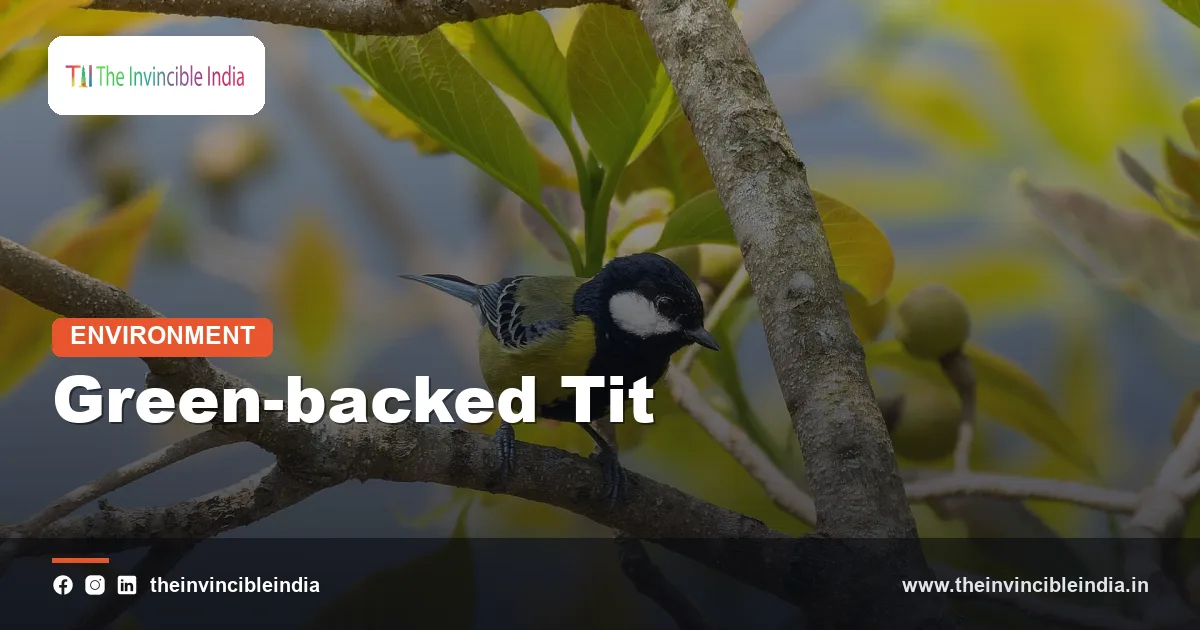
The green-backed tit (Parus monticolus) is a small, lively songbird with a yellow breast, a black stripe down the belly, an olive-green back and a glossy black head with white cheeks, found in hill forests of the Himalaya and parts of Asia. A close relative of the great tit, the green-backed tit forages in active flocks, searches leaves and twigs for insects and nests in tree holes and wall crevices.
This guide explains how to recognise the green-backed tit, where it lives in India, what it eats, how it breeds and how it differs from similar tits. It relies on stable, well-documented facts about the species.
Quick Facts
| Common name | Green-backed tit |
|---|---|
| Scientific name | Parus monticolus |
| Family | Paridae (tits, chickadees and titmice) |
| Size | About 12 to 14 cm long, a small, compact songbird |
| Range and habitat in India | Himalayan broadleaf, oak, pine and mixed forests, generally in the hills from the western Himalaya eastwards to the north-east, moving to lower altitudes in winter |
| Diet | Insects, spiders and larvae, with seeds and some fruit, especially in winter |
| Breeding | Nests in tree holes, rock crevices or wall cavities lined with moss, hair and feathers; lays several eggs in the spring and summer |
| Conservation status | Least Concern (IUCN); protected under the Wildlife (Protection) Act, 1972 |
Key Takeaways
- The green-backed tit is a small songbird in the family Paridae, named for its olive-green back and distinguished by its yellow underparts and a black central stripe.
- The green-backed tit is a close relative of the great tit and looks similar, but it has a greener back, yellower underparts and two white wing-bars.
- The green-backed tit lives in Himalayan forests and moves down to lower elevations in winter, a pattern known as altitudinal migration.
- A green-backed tit feeds mainly on insects, spiders and larvae, which it picks from leaves and twigs while hanging acrobatically, and it eats seeds when insects are scarce.
- The green-backed tit nests in natural holes, crevices or wall cavities and lines the nest with moss, hair and feathers.
- The green-backed tit is classed as Least Concern globally, but it relies on old trees and healthy forest for nest sites and food.
What is the green-backed tit?
The green-backed tit is a small, active songbird of the tit family Paridae, found in hill forests of the Himalaya and eastern Asia, and recognised by its black head, white cheeks, olive-green back and yellow breast. Its scientific name is Parus monticolus, and the species name monticolus means mountain-dwelling.
Tits are a family of small, mostly insect-eating birds that includes the great tit, the coal tit, and many other species across Europe, Asia and Africa. Most tits are agile, curious and noisy, and they readily use tree holes for nesting. The green-backed tit shares all of these traits.
The species was described in the early nineteenth century from specimens collected in the Himalaya. It was often treated as a close relative of the great tit complex, and the two are still similar in structure, behaviour and voice. A few related forms of the green-backed tit are recognised in different parts of its range, with minor differences in size and colour.
In India, the bird is a familiar resident of oak and rhododendron forests, pine woods and hill gardens, so it is a good choice for beginners who want to learn Himalayan birds.
How can you identify the green-backed tit?
The green-backed tit can be identified by its glossy black head with large white cheek patches, olive-green back, bright yellow underparts with a black stripe running down the middle, and two white bars on the wing. The black belly stripe is broad in males and narrower in females.
Plumage details
The upperparts are olive-green, with a grey rump and tail that show white edges. The wings are bluish-grey with two clear pale bars. The underparts are yellow, deeper than in most great tit forms, and the midline stripe runs from the black throat down to the vent. Juveniles are duller, with a paler yellow and a less distinct stripe.
Green-backed tit compared with the great tit
| Feature | Green-backed tit | Great tit complex |
|---|---|---|
| Back colour | Olive-green | Grey or greenish-grey depending on form |
| Underparts | Rich yellow with a black central stripe | Yellow in some forms, pale grey in others |
| Wing-bars | Two white wing-bars | Usually one, though it varies |
| Habitat | Hill and mountain forest | Wide range, including lowland and urban areas |
Other small birds with a similar yellow and black look are the black-lored tit and the yellow-cheeked tit, but these have crests or different face patterns. The simple pattern of white cheek, yellow breast and black stripe is usually enough to confirm a green-backed tit.
Where does the green-backed tit live in India?
The green-backed tit lives in India across the Himalayan hills, from the western Himalaya through Himachal Pradesh and Uttarakhand eastwards to Sikkim, Arunachal Pradesh and other north-eastern hill areas, in oak, pine, rhododendron and mixed broadleaf forests. Outside India it also ranges through Nepal, Bhutan, China, South-East Asia and Taiwan.
The bird typically occupies the middle altitudes of the Himalaya, in forests that offer both tall trees and shrubby undergrowth. In summer it is found higher up, while in winter many birds descend to lower valleys and foothills to escape snow and find insects. This regular seasonal movement is known as altitudinal migration.
The species adapts well to hill orchards, gardens and the edges of settlements, provided that trees are present. Its use of nest boxes and wall cavities has helped it live close to people in many hill towns.
- Western Himalaya: forests of oak, deodar and pine at mid elevations.
- Central Himalaya: mixed oak and rhododendron forest and hill gardens.
- Eastern Himalaya and north-east India: broadleaf and subtropical hill forests.
The green-backed tit is a resident species over most of its Indian range, although local movements vary with the severity of the winter.
What does the green-backed tit eat?
The green-backed tit eats mainly insects, spiders and caterpillars gleaned from leaves, twigs and bark, and it supplements this diet with seeds and small fruits, especially in winter when insects are scarce. During the breeding season it relies heavily on caterpillars to feed its chicks.
The bird is extremely agile, hanging upside down from thin twigs, hovering briefly and clinging to bark in order to reach prey. Its short, stout, pointed bill is well suited to picking small food items and also to breaking seeds. Tits often hold a seed with their feet and hammer it open.
Feeding behaviour
- Moves quickly through the canopy and shrub layer, checking leaves and branches.
- Joins mixed-species flocks with warblers, nuthatches, treecreepers and other small birds.
- Stores food in cracks and crevices in some seasons, as many tits do.
- Visits feeders in hill gardens and takes seeds or fat during cold weather.
Because it eats large numbers of insects, the green-backed tit helps to control forest pests such as caterpillars and aphids. A small flock can clear many leaf-eating insects from a tree in a short time.
Why does the green-backed tit join mixed flocks?
The green-backed tit joins mixed-species flocks because moving with other small insect-eating birds improves its chances of finding food and spotting predators. Mixed flocks are a regular feature of Himalayan forests, especially in winter.
In a mixed flock, different species feed in slightly different places. Tits work the outer twigs and leaves, nuthatches and treecreepers explore trunks, and warblers flit through the foliage. The movement of one species can flush insects that others then catch. At the same time, many pairs of eyes mean that an approaching hawk is likely to be noticed quickly, and an alarm call from one bird alerts all of them.
These flocks move through the forest as a loose, noisy group and can pass a point in a few minutes. Birdwatchers often find that a quiet forest suddenly fills with calls as a flock arrives. Standing still and watching the canopy can yield several species at once, with the green-backed tit among the most conspicuous.
The bird also forms pairs in the breeding season and defends a territory. Outside that season it tends to be more social and is easy to see.
How does the green-backed tit breed?
The green-backed tit breeds by building a cup-shaped nest of moss, hair, wool and feathers inside a tree hole, rock crevice or wall cavity, where the female lays several eggs in spring or early summer. Timing depends on altitude, with birds at higher elevations nesting later than those in the lower hills.
The nest site may be a natural hollow, an old woodpecker hole, a gap in a stone wall or an artificial nest box. The female does most of the nest-building and incubation, while the male defends the territory and brings food to his mate. After the eggs hatch, both parents work hard to feed the chicks, delivering caterpillars and other soft insects many times an hour.
The young leave the nest when they are fully feathered and are fed by their parents for some days afterwards. Family groups may remain together and later join a mixed flock. In favourable seasons a pair may raise more than one brood, though this varies.
- Nest material: moss, animal hair, wool, feathers and fine fibres.
- Nest sites: tree hollows, rock crevices, wall holes and nest boxes.
- Parents: both feed the chicks, with the female handling incubation.
What does the green-backed tit sound like?
The green-backed tit has a ringing, repeated song of clear, two- or three-note phrases, similar to the song of the great tit but usually described as more musical, along with a variety of harsh chattering and scolding calls. The song is heard most often in spring, when males advertise their territories.
Tits are very vocal birds, and a single species may have a large range of calls with different meanings. The green-backed tit uses contact calls to keep a flock together, alarm calls to warn of predators and soft notes between a pair. Listening is often the best way to find the bird in thick foliage.
The green-backed tit is also a good mimic of rhythm: the song often repeats the same short phrase several times before switching to a different one, which helps to separate it from similar species. With practice, observers can recognise the song and locate the singer, usually perched on a branch in the upper part of a tree.
Because the song is loud and carries, it is also a handy tool for scientists conducting bird surveys in hill forests.
Is the green-backed tit threatened?
No, the green-backed tit is not considered threatened and is classed as Least Concern by the IUCN because it has a large range and a stable population. Even so, it needs mature trees for nest holes and healthy forest for insect food, so loss of habitat can reduce local numbers.
In India the bird is protected under the Wildlife (Protection) Act, 1972, which prohibits hunting and capture. Its main local pressures are the following.
- Felling of old trees: removing trees with natural holes reduces nesting sites.
- Forest degradation: overgrazing, lopping for fodder and fires reduce the shrubby undergrowth and insect supply.
- Pesticide use: sprays in orchards and gardens reduce the supply of insects and can poison birds.
- Climate change: shifts in temperature and snow cover may alter the timing of insect abundance and the altitudinal range of the bird.
Simple measures can help, such as leaving old trees and standing dead timber in hill forests and orchards, providing nest boxes in gardens, reducing pesticide use and protecting oak and rhododendron forest on mountain slopes.
How can you see the green-backed tit?
You can see the green-backed tit by walking through Himalayan oak, pine or mixed forest at mid elevations, listening for its song and scanning the canopy for small flocks. Spring and winter are both good times, and the bird is often easier to find at lower altitudes in the cold months.
- Choose hill forest, orchards or gardens with mature trees at moderate elevations.
- Go in the early morning, when birds are most active and calling.
- Listen for the ringing song and for the chatter of a mixed-species flock.
- Look for the black head, white cheek, yellow breast and black stripe, using binoculars.
- Avoid disturbing nest holes and keep a respectful distance if parents are carrying food.
Putting up a nest box in a hill garden may attract the species to breed, bringing the pleasure of watching a family up close without disturbing wild nests.
Bottom Line
The green-backed tit is a small, colourful songbird of the Himalayan hills, easy to recognise by its yellow breast, black stripe and olive-green back. It feeds on insects, travels in mixed flocks and nests in holes, and it stays common as long as old trees and healthy hill forests remain.
Frequently Asked Questions
What is a green-backed tit?
The green-backed tit is a small songbird of the family Paridae with an olive-green back, yellow breast, black belly stripe and a black head with white cheeks. It lives in Himalayan hill forests and is a close relative of the great tit.
Where is the green-backed tit found in India?
The green-backed tit is found across the Himalayan hills of India, from the western Himalaya to the north-east. It lives in oak, pine, rhododendron and mixed forests and moves to lower altitudes in winter.
What does the green-backed tit eat?
The green-backed tit eats mainly insects, spiders and caterpillars, which it picks from leaves and twigs. It also eats seeds and small fruits, especially in winter when insects are harder to find.
How is the green-backed tit different from the great tit?
The green-backed tit has an olive-green back, richer yellow underparts and two white wing-bars, while the great tit complex has a grey or greyish-green back and usually only one wing-bar. The green-backed tit also prefers hill and mountain forest rather than a wide range of habitats.
Where does the green-backed tit nest?
The green-backed tit nests in tree holes, rock crevices, wall cavities and nest boxes. The nest is a cup of moss, hair and feathers, and both parents feed the chicks after hatching.
Is the green-backed tit rare?
No, the green-backed tit is not rare and is classed as Least Concern by the IUCN. It is common in suitable Himalayan forests, though it depends on mature trees and healthy habitat, and it is protected in India under the Wildlife (Protection) Act, 1972.
{“@context”:”https://schema.org”,”@graph”:[{“@type”:”FAQPage”,”mainEntity”:[{“@type”:”Question”,”name”:”What is a green-backed tit?”,”acceptedAnswer”:{“@type”:”Answer”,”text”:”The green-backed tit is a small songbird of the family Paridae with an olive-green back, yellow breast, black belly stripe and a black head with white cheeks. It lives in Himalayan hill forests and is a close relative of the great tit.”}},{“@type”:”Question”,”name”:”Where is the green-backed tit found in India?”,”acceptedAnswer”:{“@type”:”Answer”,”text”:”The green-backed tit is found across the Himalayan hills of India, from the western Himalaya to the north-east. It lives in oak, pine, rhododendron and mixed forests and moves to lower altitudes in winter.”}},{“@type”:”Question”,”name”:”What does the green-backed tit eat?”,”acceptedAnswer”:{“@type”:”Answer”,”text”:”The green-backed tit eats mainly insects, spiders and caterpillars, which it picks from leaves and twigs. It also eats seeds and small fruits, especially in winter when insects are harder to find.”}},{“@type”:”Question”,”name”:”How is the green-backed tit different from the great tit?”,”acceptedAnswer”:{“@type”:”Answer”,”text”:”The green-backed tit has an olive-green back, richer yellow underparts and two white wing-bars, while the great tit complex has a grey or greyish-green back and usually only one wing-bar. The green-backed tit also prefers hill and mountain forest rather than a wide range of habitats.”}},{“@type”:”Question”,”name”:”Where does the green-backed tit nest?”,”acceptedAnswer”:{“@type”:”Answer”,”text”:”The green-backed tit nests in tree holes, rock crevices, wall cavities and nest boxes. The nest is a cup of moss, hair and feathers, and both parents feed the chicks after hatching.”}},{“@type”:”Question”,”name”:”Is the green-backed tit rare?”,”acceptedAnswer”:{“@type”:”Answer”,”text”:”No, the green-backed tit is not rare and is classed as Least Concern by the IUCN. It is common in suitable Himalayan forests, though it depends on mature trees and healthy habitat, and it is protected in India under the Wildlife (Protection) Act, 1972.”}}]}]}


