

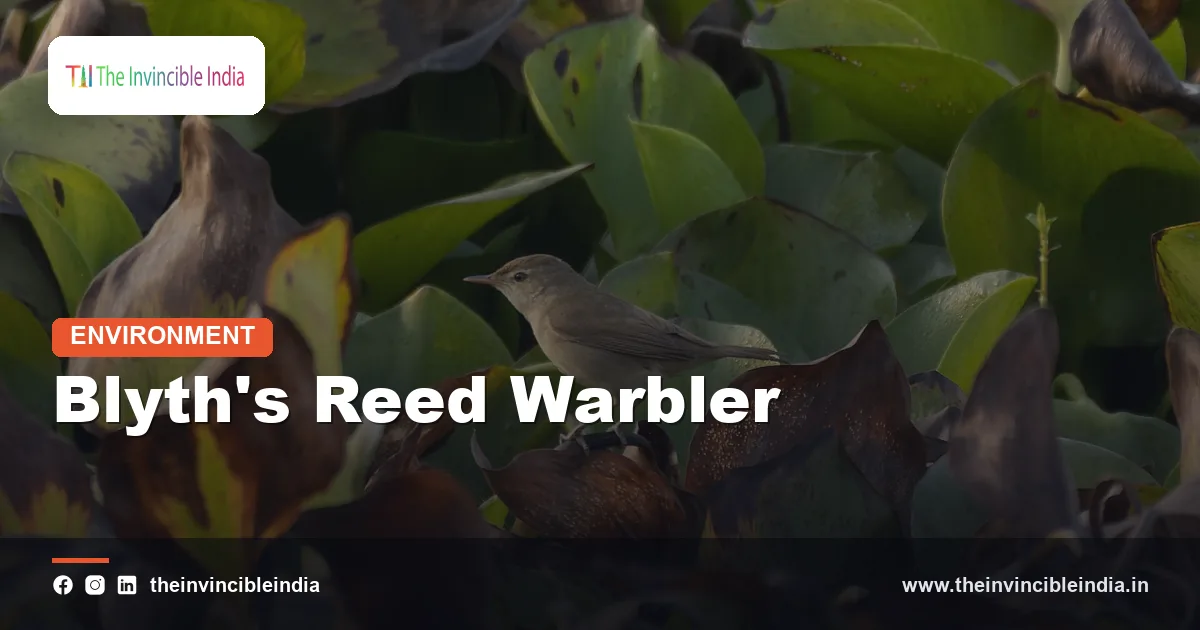
The Blyth’s reed warbler (Acrocephalus dumetorum) is a small, plain olive-brown songbird that breeds across northern and eastern Europe and western Asia and spends the winter in India, where it skulks in gardens, scrub, thickets and reedy margins. The bird is easy to overlook because it has no bright colours, no bold pattern and a habit of staying low inside dense vegetation, yet it is one of the commonest winter warblers of Indian gardens and a favourite puzzle for bird watchers.
Most people notice the Blyth’s reed warbler first by sound, not sight. A sharp, dry “tak” or “tchak” call comes from a bush, and in late winter a rich, rambling, mimicking song may pour out just before the bird leaves for the north. This article explains what the species is, where it lives in India, how to tell it from look-alike warblers, what it eats, how it breeds and why it matters.
Quick Facts
| Common name | Blyth’s reed warbler |
|---|---|
| Scientific name | Acrocephalus dumetorum |
| Family | Acrocephalidae (reed warblers and allies) |
| Size | About 12-14 cm long, weighing roughly 10-15 grams |
| Habitat in India | Gardens, scrub, hedgerows, bushes near water, reedy edges, light woodland and thickets |
| Diet | Small insects, spiders and other invertebrates picked from leaves and twigs |
| Migration | Winter visitor to India, mainly from about September-October to April-May |
| Breeding | Breeds in the northern part of Eurasia, not in peninsular India; cup nest low in dense vegetation |
| Conservation status | Least Concern (IUCN) |
Key Takeaways
- The Blyth’s reed warbler is a plain brown, medium-small warbler that visits India only in the non-breeding season, roughly from autumn to spring.
- Blyth’s reed warbler is named after Edward Blyth, the nineteenth-century English zoologist who curated the museum of the Asiatic Society in Calcutta (now Kolkata).
- The sharp, hard “tak” or “tchak” call is the most reliable everyday clue to the presence of a Blyth’s reed warbler in an Indian garden or hedge.
- Blyth’s reed warbler feeds almost entirely on small insects and spiders, which it gleans from leaves and twigs as it creeps through low vegetation.
- The Blyth’s reed warbler is a skilled mimic, and the song heard in India before spring departure can contain imitations of other birds.
- The species is classed as Least Concern on the IUCN Red List because it has a very large breeding range and a large, stable global population.
What is the Blyth’s reed warbler?
The Blyth’s reed warbler is a small insect-eating songbird of the family Acrocephalidae, the group that holds the reed warblers and their relatives. It was described scientifically in the nineteenth century and takes its English name from Edward Blyth, who spent years in Calcutta working on Indian birds and mammals and is remembered in the names of several Asian species.
The bird looks simple. The upperparts are uniform olive-brown or greyish brown, the underparts are whitish with a faint buff wash on the flanks, and the face carries a short, pale eyebrow stripe that is often indistinct. The bill is slim and pointed, the legs are brownish grey, and the tail is of moderate length with no markings. Males and females look the same, and young birds in autumn resemble adults.
Despite the word “reed” in its name, the Blyth’s reed warbler is much less tied to reedbeds than some of its cousins. In India it is just as likely to be found in a garden shrub, a lantana hedge or a patch of thorny scrub as in tall grass beside a pond. This flexibility is one reason it is so widespread in winter.
Where is the Blyth’s reed warbler found in India?
The Blyth’s reed warbler is found across most of peninsular and central India in winter, with records from the plains of the north to the southern tip and from the western coast to the eastern states. It also winters in neighbouring countries such as Sri Lanka, Nepal, Bangladesh and parts of Pakistan, which together form its main wintering area in South Asia.
Its distribution within India follows food and cover rather than any single habitat. Birds appear in:
- Urban and suburban gardens with dense shrubs and hedges.
- Scrub jungle and thorn scrub in drier regions.
- Edges of fields, canals and village ponds with bushes and tall grasses.
- Open woodland, plantations and the undergrowth of light forest.
- Reedy margins of lakes, wetlands and rivers.
Individual birds tend to be territorial in winter. A single bird may use the same hedge or garden corner day after day for months, and it may return to the same site in the following year. This site loyalty is a feature of many small migrant songbirds and is known from ringing studies of warblers in several countries.
How can you identify a Blyth’s reed warbler?
The Blyth’s reed warbler can be identified by its uniformly plain, olive-brown upperparts, whitish underparts, short pale eyebrow, slim bill, rounded head profile and its distinctive hard “tak” call. No single feature is decisive, so careful observers combine several small clues.
The main field clues are:
- Colour: a cool, greyish or olive-brown back without streaks, and a plain tail.
- Shape: a rather small, round head, a fairly short bill and a body that looks compact and slender at the same time.
- Behaviour: it creeps through the lower and middle layers of bushes, flicks its tail slowly and rarely shows itself in the open for long.
- Voice: a loud, dry “tchak” repeated at intervals, which is a more reliable identification tool than appearance.
- Wing detail: experts examine how far the wing tip extends beyond the longest tertial feathers and the spacing of the primary feathers, a technique used when the bird is in the hand or in clear photographs.
Identification is difficult because several other small brown warblers also winter in India. Beginners should treat a silent bird in thick cover as “a reed warbler type” until it calls or is seen clearly.
Which birds look like the Blyth’s reed warbler?
The Blyth’s reed warbler is most often confused with the paddyfield warbler, the booted warbler, Sykes’s warbler and the common reed warbler. These species share a plain brown plumage and a skulking nature, so separating them depends on a mixture of structure, tone and sound.
| Species | Typical clue |
|---|---|
| Blyth’s reed warbler | Olive-brown above, plain face, hard “tak” call, rather long-bodied with a rounded head |
| Paddyfield warbler | Warmer rufous-brown tone, a longer pale eyebrow with a dark upper edge, a broader tail that is often held cocked and flicked |
| Booted warbler / Sykes’s warbler | Smaller and paler, with a short bill, a pale tone on the upperparts and a quicker, finer call |
| Common reed warbler | Warmer brown with a rufous rump, a longer and heavier bill, usually more tied to reeds |
The Blyth’s reed warbler is overall the greyest and plainest of the group. Bird watchers in India often submit photographs to community platforms for confirmation, because even experienced observers can differ over a silent bird.
What does the Blyth’s reed warbler eat?
The Blyth’s reed warbler eats small insects and spiders, which it collects from leaves, twigs and stems while moving slowly through low vegetation. This diet makes the bird a quiet ally of gardeners and farmers, because the prey includes many small pests of foliage.
Typical food items include small beetles, flies, caterpillars, aphids, bugs and tiny spiders. The bird forages by gleaning, which means it picks prey from surfaces rather than chasing it in flight. It hops from stem to stem, peers under leaves and sometimes hovers briefly to take an insect from the underside of a leaf.
In the weeks before the northward journey, the Blyth’s reed warbler increases its food intake to lay down fat as fuel. Like many long-distance migrants it may also eat small fruits and berries on occasion, although insects remain the staple. A single bird may cover a small territory of a few hundred square metres through the winter and defend it against other warblers.
How does the Blyth’s reed warbler sing and call?
The Blyth’s reed warbler produces a hard, dry “tak” or “tchak” call and, mostly in spring, a long, rich, varied song that often includes imitations of other bird species. The call is heard all winter, whereas the full song is mostly delivered near the time of departure and on the breeding grounds.
The song is unhurried and musical. Phrases are repeated two or three times, then changed, in a way that resembles a thrush or a nightingale more than a typical reed warbler. Mimicry of birds that the warbler has heard on its migration route and in its breeding territory is a well-known feature of the species, and a single bird can include notes of many other species in its performance.
In India, the song is a pleasant surprise in March and April, when many birds start practising before they set off. Males sing from the inside of a bush or from a low perch, often at dawn and dusk. Listening to recordings of the call and song is the best way to learn the species, and several free bird-sound libraries hold examples.
When does the Blyth’s reed warbler arrive and leave?
The Blyth’s reed warbler arrives in India in autumn, usually from about September to October, and departs in spring, mostly in April and early May. It is therefore absent from India in the middle of the year, when it is busy breeding far to the north.
The journey is a long one. Breeding birds nest in a broad belt from eastern Europe and the Baltic region across Russia into western Siberia and Central Asia, then migrate south and south-east to the Indian subcontinent. Many travel several thousand kilometres, mostly at night, and stop to rest and feed in scrub on the way. A bird that weighs only a few grams crosses deserts, mountains and seas on such a trip.
Timing varies from year to year. Weather, food supply and distance from the breeding area change the dates by days or weeks. Bird counts and ringing data in India help track these shifts.
How does the Blyth’s reed warbler breed?
The Blyth’s reed warbler breeds only in the northern part of its range, far outside India, where the female builds a deep cup nest low in dense herbs, nettles, bushes or tall grass. Eggs number roughly four to six, are pale with darker spots, and are incubated for about two weeks, after which both parents feed the young.
Males arrive on the breeding ground first, establish territories and sing from concealed perches. After pairing, the female builds the nest from grass stems and plant fibres, often lashed to several upright stalks. The chicks fledge in about two weeks and soon follow their parents through the vegetation. By late summer, young and adults are fattening up for the southward trip.
Because the species does not nest in India, Indian winter records are the key to understanding its non-breeding ecology. Winter residents here store energy, moult in some populations and prepare for the next breeding season.
Is the Blyth’s reed warbler threatened?
No, the Blyth’s reed warbler is not threatened and is listed as Least Concern by the International Union for Conservation of Nature (IUCN). The species has a very wide range, a large population and no sign of a rapid decline across its distribution.
That does not mean it faces no pressures. Loss of wetlands, clearance of scrub and heavy use of pesticides can reduce food and cover on the wintering grounds, and changes to northern breeding habitats may matter in the long run. Window collisions and predation by cats affect small garden birds in cities. Gardens that keep some dense native shrubs, avoid chemical sprays and leave a little untidy undergrowth give wintering warblers a better chance.
How can you watch Blyth’s reed warblers in India?
The best way to watch Blyth’s reed warblers in India is to visit a quiet garden, hedge or scrub patch in the early morning between November and March and listen for the hard “tak” call. Patience matters more than equipment, since the bird shows itself only briefly.
- Stand still near dense bushes and wait for movement at the lower and middle levels.
- Use binoculars with a wide field of view and record the call on a phone if possible.
- Note the tone of the back, the eyebrow, the bill and the tail movements.
- Share photographs and recordings with local bird groups for confirmation.
- Avoid playing recorded calls, which can stress birds during the non-breeding season.
Counting and recording winter warblers is a useful form of citizen science. Many Indian bird atlases and online checklists rely on volunteers whose records show when species arrive, where they spend the winter and how numbers change over time.
Why does the Blyth’s reed warbler matter?
The Blyth’s reed warbler matters because it connects Indian gardens and wetlands to ecosystems thousands of kilometres away, and because it helps control insects. Its yearly journey shows that the health of a small hedge in an Indian city depends on habitat in Russia and Central Asia, and that conservation must work across borders.
The species also teaches observation. Distinguishing it from its cousins builds skills in listening, patience and detail that carry over to all bird watching. For many beginners in India, a hard-won sighting of a plain brown warbler is the moment when ordinary-looking birds become interesting.
Bottom Line
The Blyth’s reed warbler is a plain, secretive winter visitor that rewards careful listening more than casual looking. It is not rare or threatened, but it is a good symbol of the long-distance links between Indian gardens and northern breeding grounds.
Frequently Asked Questions
What is a Blyth’s reed warbler?
A Blyth’s reed warbler is a small olive-brown songbird in the family Acrocephalidae that breeds in northern Eurasia and winters in India and nearby countries. It is named after the zoologist Edward Blyth. The bird is hard to see because it stays low in dense vegetation, but its dry “tak” call gives it away.
Does the Blyth’s reed warbler live in India all year?
No, the Blyth’s reed warbler is only a winter visitor to India. It arrives around September and October and leaves around April and May, spending the rest of the year on its breeding grounds in the north of Europe and Asia.
How is the Blyth’s reed warbler different from other brown warblers?
The Blyth’s reed warbler is generally plainer and greyer than the paddyfield warbler and larger than the booted or Sykes’s warblers. It has an olive-brown back, a short pale eyebrow and a hard “tak” call. Experts also consider wing structure and song when a bird is silent or in poor light.
What does the Blyth’s reed warbler eat in India?
The Blyth’s reed warbler eats small insects and spiders. It picks beetles, flies, caterpillars and aphids from leaves and twigs as it creeps through bushes. It may also take a few small berries, especially before migration.
Can the Blyth’s reed warbler sing like other birds?
Yes, the Blyth’s reed warbler is a known mimic that can include imitations of other bird species in its long, musical song. The song is heard most in spring, before the bird leaves India, and on its northern breeding grounds. In winter it mostly gives its sharp “tak” call.
Is the Blyth’s reed warbler endangered?
No, the Blyth’s reed warbler is not endangered and is classed as Least Concern by the IUCN. Its breeding range is very large and its population is considered stable. Habitat loss and pesticide use can still affect local winter numbers in India.
{“@context”:”https://schema.org”,”@graph”:[{“@type”:”FAQPage”,”mainEntity”:[{“@type”:”Question”,”name”:”What is a Blyth’s reed warbler?”,”acceptedAnswer”:{“@type”:”Answer”,”text”:”A Blyth’s reed warbler is a small olive-brown songbird in the family Acrocephalidae that breeds in northern Eurasia and winters in India and nearby countries. It is named after the zoologist Edward Blyth. The bird is hard to see because it stays low in dense vegetation, but its dry “tak” call gives it away.”}},{“@type”:”Question”,”name”:”Does the Blyth’s reed warbler live in India all year?”,”acceptedAnswer”:{“@type”:”Answer”,”text”:”No, the Blyth’s reed warbler is only a winter visitor to India. It arrives around September and October and leaves around April and May, spending the rest of the year on its breeding grounds in the north of Europe and Asia.”}},{“@type”:”Question”,”name”:”How is the Blyth’s reed warbler different from other brown warblers?”,”acceptedAnswer”:{“@type”:”Answer”,”text”:”The Blyth’s reed warbler is generally plainer and greyer than the paddyfield warbler and larger than the booted or Sykes’s warblers. It has an olive-brown back, a short pale eyebrow and a hard “tak” call. Experts also consider wing structure and song when a bird is silent or in poor light.”}},{“@type”:”Question”,”name”:”What does the Blyth’s reed warbler eat in India?”,”acceptedAnswer”:{“@type”:”Answer”,”text”:”The Blyth’s reed warbler eats small insects and spiders. It picks beetles, flies, caterpillars and aphids from leaves and twigs as it creeps through bushes. It may also take a few small berries, especially before migration.”}},{“@type”:”Question”,”name”:”Can the Blyth’s reed warbler sing like other birds?”,”acceptedAnswer”:{“@type”:”Answer”,”text”:”Yes, the Blyth’s reed warbler is a known mimic that can include imitations of other bird species in its long, musical song. The song is heard most in spring, before the bird leaves India, and on its northern breeding grounds. In winter it mostly gives its sharp “tak” call.”}},{“@type”:”Question”,”name”:”Is the Blyth’s reed warbler endangered?”,”acceptedAnswer”:{“@type”:”Answer”,”text”:”No, the Blyth’s reed warbler is not endangered and is classed as Least Concern by the IUCN. Its breeding range is very large and its population is considered stable. Habitat loss and pesticide use can still affect local winter numbers in India.”}}]}]}


