

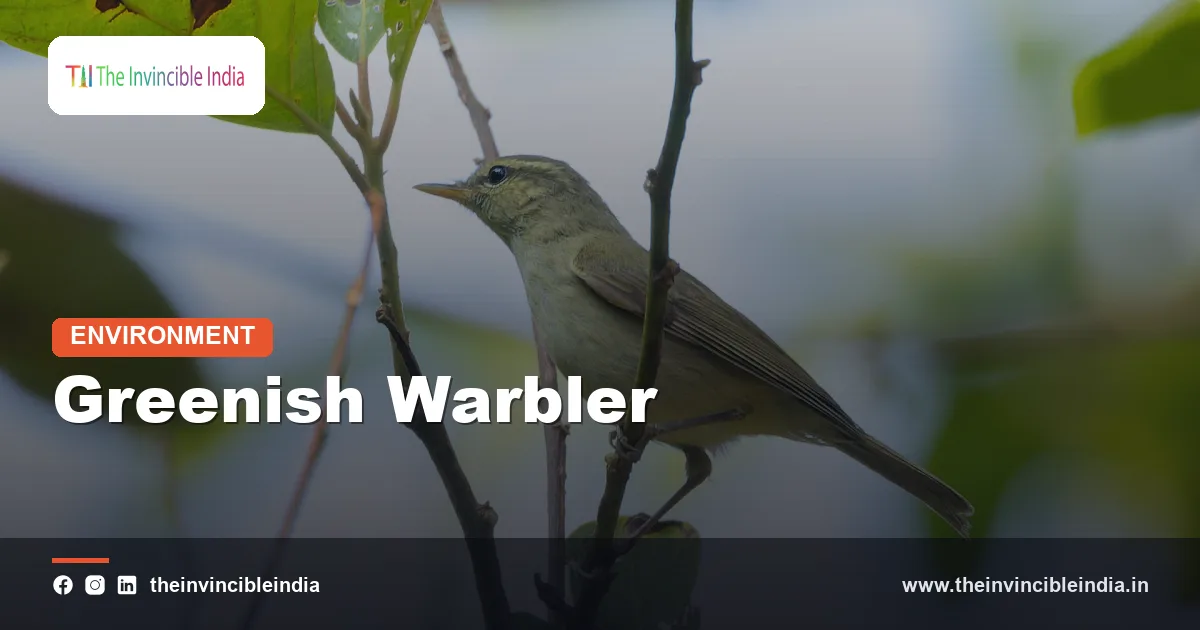
The greenish warbler (Phylloscopus trochiloides) is a tiny, restless, olive-green leaf warbler that breeds in the Himalaya and across northern Asia and winters throughout much of India, where it flits through the foliage of gardens, orchards, groves and forests in search of insects. Weighing less than ten grams, the bird is among the smallest and most active winter visitors that Indian bird watchers meet, and it is also one of the most famous birds in evolutionary biology.
A greenish warbler is easy to describe and hard to photograph. It is pale olive above, whitish below, with a long yellowish eyebrow and a single thin wing bar, and it rarely sits still for more than a second. Its loud, clear “chi-wee” call is often the first sign that one is nearby. This article explains what the species is, where it lives in India, how to identify it, what it eats, how it breeds and why scientists consider it a rare living example of how new species arise.
Quick Facts
| Common name | Greenish warbler (also called greenish leaf warbler) |
|---|---|
| Scientific name | Phylloscopus trochiloides |
| Family | Phylloscopidae (leaf warblers) |
| Size | About 10-12 cm long, weighing roughly 6-9 grams |
| Habitat in India | Gardens, tree canopies, orchards, groves, scrub and forest across the plains and hills in winter; Himalayan forests in summer |
| Diet | Tiny insects, spiders and other invertebrates gleaned from leaves and twigs |
| Migration | Winter visitor over much of India, arriving mainly from August-September and leaving by April-May; also breeds in the western Himalaya |
| Breeding | Domed nest on the ground in a bank or among roots; about 4-5 white eggs |
| Conservation status | Least Concern (IUCN) |
Key Takeaways
- The greenish warbler is a tiny olive-green leaf warbler, about 10-12 cm long, that winters across most of India and breeds in the Himalaya and northern Asia.
- Greenish warbler is a “ring species”: its breeding populations form a chain around the Tibetan Plateau, and the two ends of the chain behave as separate species where they meet in Siberia.
- A long pale yellowish eyebrow, a dark line through the eye and one narrow wing bar are the main plumage clues to a greenish warbler.
- The loud, rising, two-syllable “chi-wee” call is the most dependable way to detect a greenish warbler in an Indian garden or wood.
- Greenish warbler feeds on tiny insects and spiders picked from the leaves of trees and shrubs, which makes it a natural pest controller.
- The species is listed as Least Concern by the IUCN because its range is very large and its population is large and widespread.
What is the greenish warbler?
The greenish warbler is a small insect-eating songbird of the family Phylloscopidae, the group of leaf warblers, and it is among the most abundant winter warblers in India. The bird belongs to a genus whose members are all small, greenish or brownish, active birds that hunt in foliage and are very hard to tell apart without hearing their voices.
The upperparts of the greenish warbler are dull green or olive, the underparts are white or pale yellowish, and the face is marked by a pale yellow-white eyebrow that reaches well behind the eye. A dark stripe runs through the eye. The wing shows a single narrow pale bar across the tips of the greater coverts, which is a key feature, and sometimes a faint second bar that is much less distinct. The bill is thin, with a pale lower part, and the legs are brownish.
The sexes are alike and the bird does not change much with the seasons, though worn feathers in spring look duller and greyer than the fresh plumage of autumn. The tiny size, quick movements and constant wing flicks make the species look more like a leaf blown about by the wind than a bird.
Why is the greenish warbler called a ring species?
The greenish warbler is called a ring species because its breeding populations form a continuous chain around the Tibetan Plateau, and the birds at the two ends of the chain, which meet in central Siberia, no longer interbreed. Each neighbouring population in the ring can interbreed with the next, but the ends behave as separate species.
The idea is that the ancestors of the species lived in the Himalaya. They then spread north on both sides of the Tibetan Plateau, one lineage going through the west and Central Asia, the other through the east and China, and met again in Siberia. Along the way, song, plumage and genes changed gradually. When the two ends met, they had changed enough that males of one end did not respond to the songs of the other.
Scientists have studied the greenish warbler for this reason and have used its song differences and genetic data to understand how species form. Taxonomists do not agree on the exact classification. Some authorities treat the eastern end as a separate species, called the two-barred greenish warbler, and split other forms too. Birders in India should know that the name and the number of species may differ by checklist.
Where is the greenish warbler found in India?
The greenish warbler is found across most of India in winter, from the plains of the north through the central region to the southern peninsula and the Western Ghats, and it breeds in the western Himalaya during summer. It is therefore both a winter visitor and a summer resident in different parts of the country.
In the Himalaya, breeding birds live in forests and scrub at moderate to high elevations, where they nest on the ground or on a bank and sing from trees. After breeding, they move to lower ground and many travel to the plains and the peninsula. The winter range includes:
- Gardens and avenues in cities such as Delhi, Mumbai, Bengaluru and Chennai.
- Mango and other fruit orchards, plantations and groves.
- Deciduous and evergreen forest, forest edges and clearings.
- Scrub jungle and wooded hills.
- Village trees, riverside woods and parks.
Within these habitats the bird prefers the middle and upper layers of trees, where it hangs among leaves and moves along branches. It also feeds in lower shrubs. Similar warblers share the same areas, and in a single tree it is possible to find several leaf warbler species at once.
How can you identify a greenish warbler?
The greenish warbler can be identified by its tiny size, olive-green back, long pale eyebrow, single narrow wing bar and its loud, rising “chi-wee” call. Together these features separate the species from most other leaf warblers, though a few close look-alikes require careful comparison.
The main points to watch are:
- Wing bar: one clear thin bar, with the tips of the median coverts pale; a second bar, if any, is faint and short.
- Head pattern: a long, clean yellowish-white supercilium, which stands out against a darker eye line, and no dark crown stripe.
- Underparts: whitish, with at most a light yellow wash on the throat and breast.
- Bill: slender, dark above with a paler lower mandible.
- Behaviour: constant movement, with flicks of the wings and rapid gleaning from leaves.
Because plumage differences between leaf warblers can be small, many experienced observers rely on calls. A bird seen well but not heard is sometimes left as “a leaf warbler”.
Which leaf warblers look like the greenish warbler?
The greenish warbler is most easily confused with the two-barred greenish warbler, the large-billed leaf warbler, Tickell’s leaf warbler and the Pallas’s leaf warbler. All of these are small, active, greenish birds that visit the same trees, and several have wing bars.
| Species | Main difference from the greenish warbler |
|---|---|
| Two-barred greenish warbler | Shows a clearer second wing bar and is often a brighter, more yellow-green bird; some checklists treat it as a separate species |
| Large-billed leaf warbler | Larger and heavier, with a stronger bill, a darker, duller plumage and a different call |
| Tickell’s leaf warbler | Has no wing bar, a more yellowish underside and is common in many Indian habitats |
| Pallas’s leaf warbler | Has a bold yellow rump patch, a pale crown stripe and two strong wing bars |
The greenish warbler sits between these species in many respects, which is exactly why it is both common and confusing. Its call, a clear and ringing “chi-wee”, is a useful tie-breaker.
What does the greenish warbler eat?
The greenish warbler eats tiny insects and spiders, which it picks from leaves, twigs and flowers or catches in short aerial sallies. Its diet includes small flies, aphids, caterpillars, beetles and the eggs and larvae of many insects, all of which are abundant on the foliage of Indian trees.
The bird has a distinctive hunting style. It hops quickly along branches, hangs upside down at times, flicks its wings every few seconds and darts out to snatch flying prey. It often joins mixed feeding flocks that move through the forest in winter, in which warblers, tits, flycatchers and others forage together and warn each other of danger.
Because the greenish warbler weighs so little, it needs to feed almost constantly during the day. A leaf warbler in India usually spends most of the daylight hours searching for food. Large numbers of small birds of this kind remove many insects from crops, orchards and gardens during the winter months.
How does the greenish warbler sound?
The greenish warbler gives a loud, clear, two-syllable “chi-wee” call, with the second note higher than the first, and a fast, high-pitched, jumbled song that ends in a trill. The call is heard throughout winter, whereas the song is given mostly on the breeding grounds and by males just before leaving India.
The “chi-wee” call is short and ringing, and carries well through the canopy. It is often repeated every few seconds as the bird moves from tree to tree. The song of the breeding male is a rapid series of thin notes that rise and fall in pitch. Song differences between populations around the Tibetan Plateau are part of the evidence for the ring-species story, and recordings from different regions are used in research.
For learners, the call is one of the first sounds to recognise among Indian winter birds. Once heard, the sound is easy to separate from the weaker, softer notes of other leaf warblers.
When does the greenish warbler migrate and breed?
The greenish warbler migrates to the plains and peninsula of India from late summer, usually from about August and September, and returns north or to the Himalayan breeding forests by April and May. Breeding takes place in the Himalaya and across northern Asia in the northern summer.
On the breeding ground, the male defends a territory and sings from the trees. The female builds a domed nest on the ground, tucked into a bank, among roots or under a tuft of vegetation, using grass, moss and fine plant material. She lays about four or five white eggs and incubates them for roughly two weeks. Both parents feed the nestlings, which leave the nest after a further couple of weeks.
After breeding, the adults moult and fatten up. Young birds and adults spread out along the foothills and then move south. The journey from Himalayan breeding forests to the plains is short compared with the long flights of birds that breed in Siberia.
Is the greenish warbler threatened?
No, the greenish warbler is not threatened and is listed as Least Concern by the International Union for Conservation of Nature (IUCN). The species has an enormous range across Asia, a very large population and no evidence of a serious decline.
Local threats still exist. Felling of Himalayan forests and the loss of old trees on the plains remove feeding and nesting sites, and pesticides can reduce insect food. Birds also die in collisions with glass and in bad weather during migration. Planting a variety of native trees in towns, keeping parks and avenues green and avoiding unnecessary spraying all help winter warblers.
Why does the greenish warbler matter?
The greenish warbler matters because it is a rare real-world example of speciation in action and because it helps control insects in Indian trees. For scientists, the ring around the Tibetan Plateau shows how gradual change can create new species. For ordinary people, the bird is a daily reminder that the trees in a city street support wild life.
The species also links regions. A bird that sings in a Himalayan forest in June may be hunting in a Bengaluru park in January, so the care of mountain forests and urban trees is part of one story. Bird watchers who record the species on checklists add valuable information about arrival dates and numbers.
Bottom Line
The greenish warbler is a tiny, active, widespread leaf warbler that fills Indian trees with its ringing call each winter. It is common, secure and scientifically important, and it is best learnt through its voice, the long eyebrow and the single wing bar.
Frequently Asked Questions
What is a greenish warbler?
A greenish warbler is a tiny olive-green leaf warbler, about 10-12 cm long, that breeds in the Himalaya and northern Asia and winters across much of India. It has a long yellowish eyebrow and one narrow wing bar. It is known for its loud “chi-wee” call.
Why is the greenish warbler called a ring species?
The greenish warbler is called a ring species because its breeding populations form a chain around the Tibetan Plateau. Neighbouring populations can interbreed, but the two ends of the chain, which meet in Siberia, do not. Scientists study the bird to understand how new species form.
When can you see a greenish warbler in India?
You can see a greenish warbler in India mainly from late summer to spring, roughly August to April, in gardens, orchards and forests across the plains and peninsula. It also breeds in the western Himalaya in summer. Early morning is the best time to look.
How do you tell a greenish warbler from other leaf warblers?
You can tell a greenish warbler from other leaf warblers by its single narrow wing bar, long pale yellowish eyebrow and rising “chi-wee” call. Tickell’s leaf warbler has no wing bar, while the two-barred greenish warbler shows a clearer second bar. Pallas’s leaf warbler has a yellow rump and a pale crown stripe.
What does the greenish warbler eat?
The greenish warbler eats tiny insects and spiders, including flies, aphids, caterpillars and beetles. It picks them from leaves and twigs and sometimes catches them in the air. It often joins mixed flocks of small birds that feed together in the winter.
Is the greenish warbler a threatened bird?
No, the greenish warbler is not a threatened bird and is classified as Least Concern by the IUCN. Its range is vast and its population is large. Loss of forest and trees, pesticide use and glass collisions can still harm local birds.
{“@context”:”https://schema.org”,”@graph”:[{“@type”:”FAQPage”,”mainEntity”:[{“@type”:”Question”,”name”:”What is a greenish warbler?”,”acceptedAnswer”:{“@type”:”Answer”,”text”:”A greenish warbler is a tiny olive-green leaf warbler, about 10-12 cm long, that breeds in the Himalaya and northern Asia and winters across much of India. It has a long yellowish eyebrow and one narrow wing bar. It is known for its loud “chi-wee” call.”}},{“@type”:”Question”,”name”:”Why is the greenish warbler called a ring species?”,”acceptedAnswer”:{“@type”:”Answer”,”text”:”The greenish warbler is called a ring species because its breeding populations form a chain around the Tibetan Plateau. Neighbouring populations can interbreed, but the two ends of the chain, which meet in Siberia, do not. Scientists study the bird to understand how new species form.”}},{“@type”:”Question”,”name”:”When can you see a greenish warbler in India?”,”acceptedAnswer”:{“@type”:”Answer”,”text”:”You can see a greenish warbler in India mainly from late summer to spring, roughly August to April, in gardens, orchards and forests across the plains and peninsula. It also breeds in the western Himalaya in summer. Early morning is the best time to look.”}},{“@type”:”Question”,”name”:”How do you tell a greenish warbler from other leaf warblers?”,”acceptedAnswer”:{“@type”:”Answer”,”text”:”You can tell a greenish warbler from other leaf warblers by its single narrow wing bar, long pale yellowish eyebrow and rising “chi-wee” call. Tickell’s leaf warbler has no wing bar, while the two-barred greenish warbler shows a clearer second bar. Pallas’s leaf warbler has a yellow rump and a pale crown stripe.”}},{“@type”:”Question”,”name”:”What does the greenish warbler eat?”,”acceptedAnswer”:{“@type”:”Answer”,”text”:”The greenish warbler eats tiny insects and spiders, including flies, aphids, caterpillars and beetles. It picks them from leaves and twigs and sometimes catches them in the air. It often joins mixed flocks of small birds that feed together in the winter.”}},{“@type”:”Question”,”name”:”Is the greenish warbler a threatened bird?”,”acceptedAnswer”:{“@type”:”Answer”,”text”:”No, the greenish warbler is not a threatened bird and is classified as Least Concern by the IUCN. Its range is vast and its population is large. Loss of forest and trees, pesticide use and glass collisions can still harm local birds.”}}]}]}


