

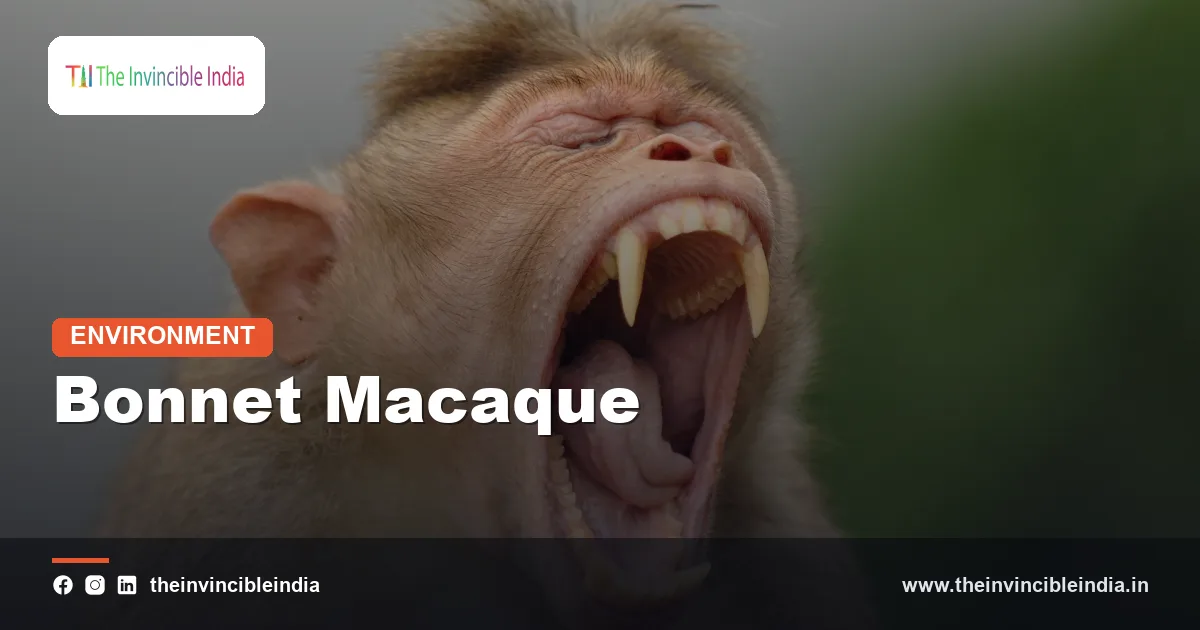
Found only in peninsular India, the bonnet macaque (Macaca radiata) is a medium-sized, brown-coated monkey named for the whorl of hair that radiates from the crown of its head like a flat cap, or bonnet. It is the commonest monkey of southern India, living in forests, farmland, temple precincts and roadsides, and it is endemic to the country, meaning that no wild populations are known outside it.
The bonnet macaque is highly social, intelligent and omnivorous, and its willingness to live near people makes it one of the most visible monkeys in the south. That same closeness brings conflict over food and space. This explainer covers how to identify the bonnet macaque, how its troops are organised, what it eats, how it breeds, and why provisioning and human-monkey conflict matter.
| Attribute | Detail |
|---|---|
| Common name | Bonnet macaque |
| Scientific name | Macaca radiata |
| Family | Cercopithecidae (Old World monkeys) |
| Distinctive feature | A whorl of hair on the crown that radiates outwards like a cap; pinkish face |
| Typical size | Males about 5 to 9 kg, females about 3 to 5 kg; the tail is roughly as long as the body |
| Range | Peninsular India, south of roughly the Tapti River, including Karnataka, Kerala, Tamil Nadu, Andhra Pradesh, Telangana, Goa and southern Maharashtra |
| Habitat | Evergreen and deciduous forest, scrub, plantations, farmland, temples and towns |
| Social structure | Troops with several males and many females, organised by dominance rank |
| Conservation status (IUCN) | Vulnerable |
Key Takeaways
- The bonnet macaque (Macaca radiata) is an Old World monkey endemic to peninsular India and is named for the whorl of hair on its crown.
- The bonnet macaque lives in multi-male, multi-female troops in which females stay in the group they were born in and males usually leave.
- The bonnet macaque is omnivorous and uses cheek pouches to carry food, eating fruits, seeds, flowers, insects and, near people, crops and handouts.
- The bonnet macaque is listed by the IUCN as Vulnerable, with threats including habitat loss, capture and conflict with people.
- Feeding bonnet macaques by hand or at roadside temples makes them dependent on people and increases aggression and road deaths.
- The bonnet macaque is protected under India’s Wildlife (Protection) Act, 1972, which prohibits hunting and capturing it.
What is the bonnet macaque?
The bonnet macaque is a species of macaque, a group of Old World monkeys in the genus Macaca, that is native to southern India. It belongs to the family Cercopithecidae, along with baboons, langurs and other macaques, and it is one of several Macaca species found in India.
India’s best-known macaques include the rhesus macaque (Macaca mulatta) of the north, the lion-tailed macaque (Macaca silenus) of the Western Ghats, the Assamese macaque, the pig-tailed macaque and the bonnet macaque of the peninsula. The bonnet macaque is often grouped with the toque macaque of Sri Lanka, with which it shares a similar look.
Two subspecies have been recognised: Macaca radiata radiata in most of the range and Macaca radiata diluta in the northern part of its range, which is paler. Taxonomic treatments differ, and some authorities regard the differences as minor.
How can you identify a bonnet macaque?
A bonnet macaque is identified by its brown-grey fur, a pinkish or pale face, a long tail and the radiating whorl of hair on its crown that looks like a cap. The hair on the head parts in the middle and spreads outwards like the spokes of a wheel, which gives the species its common name.
Additional features include:
- Face: bare, pinkish to light brown, with a slightly protruding muzzle.
- Coat: grey-brown above, paler on the belly and limbs.
- Tail: long and often held in a loose arch, differing from the shorter tail of the rhesus macaque.
- Build: sturdy, with strong limbs; males are heavier and have larger canine teeth than females.
- Cheek pouches: expandable pouches on each side of the mouth for temporary food storage.
Infants are born with dark skin and a thin coat and are carried clinging to the mother’s belly at first. Juveniles look similar to adults but are smaller. Close inspection of the head hair is the quickest way to separate this species from a rhesus macaque in the field.
Where is the bonnet macaque found?
The bonnet macaque is found throughout peninsular India, roughly south of the Tapti River, in a range that includes Karnataka, Kerala, Tamil Nadu, Andhra Pradesh, Telangana and Goa. It lives in a range of habitats from evergreen forests of the Western Ghats to dry scrub, farmland, temple towns and the outskirts of big cities.
It is common in:
- forests of the Western and Eastern Ghats and adjacent plains;
- agricultural landscapes with trees, plantations and orchards;
- temple complexes and heritage sites, such as those at Hampi and other pilgrim towns;
- roadsides, railway stations and urban areas where food is available.
Overall numbers are not precisely known and appear to have declined in many areas, which is why the species is considered vulnerable. Local groups may be large near people but scarce in intact forest, where competition with other primates and predators is higher.
How does a bonnet macaque troop work?
A bonnet macaque troop is a stable group of related females and their offspring along with several adult males, and it is organised by dominance rank. Troops usually number about 10 to 50 individuals, and they may be larger in places with plentiful food.
Key features of troop life include:
- Matrilineal structure: females stay in their birth group for life, and daughters take a rank just below their mothers.
- Male dispersal: young males leave their birth troop at adolescence and join other troops.
- Dominance hierarchy: individuals have a rank that determines priority access to food and mates.
- Relative tolerance: compared with other macaques, bonnet macaques are noted for relatively mild conflict and for frequent huddling and contact among group members.
- Grooming: individuals spend a great deal of time grooming each other to build bonds and remove parasites.
Troops have a home range, which they patrol and defend loosely. Encounters between troops may involve displays or chases. Adult males compete for rank, but males in a troop may also form alliances and cooperate against rivals.
What does the bonnet macaque eat?
The bonnet macaque is an omnivore that eats fruits, seeds, flowers, leaves, insects, eggs and small animals, and it will also take crops and human food where available. In forests it forages on the ground and in trees, and it often stuffs food into its cheek pouches to eat in a safer place.
Common foods include:
- wild fruits, such as figs, which are especially important;
- seeds, shoots, flowers and gum;
- insects, spiders, small lizards and bird eggs;
- cultivated crops, including banana, coconut, groundnut, maize and mango;
- food from tourists, pilgrims, markets and waste bins.
As seed eaters and fruit eaters, bonnet macaques help disperse the seeds of many trees. This gives them a quiet but real role in forest regeneration. In cities, their diet shifts heavily to human food, which is rich in sugar and salt and is not suitable for monkeys.
How intelligent is the bonnet macaque?
The bonnet macaque is highly intelligent, with strong social memory, flexible problem-solving and the ability to learn quickly from experience. Like other macaques, it recognises individual troop members, remembers who owes favours and adjusts behaviour to its rank.
Examples of its cleverness include:
- learning to open bags, bottles, windows and latches to reach food;
- recognising people who carry food or who threaten them;
- using vocalisations, gestures and facial expressions to communicate;
- copying the successful tactics of other troop members.
Macaques are widely used in biomedical and behavioural research, but wild bonnet macaques have also been studied in the field for their social behaviour and their ability to deal with change. Their adaptability has helped them spread into human settlements, though the same adaptability makes control by simple barriers difficult.
How does the bonnet macaque breed?
The bonnet macaque breeds on a seasonal pattern in many areas, with females usually giving birth to a single infant after a gestation of about five to six months. Births often cluster in particular seasons, which vary by region and food supply.
- Single births: twins are rare.
- Infant care: the mother nurses and carries the infant, and other females may show interest in the newborn and handle it.
- Weaning: infants are gradually weaned over many months and stay close to their mothers for a year or more.
- Maturity: females typically mature at around three to four years, and males somewhat later and then leave their troop.
- Lifespan: wild macaques commonly live about 15 to 20 years or more, and captive individuals can live longer.
Male rank has a strong effect on mating success, but females also choose mates, and mating may involve more than one partner. Infant mortality can be high where predators, disease or accidents are common.
How does the bonnet macaque differ from the rhesus macaque?
The bonnet macaque differs from the rhesus macaque mainly in its range, its crown hair and its tail length, as it lives in southern India while the rhesus macaque lives in the north. Both are common around people, so they are often confused or referred to jointly as “monkeys”.
| Feature | Bonnet macaque | Rhesus macaque |
|---|---|---|
| Scientific name | Macaca radiata | Macaca mulatta |
| Typical range | Peninsular and southern India | Northern India, from the plains to the Himalayan foothills, and beyond |
| Head hair | Radiating whorl like a bonnet | Hair swept back without a clear whorl |
| Tail | Long, about as long as the body | Medium, noticeably shorter |
| Coat | Greyish brown, paler underparts | Brownish-grey, reddish rump |
| IUCN status | Vulnerable | Least Concern |
The lion-tailed macaque is a third species in the Western Ghats. It has a dark body, a grey mane and a tufted tail, and it is much rarer and confined to forest. Bonnet macaques may share forest with lion-tailed macaques in some places, although they are more tolerant of open and disturbed habitats.
Why is the bonnet macaque in conflict with people?
The bonnet macaque comes into conflict with people because it raids crops, snatches food, enters homes and shops and sometimes bites or scratches people who resist, especially in places where it is fed. Conflict is most intense in temple towns, tourist spots, highways and the edges of forest.
The main types of conflict are:
- Crop damage: monkeys eat fruit, coconut and field crops, causing losses for small farmers.
- Food snatching: macaques learn that people carry food and grab bags and packets.
- Aggression: bites and scratches can occur, and wounds carry risks of infection; medical care and anti-rabies advice should be sought for any bite.
- Property damage: monkeys enter buildings, tear roofs and damage wiring.
- Disease concerns: in parts of Karnataka and neighbouring states, deaths of monkeys have been linked to Kyasanur Forest Disease, a tick-borne illness, and such deaths can serve as early warnings for local health authorities.
Conflict is not simply the monkeys’ fault. Much of it is caused by habitat loss, open waste and regular feeding, which draw animals to people. Solutions require changes in human behaviour as much as monkey management.
What is the problem with feeding bonnet macaques?
The problem with feeding bonnet macaques is that provisioning makes them dependent on people, raises their numbers locally, increases aggression and exposes them to traffic and disease. Feeding monkeys is often done out of faith or kindness, particularly in temple towns and along highways, but the outcomes can be harmful for both people and animals.
- Fed monkeys lose their fear of people and begin demanding food.
- Roadside feeding draws monkeys to highways, where vehicle collisions are a leading cause of death.
- Processed human food can cause dental and digestive problems.
- Large, food-supplied troops may spread diseases and parasites more easily.
- Troops with easy food breed faster, increasing pressure on the surrounding area.
Several temple trusts, forest departments and local authorities discourage feeding and have introduced notices, fines and designated feeding places. Better waste management, monkey-proof bins and sterilisation programmes managed by the forest department or veterinary experts are also used. Translocation of monkeys, though common, often fails because animals return or are attacked by resident troops.
What is the conservation status of the bonnet macaque?
The IUCN lists the bonnet macaque as Vulnerable, indicating that the species faces a high risk of decline in the wild unless threats are reduced. It is legally protected under India’s Wildlife (Protection) Act, 1972, which prohibits killing or capturing wild monkeys, and readers should check the current schedule listing, since the Act has been amended.
- Habitat loss from agriculture, plantations, mining and infrastructure is a major threat.
- Capture for the pet trade and for performing shows is illegal but still occurs.
- Retaliatory killing and poisoning occur in areas of crop conflict.
- Road accidents and electrocution are common causes of death in towns.
Protected areas in the Western Ghats and other forests hold important populations, while urban troops depend on the tolerance of people. Reliable national population estimates are scarce, so claims about total numbers should be treated with caution.
Bottom Line
The bonnet macaque is southern India’s best-known monkey, a clever, social, adaptable primate that is now Vulnerable despite its familiarity. Protecting it means safeguarding forests, managing waste and ending habits such as hand-feeding that put monkeys and people at risk. 23 October 2026
Frequently Asked Questions
What is a bonnet macaque?
A bonnet macaque (Macaca radiata) is a brown, medium-sized Old World monkey endemic to peninsular India. It is named for the whorl of hair on its crown that looks like a cap. It lives in troops in forests, farmland and temple towns.
Why is it called a bonnet macaque?
It is called a bonnet macaque because the hair on its head radiates outward from a central whorl and lies flat like a cap or bonnet. This feature helps distinguish it from the rhesus macaque, which has no such whorl. The name was applied to the species by early naturalists.
Where do bonnet macaques live in India?
Bonnet macaques live across peninsular and southern India, including Karnataka, Kerala, Tamil Nadu, Andhra Pradesh, Telangana, Goa and southern Maharashtra. They occupy forests, plantations, farmland and temple towns. The species is found nowhere else in the wild.
What do bonnet macaques eat?
Bonnet macaques eat fruits, seeds, flowers, leaves, insects and eggs, and they also take crops and human food. They carry food in their cheek pouches to eat later. Wild figs are an important natural food.
Are bonnet macaques dangerous?
Bonnet macaques are not usually dangerous in the wild, but they can bite or scratch people when food is involved or when they are threatened. Conflict is greatest where they are fed regularly. Anyone bitten should wash the wound well and seek medical care promptly.
Is the bonnet macaque endangered?
The bonnet macaque is not classed as endangered, but the IUCN lists it as Vulnerable, meaning it faces a high risk of decline. Threats include habitat loss, capture and conflict with people. It is legally protected in India under the Wildlife (Protection) Act, 1972.
{“@context”:”https://schema.org”,”@graph”:[{“@type”:”FAQPage”,”mainEntity”:[{“@type”:”Question”,”name”:”What is a bonnet macaque?”,”acceptedAnswer”:{“@type”:”Answer”,”text”:”A bonnet macaque (Macaca radiata) is a brown, medium-sized Old World monkey endemic to peninsular India. It is named for the whorl of hair on its crown that looks like a cap. It lives in troops in forests, farmland and temple towns.”}},{“@type”:”Question”,”name”:”Why is it called a bonnet macaque?”,”acceptedAnswer”:{“@type”:”Answer”,”text”:”It is called a bonnet macaque because the hair on its head radiates outward from a central whorl and lies flat like a cap or bonnet. This feature helps distinguish it from the rhesus macaque, which has no such whorl. The name was applied to the species by early naturalists.”}},{“@type”:”Question”,”name”:”Where do bonnet macaques live in India?”,”acceptedAnswer”:{“@type”:”Answer”,”text”:”Bonnet macaques live across peninsular and southern India, including Karnataka, Kerala, Tamil Nadu, Andhra Pradesh, Telangana, Goa and southern Maharashtra. They occupy forests, plantations, farmland and temple towns. The species is found nowhere else in the wild.”}},{“@type”:”Question”,”name”:”What do bonnet macaques eat?”,”acceptedAnswer”:{“@type”:”Answer”,”text”:”Bonnet macaques eat fruits, seeds, flowers, leaves, insects and eggs, and they also take crops and human food. They carry food in their cheek pouches to eat later. Wild figs are an important natural food.”}},{“@type”:”Question”,”name”:”Are bonnet macaques dangerous?”,”acceptedAnswer”:{“@type”:”Answer”,”text”:”Bonnet macaques are not usually dangerous in the wild, but they can bite or scratch people when food is involved or when they are threatened. Conflict is greatest where they are fed regularly. Anyone bitten should wash the wound well and seek medical care promptly.”}},{“@type”:”Question”,”name”:”Is the bonnet macaque endangered?”,”acceptedAnswer”:{“@type”:”Answer”,”text”:”The bonnet macaque is not classed as endangered, but the IUCN lists it as Vulnerable, meaning it faces a high risk of decline. Threats include habitat loss, capture and conflict with people. It is legally protected in India under the Wildlife (Protection) Act, 1972.”}}]}]}


