

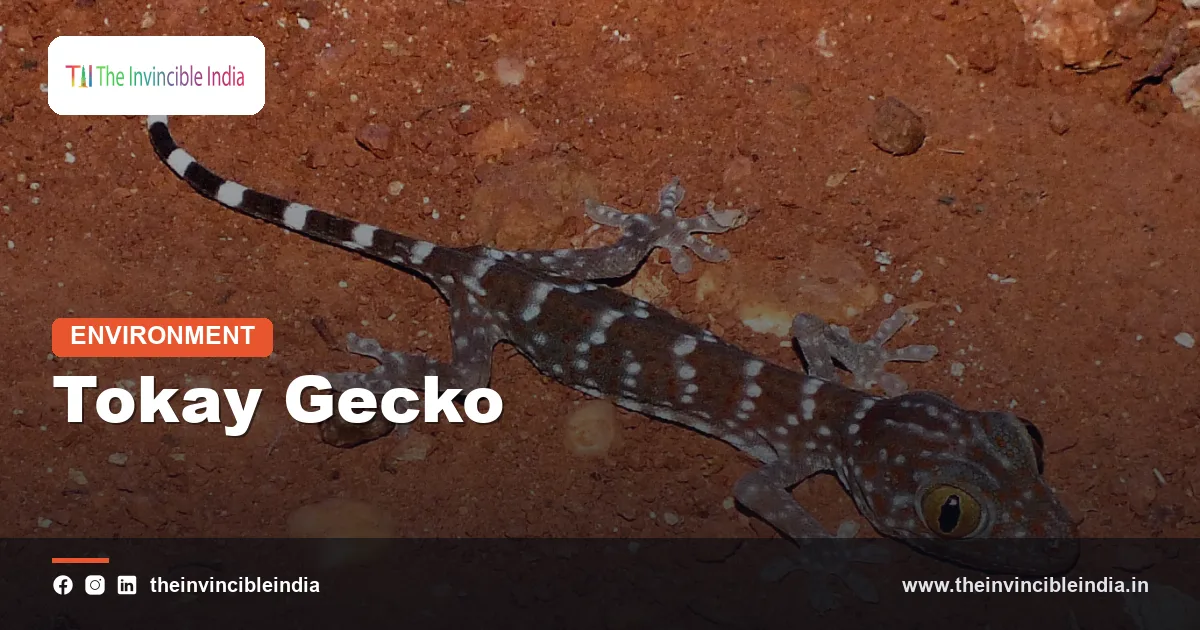
The tokay gecko (Gekko gecko) is a large, nocturnal, blue-grey gecko with bright orange-red spots, found in the forests and villages of Northeast India and across South and Southeast Asia, and named after its loud, repeated “to-kay” call. It is one of the biggest geckos in the world, a fierce defender of its territory with a powerful bite, and a valuable insect-eater around human homes.
In recent years the tokay gecko has also become one of India’s most trafficked small reptiles, because of baseless claims that it can cure serious diseases or fetch huge sums. This explainer covers the animal’s biology, its place in the Northeast, the myths driving the illegal trade, and the legal protection it enjoys.
| Quick Facts | Details |
|---|---|
| Scientific name | Gekko gecko (Linnaeus, 1758) |
| Family | Gekkonidae (true geckos) |
| Typical range in India | Northeast India and adjoining eastern states, mostly in forests, plantations and human settlements |
| Size | Commonly 25 to 35 cm in total length, with large males sometimes longer |
| Appearance | Blue-grey to slate body with orange to red spots and light bands on the tail |
| Activity pattern | Nocturnal and arboreal; hides in tree hollows, rock crevices and roof spaces by day |
| Diet | Insects and other invertebrates, plus occasional small vertebrates |
| Reproduction | Usually one or two hard-shelled eggs per clutch, stuck to a surface |
| Protection | Protected in India under the Wildlife (Protection) Act, 1972; listed in CITES Appendix II since 2023 |
Key Takeaways
- The tokay gecko (Gekko gecko) is one of the largest true geckos in the world and is easy to recognise by its blue-grey skin and orange-red spots.
- The tokay gecko gets its name from its loud, repeated “to-kay” call, which males use to claim territory and attract mates.
- The tokay gecko eats insects and other small animals, so it acts as a natural pest controller in the homes and plantations where it lives.
- A tokay gecko bite is painful and the animal is known for holding on tightly, but the species is not venomous.
- No scientific evidence supports claims that tokay gecko body parts can cure HIV, cancer or any other disease.
- Capturing, selling or trafficking tokay geckos is illegal in India, and the species gained international trade controls through CITES Appendix II in 2023.
What is the tokay gecko?
The tokay gecko is a large lizard in the family Gekkonidae, the true geckos, and its scientific name is Gekko gecko. It was formally described by Carl Linnaeus in the eighteenth century and is the best-known member of the genus Gekko.
The species is a climbing, tree-dwelling reptile that has adapted well to life near people. It uses cracks in old walls, temple eaves, bamboo houses and tree trunks as shelter. Unlike the small, pale house geckos that most Indians see on ceilings, the tokay gecko is bulky, heavy-headed and strongly patterned, and it will openly confront anything that threatens it.
Because it is large, loud and colourful, the tokay is often noticed even by people with no interest in wildlife. Its behaviour, from the sudden call at night to the stubborn grip of its toes, has also given it a place in village folklore across its range.
Where is the tokay gecko found in India?
In India the tokay gecko is found mainly in the Northeast, in states such as Assam, Meghalaya, Mizoram, Nagaland, Manipur, Tripura and Arunachal Pradesh, and in nearby parts of eastern India. Its wider range stretches through Bangladesh, Nepal, Myanmar and much of Southeast Asia, up to Indonesia and the Philippines.
The gecko prefers warm, humid country with plenty of trees. Typical habitats include:
- Evergreen and semi-evergreen forests, where it lives in hollow trunks and rock faces.
- Plantations such as tea estates, rubber and areca nut gardens.
- Villages and towns, where it uses the walls and roofs of old buildings.
Exact distribution limits within India are not fully mapped, and the animal has also been moved by people and by the pet trade, so records outside its natural range do not always mean a wild population.
What does a tokay gecko look like?
A tokay gecko has a stout, flattened body covered in small granular scales, a broad head with large eyes, and a blue-grey to slate colour dotted with orange or red spots. Adults commonly reach 25 to 35 centimetres including the tail, and some reach more, which makes them far bigger than ordinary house geckos.
The details help with identification:
- Eyes: large and golden or yellowish, with vertical pupils that narrow to slits in bright light and open wide at night.
- Tail: banded in pale and dark rings, and capable of breaking off when the gecko is seized.
- Toes: broad pads on each toe, which are the key to its climbing skill.
- Colour: skin tone shifts somewhat with temperature, stress and time of day, so individuals can look paler or darker.
Males and females look broadly similar, though males tend to be larger and have a more prominent head and pores near the vent.
Why is it called the tokay gecko?
The tokay gecko is named after its call, a loud, rhythmic “to-kay” or “tokay” that the male repeats at night, often rising in volume before ending in a series of clicks. The name is an imitation of that sound and appears, with small spelling differences, in many Asian languages.
The call has real biological purposes. Males use it to advertise their presence, warn rival males away from a territory and attract females during the breeding season. A calling gecko can often be heard well outside the house or tree it is occupying.
Folk beliefs have grown around the call in different regions, with some communities treating the number of calls as an omen. These ideas are cultural traditions, not facts, and they should not be confused with the false medical claims that drive trafficking.
What does the tokay gecko eat?
The tokay gecko is an opportunistic predator whose diet is mainly insects and other invertebrates, including moths, beetles, grasshoppers, cockroaches, crickets and spiders. Larger individuals also eat smaller geckos, frogs, nestling birds and occasionally small rodents.
It hunts mostly at night. The gecko sits still near a light, a window or a tree crack and waits for prey to come within reach, then lunges quickly. Prey is gripped in the strong jaws and swallowed whole.
Around homes, this appetite for mosquitoes, moths and cockroaches is useful. Farmers and gardeners in the Northeast often tolerate the gecko for this reason, although its loud calls and its habit of stalking in roof spaces can annoy light sleepers.
How does a tokay gecko climb walls?
A tokay gecko climbs walls and even glass using microscopic hairs on its toe pads that stick to surfaces through weak molecular attraction known as van der Waals forces. Each toe pad carries rows of thin plates called lamellae, and each plate is covered in millions of tiny hair-like structures called setae.
The key points of this adhesive system are:
- The setae split into even finer tips, which maximises the contact area with a surface.
- The grip uses no glue, suction or liquid, so it works on dry, smooth and rough surfaces alike.
- The gecko releases its hold by changing the angle of its toes, peeling the setae away.
The tokay gecko has been studied closely by scientists who design dry adhesives and climbing robots, because its natural grip is strong, reusable and clean.
How does the tokay gecko breed and live?
The tokay gecko breeds by laying hard-shelled eggs, usually one or two at a time, which the female sticks to a wall, tree hollow or rafter, where they harden in the air. Females can lay several clutches in a season, and the young hatch after a few months, depending on temperature.
Parental behaviour is limited but notable. In many reports a parent stays near the eggs and may guard them for a time. Hatchlings are small, boldly banded and entirely independent from the start.
In captivity tokay geckos can live for ten years or more. In the wild their life is shorter because of predators such as snakes, owls, mongooses and cats, as well as habitat loss. A tokay can drop its tail to escape a predator, and a new, usually duller tail grows back over several weeks.
Is the tokay gecko’s bite dangerous?
A tokay gecko’s bite is not dangerous in the sense of venom, since the species is non-venomous, but it is strong enough to break skin and is known to hurt. The gecko often holds on after biting and may refuse to let go for some time.
The animal bites only in defence, usually when it is cornered, grabbed or handled. Sensible precautions include:
- Leave a wild tokay gecko alone and let it leave by itself.
- Avoid trying to pull a gripping gecko off the skin, which can worsen the wound; a gentle approach is better.
- Clean any bite with soap and water and seek medical advice if the wound is deep or becomes sore or swollen.
Although the bite is painful, the tokay is far more of a risk to itself than to people when it is caught, handled roughly and sold.
Why is the tokay gecko trafficked in India?
The tokay gecko is trafficked in India mainly because of false beliefs that its body or tongue can cure diseases such as cancer, HIV or sexual weakness, and because smugglers promise buyers fantastic prices. There is no scientific evidence for any of these medicinal claims.
Several forces feed the trade:
- Traditional-medicine demand: dried geckos are used in some markets outside India, and Indian animals have been smuggled across borders to supply them.
- Scams: rumours of absurd prices per gecko lure poor villagers into catching animals, while middlemen keep the profit or simply cheat the sellers.
- Pet trade: the animal’s size and colour attract some collectors, though it is a difficult pet because of its temper.
Enforcement agencies in India have reported seizures of tokay geckos in several states, and wildlife groups have run awareness campaigns in the Northeast against the myths.
Is the tokay gecko protected by law in India?
Yes, the tokay gecko is legally protected in India, because capturing, keeping or trading it is an offence under the Wildlife (Protection) Act, 1972. The species has been listed in a schedule of the Act, and the 2022 amendment reorganised the schedules, so readers should check the current text for the exact schedule.
International protection also exists. At the 2022 conference of the parties, countries agreed to list Gekko gecko in CITES Appendix II, and the listing took effect in 2023. Appendix II means that international trade must be regulated and backed by permits. The International Union for Conservation of Nature (IUCN) has generally treated the species as of lower concern overall, but heavy local collection can still harm populations.
How do tokay geckos compare with house geckos?
Tokay geckos differ from common house geckos in size, colour, voice and temperament, even though both belong to the gecko family. The table below sets out the main points.
| Feature | Tokay gecko | Common house gecko |
|---|---|---|
| Scientific group | Gekko gecko | Species of Hemidactylus |
| Size | Large, often 25 to 35 cm | Small, often 10 to 15 cm |
| Colour | Blue-grey with orange-red spots | Pale, translucent pink-brown |
| Voice | Loud “to-kay” call | Soft chirps or clicks |
| Range in India | Mainly the Northeast and east | Throughout the country |
| Temperament | Aggressive when handled, bites firmly | Timid, rarely bites |
| Eggs | Hard, usually one or two | Hard, usually one or two |
Bottom Line
The tokay gecko is a large, loud and ecologically useful gecko of Northeast India, now threatened more by myth and trafficking than by its own habits. Understanding its biology, leaving it alone and rejecting the false medical claims are the surest ways to keep it safe in the wild. Anyone offered a tokay gecko for a large sum should treat it as a scam and report it to the forest department.
Frequently Asked Questions
What is a tokay gecko?
A tokay gecko is a large, nocturnal gecko (Gekko gecko) with a blue-grey body and orange-red spots. It lives in Northeast India and across Southeast Asia, and it is named after its loud “to-kay” call. The species eats insects and small animals and is one of the biggest geckos in the world.
Is the tokay gecko poisonous or venomous?
No, the tokay gecko is neither poisonous nor venomous. Its danger lies only in its strong bite, which can break the skin and may hurt for some time. Washing the wound and seeking medical advice if it looks serious is enough in most cases.
Does the tokay gecko cure HIV or cancer?
No, there is no scientific evidence that any part of a tokay gecko can cure HIV, cancer or any other illness. These claims are myths spread by traffickers and scammers. Buying or selling the animal on such a promise is a crime and fuels cruelty to wildlife.
Is it illegal to keep a tokay gecko in India?
Yes, keeping, capturing or trading a tokay gecko is illegal in India under the Wildlife (Protection) Act, 1972. The species has also been in CITES Appendix II since 2023, which regulates international trade. Anyone who finds a captive animal should contact the forest department.
What does a tokay gecko eat?
A tokay gecko eats mainly insects, such as moths, beetles, cockroaches and crickets. Bigger geckos also take spiders, other geckos, frogs and sometimes small rodents or nestling birds. It usually hunts at night by waiting and then lunging at prey.
Why does the tokay gecko make a loud sound?
The tokay gecko calls loudly to mark its territory and to attract mates, and the sound gives the species its name. The call is a repeated “to-kay” that often ends in clicks, and males are the main callers. It is most often heard at night during the breeding season.
{“@context”:”https://schema.org”,”@graph”:[{“@type”:”FAQPage”,”mainEntity”:[{“@type”:”Question”,”name”:”What is a tokay gecko?”,”acceptedAnswer”:{“@type”:”Answer”,”text”:”A tokay gecko is a large, nocturnal gecko (Gekko gecko) with a blue-grey body and orange-red spots. It lives in Northeast India and across Southeast Asia, and it is named after its loud “to-kay” call. The species eats insects and small animals and is one of the biggest geckos in the world.”}},{“@type”:”Question”,”name”:”Is the tokay gecko poisonous or venomous?”,”acceptedAnswer”:{“@type”:”Answer”,”text”:”No, the tokay gecko is neither poisonous nor venomous. Its danger lies only in its strong bite, which can break the skin and may hurt for some time. Washing the wound and seeking medical advice if it looks serious is enough in most cases.”}},{“@type”:”Question”,”name”:”Does the tokay gecko cure HIV or cancer?”,”acceptedAnswer”:{“@type”:”Answer”,”text”:”No, there is no scientific evidence that any part of a tokay gecko can cure HIV, cancer or any other illness. These claims are myths spread by traffickers and scammers. Buying or selling the animal on such a promise is a crime and fuels cruelty to wildlife.”}},{“@type”:”Question”,”name”:”Is it illegal to keep a tokay gecko in India?”,”acceptedAnswer”:{“@type”:”Answer”,”text”:”Yes, keeping, capturing or trading a tokay gecko is illegal in India under the Wildlife (Protection) Act, 1972. The species has also been in CITES Appendix II since 2023, which regulates international trade. Anyone who finds a captive animal should contact the forest department.”}},{“@type”:”Question”,”name”:”What does a tokay gecko eat?”,”acceptedAnswer”:{“@type”:”Answer”,”text”:”A tokay gecko eats mainly insects, such as moths, beetles, cockroaches and crickets. Bigger geckos also take spiders, other geckos, frogs and sometimes small rodents or nestling birds. It usually hunts at night by waiting and then lunging at prey.”}},{“@type”:”Question”,”name”:”Why does the tokay gecko make a loud sound?”,”acceptedAnswer”:{“@type”:”Answer”,”text”:”The tokay gecko calls loudly to mark its territory and to attract mates, and the sound gives the species its name. The call is a repeated “to-kay” that often ends in clicks, and males are the main callers. It is most often heard at night during the breeding season.”}}]}]}


