

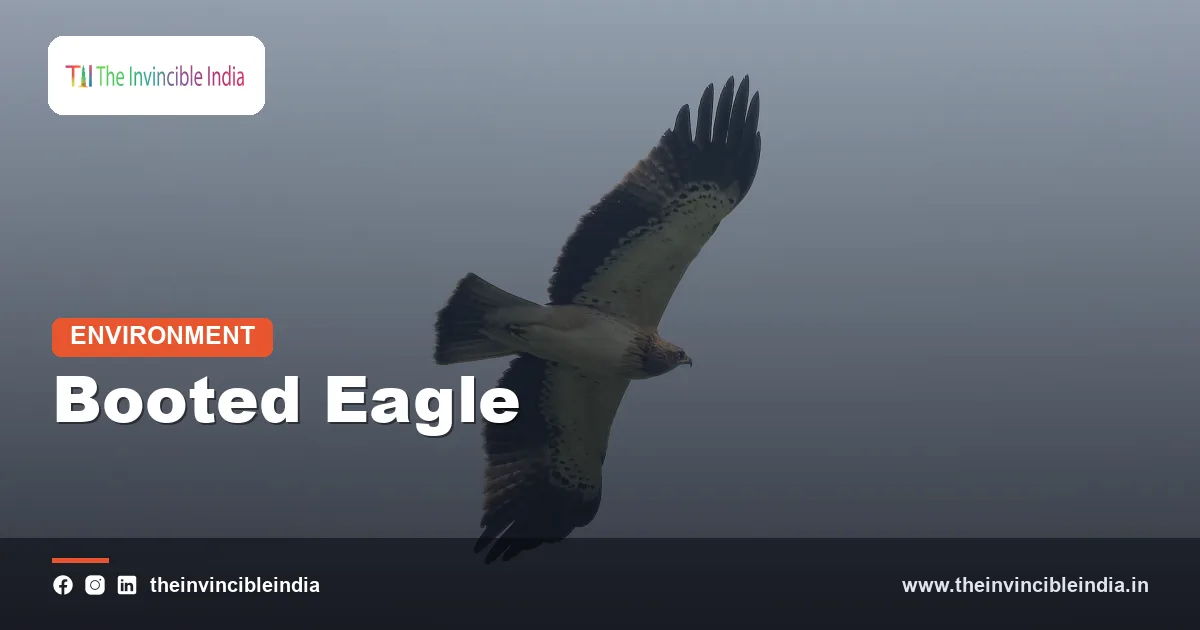
The booted eagle (Hieraaetus pennatus) is a small, agile eagle of the family Accipitridae, about the size of a common buzzard, that exists in two colour forms, pale and dark, and is a regular winter visitor across much of India. It is named for the feathers that cover its legs down to the toes, like boots, and it is best recognised in the air by the bright white patches at the front of its wings.
Many Indian birdwatchers meet the booted eagle as a lone bird circling over open woodland, scrubby hills, farmland edges or even town outskirts between autumn and spring. This explainer covers what the booted eagle is, how to identify the two forms, where it breeds and winters, how it hunts, and how it differs from other raptors that look similar overhead.
Quick Facts
| Common name | Booted eagle |
|---|---|
| Scientific name | Hieraaetus pennatus (also placed in the genus Aquila by some authorities) |
| Family | Accipitridae (hawks, eagles, kites and harriers) |
| Size | About 40 to 52 cm long with a wingspan of roughly 100 to 130 cm |
| India range and habitat | Winter visitor to much of the country, in open woodland, wooded hills, scrub and farmland; breeds in parts of the western Himalaya |
| Diet | Small birds, lizards, small mammals and large insects |
| Breeding and migration | Breeds in southern Europe, north-west Africa and Asia; Asian birds migrate south to winter in the Indian subcontinent |
| Colour forms | Pale morph and dark morph, with a white shoulder patch in both |
| Conservation status | Least Concern on the IUCN Red List (global assessment) |
Key Takeaways
- The booted eagle is one of the smallest eagles seen in India, comparable in size to a buzzard but with the long, broad wings and fingered wingtips typical of eagles.
- The booted eagle occurs in a pale form with white underparts and a dark form with chocolate-brown underparts, and both forms show white patches at the base of the leading edge of the wing.
- Booted eagles seen in India are mostly winter visitors that arrive from breeding grounds to the north between autumn and early winter and leave by spring.
- The booted eagle hunts small birds, reptiles and mammals by stooping steeply from a soaring or circling flight.
- The name booted eagle comes from the fully feathered legs, which extend as a covering down to the toes.
- The booted eagle is rated Least Concern globally, though it depends on tree cover and open hunting ground that are changing across its range.
What is the booted eagle?
The booted eagle is a small to medium-sized bird of prey that belongs to the group known as booted eagles, a set of small eagles with feathered legs. It is a true eagle in structure, with a strong hooked bill, powerful feet with sharp talons and broad wings, but its body is slim and light, so it is sometimes mistaken for a buzzard or a kite.
The scientific name Hieraaetus pennatus reflects the group classification, although some modern authorities merge the small booted eagles into the genus Aquila, so the Latin name may differ between field guides. The English name remains stable and widely used.
Its legs are feathered right to the base of the toes, which is a feature shared by the larger true eagles of the genus Aquila, and it distinguishes them from kites, harriers and many hawks that have bare lower legs. The feathering is thought to protect the legs against bites from prey and to help in colder habitats.
How can you identify a booted eagle?
A booted eagle is identified by its small eagle shape, its square-ended or slightly rounded tail, its pale and dark flight feathers, and the bright white spots at the front of each wing where it meets the body, often called landing lights. These white marks are visible in both colour forms from a distance, and they are the single most useful field mark.
The pale morph
The pale form has white or cream underparts, with dark flight feathers on the wing that contrast sharply with the pale wing lining. The head is often pale or lightly streaked, and the upper side of the wing shows a diagonal pale band across the coverts. From below, the bird looks like a white bird with black wing edges and a dark band along the trailing edge.
The dark morph
The dark form has a warm brown or chocolate underside, including the wing linings, and the flight feathers look slightly paler than the body. The white shoulder patches remain visible. The tail is usually pale at its base on the underside and above, and a pale band on the upper tail base is a helpful clue.
Other useful clues
- The tail is relatively long and square, and in the pale form it is greyish with a darker tip.
- The wings are held flat or slightly bowed during soaring, with the fingers at the tips spread.
- The upper tail coverts are often pale, forming a light rump patch.
- The call is a high, thin, repeated whistle, usually given during the breeding season.
How common are the two colour forms?
The pale form is the more common of the two colour forms, while the dark form is less frequent but regular. Both forms interbreed, and chicks of a pair can be of either type, because the difference is a matter of plumage genetics and not of separate species.
The ratio of dark to pale birds differs among populations. In some parts of the species’ range the dark form is much rarer, which means that an observer in India is more likely to meet a pale bird, although a dark bird should not be a surprise. Birdwatchers are encouraged to record the morph with each sighting, since this adds to knowledge of how forms are distributed through the winter range.
Where does the booted eagle live in India?
The booted eagle lives across much of India during the winter months, in open deciduous forest, wooded hills, thorn scrub, farmland with scattered trees and sometimes the edges of towns. The species is widespread across the peninsula and the northern plains, although it is thinly spread and rarely seen in large numbers.
A small number of booted eagles breed in India itself, mainly in the forested slopes of the western Himalaya, where they nest in trees. Most birds that appear in the rest of the country, however, are migrants from breeding areas farther north and west in Asia and Europe.
The bird avoids dense, closed evergreen forest, preferring places where trees give nest and perch sites and open ground gives hunting room. It is therefore frequently seen over mixed habitats where forest meets cultivation or scrub.
Why does the booted eagle migrate to India?
The booted eagle migrates to India because the winter food supply in its northern breeding areas falls, and the milder climate and plentiful small prey of the Indian subcontinent let the bird survive until spring. Migration is a seasonal response to food and weather, not a one-time movement.
Populations of this species follow different routes. European and north-west African birds largely winter in Africa south of the Sahara, while many Asian birds head south and east into the Indian subcontinent. The birds travel by soaring on rising warm air and then gliding forward, a method that saves energy and keeps the eagle in the air for long stretches.
Typical seasonal pattern in India
| Period | Booted eagle activity in India |
|---|---|
| Autumn | Arrival of migrants from northern breeding areas, often first seen in northern and central regions |
| Winter | Birds spread over hills, scrub and farmland, hunting and roosting alone |
| Early spring | Birds begin moving north again toward breeding grounds |
| Summer | Few birds remain, apart from breeders in the western Himalaya |
Exact dates vary from year to year with weather and region, so these periods should be read as general guides rather than fixed calendar dates.
What does the booted eagle eat?
The booted eagle eats mainly small birds, lizards, small mammals and large insects, taking whatever it can catch with a swift attack. Birds are often the most important part of the diet, and the eagle commonly targets species such as pigeons, doves, larks and partridges.
The bird hunts in several ways. It may soar high over open ground and then drop in a steep stoop with partly closed wings, accelerating toward prey. It may also glide low along a hedge or woodland edge to surprise birds, or watch from a tree perch and launch an ambush. The strike is made with the feet, and the talons kill the prey on contact or shortly after.
Typical prey
- Small and medium birds, including pigeons, doves, larks and small game birds.
- Lizards, including garden lizards and larger skinks.
- Small mammals such as mice, voles and young rabbits or hares.
- Large insects such as grasshoppers and beetles, taken occasionally.
As a predator of rodents, reptiles and birds, the booted eagle plays a small role in controlling those populations. It is not a significant threat to poultry, since it is too small to carry off full-grown domestic birds and normally avoids human settlements.
How does the booted eagle breed?
The booted eagle breeds by building or reusing a stick nest high in a tree, laying one or two eggs, and rearing the young for several weeks after hatching. The nest is a platform of sticks lined with green leaves, typically placed in a forked branch or on a large limb.
The female does most of the incubation, and the male supplies food. In courtship, the pair perform aerial displays that include steep dives, rolling, undulating flight and calling. The young leave the nest after several weeks but remain dependent on the parents for a period afterwards, and the breeding cycle lasts through much of the summer.
Since the bulk of the breeding takes place away from India, observers in the peninsula rarely see nesting activity. In the western Himalaya, however, nests have been recorded in forested valleys, and these breeding birds are of special interest for regional surveys.
How does the booted eagle differ from similar birds?
The booted eagle differs from similar raptors in size, shape and wing pattern: it is smaller than most true eagles, has feathered legs unlike kites and harriers, and shows white shoulder patches that buzzards lack. In the air, careful attention to shape and pattern usually solves the puzzle.
| Bird | Distinguishing points |
|---|---|
| Booted eagle | Small eagle, white shoulder patches, pale or dark underparts, square tail, feathered legs |
| Common buzzard | Similar size but rounder wings, shorter tail and no white shoulder patches; often has a dark carpal patch |
| Black kite | Forked tail, more angled wings and a lazy, drifting flight; bare lower legs |
| Short-toed snake eagle | Larger, with a big rounded head, pale underside and barred tail; often hovers |
| Changeable hawk-eagle | More heavily built, often crested, with a different, stockier silhouette and forest habitat |
The white landing lights are the quickest clue to separate the booted eagle from most lookalikes. In bad light or at great distance, birdwatchers also look at the shape of the tail and the manner of soaring.
Is the booted eagle threatened?
The booted eagle is not globally threatened, since the IUCN Red List classifies it as Least Concern on account of its wide range and large overall population. Regional pressures nonetheless exist, and local trends can differ from the global picture.
Threats to raptors in general include loss of tree cover and open hunting habitat, the use of pesticides that accumulate in the food chain, illegal shooting and trapping on migration routes, and collisions with power lines and wind turbines. Disturbance at nest sites can also cause breeding failure.
In India, all birds of prey are protected under the Wildlife (Protection) Act, 1972, and the booted eagle falls within the schedules that cover wild birds, which prohibit hunting and trade. Conserving mosaic landscapes of woodland, scrub and fields is the most helpful long-term step for wintering raptors.
How can you watch a booted eagle in India?
You can watch a booted eagle in India by scanning the sky over wooded hills, forest edges and open farmland from late autumn to early spring, especially during the warm midday hours when raptors soar on thermals. A pair of binoculars and patience are the main requirements.
- Look for a small eagle circling alone, with long wings and a long square tail.
- Check for the white spots at the front of the wings, which are visible even when the bird is quite high.
- Note the colour form, pale or dark, and record the date and place.
- Visit hill forests, ridge lines and open sanctuaries where raptors gather.
- Keep a respectful distance from any nest and avoid playing recorded calls to attract the bird.
Citizen-science records from many observers help scientists understand where and when booted eagles winter, so even a single dated sighting with a photograph has value.
Bottom Line
The booted eagle is a compact, agile raptor whose two colour forms and bright wing patches make it one of the more recognisable small eagles over Indian skies in winter. It is secure at the global level, but like all raptors it relies on healthy habitat, abundant prey and safe migration routes. Learning to identify it adds a rewarding species to any winter birdwatching list.
Frequently Asked Questions
What is a booted eagle?
The booted eagle is a small, agile eagle of the family Accipitridae with fully feathered legs. It occurs in a pale and a dark colour form and has white patches at the front of its wings. In India it is mostly a winter visitor.
Why is it called the booted eagle?
The booted eagle is called so because its legs are covered in feathers down to the toes, like boots. Many kites, harriers and hawks have bare lower legs instead. The feathering is shared with the larger true eagles.
Is the booted eagle found in India?
The booted eagle is found in India, mainly as a winter visitor from autumn to spring. It uses open woodland, wooded hills, scrub and farmland across much of the country. A small number breed in the western Himalaya.
How do you tell a pale booted eagle from a dark one?
A pale booted eagle has white or cream underparts, while a dark one has chocolate-brown underparts. Both forms show white patches where the wing meets the body. They are the same species and can even occur in the same pair.
What does the booted eagle eat?
The booted eagle eats mainly small birds, lizards, small mammals and large insects. It catches them by stooping at speed from a soaring flight or by ambushing from a perch. Birds such as pigeons and larks are among its favoured prey.
Is the booted eagle endangered?
The booted eagle is not endangered, because the IUCN rates it Least Concern globally. Habitat loss, pesticides, illegal shooting on migration and power-line collisions still affect raptors in general. In India the species is protected under the Wildlife (Protection) Act, 1972.
{“@context”:”https://schema.org”,”@graph”:[{“@type”:”FAQPage”,”mainEntity”:[{“@type”:”Question”,”name”:”What is a booted eagle?”,”acceptedAnswer”:{“@type”:”Answer”,”text”:”The booted eagle is a small, agile eagle of the family Accipitridae with fully feathered legs. It occurs in a pale and a dark colour form and has white patches at the front of its wings. In India it is mostly a winter visitor.”}},{“@type”:”Question”,”name”:”Why is it called the booted eagle?”,”acceptedAnswer”:{“@type”:”Answer”,”text”:”The booted eagle is called so because its legs are covered in feathers down to the toes, like boots. Many kites, harriers and hawks have bare lower legs instead. The feathering is shared with the larger true eagles.”}},{“@type”:”Question”,”name”:”Is the booted eagle found in India?”,”acceptedAnswer”:{“@type”:”Answer”,”text”:”The booted eagle is found in India, mainly as a winter visitor from autumn to spring. It uses open woodland, wooded hills, scrub and farmland across much of the country. A small number breed in the western Himalaya.”}},{“@type”:”Question”,”name”:”How do you tell a pale booted eagle from a dark one?”,”acceptedAnswer”:{“@type”:”Answer”,”text”:”A pale booted eagle has white or cream underparts, while a dark one has chocolate-brown underparts. Both forms show white patches where the wing meets the body. They are the same species and can even occur in the same pair.”}},{“@type”:”Question”,”name”:”What does the booted eagle eat?”,”acceptedAnswer”:{“@type”:”Answer”,”text”:”The booted eagle eats mainly small birds, lizards, small mammals and large insects. It catches them by stooping at speed from a soaring flight or by ambushing from a perch. Birds such as pigeons and larks are among its favoured prey.”}},{“@type”:”Question”,”name”:”Is the booted eagle endangered?”,”acceptedAnswer”:{“@type”:”Answer”,”text”:”The booted eagle is not endangered, because the IUCN rates it Least Concern globally. Habitat loss, pesticides, illegal shooting on migration and power-line collisions still affect raptors in general. In India the species is protected under the Wildlife (Protection) Act, 1972.”}}]}]}


