

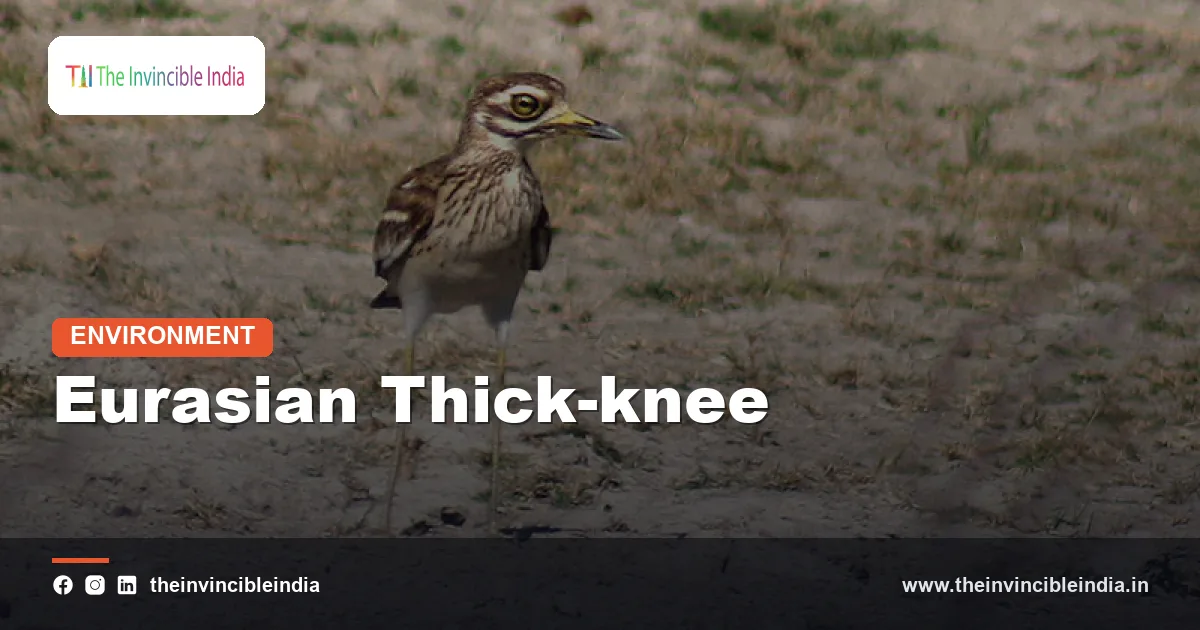
The Eurasian thick-knee (Burhinus oedicnemus), also called the stone-curlew, is a large-eyed, long-legged ground bird of dry open country that spends the day motionless on stony or fallow ground and becomes active at dusk and through the night. In India the species is widespread in scrub, dry riverbeds, wasteland and the edges of farmland, where its sandy, streaked plumage makes it almost impossible to spot until it moves.
The bird is better known by its wailing, curlew-like call than by sight. Many people in rural India have heard the eerie evening cries without ever seeing the caller. This explainer covers what the Eurasian thick-knee is, how to identify it, where it lives, what it eats, how it nests and how it differs from its relatives.
Quick Facts
| Common names | Eurasian thick-knee, Eurasian stone-curlew, stone-curlew |
|---|---|
| Scientific name | Burhinus oedicnemus |
| Family | Burhinidae (thick-knees and stone-curlews) |
| Size | Roughly 40 to 44 cm long, a little larger than a pigeon, with long legs |
| India range and habitat | Dry open country, scrub, stony wasteland, fallow fields and dry riverbeds across much of the subcontinent |
| Diet | Insects, beetles, earthworms, snails, small lizards, frogs and occasionally small rodents |
| Breeding | Two camouflaged eggs laid in a bare ground scrape; largely resident in peninsular India |
| Activity pattern | Crepuscular and nocturnal; rests by day |
| Conservation status | Least Concern on the IUCN Red List (global assessment) |
Key Takeaways
- The Eurasian thick-knee is a medium-large, ground-dwelling bird of the family Burhinidae, recognisable by its huge yellow eye and thickened, knobby-looking ankle joints.
- Eurasian thick-knees are mainly active from dusk to dawn, and their large eyes are an adaptation for seeing in low light.
- The sandy, streaked plumage of the Eurasian thick-knee is a form of camouflage, and the bird typically freezes or crouches rather than flying when approached.
- Eurasian thick-knees feed mostly on ground invertebrates such as beetles, crickets and earthworms, with the occasional lizard or small mammal.
- A Eurasian thick-knee normally lays two eggs directly on bare, stony ground without building a proper nest, and the young leave the nest soon after hatching.
- The Eurasian thick-knee is rated Least Concern globally, but it depends on undisturbed open land that is being lost to development and intensive farming.
What is the Eurasian thick-knee?
The Eurasian thick-knee is a wader-like bird that has abandoned the water’s edge for dry land, belonging to the small family Burhinidae, whose members are called thick-knees or stone-curlews. Despite the name curlew, the species is not closely related to true curlews, which belong to the sandpiper family. The resemblance lies mainly in the haunting, rising whistle that echoes over open plains after sunset.
The English name thick-knee is slightly misleading, because the thickened joint on the leg is actually the ankle, the joint between the shank and the long foot bone. This joint looks swollen against thin yellow legs and gives the bird its distinctive knobby appearance. The name stone-curlew comes from the bird’s fondness for stony ground and the curlew-like call.
Taxonomists have revised the group several times. Populations breeding across Europe, North Africa and western and central Asia belong to the Eurasian species, while birds resident in the Indian subcontinent have long been treated as a separate race. Some authorities now treat the Indian birds as a distinct species, often called the Indian stone-curlew, so field guides and checklists may use different names for what looks like the same bird. Readers comparing sources should expect this naming difference.
How can you identify a Eurasian thick-knee?
A Eurasian thick-knee can be identified by its very large pale yellow eyes, sandy-brown streaked upperparts, pale underparts and long yellow legs with thick ankle joints. The bird stands upright and looks front-heavy, with a rounded head and a short, stout bill that is yellow at the base and dark at the tip.
Key field marks
- A big, round, staring yellow eye surrounded by a pale patch, which gives the face a startled look.
- Sandy-brown plumage heavily streaked with dark brown on the back, breast and neck.
- A pale stripe above and below the eye, framed by a darker line, forming a distinct facial pattern.
- A pale wing panel formed by a pale bar on the closed wing, bordered by dark bars.
- Long yellow legs and a short tail that extends only slightly beyond the folded wings.
In flight
In flight, the Eurasian thick-knee shows long, rounded wings with a bold black-and-white pattern. Two white patches stand out on the dark flight feathers, and the legs trail behind the short tail. Flight is typically low, steady and powered by slow, deep wingbeats, and the bird often glides briefly before landing and freezing in place.
Size and posture
The bird is about as long as a pigeon, but its long legs and neck make it look taller. When alarmed, it may stretch the neck upward or, more often, crouch low with the neck drawn in so that the body merges with the ground. When it walks, it moves in short, deliberate runs with the head held low, then stops suddenly.
Where does the Eurasian thick-knee live in India?
The Eurasian thick-knee lives across a broad belt of dry, open and sparsely vegetated land in India, from the semi-arid plains of the north-west to the scrub of the Deccan and the south. It favours stony hillsides, dry riverbeds, fallow fields, thorn scrub, orchards and dry grassland with scattered bushes.
The bird avoids dense forest and waterlogged land. It also keeps away from tall, lush crops, because it needs a clear view of the ground to spot predators and prey. Short, open vegetation gives it that visibility and allows it to run quickly from danger.
Typical Indian habitats
- Dry, stony scrubland and rocky hill slopes with thorny bushes.
- Sandy or gravelly beds of seasonal rivers and streams.
- Fallow agricultural fields and field margins left uncultivated.
- Open plantations, orchards and the outskirts of villages.
- Dry grassland and wasteland on the edges of towns.
The bird is largely resident in the peninsula and northern plains, and local movements follow rain and food. Populations in cooler parts of the species’ wider range elsewhere are migratory, but in India the bird is best thought of as a settled species that stays close to its territory through the year.
Why is the Eurasian thick-knee active at night?
The Eurasian thick-knee is active mostly at night because darkness reduces the risk from predators and lets the bird hunt insects and other invertebrates that surface after sunset. Its unusually large eyes, a hallmark of the family, collect more light, which helps it see in dim conditions.
During the day the bird rests, often sitting almost invisible in the shade of a bush or on bare ground. Its plumage is designed for this: the mix of buff and brown streaks mimics dry soil, stones and withered grass. Birds that rely on camouflage rarely flee early, so a thick-knee may stay motionless until a person is only a few metres away.
At dusk, the birds begin to move, stretch and walk about. They call frequently during the hours around sunset and again before dawn, and on moonlit nights the calling may continue for long periods. The activity pattern is described as crepuscular, meaning active at twilight, and nocturnal, meaning active at night.
What does the Eurasian thick-knee eat?
The Eurasian thick-knee eats mainly ground-dwelling invertebrates, including beetles, grasshoppers, crickets, caterpillars, earthworms and snails. Larger individuals also take small lizards, frogs and young rodents when the chance arises.
The bird hunts by walking slowly or in short runs, stopping to scan, and then making a quick stab or lunge with its bill. It relies on sight rather than touch, which suits the large eyes. After rain, when earthworms and insects come to the surface, feeding becomes easier.
Why the diet matters to farmers
Because the Eurasian thick-knee consumes many beetles, grubs and crickets, it can help reduce numbers of some pests around fields and orchards. This benefit is modest and local, but it is a useful example of how ordinary wildlife supports farmland. Heavy use of insecticides, however, can reduce the insect supply and may also poison the birds directly.
| Food group | Examples |
|---|---|
| Insects | Beetles, crickets, grasshoppers, caterpillars, ants |
| Other invertebrates | Earthworms, snails, slugs, spiders, centipedes |
| Small vertebrates | Lizards, frogs, young mice and other small rodents |
How does the Eurasian thick-knee breed?
The Eurasian thick-knee breeds on the ground, laying usually two eggs in a shallow scrape that is bare, stony or lightly lined with small stones, pebbles or debris. The pair do not build a conventional nest, so the eggs lie fully exposed and depend on their colouring to avoid detection.
The eggs are buff or pale brown with darker blotches and streaks, closely matching the surroundings. Both parents incubate, taking turns on the eggs, and the incubation period is roughly three and a half weeks. In India the breeding season varies by region and usually falls in the drier months before and around the monsoon, mainly from spring into early summer.
Chicks and parental care
The chicks are precocial, meaning they hatch with open eyes and downy, camouflaged feathers and can walk within hours. They leave the scrape quickly and hide among stones and low vegetation. The parents feed and guard them while the young learn to forage. When a predator approaches, the chicks crouch and freeze, while an adult may call, run off or perform a distraction display.
Why ground nesting is risky
Ground nests face threats from trampling by livestock, tractors and people, as well as from dogs, crows, mongooses and other predators. A pair that loses a clutch can sometimes lay a replacement. This risk is why undisturbed patches of wasteland, even small ones, have real conservation value for the species.
What does the call of the Eurasian thick-knee sound like?
The call of the Eurasian thick-knee is a loud, plaintive, rising whistle that sounds like “kur-lee” and is repeated, often building into a wailing chorus. It carries across open country for a long distance, and it is the most common way people notice the bird.
Calling peaks at dusk and again before dawn, and neighbouring pairs may answer one another across fields. The call serves to mark territory, to keep contact between mates and to coordinate movements in the dark. Some observers describe it as mournful, which has led to folk associations with night and solitude in several regions.
Because the bird is so difficult to see, learning the call is one of the most efficient ways to confirm its presence in an area. Birdwatchers often listen at sunset near dry scrub or riverbeds and then scan the ground with binoculars or a torch with a dim, filtered light.
How does the Eurasian thick-knee differ from similar birds?
The Eurasian thick-knee differs from other thick-knees mainly in size, bill shape and habitat: it is smaller than the great thick-knee, has a shorter and less upturned bill, and prefers dry land rather than river and coastal shores. Several relatives share parts of India.
| Bird | Key differences |
|---|---|
| Eurasian thick-knee | Medium size, streaked sandy plumage, short yellow-based bill, dry open country |
| Great thick-knee (Esacus recurvirostris) | Larger, with a massive upturned bill, bold black-and-white face, found along rivers and coasts |
| Beach thick-knee (Esacus magnirostris) | Large, coastal, with a heavy bill and strong face pattern, found on beaches and mangrove shores |
| Indian stone-curlew | Closely similar; often treated as a separate species or a local race of the Eurasian bird |
True curlews are also different birds. They have long, downcurved bills and live on mudflats and wetlands, while thick-knees have short, straight bills and live in dry open habitats. Knowing these differences helps avoid confusion in the field.
Is the Eurasian thick-knee threatened?
The Eurasian thick-knee is not globally threatened, because the IUCN Red List classifies the species as Least Concern on account of its very wide range. Locally, however, populations can decline sharply when open habitat is lost.
The main pressures are the conversion of scrubland and wasteland to housing, industry and intensive agriculture, the use of pesticides that reduce insect food, disturbance and trampling at nest sites, and predation by free-ranging dogs. Ground-nesting makes the bird especially sensitive to human activity in the breeding season.
Ways to help
- Protect patches of uncultivated scrub and fallow land, which are often wrongly seen as unproductive.
- Avoid ploughing, burning or levelling open ground during the main breeding months where nests are known.
- Reduce unnecessary pesticide use near fields and orchards.
- Keep dogs under control in dry riverbed and wasteland habitats.
- Record sightings on citizen-science platforms to improve knowledge of distribution.
How can you watch a Eurasian thick-knee in India?
You can watch a Eurasian thick-knee by visiting dry scrub, stony wasteland or riverbeds around dusk and scanning slowly for a motionless, upright shape. Patience matters more than equipment, because the bird relies on staying still.
- Visit in the hour before sunset and listen for the wailing call.
- Scan the ground with binoculars, looking for the round yellow eye.
- Stay in a vehicle or stand still, because thick-knees often tolerate vehicles better than people on foot.
- Do not approach a bird that is crouching or a spot where it may be nesting.
- Avoid flash photography and bright spotlights at night, which can disturb and expose the birds.
Good areas include dry plains, ravines, quarry edges and unused land near villages in many states. The bird may also visit the edges of wildlife sanctuaries with open scrub. Checking local bird lists and regional guides helps narrow down reliable spots.
Bottom Line
The Eurasian thick-knee is a camouflaged, big-eyed ground bird whose evening call is far more familiar than its appearance. It remains common enough to be rated Least Concern, but its future in India depends on keeping patches of open, undisturbed dry land. Noticing and protecting such ordinary habitat is the most practical way to keep the species around.
Frequently Asked Questions
What is the Eurasian thick-knee?
The Eurasian thick-knee is a large-eyed, long-legged ground bird of the family Burhinidae, also called the stone-curlew. It lives in dry, open country, rests by day and is active at dusk and night. It is known for its sandy streaked camouflage and wailing call.
Why is it called a thick-knee?
The bird is called a thick-knee because its ankle joint looks swollen against its thin yellow legs. The thickened joint is actually the ankle, not the knee. The effect gives the legs a knobby appearance that is a key identification feature.
Is the Eurasian thick-knee nocturnal?
The Eurasian thick-knee is mainly nocturnal and crepuscular, meaning it is active at night and at twilight. It rests, often motionless, during the day. Its large yellow eyes help it see and hunt in low light.
What does the Eurasian thick-knee eat?
The Eurasian thick-knee eats mostly insects and other invertebrates, including beetles, crickets, grasshoppers, earthworms and snails. It also takes small lizards, frogs and young rodents occasionally. It hunts on foot by watching, then lunging quickly with its bill.
How many eggs does the Eurasian thick-knee lay?
The Eurasian thick-knee usually lays two eggs. They are placed in a bare scrape on stony or open ground, without a built nest. The buff, blotched eggs are camouflaged, and both parents help with incubation.
Is the Eurasian thick-knee endangered?
The Eurasian thick-knee is not endangered, since the IUCN rates the species Least Concern globally. Local populations can still fall when scrub and wasteland are converted to buildings or intensive farming. Ground nests are also vulnerable to disturbance and predators.
{“@context”:”https://schema.org”,”@graph”:[{“@type”:”FAQPage”,”mainEntity”:[{“@type”:”Question”,”name”:”What is the Eurasian thick-knee?”,”acceptedAnswer”:{“@type”:”Answer”,”text”:”The Eurasian thick-knee is a large-eyed, long-legged ground bird of the family Burhinidae, also called the stone-curlew. It lives in dry, open country, rests by day and is active at dusk and night. It is known for its sandy streaked camouflage and wailing call.”}},{“@type”:”Question”,”name”:”Why is it called a thick-knee?”,”acceptedAnswer”:{“@type”:”Answer”,”text”:”The bird is called a thick-knee because its ankle joint looks swollen against its thin yellow legs. The thickened joint is actually the ankle, not the knee. The effect gives the legs a knobby appearance that is a key identification feature.”}},{“@type”:”Question”,”name”:”Is the Eurasian thick-knee nocturnal?”,”acceptedAnswer”:{“@type”:”Answer”,”text”:”The Eurasian thick-knee is mainly nocturnal and crepuscular, meaning it is active at night and at twilight. It rests, often motionless, during the day. Its large yellow eyes help it see and hunt in low light.”}},{“@type”:”Question”,”name”:”What does the Eurasian thick-knee eat?”,”acceptedAnswer”:{“@type”:”Answer”,”text”:”The Eurasian thick-knee eats mostly insects and other invertebrates, including beetles, crickets, grasshoppers, earthworms and snails. It also takes small lizards, frogs and young rodents occasionally. It hunts on foot by watching, then lunging quickly with its bill.”}},{“@type”:”Question”,”name”:”How many eggs does the Eurasian thick-knee lay?”,”acceptedAnswer”:{“@type”:”Answer”,”text”:”The Eurasian thick-knee usually lays two eggs. They are placed in a bare scrape on stony or open ground, without a built nest. The buff, blotched eggs are camouflaged, and both parents help with incubation.”}},{“@type”:”Question”,”name”:”Is the Eurasian thick-knee endangered?”,”acceptedAnswer”:{“@type”:”Answer”,”text”:”The Eurasian thick-knee is not endangered, since the IUCN rates the species Least Concern globally. Local populations can still fall when scrub and wasteland are converted to buildings or intensive farming. Ground nests are also vulnerable to disturbance and predators.”}}]}]}


