

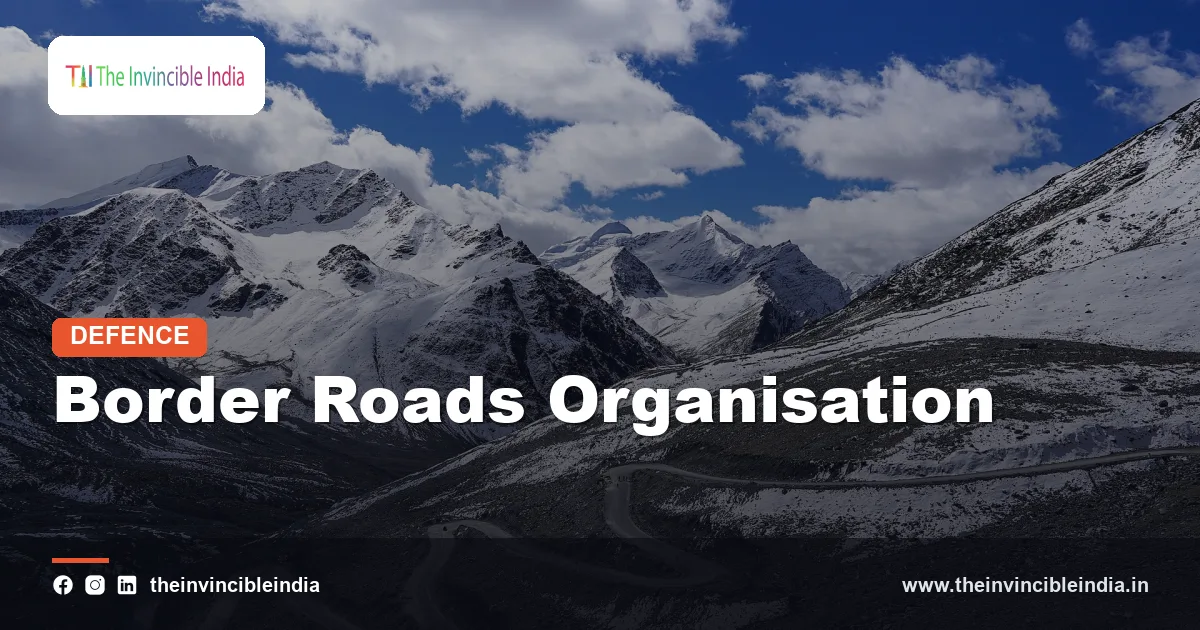
The Border Roads Organisation (BRO) is the Indian government agency, established on 7 May 1960 and functioning under the Ministry of Defence, that builds and maintains roads, bridges, tunnels and airfields in India’s border and remote regions and in friendly neighbouring countries. The Border Roads Organisation (BRO) is staffed by a mix of civilian engineers, uniformed Army Engineers and a force of workers known as the General Reserve Engineer Force (GREF), and it serves both the Indian armed forces and ordinary citizens in some of the most difficult terrain on Earth.
This explainer covers how the Border Roads Organisation was created, how it is organised into named “Projects”, which record-setting roads and tunnels it has built, including the Atal Tunnel and the Sela Tunnel, and why its dual civil-military role carries strategic weight. It uses only widely documented public facts and was last reviewed on 15 October 2026.
Quick Facts: Border Roads Organisation (BRO)
| Attribute | Detail |
|---|---|
| Established | 7 May 1960 |
| Parent ministry | Ministry of Defence (fully so since 2015; earlier funded through the road transport ministry) |
| Head | Director General Border Roads (DGBR), a Lieutenant General-rank post |
| Headquarters | New Delhi |
| Workforce | Border Roads Engineering Service, General Reserve Engineer Force (GREF), and Army Engineers on deputation |
| Structure | Regional “Projects” (such as Beacon, Himank, Vartak, Sampark and Deepak) led by Chief Engineers |
| Foreign work | Project Dantak in Bhutan, and roads in Afghanistan and Myanmar under Indian assistance programmes |
| Notable works | Atal Tunnel (Rohtang), Sela Tunnel (Arunachal Pradesh), Umling La road (Ladakh), Darbuk-Shyok-Daulat Beg Oldi road |
Key Takeaways
- The Border Roads Organisation (BRO) was founded on 7 May 1960 to build strategic roads in India’s border regions.
- The Border Roads Organisation is headed by the Director General Border Roads, a Lieutenant General, and operates under the Ministry of Defence.
- The Border Roads Organisation works through regional Projects, such as Beacon, Himank, Vartak, Sampark and Deepak, each commanded by a Chief Engineer.
- The Border Roads Organisation built the 9-km-long Atal Tunnel under the Rohtang Pass, opened in October 2020, and the Sela Tunnel in Arunachal Pradesh, inaugurated in March 2024.
- The Border Roads Organisation received a Guinness World Record in 2021 for the highest motorable road at Umling La in Ladakh.
- The Border Roads Organisation serves a dual role, supporting military movement along the frontier while connecting remote villages to schools, hospitals and markets.
What is the Border Roads Organisation?
The Border Roads Organisation is a road-construction and maintenance agency of the Government of India that operates in the mountainous, forested, desert and snow-bound frontier regions where ordinary contractors rarely work. Its core task is to give the armed forces all-weather access to the borders, and its secondary task is to open up remote communities to roads, bridges and, increasingly, tunnels and airfields.
The organisation is not a branch of the armed forces in the usual sense, yet it has a strongly military character. Its senior officers include engineers of the Army and of the Border Roads Engineering Service, and its labour force, the GREF, is described in public accounts as an integral part of the armed forces for the purposes of Article 33 of the Constitution, which allows Parliament to modify the application of fundamental rights to members of the forces.
In everyday language, the BRO is best understood as India’s frontier infrastructure builder, and as a mix of a public works department and a military engineering unit.
When and why was the Border Roads Organisation created?
The Border Roads Organisation was created on 7 May 1960 on the initiative of Prime Minister Jawaharlal Nehru, in the years when India’s lack of roads in the Himalayan borderlands was seen as a major strategic weakness. Before 1960, many border posts in the Himalaya and in the Northeast could be reached only by mule tracks or on foot, which made supply, reinforcement and development extremely slow.
The new body was governed by a Border Roads Development Board, which set priorities and funding for strategic roads, and an executive organisation, the BRO, which carried out the work. The earliest projects were raised in 1960, and public histories name Project Beacon in Jammu and Kashmir and Project Vartak in the Northeast among the first.
The need for such an organisation became sharper after the 1962 India-China war, which exposed the difficulty of moving troops and supplies to high-altitude frontier posts. Over the following decades the BRO expanded to cover the western desert, the Himalayan arc, the Northeast, and the Andaman and Nicobar Islands.
In 2015 the BRO was brought fully under the Ministry of Defence. Until then, much of its funding had come through the Ministry of Road Transport and Highways, so the change aligned the organisation more closely with defence planning.
Who runs the Border Roads Organisation?
The Border Roads Organisation is run by the Director General Border Roads (DGBR), an officer of Lieutenant General rank, who reports to the Ministry of Defence and works under the overall guidance of the Border Roads Development Board. The Board is the policy-level body that oversees the organisation’s programme.
Below the DGBR, the BRO is organised in a hierarchy that mirrors both civil engineering and the Army:
- Directorate General Border Roads (DGBR): The headquarters in New Delhi, which plans, allocates resources and monitors progress.
- Projects: Regional formations, each led by a Chief Engineer, responsible for a defined geographic area.
- Task Forces and Road Construction Companies: Field units that carry out road building, bridge construction and maintenance.
- Personnel streams: Officers of the Border Roads Engineering Service (BRES), officers and soldiers of the Army Engineers on deputation, and GREF personnel.
The General Reserve Engineer Force was raised to provide a disciplined, mobile labour force that could work under harsh and sometimes hostile conditions. Its personnel serve under a code of discipline similar to that of the armed forces.
What are the BRO “Projects” such as Himank and Vartak?
A BRO “Project” is a regional unit of the Border Roads Organisation that is responsible for all road-related work in a specified territory, and each Project has a distinctive name chosen to reflect its region or mission. Projects are commanded by Chief Engineers, and many have been split or renamed as workloads grew.
Selected BRO Projects and their areas
| Project | Region or role |
|---|---|
| Beacon | Jammu and Kashmir, including the Kashmir valley and approaches to Ladakh; one of the oldest Projects |
| Himank | Ladakh, especially the Leh region and high-altitude passes; formed from the original Beacon area |
| Sampark | Jammu and Kashmir, centred on Jammu |
| Vijayak | Ladakh, with responsibility for strategic roads in the Leh area |
| Vartak | Arunachal Pradesh and the eastern Himalaya; one of the earliest Projects |
| Arunank | Arunachal Pradesh |
| Brahmank | Arunachal Pradesh |
| Udayak | Northeast India |
| Sewak | Northeast India, including Nagaland |
| Pushpak | Mizoram, Assam and Manipur |
| Swastik | Sikkim |
| Deepak | Himachal Pradesh and adjoining mountain areas |
| Shivalik | Uttarakhand and the border with Nepal and Tibet |
| Chetak | Rajasthan, in the Thar desert |
| Yojak | High-altitude tunnels and the Manali-Ladakh axis, including maintenance of the Atal Tunnel |
| Dantak | Bhutan, working with the Royal Government of Bhutan |
The list shows how the BRO’s work is divided by geography. Himank and Beacon handle some of the highest-altitude roads, Vartak and its offshoots cover the eastern Himalaya, and Chetak deals with the sand and heat of the western border.
What are the BRO’s record-altitude roads?
The Border Roads Organisation has built some of the highest motorable roads in the world, with the Umling La road in eastern Ladakh recognised by Guinness World Records in November 2021 as the highest motorable road, at an altitude of around 19,000 feet. The road connects Chisumle and Demchok in the Hanle region and passes through terrain where oxygen levels are about half those at sea level.
Other prominent BRO road achievements include:
- Leh-Manali Highway: The road crosses several passes above 16,000 feet and is maintained each year by clearing snow after the winter closure.
- Khardung La road: This road, near Leh, is among the highest motorable passes in the world, at more than 17,000 feet.
- Darbuk-Shyok-Daulat Beg Oldi (DS-DBO) road: A road of over 250 km that runs along the Shyok river towards the Karakoram Pass and links the Indian Army’s northernmost posts in Ladakh.
- Lipulekh link road: A road in Uttarakhand that shortens the route to the Kailash Mansarovar pilgrimage, which the BRO built and which was inaugurated in 2020.
Building such roads requires special methods. Crews work in a short summer season, face avalanches, landslides and thin air, and often rely on explosives, heavy machinery airlifted in parts, and prefabricated Bailey bridges that can be assembled quickly.
What is the Atal Tunnel and why is it important?
The Atal Tunnel is a roughly 9-kilometre road tunnel under the Rohtang Pass in Himachal Pradesh, built by the Border Roads Organisation and opened on 3 October 2020, that provides all-weather road access between Manali and the Lahaul-Spiti valley. It is named after former Prime Minister Atal Bihari Vajpayee, who announced the project in 2000.
Before the tunnel opened, the Rohtang Pass route was blocked by heavy snow for around six months of the year, which isolated Lahaul and Spiti and the roads leading further on to Ladakh. The tunnel shortened the journey between Manali and Keylong by several hours and removed the dependence on the pass in winter.
The key features of the tunnel include:
- Altitude: It lies at about 10,000 feet, and is frequently described as the longest highway tunnel in the world at that altitude.
- Design: A single main tube with a parallel escape tunnel, ventilation, fire-safety systems and emergency exits at regular intervals.
- Strategic value: Troops and supplies can move to Ladakh and Lahaul-Spiti throughout the year, which improves the resilience of the supply route to the northern border.
- Maintenance: Public accounts note that BRO’s Project Yojak maintains the tunnel.
What is the Sela Tunnel?
The Sela Tunnel is a pair of tunnels with connecting road under the Sela Pass in West Kameng district of Arunachal Pradesh, built by the Border Roads Organisation at an altitude of around 13,000 feet and inaugurated on 9 March 2024. The project ensures all-weather road connectivity to the Tawang sector, which is of high strategic importance because it lies close to the border with China.
The Sela Pass, at around 13,700 feet, usually receives heavy snowfall and is prone to landslides, and the older road over it was frequently closed. The tunnels bypass the pass and cut travel time on the route from Guwahati and Tezpur to Tawang.
The Sela Tunnel forms part of the NH 13 corridor and is one of several tunnelling projects the BRO has taken up along the frontier, together with ones such as the Shinku La and Zojila tunnels in the western Himalaya, which were under construction at the time of writing. Their timelines can change, so readers should check official announcements for current status.
What does the BRO do besides roads?
The BRO builds more than roads: its portfolio includes bridges, tunnels, airfields and helipads, buildings and, in emergencies, disaster-relief works. Its Bailey bridges and permanent bridges in the mountains allow crossing of rivers that would otherwise cut off whole valleys.
The organisation’s wider tasks include:
- Airfields and helipads: The BRO has built and upgraded airstrips and advanced landing grounds in border areas, including in Ladakh.
- Snow clearance: Every year BRO teams reopen high passes after winter by clearing metres of snow.
- Disaster response: After floods, cloudbursts and landslides, such as the 2013 Uttarakhand floods, the BRO restores road links so that rescue and relief can reach affected areas.
- Foreign projects: The BRO has built roads abroad as part of Indian assistance programmes, with Project Dantak in Bhutan, which has operated since the early 1960s, as the best-known example.
How does the BRO serve both military and civilian needs?
The Border Roads Organisation serves a dual role because the roads it builds carry military convoys and civilian traffic alike, so a single road strengthens both national security and local development. Roads to remote villages in Ladakh, Arunachal Pradesh, Sikkim and Uttarakhand bring ambulances, school buses, tourism and trade, while the same roads allow the Army to rotate troops and carry supplies.
The strategic logic is straightforward. A border post without a road must be supplied by air or by porters, which is costly and dependent on the weather. A road reduces that dependence, speeds reinforcement and enables heavy equipment to be moved.
Civil benefits are equally concrete. Roads reduce isolation, make emergency medical evacuation feasible and encourage people to remain in border villages, which is itself regarded as a strategic benefit by planners. The Vibrant Villages Programme of the government, for example, treats frontier-village infrastructure as a security and development priority.
Military and civil benefits compared
| Area | Military benefit | Civil benefit |
|---|---|---|
| Roads | Faster troop and supply movement | Access to markets, schools and health care |
| Tunnels | All-weather supply lines | Year-round connectivity, shorter journeys |
| Bridges | Heavy vehicle and equipment crossing | Links across rivers and gorges |
| Airfields | Air landing and airlift capability | Emergency evacuation, regional connectivity |
| Snow clearance | Reopened passes for convoys | Seasonal reopening for travellers and trade |
What challenges does the BRO face?
The Border Roads Organisation faces challenges of terrain, climate, logistics and workforce, and these shape the pace of its projects. Public discussion has long noted that frontier roads are costly and time-consuming to build, and that cost and delays rise with altitude.
The main challenges include:
- Short working season: In many areas, construction is possible only for a few months each year.
- Geology and weather: Fragile mountains, avalanches, landslides and flash floods can undo work within a single season.
- Environmental concerns: Road and tunnel building in the Himalaya raises debates about slope stability, forests and water sources, and projects require environmental and forest clearances.
- Logistics and labour: Moving machinery and materials over long, thin supply lines and retaining workers in remote locations is difficult.
The BRO has responded by adopting modern construction methods, including the New Austrian Tunnelling Method for tunnels, geosynthetics and more machinery, along with bigger budgets and a greater role for private contractors in some works.
Bottom Line
The Border Roads Organisation, set up in 1960, is India’s primary builder of frontier infrastructure and works through regional Projects such as Himank, Vartak, Beacon and Dantak. Landmarks such as the Atal Tunnel, the Sela Tunnel and the Umling La road illustrate its dual role of strengthening national security while connecting remote communities.
Frequently Asked Questions
What is the Border Roads Organisation (BRO)?
The Border Roads Organisation is an Indian government agency, formed on 7 May 1960, that builds and maintains roads, bridges, tunnels and airfields in border and remote regions. It operates under the Ministry of Defence. It is staffed by engineers, Army Engineers and the General Reserve Engineer Force.
Who heads the Border Roads Organisation?
The Director General Border Roads (DGBR), an officer of Lieutenant General rank, heads the Border Roads Organisation. The DGBR reports to the Ministry of Defence. The organisation is also overseen by the Border Roads Development Board.
Which major tunnels has the BRO built?
The Border Roads Organisation built the Atal Tunnel under the Rohtang Pass, opened in October 2020, and the Sela Tunnel in Arunachal Pradesh, inaugurated in March 2024. Both give all-weather access to strategic border regions. The BRO is also associated with other tunnel projects in the western Himalaya.
What is the highest road built by the BRO?
The Umling La road in eastern Ladakh is the highest motorable road built by the Border Roads Organisation, and it was recognised by Guinness World Records in 2021. It stands at an altitude of around 19,000 feet. The road runs between Chisumle and Demchok.
What do names like Himank and Vartak mean in the BRO?
Himank and Vartak are names of BRO Projects, which are regional units responsible for roads in a defined area. Himank works in Ladakh, while Vartak works in Arunachal Pradesh and the eastern Himalaya. Each Project is led by a Chief Engineer.
Is the BRO part of the Army?
The Border Roads Organisation is not part of the Army, but it operates under the Ministry of Defence and has a strongly military character. Its staff include officers of the Army Engineers on deputation, civilian engineers and the General Reserve Engineer Force. It builds roads that serve both military and civilian users.
{“@context”:”https://schema.org”,”@graph”:[{“@type”:”FAQPage”,”mainEntity”:[{“@type”:”Question”,”name”:”What is the Border Roads Organisation (BRO)?”,”acceptedAnswer”:{“@type”:”Answer”,”text”:”The Border Roads Organisation is an Indian government agency, formed on 7 May 1960, that builds and maintains roads, bridges, tunnels and airfields in border and remote regions. It operates under the Ministry of Defence. It is staffed by engineers, Army Engineers and the General Reserve Engineer Force.”}},{“@type”:”Question”,”name”:”Who heads the Border Roads Organisation?”,”acceptedAnswer”:{“@type”:”Answer”,”text”:”The Director General Border Roads (DGBR), an officer of Lieutenant General rank, heads the Border Roads Organisation. The DGBR reports to the Ministry of Defence. The organisation is also overseen by the Border Roads Development Board.”}},{“@type”:”Question”,”name”:”Which major tunnels has the BRO built?”,”acceptedAnswer”:{“@type”:”Answer”,”text”:”The Border Roads Organisation built the Atal Tunnel under the Rohtang Pass, opened in October 2020, and the Sela Tunnel in Arunachal Pradesh, inaugurated in March 2024. Both give all-weather access to strategic border regions. The BRO is also associated with other tunnel projects in the western Himalaya.”}},{“@type”:”Question”,”name”:”What is the highest road built by the BRO?”,”acceptedAnswer”:{“@type”:”Answer”,”text”:”The Umling La road in eastern Ladakh is the highest motorable road built by the Border Roads Organisation, and it was recognised by Guinness World Records in 2021. It stands at an altitude of around 19,000 feet. The road runs between Chisumle and Demchok.”}},{“@type”:”Question”,”name”:”What do names like Himank and Vartak mean in the BRO?”,”acceptedAnswer”:{“@type”:”Answer”,”text”:”Himank and Vartak are names of BRO Projects, which are regional units responsible for roads in a defined area. Himank works in Ladakh, while Vartak works in Arunachal Pradesh and the eastern Himalaya. Each Project is led by a Chief Engineer.”}},{“@type”:”Question”,”name”:”Is the BRO part of the Army?”,”acceptedAnswer”:{“@type”:”Answer”,”text”:”The Border Roads Organisation is not part of the Army, but it operates under the Ministry of Defence and has a strongly military character. Its staff include officers of the Army Engineers on deputation, civilian engineers and the General Reserve Engineer Force. It builds roads that serve both military and civilian users.”}}]}]}


