

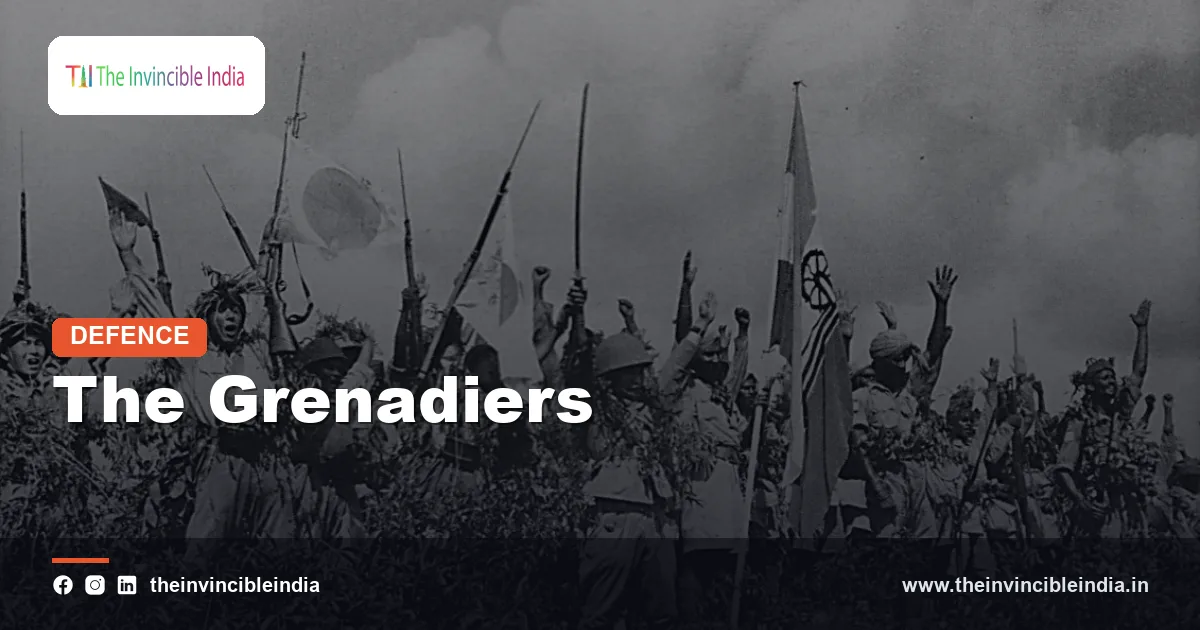
The Grenadiers is a decorated infantry regiment of the Indian Army, headquartered at its Regimental Centre in Jabalpur, Madhya Pradesh, whose oldest battalion traces its origins to the Bombay Army of the East India Company in the late 1770s. The Grenadiers Regiment draws its name from the elite grenadier companies of eighteenth-century armies, carries the motto and war cry “Sarvada Shaktishali” (Ever Powerful), and counts three Param Vir Chakra recipients among its soldiers.
This explainer sets out how the regiment was formed, how it is organised, what its traditions mean, and which actions built its gallantry record, including the 1999 capture of Tiger Hill in the Kargil conflict. It relies only on widely documented, public facts and was last reviewed on 15 October 2026.
Quick Facts: The Grenadiers Regiment
| Attribute | Detail |
|---|---|
| Full name | The Grenadiers (commonly called the Grenadiers Regiment) |
| Branch | Infantry, Indian Army |
| Origin | Bombay Army of the East India Company; the permanent grenadier battalion is dated to 1779 (1778 is also cited) |
| Renamings | 4th Bombay Grenadiers (1922); Indian Grenadiers (1945); The Grenadiers (after the Second World War) |
| Regimental Centre | Jabalpur, Madhya Pradesh |
| Motto and war cry | “Sarvada Shaktishali” (Ever Powerful) |
| Composition | Mixed-class regiment drawing on several communities |
| Param Vir Chakra recipients | Three: Abdul Hamid (1965), Hoshiar Singh (1971), Yogendra Singh Yadav (1999) |
| Nickname | “The Grinders” |
Key Takeaways
- The Grenadiers Regiment is an infantry regiment of the Indian Army with its Regimental Centre at Jabalpur, Madhya Pradesh.
- The Grenadiers Regiment descends from the grenadier battalion of the East India Company’s Bombay Army, formed in the late 1770s.
- The Grenadiers Regiment has three Param Vir Chakra recipients: Company Havildar Major Abdul Hamid, Major Hoshiar Singh and Grenadier Yogendra Singh Yadav.
- Grenadier Yogendra Singh Yadav of the 18th Battalion, The Grenadiers, received the Param Vir Chakra for the Tiger Hill assault in July 1999 and is widely cited as the youngest recipient of India’s highest gallantry award.
- The regimental motto and war cry “Sarvada Shaktishali” means “Ever Powerful”.
- The Grenadiers earned post-Independence battle honours including Gurais (1948), Asal Uttar (1965), Jarpal (1971) and Tololing and Tiger Hill (1999).
What is the Grenadiers Regiment?
The Grenadiers Regiment is a line infantry regiment of the Indian Army, formed from the grenadier battalion tradition of the old Bombay Army and now organised as a numbered set of battalions that serve across India’s operational theatres. Like other Indian infantry regiments, the Grenadiers is not a single fighting formation. It is an administrative and traditional “family” of battalions that share a name, a training and records centre, a cap badge, a history and a code of customs, while each battalion is deployed independently under brigades and divisions.
Public accounts describe the regiment as having more than twenty regular battalions, together with battalions that serve in the Rashtriya Rifles counter-insurgency force and the Territorial Army. Figures differ slightly between sources, because battalions are periodically raised, converted or re-designated, so the exact count is best treated as approximate.
The regiment’s identity rests on three pillars: a long lineage that predates the Indian Army itself, a mixed-class recruiting base, and a high-profile record of gallantry awards in the wars fought since 1947.
Where does the name “Grenadier” come from?
The word “grenadier” comes from the grenade, and it originally described the strongest soldiers in a European infantry unit, selected to hurl hand grenades at enemy positions in the seventeenth and eighteenth centuries. A grenadier company was an elite company within a battalion, made up of tall, physically powerful soldiers who were sent to the most difficult points of an assault.
By the eighteenth century, grenadier companies had become a mark of status in many European armies, and the title spread to the armies of the East India Company. When the Company raised sepoy battalions in its Bombay Presidency, it also formed grenadier units, because the Company’s armies followed the tactical fashions of European warfare.
Hand grenades eventually became less central to infantry tactics, yet the name stuck. The Grenadiers Regiment keeps the title as a statement of heritage, and the flaming grenade remains the visual symbol associated with the regiment.
When and how was the Grenadiers Regiment raised?
The Grenadiers Regiment traces its beginnings to the Bombay Army of the East India Company, with the permanent grenadier battalion dated to 1779, although 1778 is also cited in some references. The early battalion served as part of the Company’s Bombay sepoy forces, which fought in the wars that shaped western and southern India in the late eighteenth and early nineteenth centuries.
Over the nineteenth century, the Bombay Army was reorganised several times, and its infantry battalions were renumbered more than once. In the large reforms that followed the First World War, the Indian infantry was grouped into regiments with a single regimental centre. On 1 March 1922 the grouping that included the grenadier battalions was constituted as the 4th Bombay Grenadiers.
In October 1945 the regiment lost its numerical prefix and became the Indian Grenadiers. After the Second World War, the title was shortened to The Grenadiers, which is the name it carries today.
Timeline of the regiment’s name and status
| Period | Designation or event |
|---|---|
| Late 1770s | Grenadier battalion raised in the Bombay Army of the East India Company |
| 19th century | Repeated reorganisation and renumbering of Bombay Army infantry battalions |
| 1 March 1922 | Constituted as the 4th Bombay Grenadiers |
| October 1945 | Renamed Indian Grenadiers |
| After the Second World War | Renamed The Grenadiers |
| 1948 onwards | Post-Independence battle honours begin with Gurais |
What does “Sarvada Shaktishali” mean?
“Sarvada Shaktishali” is a Sanskrit-derived phrase meaning “Ever Powerful” or “Always Powerful”, and it serves as the motto and war cry of the Grenadiers Regiment. The words combine “sarvada”, meaning always, with “shaktishali”, meaning powerful or full of strength.
A war cry in the Indian Army is shouted by soldiers before and during an assault, and it plays several roles. It builds cohesion within a battalion, it signals identity on the battlefield, and it links serving soldiers to the regiment’s earlier generations. Many Indian infantry regiments have their own distinct cries, and the Grenadiers cry is intended to express physical and moral strength.
The motto also reflects the original grenadier idea, in which the strongest and most reliable soldiers were chosen for the most demanding tasks. The regiment’s informal nickname, “The Grinders”, draws on a similar picture of persistence under pressure.
Where is the Grenadiers Regimental Centre and what does it do?
The Grenadiers Regimental Centre is located at Jabalpur in Madhya Pradesh, and it is the home of the regiment’s recruit training, records and administration. Every infantry regiment in the Indian Army has such a centre, where new recruits receive their basic military training before joining a battalion.
The centre performs several functions for the regiment:
- Recruit training: Soldiers enrolled for the regiment undergo basic infantry training at the centre, including weapons handling, fieldcraft, physical conditioning and drill.
- Records and welfare: The centre maintains service records and supports ex-servicemen and the families of serving and fallen soldiers.
- Tradition and ceremonial: The centre preserves the regiment’s colours, memorials and museum material, and hosts regimental ceremonies, including those that mark Param Vir Chakra recipients.
- Reinforcement: Trained soldiers move from the centre to the regiment’s battalions as vacancies arise.
The head of the regiment’s traditions is the Colonel of the Regiment, a senior serving or retired officer of the Grenadiers who guides regimental policy and customs.
Who are the Grenadiers recruited from?
The Grenadiers Regiment is a mixed-class regiment, meaning that its battalions are composed of soldiers drawn from several communities rather than from a single one. Historical records show that in the 1920s the regiment drew on groups such as Rajputana Muslims, Jats, Marathas, Mers and Merats, and that in 1946 the composition was reorganised around Jats and Hindustani Muslims.
In the post-Independence period, the regiment’s recruitment base has been described as including Rajputs, Kaimkhanis, Hindustani Muslims, Dogras, Gujjars, Ahirs, Meenas, Gujaratis and Jats. These details are drawn from public regimental histories, and the exact mix within any battalion can vary.
The regiment’s composition is a result of the postwar reorganisation of the Indian Army and of the partition of 1947, which changed which communities were available to which regiments. The mixed composition is one reason the regiment describes itself as a unit that is bound together by regimental identity rather than by a single regional or caste background.
What is the gallantry record of the Grenadiers Regiment?
The Grenadiers Regiment holds three Param Vir Chakras, India’s highest wartime gallantry award, along with a large number of Maha Vir Chakras, Vir Chakras, Kirti Chakras, Shaurya Chakras and Sena Medals earned across several conflicts. The three Param Vir Chakra recipients come from three different wars, which is often cited as evidence of the regiment’s consistent performance across decades.
Param Vir Chakra recipients of the Grenadiers
| Recipient | Unit | Conflict | Action |
|---|---|---|---|
| Company Havildar Major (CQMH) Abdul Hamid | 4th Battalion, The Grenadiers | 1965 Indo-Pakistani War | Battle of Asal Uttar, Khem Karan sector, September 1965 |
| Major Hoshiar Singh | 3rd Battalion, The Grenadiers | 1971 Indo-Pakistani War | Basantar and Jarpal area, Shakargarh sector, December 1971 |
| Grenadier Yogendra Singh Yadav | 18th Battalion, The Grenadiers | 1999 Kargil conflict | Tiger Hill assault, July 1999 |
Abdul Hamid and Asal Uttar, 1965
Company Havildar Major Abdul Hamid received the Param Vir Chakra for destroying enemy tanks near Chima village during the Battle of Asal Uttar on 10 September 1965. Operating a recoilless gun mounted on a jeep, he used the cover of the sugarcane fields to engage Pakistani armour and is credited with knocking out several tanks before he was killed. The battle, fought near Khem Karan in Punjab, is remembered as one of the largest tank battles of the war and is often called the “Patton graveyard” because of the American-made tanks that were destroyed.
Hoshiar Singh and Jarpal, 1971
Major Hoshiar Singh was awarded the Param Vir Chakra for leading his company in the Shakargarh sector in December 1971, where the fighting concentrated around the River Basantar and the village of Jarpal. He continued to command and to inspire his men even after being wounded, and his company held ground against repeated counter-attacks. The regiment’s battle honours of Jarpal and Chakra date from this phase of the 1971 war.
Yogendra Singh Yadav and Tiger Hill, 1999
Grenadier Yogendra Singh Yadav received the Param Vir Chakra for his role in the capture of Tiger Hill during the Kargil conflict in the first week of July 1999. He was part of a “Ghatak” commando platoon of the 18th Battalion, The Grenadiers, that climbed a near-vertical cliff face at night to reach the enemy positions. Though badly wounded, he continued to fight and helped silence enemy bunkers, which allowed the assault to succeed. He was only 19 years old and is widely described as the youngest soldier to have received the Param Vir Chakra.
How did the Grenadiers capture Tiger Hill in the Kargil conflict?
The 18th Battalion, The Grenadiers, played the leading role in the recapture of Tololing and then Tiger Hill during the Kargil conflict, using night climbing, artillery support and close assault to remove Pakistani positions on the heights above the Srinagar-Leh highway. The two features overlook National Highway 1A near Dras, which was the main supply line to Ladakh, so their recapture was strategically important.
The Tololing action in June 1999 is often cited as the first major success of the Indian Army’s counter-offensive in the Dras sector. The 18th Grenadiers, together with other units, fought a long, bitter battle for the peak and its surrounding points. Tiger Hill, rising to over 16,000 feet, followed in early July.
Several features of the Tiger Hill operation stand out in public accounts:
- The approach: The assault parties climbed a steep, ice-covered face at night because the more obvious routes were covered by enemy observation and fire.
- Artillery support: Indian artillery, including the Bofors field guns, fired in support of the infantry climb.
- The assault: Small groups, including the Ghatak platoon, closed in on enemy bunkers in close combat.
- Recognition: The regiment earned the battle honours “Tololing” and “Tiger Hill”, and individual awards for gallantry, including the Param Vir Chakra for Yogendra Singh Yadav.
The Tiger Hill action is now one of the most widely remembered episodes of the Kargil conflict, and it is regularly commemorated on Kargil Vijay Diwas, observed each year on 26 July.
What battle honours has the Grenadiers Regiment earned?
The Grenadiers Regiment carries a long list of battle honours that run from the early campaigns of the East India Company to the Kargil conflict of 1999. Pre-Independence honours include Mangalore, Kohima and Megiddo, while the post-Independence honours were earned in India’s wars after 1947.
Post-Independence battle honours
| Battle honour | Year | Context |
|---|---|---|
| Gurais | 1948 | Jammu and Kashmir operations after the 1947 tribal invasion |
| Asal Uttar | 1965 | Defence against Pakistani armoured thrust near Khem Karan |
| Jarpal | 1971 | Shakargarh sector, Indo-Pakistani War |
| Chakra | 1971 | Shakargarh sector, Indo-Pakistani War |
| Tololing and Tiger Hill | 1999 | Kargil conflict, Dras sector |
Battle honours are awarded to a regiment or battalion for an engagement in which it distinguished itself, and they are inscribed on the unit’s colours. The Grenadiers’ pre-Independence honours reflect service in the Anglo-Mysore wars, in the world wars and in campaigns in West Asia and Burma. Kohima, in Nagaland, relates to the Second World War defence against the Japanese advance in 1944.
What traditions and customs does the Grenadiers Regiment follow?
The Grenadiers Regiment follows the customs common to Indian infantry regiments, including a regimental flag and colours, an annual Regimental Day, a regimental march and a code of conduct that emphasises naam, namak aur nishan (name, salt and standard), the Indian Army’s traditional ideals of honour, loyalty and identity. Regimental traditions are passed from generation to generation, and they often involve families in which fathers, sons and grandsons serve in the same unit.
Key traditional elements include:
- The cap badge: A grenade with flames, the classic symbol of grenadier units worldwide.
- Colours: Battalions carry the President’s Colours and Regimental Colours, which bear the battle honours.
- Memorials and museum: The regimental centre keeps records and displays of the Param Vir Chakra recipients and other decorated soldiers.
- Reunions and welfare: Serving and retired Grenadiers keep in touch through regimental associations and reunions.
The Indian Army places high emphasis on regimental spirit because small units in battle depend on trust, shared identity and the willingness to take risks for comrades. The Grenadiers’ traditions are meant to strengthen exactly that bond.
How does the Grenadiers Regiment fit into the Indian Army?
The Grenadiers Regiment sits within the Infantry arm of the Indian Army, which is the largest combat arm, and its battalions are placed under the operational control of brigades, divisions and corps rather than under the regimental centre. A battalion of the Grenadiers may serve alongside battalions of other regiments, such as the Rajput Regiment, the Jat Regiment or the Dogra Regiment, in the same brigade.
Grenadier battalions have served in a range of roles, including conventional operations in the plains and in the mountains, counter-insurgency in Jammu and Kashmir and the Northeast, and United Nations peacekeeping missions. Battalions within the Rashtriya Rifles, which was raised in the 1990s for counter-terrorism in Jammu and Kashmir, are manned by soldiers drawn from various infantry regiments, including the Grenadiers.
The regiment’s soldiers, like all Indian infantrymen, are trained in combat arms skills, high-altitude operation and mechanised warfare. Some Grenadier battalions have been converted to the mechanised infantry role, but exact assignments are adjusted by the Army and are not fixed.
Why does the Grenadiers Regiment matter?
The Grenadiers Regiment matters because it combines one of the longest unit lineages in the Indian Army with an exceptional gallantry record and an illustration of how a mixed-class regiment can build a shared identity. The regiment’s three Param Vir Chakras span three different wars, and the Tiger Hill action in 1999 remains one of the best-known operations of modern Indian military history.
The regiment also offers a window into how the Indian Army evolved from the armies of the East India Company, through the British Indian Army, into the national force of independent India. Names, customs and battle honours carry that story forward in an unbroken line.
Bottom Line
The Grenadiers Regiment is one of the Indian Army’s most decorated infantry regiments, rooted in the Bombay Army of the late 1770s and based at Jabalpur. Its motto “Sarvada Shaktishali”, its three Param Vir Chakras and its role in the 1999 Tiger Hill action together define its public identity.
Frequently Asked Questions
What is the Grenadiers Regiment?
The Grenadiers Regiment is an infantry regiment of the Indian Army with its Regimental Centre at Jabalpur, Madhya Pradesh. It descends from the grenadier battalion of the East India Company’s Bombay Army, formed in the late 1770s. The regiment is administratively a family of battalions that serve under different brigades and divisions.
What is the war cry of the Grenadiers Regiment?
The war cry and motto of the Grenadiers Regiment is “Sarvada Shaktishali”, which means “Ever Powerful”. The phrase combines the words for “always” and “powerful”. It expresses the regiment’s identity as a force built on strength and reliability.
How many Param Vir Chakras has the Grenadiers Regiment won?
The Grenadiers Regiment has won three Param Vir Chakras. They were awarded to Company Havildar Major Abdul Hamid for the 1965 war, to Major Hoshiar Singh for the 1971 war and to Grenadier Yogendra Singh Yadav for the 1999 Kargil conflict. The three awards come from three different wars.
What did the Grenadiers do at Tiger Hill in 1999?
The 18th Battalion, The Grenadiers, led the assault that recaptured Tiger Hill from Pakistani positions in early July 1999 during the Kargil conflict. Soldiers, including a Ghatak commando platoon, climbed a steep cliff at night and fought at close quarters. Grenadier Yogendra Singh Yadav received the Param Vir Chakra for his part in the action.
Where is the Grenadiers Regimental Centre located?
The Grenadiers Regimental Centre is located at Jabalpur in Madhya Pradesh. The centre trains recruits, maintains records and preserves the regiment’s traditions. Trained soldiers are posted from the centre to the regiment’s battalions.
Who is eligible to join the Grenadiers Regiment?
The Grenadiers Regiment is a mixed-class regiment that has historically drawn soldiers from communities such as Jats, Rajputs, Dogras, Gujjars, Ahirs and Muslims. Enrolment follows the Indian Army’s recruitment rules, which are published by the Army and may change over time. Anyone interested should consult the official Indian Army recruitment notices for current eligibility.
{“@context”:”https://schema.org”,”@graph”:[{“@type”:”FAQPage”,”mainEntity”:[{“@type”:”Question”,”name”:”What is the Grenadiers Regiment?”,”acceptedAnswer”:{“@type”:”Answer”,”text”:”The Grenadiers Regiment is an infantry regiment of the Indian Army with its Regimental Centre at Jabalpur, Madhya Pradesh. It descends from the grenadier battalion of the East India Company’s Bombay Army, formed in the late 1770s. The regiment is administratively a family of battalions that serve under different brigades and divisions.”}},{“@type”:”Question”,”name”:”What is the war cry of the Grenadiers Regiment?”,”acceptedAnswer”:{“@type”:”Answer”,”text”:”The war cry and motto of the Grenadiers Regiment is “Sarvada Shaktishali”, which means “Ever Powerful”. The phrase combines the words for “always” and “powerful”. It expresses the regiment’s identity as a force built on strength and reliability.”}},{“@type”:”Question”,”name”:”How many Param Vir Chakras has the Grenadiers Regiment won?”,”acceptedAnswer”:{“@type”:”Answer”,”text”:”The Grenadiers Regiment has won three Param Vir Chakras. They were awarded to Company Havildar Major Abdul Hamid for the 1965 war, to Major Hoshiar Singh for the 1971 war and to Grenadier Yogendra Singh Yadav for the 1999 Kargil conflict. The three awards come from three different wars.”}},{“@type”:”Question”,”name”:”What did the Grenadiers do at Tiger Hill in 1999?”,”acceptedAnswer”:{“@type”:”Answer”,”text”:”The 18th Battalion, The Grenadiers, led the assault that recaptured Tiger Hill from Pakistani positions in early July 1999 during the Kargil conflict. Soldiers, including a Ghatak commando platoon, climbed a steep cliff at night and fought at close quarters. Grenadier Yogendra Singh Yadav received the Param Vir Chakra for his part in the action.”}},{“@type”:”Question”,”name”:”Where is the Grenadiers Regimental Centre located?”,”acceptedAnswer”:{“@type”:”Answer”,”text”:”The Grenadiers Regimental Centre is located at Jabalpur in Madhya Pradesh. The centre trains recruits, maintains records and preserves the regiment’s traditions. Trained soldiers are posted from the centre to the regiment’s battalions.”}},{“@type”:”Question”,”name”:”Who is eligible to join the Grenadiers Regiment?”,”acceptedAnswer”:{“@type”:”Answer”,”text”:”The Grenadiers Regiment is a mixed-class regiment that has historically drawn soldiers from communities such as Jats, Rajputs, Dogras, Gujjars, Ahirs and Muslims. Enrolment follows the Indian Army’s recruitment rules, which are published by the Army and may change over time. Anyone interested should consult the official Indian Army recruitment notices for current eligibility.”}}]}]}


