

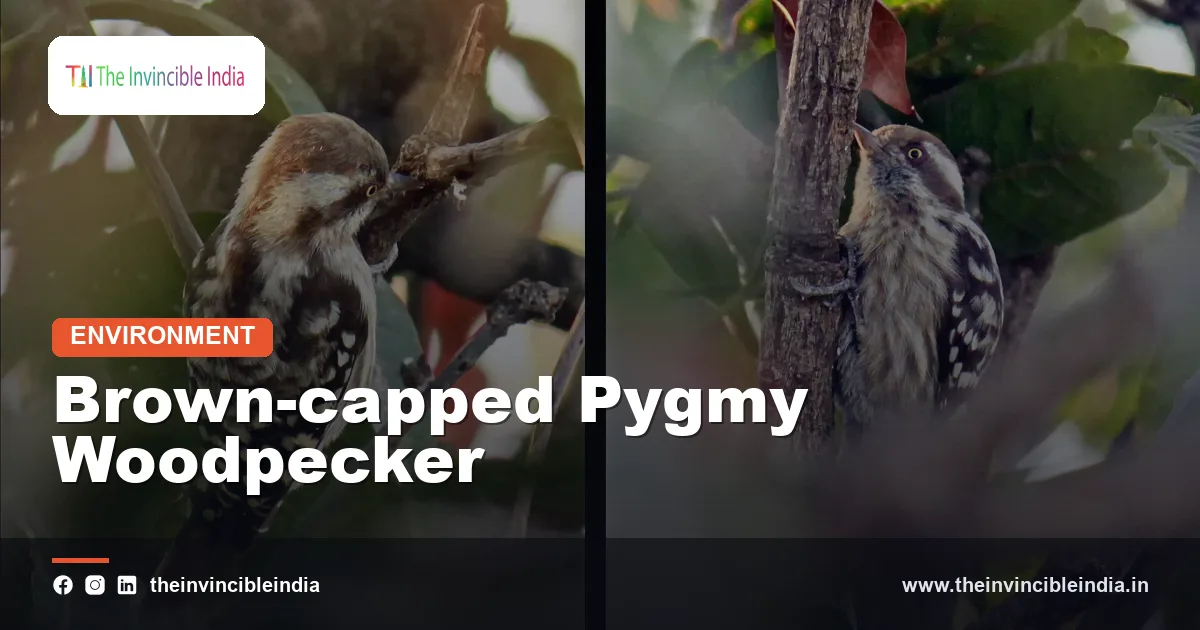
The brown-capped pygmy woodpecker (Yungipicus nanus) is India’s smallest woodpecker, a sparrow-sized bird with a brown cap, a black-and-white barred back and streaked pale underparts that lives in gardens, groves and open woodland and feeds on small insects. It measures only about 12 to 13 cm, and its tiny size, quiet manner and habit of working thin twigs mean that it is often overlooked even in places where it is common.
The brown-capped pygmy woodpecker is a resident, hole-nesting bird that is found across much of peninsular India and the foothills of the Himalaya. This article explains what the brown-capped pygmy woodpecker is, how to recognise it, where it lives, what it eats and how its soft drumming and small nest holes fit into the life of a garden or woodland.
| Attribute | Detail |
|---|---|
| Common name | Brown-capped pygmy woodpecker |
| Scientific name | Yungipicus nanus (earlier placed in Dendrocopos) |
| Family | Picidae (woodpeckers) |
| Size | About 12 to 13 cm long, roughly the size of a sparrow or smaller |
| Range and habitat in India | Open deciduous woodland, scrub forest, groves, orchards, gardens and avenue trees across much of the peninsula and parts of the north |
| Diet | Small insects, ants, tiny larvae and eggs picked from bark and twigs, plus some nectar and soft fruit |
| Breeding | Excavates a small nest hole in a dead or soft branch; lays about two to three white eggs, mainly in the dry months |
| Conservation status | Least Concern on the IUCN Red List |
Key Takeaways
- The brown-capped pygmy woodpecker is the smallest woodpecker in India, at roughly 12 to 13 cm, and is about the size of a sparrow.
- The brown-capped pygmy woodpecker has a plain brown crown, a black-and-white barred back and whitish underparts streaked with dark brown.
- The brown-capped pygmy woodpecker feeds mainly on small insects, ants and larvae, which it picks from bark, twigs and leaf bases rather than chiselling deep into wood.
- The brown-capped pygmy woodpecker nests in a small hole that it excavates in a soft, dead branch, and the entrance is only slightly larger than the bird itself.
- The brown-capped pygmy woodpecker lives in light woodland, orchards and gardens, so it is one of the few woodpeckers that regularly visits towns and cities.
- The brown-capped pygmy woodpecker is listed as Least Concern, and is easily missed because its drumming is soft and its call is a thin trill.
What is the brown-capped pygmy woodpecker?
The brown-capped pygmy woodpecker is the smallest member of the woodpecker family Picidae found in India, and belongs to a group of tiny woodpeckers called pygmy woodpeckers. These birds are only a little bigger than a sunbird or a large warbler, yet they share the structure of larger woodpeckers: a stiff tail, strong claws and a sharp, straight bill.
The scientific name Yungipicus nanus reflects recent changes in classification. The species was long placed in the genus Dendrocopos along with the pied woodpeckers, and many field guides in India still list it under that older name. The word nanus comes from the Latin for dwarf and refers to its tiny size.
The name brown-capped refers to the plain brown crown. This feature separates the species from the grey-capped pygmy woodpecker, a closely related bird whose range reaches the Himalayan foothills and north-eastern India and whose crown is grey.
What does the brown-capped pygmy woodpecker look like?
The brown-capped pygmy woodpecker looks like a tiny, pied woodpecker with a brown crown, a white stripe above and behind the eye, a barred black-and-white back and white underparts streaked with brown. The overall impression is of a small, neat and rather dull bird compared with the bright colours of larger woodpeckers.
The key features are:
- Crown: plain brown, without the bright red or yellow seen in many other woodpeckers.
- Face: a pale face with a white streak behind the eye and a darker line running down the side of the neck.
- Back and wings: black with narrow white bars, which creates a finely striped look.
- Underparts: whitish to buff with dark streaks on the breast and flanks.
- Bill: short, thin and pointed, suited to picking and probing rather than heavy chiselling.
- Tail: short and stiff, used as a prop on vertical surfaces.
The male and female look much alike in the field. Careful observers sometimes note small differences in the markings on the sides of the head, but these are too subtle for casual identification. Young birds are similar to adults but a little duller.
Is the brown-capped pygmy woodpecker really India’s smallest woodpecker?
Yes, the brown-capped pygmy woodpecker is generally regarded as the smallest woodpecker in India, at about 12 to 13 cm in length. Other pygmy woodpeckers, such as the grey-capped pygmy woodpecker, are slightly larger, and most other Indian woodpeckers are much bigger.
Size comparisons help to put the bird in perspective:
| Bird | Approximate length | Notes |
|---|---|---|
| Brown-capped pygmy woodpecker | 12 to 13 cm | Brown crown; smallest Indian woodpecker |
| Grey-capped pygmy woodpecker | About 14 to 15 cm | Grey crown; found mainly in the north and north-east |
| Rufous woodpecker | About 25 cm | Chestnut plumage; associated with ants |
| Black-rumped flameback | About 28 to 29 cm | Golden back; common in towns and gardens |
| Greater flameback | About 33 cm | Large woodpecker with a crest |
The brown-capped pygmy woodpecker is so small that it is often mistaken for a nuthatch, a tit or a warbler when it clings to a twig. The woodpecker is distinguished by its upright climbing posture, the barred back and the way it hitches up a branch with its tail pressed to the bark.
Where does the brown-capped pygmy woodpecker live?
The brown-capped pygmy woodpecker lives in open woodland, scrub forest, mango and other orchards, village groves, gardens and tree-lined roads across much of peninsular India. It is a bird of light, open habitats rather than dense, tall forest.
It is commonly found in:
- Dry and moist deciduous woodland with scattered trees.
- Scrub forest and thorn forest on the plains.
- Gardens, orchards, avenues and parks, including those in large cities.
- Village groves and farmland with a good tree cover.
Outside India, the species ranges into Sri Lanka and parts of the surrounding region. It prefers lower altitudes, and its numbers fall in thick evergreen forest where larger woodpeckers dominate.
The ability to live around people makes this woodpecker unusually familiar to urban birdwatchers. A garden with a few mature trees, some dead wood and a supply of insects may hold a pair for years, even in a busy residential colony.
What does the brown-capped pygmy woodpecker eat?
The brown-capped pygmy woodpecker eats small insects, ants, tiny larvae and insect eggs, and it also takes some nectar and soft fruit. It forages mainly on thin twigs and small branches, rather than on thick trunks.
The bird feeds in several ways:
- Gleaning insects from the surface of bark, twigs and leaf bases.
- Probing cracks and small holes with its thin bill.
- Tapping gently on soft or dead wood to expose larvae.
- Hanging upside down or sideways on twigs to reach food on the underside.
- Occasionally visiting flowering trees to take nectar and the insects attracted to blossoms.
The foraging style is closer to that of a tit or a nuthatch than to the heavy chiselling of larger woodpeckers. The bird often joins mixed-species flocks of small birds that move through the trees together, and it can be spotted by watching for a small, barred shape working the outer branches.
By eating many small insects, including ants, aphids and the larvae of wood-borers, the brown-capped pygmy woodpecker contributes to the natural control of garden and orchard pests.
How does the brown-capped pygmy woodpecker drum and call?
The brown-capped pygmy woodpecker drums softly and gives a short, high-pitched trill or rattling call, which is easier to miss than the loud hammering of larger woodpeckers. Its drum is a rapid, light tapping that carries only a short distance.
The calls include a thin, sharp note repeated quickly, often described as a faint rattle or a series of pit or tit-like notes. The sound is high and easily lost among the calls of other birds, so many people hear it without realising what it is.
Drumming serves several functions in the life of the bird:
- It announces the occupation of a territory to other pygmy woodpeckers.
- It helps pairs to keep in contact.
- It may play a part in selecting and testing wood for a nest hole.
Because a pygmy woodpecker is so light, it can tap on thin dead twigs that would not support a larger bird, and this gives its drumming a faint and delicate quality.
How does the brown-capped pygmy woodpecker breed?
The brown-capped pygmy woodpecker breeds by excavating a small cavity, often in a dead or soft branch, and laying about two to three white eggs in it. The entrance hole is tiny, just enough for a bird about the size of a sparrow.
The main points of the breeding cycle are:
- Site selection: the pair chooses a soft, decaying branch or trunk, frequently at a modest height.
- Excavation: both partners dig the hole, which may take one to two weeks, and the chips are carried away or left to drop.
- Eggs: two to three glossy white eggs are laid on the wood chips at the bottom of the cavity.
- Parental care: both sexes incubate and feed the chicks with small insects.
- Fledging: the young leave the nest after a few weeks and remain with the parents for a time.
The breeding season in India falls mainly in the dry months of the year, though the exact timing varies by region and local rainfall. As with other woodpeckers, old holes may be reused by other small cavity-nesters such as tits, small insects and bees after the woodpecker has finished with them.
How can you spot a brown-capped pygmy woodpecker in a garden?
You can spot a brown-capped pygmy woodpecker in a garden by scanning thin branches and twigs of mature trees for a tiny, barred bird that moves in short hops and taps softly. Patience and a quiet approach are more valuable than any equipment.
These tips improve the chance of a sighting:
- Listen for a faint tapping or a thin trill, especially in the early morning.
- Watch mixed flocks of small birds, since the woodpecker often travels with them.
- Check flowering and fruiting trees, where insects gather.
- Look at the outer parts of the canopy rather than the main trunk.
- Keep a patch of dead wood or an old tree in a corner of the garden where it is safe to do so.
A pair often holds a small territory throughout the year, so once a bird is located in a garden or park, it can be seen repeatedly in the same cluster of trees.
Is the brown-capped pygmy woodpecker threatened?
The brown-capped pygmy woodpecker is not threatened at present and is listed as Least Concern on the IUCN Red List, because it has a wide range and uses many types of tree-covered habitat. It is described as fairly common in suitable areas.
Some local pressures exist:
- Tree felling: the loss of old trees, avenue trees and orchard trees removes nesting and feeding sites.
- Removal of dead wood: excessive tidying of gardens and parks leaves no soft branches for nest holes.
- Pesticides: spraying reduces the supply of insect food.
- Habitat conversion: clearing of scrub woodland for construction and intensive agriculture reduces habitat.
Since the species thrives on trees of modest size and accepts gardens, simple steps such as protecting mature trees, leaving some dead branches in place and reducing pesticide use help to keep it present in towns.
Why does the brown-capped pygmy woodpecker matter?
The brown-capped pygmy woodpecker matters because it shows that even small patches of trees in towns and farmland can support wild birds, and it plays a role as a small-scale insect predator and cavity creator. Its presence suggests that a site has mature trees and a working insect community.
The species also teaches beginners about the diversity of woodpeckers. Many people picture a woodpecker as a large bird hammering a trunk, but the brown-capped pygmy woodpecker shows that the family includes tiny birds with quiet habits, adapted to twigs and thin branches.
Bottom Line
The brown-capped pygmy woodpecker is India’s smallest woodpecker, a sparrow-sized, brown-capped bird that lives in gardens, groves and open woods. It is common but inconspicuous, so looking at thin twigs and listening for soft tapping is the key to finding it.
Frequently Asked Questions
What is the brown-capped pygmy woodpecker?
The brown-capped pygmy woodpecker is a tiny woodpecker, scientifically named Yungipicus nanus, found across much of India. It is about 12 to 13 cm long, with a brown crown, a barred black-and-white back and streaked whitish underparts.
Which is the smallest woodpecker in India?
The smallest woodpecker in India is the brown-capped pygmy woodpecker, which is roughly the size of a sparrow. Other pygmy woodpeckers are slightly larger, and most other Indian woodpeckers are much bigger.
What does the brown-capped pygmy woodpecker eat?
The brown-capped pygmy woodpecker eats small insects, ants, tiny larvae and insect eggs, and it also takes some nectar and soft fruit. It picks its food from bark and thin twigs rather than digging deep into wood.
Where does the brown-capped pygmy woodpecker nest?
The brown-capped pygmy woodpecker nests in a small hole that it digs in a dead or soft branch. The female lays about two to three white eggs, and both parents incubate them and feed the chicks.
Can you see the brown-capped pygmy woodpecker in cities?
Yes, the brown-capped pygmy woodpecker can be seen in cities that have gardens, parks and mature avenue trees. It forages on thin branches and often joins mixed flocks of small birds.
How is the brown-capped pygmy woodpecker different from the grey-capped pygmy woodpecker?
The brown-capped pygmy woodpecker has a brown crown and is slightly smaller, while the grey-capped pygmy woodpecker has a grey crown. The grey-capped species is found mainly in the Himalayan foothills and the north-east, whereas the brown-capped species is widespread in the peninsula.
{“@context”:”https://schema.org”,”@graph”:[{“@type”:”FAQPage”,”mainEntity”:[{“@type”:”Question”,”name”:”What is the brown-capped pygmy woodpecker?”,”acceptedAnswer”:{“@type”:”Answer”,”text”:”The brown-capped pygmy woodpecker is a tiny woodpecker, scientifically named Yungipicus nanus, found across much of India. It is about 12 to 13 cm long, with a brown crown, a barred black-and-white back and streaked whitish underparts.”}},{“@type”:”Question”,”name”:”Which is the smallest woodpecker in India?”,”acceptedAnswer”:{“@type”:”Answer”,”text”:”The smallest woodpecker in India is the brown-capped pygmy woodpecker, which is roughly the size of a sparrow. Other pygmy woodpeckers are slightly larger, and most other Indian woodpeckers are much bigger.”}},{“@type”:”Question”,”name”:”What does the brown-capped pygmy woodpecker eat?”,”acceptedAnswer”:{“@type”:”Answer”,”text”:”The brown-capped pygmy woodpecker eats small insects, ants, tiny larvae and insect eggs, and it also takes some nectar and soft fruit. It picks its food from bark and thin twigs rather than digging deep into wood.”}},{“@type”:”Question”,”name”:”Where does the brown-capped pygmy woodpecker nest?”,”acceptedAnswer”:{“@type”:”Answer”,”text”:”The brown-capped pygmy woodpecker nests in a small hole that it digs in a dead or soft branch. The female lays about two to three white eggs, and both parents incubate them and feed the chicks.”}},{“@type”:”Question”,”name”:”Can you see the brown-capped pygmy woodpecker in cities?”,”acceptedAnswer”:{“@type”:”Answer”,”text”:”Yes, the brown-capped pygmy woodpecker can be seen in cities that have gardens, parks and mature avenue trees. It forages on thin branches and often joins mixed flocks of small birds.”}},{“@type”:”Question”,”name”:”How is the brown-capped pygmy woodpecker different from the grey-capped pygmy woodpecker?”,”acceptedAnswer”:{“@type”:”Answer”,”text”:”The brown-capped pygmy woodpecker has a brown crown and is slightly smaller, while the grey-capped pygmy woodpecker has a grey crown. The grey-capped species is found mainly in the Himalayan foothills and the north-east, whereas the brown-capped species is widespread in the peninsula.”}}]}]}


