

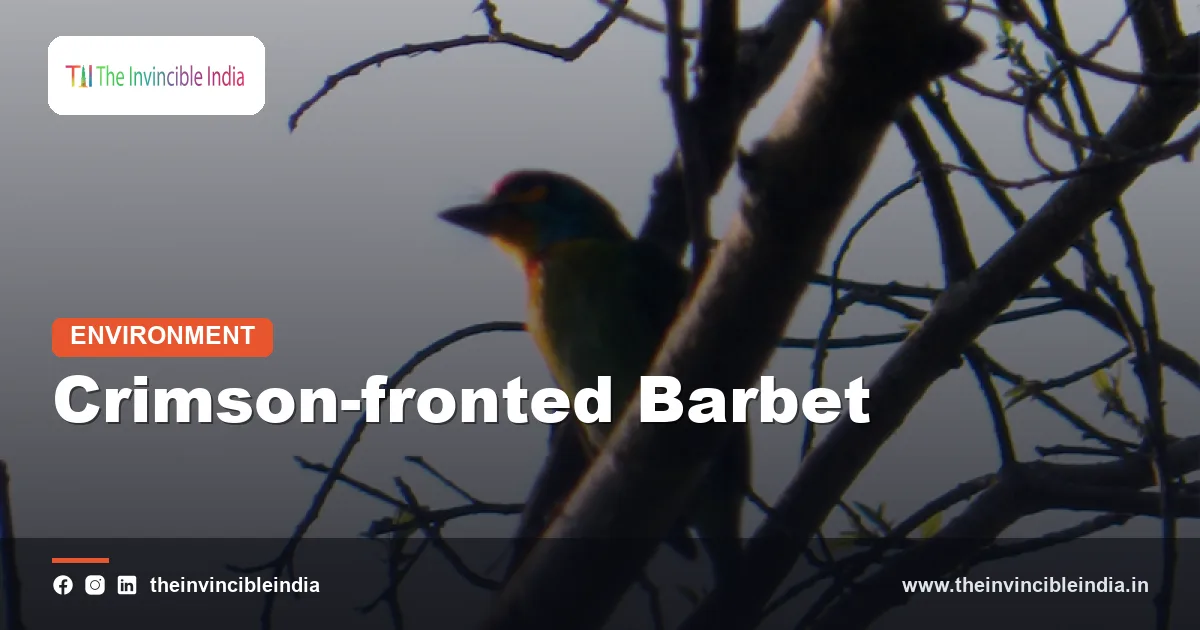
The crimson-fronted barbet is a small, plump, grass-green barbet with a bright red forehead and yellow and blue patches on the face, found in the forests, plantations and wooded gardens of the Western Ghats, where it is endemic within India. It spends most of its time high in fruiting trees, feeds largely on figs and berries, and is far easier to hear than to see because its green plumage blends into the leaves.
The crimson-fronted barbet is a resident, hole-nesting bird that excavates its nest in dead wood and plays an important role as a seed disperser in the hill forests of south-western India. This article explains what the crimson-fronted barbet is, how to recognise it, where it lives, what it eats, how it breeds and why its range makes it a bird worth watching.
| Attribute | Detail |
|---|---|
| Common name | Crimson-fronted barbet (the Indian population is also called Malabar barbet by some authorities) |
| Scientific name | Psilopogon rubricapillus (formerly Megalaima rubricapilla); some authorities treat the Indian birds as Psilopogon malabaricus |
| Family | Megalaimidae (Asian barbets), placed by some authors in Ramphastidae |
| Size | About 16 cm long, slightly smaller than a myna |
| Range and habitat in India | Endemic to the Western Ghats; evergreen and moist deciduous forest, plantations and wooded gardens |
| Diet | Mostly figs and other small fruits and berries, with some flowers, nectar and insects |
| Breeding | Excavates a nest hole in a dead branch or trunk; lays about two to four white eggs, mostly in the dry months before the monsoon |
| Conservation status | Least Concern on the IUCN Red List |
Key Takeaways
- The crimson-fronted barbet is a small green barbet with a crimson forehead and yellow and blue facial patches, and it is endemic to the Western Ghats within India.
- The crimson-fronted barbet feeds mainly on figs and other small fruits, and it spreads the seeds of forest trees through its droppings.
- The crimson-fronted barbet is usually located by its loud, repeated, ringing call, since its green plumage makes it almost invisible among leaves.
- The crimson-fronted barbet nests in a hole that it excavates in a dead branch or trunk, and the nest is later reused by other cavity-nesting animals.
- The crimson-fronted barbet lives in evergreen and moist deciduous forests as well as shaded coffee, tea and spice plantations of the Western Ghats.
- The crimson-fronted barbet is classified as Least Concern, but it relies on fruiting trees and old, dead wood that are lost when forest is cleared.
What is the crimson-fronted barbet?
The crimson-fronted barbet is a species of Asian barbet, a group of stout, big-headed, fruit-eating birds that belong to the genus Psilopogon. The word barbet comes from the Latin word for beard and refers to the stiff bristles that surround the base of the bill.
Taxonomists have revised the name of the bird more than once. Older books call it Megalaima rubricapilla, and many field guides still use that name, while newer lists use Psilopogon. The birds of the Western Ghats are also treated by some authorities as a separate species, the Malabar barbet, to distinguish them from the population in Sri Lanka. For the Indian reader, the key point is that the crimson-fronted barbet of the Western Ghats is a restricted-range bird that is found nowhere else in India.
Barbets as a group are related to toucans and woodpeckers, and share the habit of excavating nest holes in wood. They are heavy-billed, short-tailed birds that perch upright and forage for fruit in the canopy.
What does the crimson-fronted barbet look like?
The crimson-fronted barbet looks like a small, round-bodied green bird with a bright red forehead, yellow patches on the face and a bluish tinge on the throat and head. The rest of the body is a leafy green with paler, streaked underparts, which provides excellent camouflage in the canopy.
The main features to look for are:
- Forehead: a vivid crimson patch on the front of the crown, which gives the bird its name.
- Face: yellow patches around the eye and on the face, set against a blue or bluish wash.
- Body: bright green above and paler green, streaked below.
- Bill: stout, short and slightly curved, with bristles at the base.
- Posture: upright, rounded and stocky, with a short tail.
- Feet: short legs with two toes pointing forwards and two backwards, a feature shared with woodpeckers.
The sexes look alike, and young birds are duller, with little or no red on the forehead. Because the bird often sits still at the top of a leafy tree, it can be missed even when it is calling nearby.
Where does the crimson-fronted barbet live?
The crimson-fronted barbet lives in the Western Ghats, the long mountain range that runs along the south-western coast of India, and it is found in the hill forests of the southern and central parts of this range. It occurs in evergreen and moist deciduous forest, and it is also common in plantations and gardens that retain tall shade trees.
The species is generally found:
- In evergreen and semi-evergreen forest from the foothills to mid-elevation hills.
- In moist deciduous forest on the lower slopes of the range.
- In shaded coffee, cardamom and tea estates with tall trees.
- In wooded gardens, hill stations and the edges of villages with fruiting trees.
Within India it does not occur in the Himalaya, central India or the Eastern Ghats. A closely related form lives in Sri Lanka, which is why the species is sometimes described as a Western Ghats and Sri Lanka bird. In biogeographic terms, this pattern reflects the shared forest history of the two regions.
The Western Ghats are recognised as one of the world’s biodiversity hotspots and have been inscribed as a UNESCO World Heritage Site, with many endemic plants, amphibians and birds. The crimson-fronted barbet is one of several birds that make this landscape special.
Why is the crimson-fronted barbet called an endemic bird?
The crimson-fronted barbet is called an endemic bird of the Western Ghats because, within India, it breeds only in this mountain range. An endemic species is one that is found naturally in a single, restricted region and nowhere else.
Endemism matters for conservation because the survival of the species depends on one habitat. If the Western Ghats forest is fragmented or degraded, there is no other Indian population to take its place. Several other Western Ghats endemics share the same forests, including the white-cheeked barbet, the Malabar parakeet and the Nilgiri wood pigeon.
Despite this restricted range, the crimson-fronted barbet is not considered threatened because it adapts to plantations and gardens and is fairly common within its range.
What does the crimson-fronted barbet eat?
The crimson-fronted barbet eats mostly fruit, especially figs, and also takes berries, flowers, nectar and some insects. A fruiting fig tree is the most reliable place to find the bird.
The diet includes:
- Figs: wild fig trees of the genus Ficus, which fruit through the year and attract many birds.
- Berries and small fruits: from native trees and shrubs, such as those of the laurel and nutmeg families.
- Flowers and nectar: especially from flowering trees such as silk cotton and coral tree.
- Insects: such as caterpillars and beetles, which supply protein, especially for nestlings.
The bird is often seen feeding alongside bulbuls, mynas, hornbills, fruit pigeons and other barbets. Fig trees draw such mixed crowds that they are sometimes called keystone resources, because many animals depend on them when other food is scarce.
Why are barbets important seed dispersers?
Barbets are important seed dispersers because they swallow fruits whole, fly to other trees and then pass the seeds undamaged in their droppings or regurgitate them. This movement helps forest trees to colonise new patches and maintains the diversity of the forest.
The crimson-fronted barbet is a small bird and handles small fruits, which complements the role of larger fruit-eaters such as hornbills. Together, the different-sized birds spread seeds of different sizes, and the loss of any one group can reduce natural forest regeneration.
How does the crimson-fronted barbet call?
The crimson-fronted barbet calls with a loud, steady, repeated series of ringing notes that are given for long periods from a high perch. The sound is monotonous and carries well through the forest, and it is often the first sign that the bird is nearby.
The call has some typical features:
- It is a repeated note rather than a musical song.
- It is given from the top of a tree, often with the head thrown up and the throat swelling.
- It is heard most often in the early morning and again in the late afternoon.
- It is delivered more frequently in the breeding season, when males advertise their territories.
Birdwatchers often use the call, rather than the sight of the bird, to count barbets in the forest. The call is similar in character to that of the coppersmith barbet, a related species found throughout India, but the two birds differ in plumage and in the details of the call. Experienced observers learn to tell them apart by pitch and rhythm.
How does the crimson-fronted barbet breed?
The crimson-fronted barbet breeds by excavating a nest hole in a dead branch or trunk and laying about two to four white eggs in the cavity. The hole is dug by the birds themselves, using the bill as a chisel.
The breeding cycle usually runs as follows:
- Territory: males call from the treetops to claim a territory and attract a mate.
- Excavation: the pair digs a round entrance and a vertical chamber in soft or rotting wood, often on the underside of a branch.
- Egg laying: two to four glossy white eggs are laid on wood chips at the base of the cavity.
- Care of young: both parents incubate the eggs and bring fruit and insects to the nestlings.
- Fledging: the young leave the nest after several weeks and remain with the adults for some time.
In the Western Ghats, breeding takes place largely in the drier part of the year, before the heavy monsoon rains. Dead trees and branches are therefore essential, and forest managers who remove all dead wood unintentionally remove nesting sites for barbets and other hole-nesting animals.
Abandoned barbet holes are used by other creatures such as flying squirrels, tits, small owls and bats, which makes a barbet a provider of homes for many other species.
How is the crimson-fronted barbet different from other barbets?
The crimson-fronted barbet differs from other Indian barbets mainly in size, head colour and range, as it is a small barbet with a red forehead that is restricted to the Western Ghats. Several other barbets share the same forests or overlap with it in gardens.
| Barbet | Approximate size | Key features |
|---|---|---|
| Crimson-fronted barbet | About 16 cm | Red forehead; yellow and blue face patches; Western Ghats |
| Coppersmith barbet | About 17 cm | Red forehead and red breast patch; yellow face; widespread in India; metallic hammering call |
| White-cheeked barbet | About 23 cm | Brown head with white cheeks; endemic to the Western Ghats |
| Brown-headed barbet | About 27 cm | Larger; brown head and breast; widespread in plains and gardens |
The most useful distinguishing clues are the red forehead without a red breast patch, which separates the crimson-fronted barbet from the coppersmith barbet, and the small size, which separates it from the white-cheeked and brown-headed barbets.
Is the crimson-fronted barbet threatened?
The crimson-fronted barbet is not threatened at present and is listed as Least Concern on the IUCN Red List, because it is fairly common in the Western Ghats and adapts to shaded plantations. Its restricted range, however, makes habitat change in the Ghats a long-term concern.
The main pressures include:
- Forest loss and fragmentation: clearing for agriculture, roads, mining and settlements reduces the area of suitable forest.
- Loss of shade trees: conversion of shaded estates into open monocultures removes feeding and nesting trees.
- Removal of dead wood: felling of dead trees takes away nesting sites.
- Climate change: shifts in rainfall and temperature may alter fruiting patterns and the distribution of montane forests.
Conservation of the Western Ghats through protected areas, community-managed forests and shade-grown plantations helps this species along with a rich variety of other wildlife.
How can you see a crimson-fronted barbet?
You can see a crimson-fronted barbet by visiting Western Ghats forests, hill stations or shaded estates in the early morning, listening for the repeated call and scanning fruiting fig trees. Patience and binoculars are the main requirements.
These steps help:
- Locate a fruiting tree, since barbets visit regularly and stay for long periods.
- Follow the call to the top of a tree and look for a small, upright bird with a red forehead.
- Watch against the sky for a silhouette with a large head and a short tail.
- Check the edges of forest roads, estates and gardens where fruit trees grow.
Good places include forests, sanctuaries and plantation areas across Karnataka, Kerala and Tamil Nadu. The bird is one of the reasons birdwatchers visit the Western Ghats, as it offers a chance to see a restricted-range endemic with relative ease.
Bottom Line
The crimson-fronted barbet is a small, green, red-browed fruit-eater that is endemic to the Western Ghats within India. It is secure for now, but its fortunes are tied to the forests, fig trees and dead wood of the Ghats.
Frequently Asked Questions
What is the crimson-fronted barbet?
The crimson-fronted barbet is a small green barbet with a crimson forehead and yellow and blue patches on the face. It is found in the Western Ghats of India and feeds mainly on figs and other fruits.
Where is the crimson-fronted barbet found in India?
The crimson-fronted barbet is found only in the Western Ghats within India, in forests, plantations and wooded gardens. A closely related form lives in Sri Lanka.
What does the crimson-fronted barbet eat?
The crimson-fronted barbet eats mostly figs and other small fruits and berries, along with some flowers, nectar and insects. Fruiting fig trees are the best places to look for it.
How can you identify a crimson-fronted barbet?
You can identify a crimson-fronted barbet by its small size, green body, red forehead and yellow and blue facial patches. Its loud, repeated, ringing call is often the first clue to its presence.
Where does the crimson-fronted barbet nest?
The crimson-fronted barbet nests in a hole that it excavates in a dead branch or trunk. The female lays about two to four white eggs, and both parents incubate them and feed the young.
Is the crimson-fronted barbet an endangered bird?
No, the crimson-fronted barbet is not endangered and is classed as Least Concern by the IUCN. Its range is restricted to the Western Ghats, so loss of forest and shade trees remains a long-term risk.
{“@context”:”https://schema.org”,”@graph”:[{“@type”:”FAQPage”,”mainEntity”:[{“@type”:”Question”,”name”:”What is the crimson-fronted barbet?”,”acceptedAnswer”:{“@type”:”Answer”,”text”:”The crimson-fronted barbet is a small green barbet with a crimson forehead and yellow and blue patches on the face. It is found in the Western Ghats of India and feeds mainly on figs and other fruits.”}},{“@type”:”Question”,”name”:”Where is the crimson-fronted barbet found in India?”,”acceptedAnswer”:{“@type”:”Answer”,”text”:”The crimson-fronted barbet is found only in the Western Ghats within India, in forests, plantations and wooded gardens. A closely related form lives in Sri Lanka.”}},{“@type”:”Question”,”name”:”What does the crimson-fronted barbet eat?”,”acceptedAnswer”:{“@type”:”Answer”,”text”:”The crimson-fronted barbet eats mostly figs and other small fruits and berries, along with some flowers, nectar and insects. Fruiting fig trees are the best places to look for it.”}},{“@type”:”Question”,”name”:”How can you identify a crimson-fronted barbet?”,”acceptedAnswer”:{“@type”:”Answer”,”text”:”You can identify a crimson-fronted barbet by its small size, green body, red forehead and yellow and blue facial patches. Its loud, repeated, ringing call is often the first clue to its presence.”}},{“@type”:”Question”,”name”:”Where does the crimson-fronted barbet nest?”,”acceptedAnswer”:{“@type”:”Answer”,”text”:”The crimson-fronted barbet nests in a hole that it excavates in a dead branch or trunk. The female lays about two to four white eggs, and both parents incubate them and feed the young.”}},{“@type”:”Question”,”name”:”Is the crimson-fronted barbet an endangered bird?”,”acceptedAnswer”:{“@type”:”Answer”,”text”:”No, the crimson-fronted barbet is not endangered and is classed as Least Concern by the IUCN. Its range is restricted to the Western Ghats, so loss of forest and shade trees remains a long-term risk.”}}]}]}


