

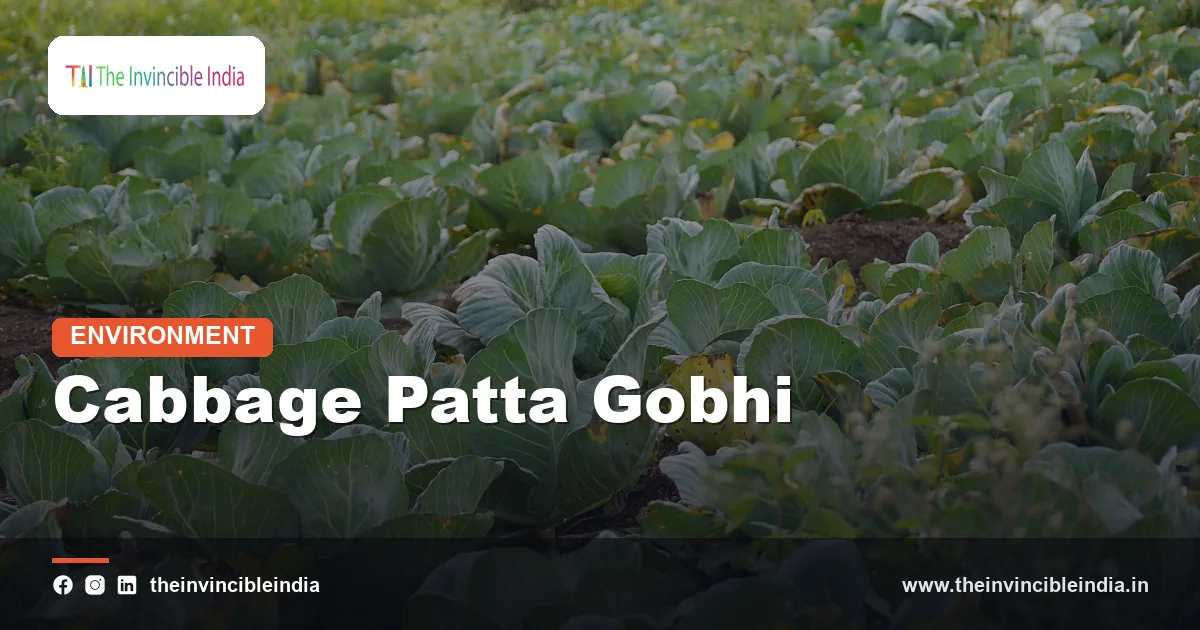
The cabbage (Brassica oleracea var. capitata), known in Hindi as patta gobhi or bandh gobhi, is a leafy, cool-season vegetable whose tightly packed leaves form a round or flattened head that is eaten both cooked and raw. Cabbage is one of the most widely grown and most affordable vegetables in India, appearing in home kitchens, street-food stalls and restaurant menus across every region.
Although the cabbage is not native to the subcontinent, it has been grown in India for several centuries and has become part of everyday cooking, from the stir-fried poriyal of Tamil Nadu to the sabzi and paratha of the north. This article explains how the cabbage plant grows, where it is cultivated, how it is used and what its main varieties, pests and nutrients are.
Cabbage Quick Facts
| Attribute | Detail |
|---|---|
| Common names | Cabbage, patta gobhi, bandh gobhi, bandhakopi (Bengali), muttaikose (Tamil), kosu (Telugu) |
| Scientific name | Brassica oleracea var. capitata |
| Family | Brassicaceae (the mustard or cabbage family) |
| Where grown in India | Widely across the country, with large areas in West Bengal, Odisha, Bihar, Madhya Pradesh, Assam, Gujarat and Haryana, and hill-region crops in the summer |
| Season | Mainly a rabi (winter) crop in the plains; sown in nurseries from about August to November, with some hill and off-season cultivation |
| Part used | The compact head formed by overlapping leaves |
| Uses | Sabzi, paratha stuffing, pakora, salad, Indo-Chinese dishes, fermented preparations |
| Nutrition | Low in calories; a useful source of vitamin C, vitamin K, folate and dietary fibre |
Key Takeaways
- The cabbage is a biennial plant of the mustard family that farmers grow as an annual for its edible leafy head.
- Cabbage was domesticated from a wild coastal plant of Europe and reached India through trade and colonial-era contact over several centuries.
- Cabbage belongs to the same species, Brassica oleracea, as cauliflower, broccoli, kale, kohlrabi and Brussels sprouts.
- India is one of the world’s largest cabbage producers, ranking among the top few countries after China by volume in recent decades.
- Cabbage in India is mostly a winter crop, transplanted from nursery seedlings and ready to harvest roughly two to four months after transplanting, depending on the variety.
- Cabbage supplies vitamin C, vitamin K, folate and fibre at very low cost, which makes it a common everyday vegetable.
What Is Cabbage and Where Did It Come From?
Cabbage is a cultivated form of the wild cabbage, a hardy plant that grew on the sea cliffs and coasts of western and southern Europe. Over many centuries, farmers selected plants with larger, more tightly packed leaf buds, and the result was the modern headed cabbage, which was well established in European cooking by the Middle Ages.
Cabbage is generally believed to have reached India after European traders and settlers began bringing vegetable seeds to the coast several centuries ago. Indian farmers and agricultural institutions then adapted the crop to local conditions. Early introductions favoured cool hill stations, and later breeding made it possible to grow cabbage across the plains in winter.
The vegetable now has a firm place in regional food cultures, and its name varies by language. In Hindi it is patta gobhi, literally “leaf cauliflower”, while in Bengali it is bandhakopi and in Tamil it is muttaikose. The mustard family, to which cabbage belongs, also includes mustard greens, radish, turnip and many other crops already familiar to Indian farmers.
What Does a Cabbage Plant Look Like and How Does It Grow?
A cabbage plant is a low, stocky plant with a short thick stem and large, broad, waxy leaves that curl inward to form a dense head. The outer leaves, called wrapper leaves, are loose and open, while the inner leaves overlap tightly around the growing tip, producing the round, oval or flat head that is harvested.
Botanically, cabbage is a biennial. In its first year the plant builds a rosette of leaves and a head. If left through winter and exposed to a sustained period of cold, it sends up a flowering stalk in its second year with small yellow, four-petalled flowers typical of the mustard family. This is why most Indian cabbage seed is produced in cooler hill regions, since plains in much of India do not provide the winter chill needed for flowering.
The leaf colour of cabbage depends on the variety and ranges from pale green to deep green, and red or purple types contain the pigment anthocyanin. Head shape, size and firmness are the main qualities that farmers and traders look for.
- Root system: relatively shallow and fibrous, so the crop needs regular watering.
- Stem: short and thick, with leaves arranged in a tight spiral.
- Head: a compact bud of leaves, weighing from under a kilogram to several kilograms.
- Temperature preference: grows best in cool weather, with moderate temperatures favouring good head formation.
What Are the Main Types of Cabbage?
The main types of cabbage are green cabbage, red or purple cabbage, Savoy cabbage and pointed cabbage, and they differ in leaf texture, colour and head shape. In Indian markets, round or flat green cabbage is by far the most common, while the other types appear in smaller quantities.
| Type | Appearance | Notes |
|---|---|---|
| Green round-headed | Smooth, pale to mid-green leaves in a firm round head | The standard market cabbage in India |
| Flat or drumhead | Large, flattened, heavy head | Long-established open-pollinated types such as Pusa Drumhead are of this kind |
| Red or purple | Deep purple leaves with pale veins | Mostly used in salads and in urban markets |
| Savoy | Crinkled, deeply veined leaves in a looser head | Grown in small quantities, often in hill regions |
| Pointed or conical | Cone-shaped head with tender leaves | Cooks quickly and is less common in Indian markets |
Indian growers use both open-pollinated varieties and hybrids. Well-known older varieties include Golden Acre, Pride of India, Pusa Drumhead and Late Flat Dutch, while public institutes and private seed companies have released many hybrids with uniform heads, better heat tolerance and longer field holding. Chinese cabbage, sometimes sold as napa cabbage, is a different species, Brassica rapa, and should not be confused with ordinary head cabbage.
Where Is Cabbage Grown in India?
Cabbage is grown in almost every Indian state, with West Bengal, Odisha, Bihar, Madhya Pradesh, Assam, Gujarat and Haryana among the states with large areas under the crop. Exact rankings change from year to year, and the figures published by the Ministry of Agriculture and Farmers Welfare and the National Horticulture Board are revised regularly.
The plains of eastern and central India grow the bulk of the winter crop, where mild, dry winters suit nursery raising and transplanting. In the hills of Himachal Pradesh, Uttarakhand, Jammu and Kashmir, Karnataka and Tamil Nadu (notably the Nilgiris), cooler summers allow cabbage to be grown in months when the plains are too hot. This staggered production helps keep markets supplied for much of the year.
India is generally counted among the top few cabbage-producing countries in the world, behind China, with annual output measured in millions of tonnes. Because the crop is perishable, it is typically sold close to where it is grown, in nearby wholesale markets known as mandis, although cold chains have extended its reach.
How Is Cabbage Cultivated in India?
Cabbage is cultivated in India by raising seedlings in a nursery and transplanting them to prepared fields, usually in the cool season. Growers prefer well-drained, fertile loam soils rich in organic matter, with a neutral to slightly acidic reaction, and they avoid waterlogged land.
Nursery and transplanting
Seeds are sown in raised nursery beds, and the seedlings are ready for transplanting after about four to six weeks, when they have four to six true leaves. Seedlings are planted on ridges or flat beds at spacings that depend on variety, commonly around 45 cm between rows and plants for medium-sized heads, with wider spacing for large drumhead types.
Water and nutrients
Cabbage has shallow roots and needs frequent, light irrigation, especially during head formation. Uneven watering can cause heads to split. The crop responds well to farmyard manure or compost and balanced nitrogen, phosphorus and potassium, and also needs boron and calcium in some soils to avoid disorders such as hollow stem and tip burn.
Harvest and yield
Heads are harvested when they are firm and fully formed, which takes roughly two to four months after transplanting depending on variety, with early hybrids maturing sooner. Delayed harvesting leads to bursting heads. Yields vary widely with variety and management, and well-managed crops produce many tonnes per hectare.
Which Pests and Diseases Affect Cabbage?
The main pests of cabbage are the diamondback moth, the cabbage white butterfly, aphids and the cabbage head borer, while important diseases include black rot, clubroot and downy mildew. These problems are common to many crops in the mustard family and often build up when cabbage is grown repeatedly in the same field.
- Diamondback moth (Plutella xylostella): its larvae chew holes in leaves and have developed resistance to many insecticides in several countries.
- Cabbage butterfly (Pieris brassicae): green caterpillars that feed on outer leaves in groups.
- Aphids: small sap-sucking insects that cluster on leaves and weaken the plant.
- Black rot (Xanthomonas campestris pv. campestris): a bacterial disease that causes V-shaped yellow lesions on leaf margins.
- Clubroot: a soil-borne disease that deforms the roots and is favoured by acidic, wet soils.
Integrated pest management is widely recommended and includes crop rotation, clean seedlings, pheromone traps, mustard trap crops, biological agents such as Bacillus thuringiensis and the careful, label-guided use of pesticides. Because cabbage heads are eaten directly, observing waiting periods before harvest is important for food safety.
How Is Cabbage Used in Indian Cooking?
Cabbage is used in Indian cooking as a stir-fried or curried sabzi, a filling for parathas and snacks, a raw salad ingredient and a base for Indo-Chinese dishes. Its mild, slightly sweet flavour when cooked lets it take on spices easily.
- Patta gobhi sabzi: shredded cabbage tempered with cumin, turmeric and green chilli, often combined with potato or green peas.
- Poriyal and thoran: South Indian dry preparations in which cabbage is cooked with mustard seeds, curry leaves and grated coconut.
- Sambharo: a quick Gujarati warm salad of shredded cabbage and carrot with mustard seed and chilli.
- Pakora and paratha: grated cabbage is mixed into gram flour batter or wheat dough.
- Indo-Chinese dishes: cabbage forms the filling or base in vegetable Manchurian, spring rolls and fried rice.
- Raw uses: thinly sliced cabbage in salads, sandwiches, momos and as a crunchy topping on street food.
Cabbage is also fermented in many cuisines, as in sauerkraut and kimchi (the latter normally made with Chinese cabbage), and pickled cabbage appears in some Indian regional preparations. Cooking time matters, because overcooked cabbage turns soft and develops a strong sulphur smell.
What Nutrients Does Cabbage Provide?
Cabbage provides vitamin C, vitamin K, folate and dietary fibre while containing very few calories, and it is made up mostly of water. A cup of raw shredded cabbage typically supplies a notable share of the daily vitamin C and vitamin K requirement for an adult, though exact values depend on variety and growing conditions.
Like other members of the mustard family, cabbage contains sulphur compounds called glucosinolates. When the leaves are chopped or chewed, an enzyme called myrosinase converts these compounds into isothiocyanates, which give cabbage its sharp aroma and are studied by nutrition scientists. Red cabbage also contains anthocyanins, the pigments responsible for its colour.
The vegetable is sometimes said to cause gas in some people, because its fibre and certain sugars are fermented by gut bacteria. Cooking, finely chopping and moderate portions usually reduce this effect. Anyone with a thyroid condition or on blood-thinning medication should follow the advice of a doctor on diet, since large quantities of cabbage can affect iodine uptake and vitamin K intake.
How Should Cabbage Be Selected and Stored?
A good cabbage feels heavy for its size, has a firm and compact head, and has fresh, crisp leaves without brown patches or insect holes. The stem end should look freshly cut and not dried or split.
In a refrigerator, a whole head of cabbage keeps for one to two weeks, and sometimes longer, if stored loose in a vegetable drawer with the outer leaves intact. Once cut, the surface should be covered to limit moisture loss. Washing is best done just before use, after removing the outer leaves, since the inner leaves are usually clean and protected.
At the market level, cabbage is transported in sacks or crates, and rough handling or heat can lead to bruising and rot. Better packaging, shade and cooled transport help cut post-harvest losses, which are a recognised problem for perishable vegetables in India.
Why Does Cabbage Matter to Indian Farmers and Consumers?
Cabbage matters because it is a short-duration, widely adapted cash crop that gives smallholder farmers a quick return and gives consumers a nutritious vegetable at a low price. The crop’s cycle of only a few months fits between other crops in many rotations.
Its main challenges are price swings caused by gluts during the peak winter season, perishability, and pest resistance. Government programmes and agricultural universities support farmers with improved seed, protected nursery practices and market information. Drip irrigation, mulching and varieties suited to warmer conditions are among the practices that help growers reduce risk.
For consumers, cabbage is among the easiest vegetables to cook and the most flexible, adapting equally to a simple home meal, a festival thali or a roadside snack.
Bottom Line
The cabbage is a cool-season member of the mustard family that came to India from Europe and is now grown in most states. It is cheap, versatile and nutritious, and it supports many smallholder farmers, though pests, price swings and perishability remain constant challenges.
Frequently Asked Questions
What is cabbage called in Hindi?
Cabbage is called patta gobhi or bandh gobhi in Hindi. The names mean “leaf cauliflower” and “closed cauliflower”, referring to the closed head of leaves. Regional names include bandhakopi in Bengali and muttaikose in Tamil.
Is cabbage native to India?
No, cabbage is not native to India. It was domesticated from a wild coastal plant of Europe and was brought to the subcontinent over several centuries through trade and colonial-era contact. Indian agricultural research has since adapted it to the plains and the hills.
Which season is best for growing cabbage in India?
Winter is the best season for growing cabbage in most of the Indian plains, with nursery sowing from about August to November. Cabbage prefers cool weather, so heads form best at moderate temperatures. Hill regions grow the crop in summer as well.
How long does cabbage take to grow?
Cabbage usually takes about two to four months from transplanting to harvest, depending on the variety. Seedlings spend roughly four to six weeks in the nursery before being transplanted. Early hybrids mature sooner than large late-season drumhead types.
Is cabbage related to cauliflower and broccoli?
Yes, cabbage, cauliflower and broccoli are all forms of the same species, Brassica oleracea. Kale, kohlrabi and Brussels sprouts also belong to it. Farmers and plant breeders selected different parts of the plant over centuries to produce these distinct vegetables.
Why does cooked cabbage sometimes smell strong?
Cooked cabbage smells strong because it contains sulphur compounds called glucosinolates that break down into pungent substances when heated. Overcooking increases the smell, as the compounds continue to release sulphur gases. Shorter cooking times and a little spice or acid reduce the smell.
{“@context”:”https://schema.org”,”@graph”:[{“@type”:”FAQPage”,”mainEntity”:[{“@type”:”Question”,”name”:”What is cabbage called in Hindi?”,”acceptedAnswer”:{“@type”:”Answer”,”text”:”Cabbage is called patta gobhi or bandh gobhi in Hindi. The names mean “leaf cauliflower” and “closed cauliflower”, referring to the closed head of leaves. Regional names include bandhakopi in Bengali and muttaikose in Tamil.”}},{“@type”:”Question”,”name”:”Is cabbage native to India?”,”acceptedAnswer”:{“@type”:”Answer”,”text”:”No, cabbage is not native to India. It was domesticated from a wild coastal plant of Europe and was brought to the subcontinent over several centuries through trade and colonial-era contact. Indian agricultural research has since adapted it to the plains and the hills.”}},{“@type”:”Question”,”name”:”Which season is best for growing cabbage in India?”,”acceptedAnswer”:{“@type”:”Answer”,”text”:”Winter is the best season for growing cabbage in most of the Indian plains, with nursery sowing from about August to November. Cabbage prefers cool weather, so heads form best at moderate temperatures. Hill regions grow the crop in summer as well.”}},{“@type”:”Question”,”name”:”How long does cabbage take to grow?”,”acceptedAnswer”:{“@type”:”Answer”,”text”:”Cabbage usually takes about two to four months from transplanting to harvest, depending on the variety. Seedlings spend roughly four to six weeks in the nursery before being transplanted. Early hybrids mature sooner than large late-season drumhead types.”}},{“@type”:”Question”,”name”:”Is cabbage related to cauliflower and broccoli?”,”acceptedAnswer”:{“@type”:”Answer”,”text”:”Yes, cabbage, cauliflower and broccoli are all forms of the same species, Brassica oleracea. Kale, kohlrabi and Brussels sprouts also belong to it. Farmers and plant breeders selected different parts of the plant over centuries to produce these distinct vegetables.”}},{“@type”:”Question”,”name”:”Why does cooked cabbage sometimes smell strong?”,”acceptedAnswer”:{“@type”:”Answer”,”text”:”Cooked cabbage smells strong because it contains sulphur compounds called glucosinolates that break down into pungent substances when heated. Overcooking increases the smell, as the compounds continue to release sulphur gases. Shorter cooking times and a little spice or acid reduce the smell.”}}]}]}


