

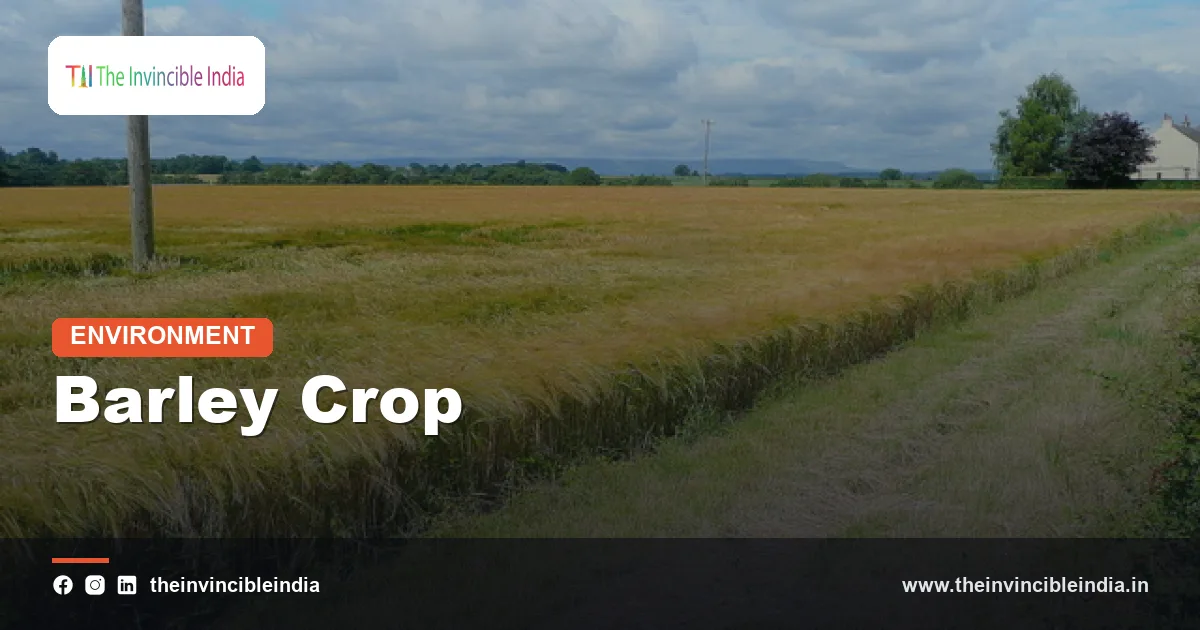
Barley is a hardy cereal grass (Hordeum vulgare) grown for its grain, called jau in Hindi, and in India barley is a winter rabi crop sown mainly in the northern plains and the cold, dry mountain regions, where it has been cultivated for thousands of years. The grain is used as human food, animal feed, and the main raw material for malt, and it holds an important place in Indian rituals and traditional diets.
Barley thrives where wheat struggles, tolerating poor soils, salinity, cold and limited water. This article explains what barley is, where and how it is grown in India, the difference between its types, how it is used in food, drinks and industry, and why it remains valuable even though wheat and rice dominate Indian fields.
Quick Facts
| Common names | Barley; jau (also yava in Sanskrit); sattu is a flour made from roasted barley and gram |
|---|---|
| Scientific name | Hordeum vulgare |
| Family | Poaceae (the grass family) |
| Origin | Domesticated about ten thousand years ago in the Fertile Crescent of West Asia |
| Where grown in India | Uttar Pradesh, Rajasthan, Madhya Pradesh, Haryana, Punjab, Bihar, Himachal Pradesh, Uttarakhand, Jammu and Kashmir and Ladakh |
| Season | Rabi: sown around October to December, harvested around March to April |
| Part used | Grain (seed); straw and green plants as fodder |
| Main uses | Malt for brewing and health drinks, food flour and flakes, sattu, animal feed, fodder, barley water |
| Importance | A low-input, stress-tolerant cereal suited to marginal land, plus the key raw material of the malting industry |
Key Takeaways
- Barley (Hordeum vulgare) is a cereal grass of the family Poaceae and is known as jau in Hindi and yava in Sanskrit.
- Barley is a rabi crop in India, sown in the cool season and harvested in spring, with the main growing areas in the northern and north-western states.
- Barley tolerates drought, cold, poor soil and salinity better than wheat, which makes it valuable on marginal land.
- Barley grain is the principal raw material for malt, used in brewing, distilling and malted food drinks, and Indian malting industries rely on specially bred malting varieties.
- Barley contains beta-glucan, a soluble fibre that is associated with digestive benefits and cholesterol control, but it contains gluten and is not suitable for people with coeliac disease.
- Jau is used in Hindu ritual practice, including the sowing of barley seeds in pots during Navratri.
What is barley?
Barley is an annual cereal grass whose grain grows in spikes at the top of a slender, hollow-jointed stem, and it ranks among the world’s leading cereal crops alongside wheat, rice and maize. The plant grows about 60 to 120 centimetres tall and has narrow leaves, a stem with nodes and a spike or ear that carries the grain-bearing florets.
Barley is easily recognised by the long, stiff, hair-like projections called awns that extend from each grain, giving the ear a bristly look. The grain is a caryopsis, a one-seeded dry fruit, and in most varieties the grain is enclosed in a tough husk that must be removed or polished before use.
Barley is a self-pollinating plant, which means seed produced by a farmer’s crop generally breeds true and farmers can save seed with little loss of quality, unlike hybrids of cross-pollinated crops.
What is the history of barley in India?
Barley has been cultivated in the Indian subcontinent for thousands of years, with archaeological evidence from the Neolithic site of Mehrgarh in present-day Balochistan, Pakistan, showing that early farmers grew it before wheat became dominant. In Sanskrit literature the grain is called yava, and it appears in the Vedic texts both as a food and as a sacrificial offering.
Barley’s early importance reflected its adaptability. It matured quickly, tolerated poor soil and could be grown in the cold winters of the northern plains. Over centuries wheat and rice gained prestige and area, but barley remained a staple of poorer households, mountain communities and ritual use. Even today in many families, barley water and sattu are traditional summer drinks.
In ritual practice, barley grains are used in havan (fire offerings), and barley seeds are sown in clay pots at the start of Navratri in many northern households. The green shoots, called jawara, are then used in the festival rituals.
Where is barley grown in India?
Barley is grown in India mainly in Uttar Pradesh, Rajasthan, Madhya Pradesh, Haryana, Punjab, Bihar and the Himalayan states of Himachal Pradesh, Uttarakhand, Jammu and Kashmir and Ladakh. Its area is far smaller than that of wheat, and production figures have gradually shifted over the decades as farmers moved to wheat, mustard and other more profitable crops.
- Rajasthan: a major barley state, with malting barley in several districts and hardy dryland barley elsewhere.
- Uttar Pradesh: a long-standing barley area in the Gangetic plain, especially on lighter or saline soils.
- Haryana and Punjab: growing areas for malting barley, linked to the brewing and malting industry.
- Madhya Pradesh and Bihar: smaller areas, mostly feed and food types.
- Himachal Pradesh, Uttarakhand, Jammu and Kashmir and Ladakh: hulless and hardy barley grown in cold, high-altitude fields, where few other cereals can ripen.
High-altitude barley is of special importance because in places such as Ladakh and Lahaul-Spiti, it is a food staple, used for roasted flour and traditional beer-like drinks.
What are the types of barley?
Barley is classified by ear structure, husk and end use, and the main groups are two-row and six-row barley, hulled and hulless barley, and malting, feed and food barley. These categories are not exclusive, so a single variety may be six-row, hulled and used as feed.
| Classification | Types | What distinguishes them |
|---|---|---|
| Ear structure | Two-row and six-row | Two-row has two rows of grain on the spike and large uniform grains; six-row has six rows and smaller grains |
| Husk | Hulled and hulless (naked) | Hulless grain threshes free of its husk and is easier to eat directly |
| End use | Malting, feed and food | Malting types need low protein and uniform plump grain; feed types are chosen for yield |
| Growth habit | Winter and spring types | Indian barley is generally spring-habit and sown in the cool season |
Malting barley receives the highest price but also demands strict quality: grains must be plump, uniform, with high germination and controlled protein content. Hulless barley is more nutritious to eat because the outer husk is already removed, and it is the type grown in high mountain areas.
How is barley grown?
Barley is grown by sowing seed in a fine field in October to December, applying modest fertiliser and irrigation, and harvesting the crop in March to April when the ears turn golden and the grain hardens. It is a short-duration crop that matures in roughly 120 to 150 days, depending on the variety and the climate.
Climate and soil
Barley grows best in cool, dry weather and is notable for maturing earlier than wheat. It tolerates sandy loams, light soils and mildly saline or alkaline land that would depress wheat yields. Waterlogging, however, harms the crop.
Sowing and inputs
Seed is sown in rows, either with a seed drill or by broadcasting in traditional farming. Barley needs less nitrogen than wheat, and heavy nitrogen applications to malting barley can raise grain protein beyond the level that maltsters accept. Two or three irrigations are usually sufficient in the plains, and some rainfed areas get by with one or none.
Harvest and storage
The crop is cut when the ears dry and the straw turns golden, then threshed to separate the grain. Stored at safe moisture, the grain keeps well. Barley straw is also collected and used as cattle fodder and bedding.
Why is barley suited to dry and marginal land?
Barley is suited to dry and marginal land because it matures early, needs less water than wheat, and tolerates drought, cold, salinity and poor fertility better than most other cereals. These traits allow farmers to grow a grain crop where other cereals may fail.
The early maturity helps barley escape the terminal heat and moisture stress that often hits wheat in March, and its root system is effective at gathering water from lighter soils. As salinity and sodicity affect parts of the Indo-Gangetic plain, barley offers a dependable option on affected fields, and it is often grown as a first crop to reclaim saline soils.
These advantages come with trade-offs. Barley generally earns a lower return than wheat or mustard in many regions, unless sold at a malting premium, which is why area has declined in several states. Its fodder value and low input costs partly offset this for small farmers.
What is barley used for?
Barley is used for malt production, animal feed, human food and traditional drinks, and the largest share of the world’s barley goes to feed and malting. In India, human food use is smaller than that of wheat or rice but remains culturally important.
- Malt: barley grain is soaked, allowed to sprout, then dried and kilned. The resulting malt is used to brew beer, distil whisky and make malted milk drinks and baby foods.
- Sattu: roasted barley, often mixed with roasted gram, ground into flour and mixed with water, salt or jaggery as a cooling, energy-rich drink or filling in bread such as litti.
- Flour and roti: jau atta is mixed with wheat flour for flatbreads in some regions.
- Pearled barley and flakes: used in soups, porridges and stews.
- Barley water: a traditional drink made by boiling the grain, valued as a cooling summer beverage.
- Tsampa and mountain foods: in Ladakh and neighbouring regions, roasted hulless barley flour is a staple.
- Animal feed and fodder: grain is fed to cattle, poultry and horses, and green plants and straw are used as fodder.
The malting industry is the main commercial driver of barley demand and a reason why quality malting varieties have been developed by Indian research institutions.
Is barley healthy?
Barley is a nutritious whole grain that provides dietary fibre, protein, B vitamins and minerals, and it is especially rich in beta-glucan, a soluble fibre linked with healthy cholesterol levels and slower sugar absorption. Whole and hulless barley retain the most fibre, while heavily polished pearled barley retains less.
Barley has a low to moderate glycaemic response compared with refined cereals, which is one reason it is recommended in many traditional and modern diets. Sattu is also appreciated for its combination of carbohydrate and protein.
Important caution
Barley contains hordein, a gluten-type protein, and it is therefore unsuitable for people with coeliac disease or gluten sensitivity. As with any food, claims that barley water cures specific diseases are not supported, and people with medical conditions should follow professional advice about their diet.
How does barley compare with wheat?
Barley is more tolerant of poor conditions and matures earlier than wheat, whereas wheat produces a higher yield and the gluten needed for leavened bread. Both are rabi cereals of the grass family, grown in the same seasons across the northern plains, but they serve different needs.
| Feature | Barley | Wheat |
|---|---|---|
| Maturity | Earlier, roughly 120 to 150 days | Later, roughly 120 to 160 days |
| Stress tolerance | Better on salinity, drought and cold | Less tolerant of salinity and terminal heat |
| Water need | Lower | Higher |
| Typical yield | Usually lower on good land | Usually higher on good land |
| Gluten quality | Not suited to leavened loaves | Ideal for chapati and bread |
| Main commercial use | Malt, feed, specialty foods | Flour for staple foods |
Where does Indian barley research happen?
Indian barley research is led by the ICAR-Indian Institute of Wheat and Barley Research (IIWBR) at Karnal in Haryana, which coordinates breeding programmes and variety trials across the country. Agricultural universities and the malting industry also contribute through trials and contract farming.
Breeding goals include higher grain yield, plump grain size, good malting quality, resistance to rusts, spot blotch and aphids, and improved tolerance of salinity and heat. Linking farmers with maltsters through assured purchase has helped sustain malting barley cultivation in states such as Rajasthan, Haryana and Punjab.
Bottom Line
Barley, or jau, is a resilient cereal with a very long history in India, valued for its tolerance of harsh conditions and its role in malt, fodder, traditional foods and rituals. Although wheat has overtaken it in the fields, barley continues to be a dependable crop for marginal land and a quiet pillar of the malting industry.
Frequently Asked Questions
What is barley called in Hindi?
Barley is called jau in Hindi and yava in Sanskrit. The grain has been used in India for thousands of years. Its roasted flour is known as sattu when mixed with roasted gram.
Which season is barley grown in India?
Barley is grown in the rabi season in India, sown between October and December and harvested around March and April. It prefers cool, dry weather. High-altitude areas may follow slightly different calendars.
Which states grow barley in India?
Uttar Pradesh, Rajasthan, Madhya Pradesh, Haryana, Punjab and Bihar are the main plains states, while Himachal Pradesh, Uttarakhand, Jammu and Kashmir and Ladakh grow it in the hills. Rajasthan, Haryana and Punjab are important for malting barley. Area under the crop has declined as farmers shifted to wheat and other crops.
Is barley gluten-free?
No, barley is not gluten-free because it contains hordein, a gluten-type protein. People with coeliac disease or gluten sensitivity should avoid barley and barley malt products. Rice, millets and maize are common gluten-free grain alternatives.
What is barley used for besides food?
Barley is used mainly to make malt for brewing, distilling and malted drinks, and as animal feed and fodder. The straw is used as bedding and roughage for cattle. In India it also has ritual uses, such as sowing barley seeds during Navratri.
Why is barley good for health?
Barley is good for health because it provides dietary fibre, especially beta-glucan, along with protein, B vitamins and minerals. The soluble fibre helps slow sugar absorption and supports healthy cholesterol levels. Whole or hulless barley is more nutritious than heavily polished pearled barley.
{“@context”:”https://schema.org”,”@graph”:[{“@type”:”FAQPage”,”mainEntity”:[{“@type”:”Question”,”name”:”What is barley called in Hindi?”,”acceptedAnswer”:{“@type”:”Answer”,”text”:”Barley is called jau in Hindi and yava in Sanskrit. The grain has been used in India for thousands of years. Its roasted flour is known as sattu when mixed with roasted gram.”}},{“@type”:”Question”,”name”:”Which season is barley grown in India?”,”acceptedAnswer”:{“@type”:”Answer”,”text”:”Barley is grown in the rabi season in India, sown between October and December and harvested around March and April. It prefers cool, dry weather. High-altitude areas may follow slightly different calendars.”}},{“@type”:”Question”,”name”:”Which states grow barley in India?”,”acceptedAnswer”:{“@type”:”Answer”,”text”:”Uttar Pradesh, Rajasthan, Madhya Pradesh, Haryana, Punjab and Bihar are the main plains states, while Himachal Pradesh, Uttarakhand, Jammu and Kashmir and Ladakh grow it in the hills. Rajasthan, Haryana and Punjab are important for malting barley. Area under the crop has declined as farmers shifted to wheat and other crops.”}},{“@type”:”Question”,”name”:”Is barley gluten-free?”,”acceptedAnswer”:{“@type”:”Answer”,”text”:”No, barley is not gluten-free because it contains hordein, a gluten-type protein. People with coeliac disease or gluten sensitivity should avoid barley and barley malt products. Rice, millets and maize are common gluten-free grain alternatives.”}},{“@type”:”Question”,”name”:”What is barley used for besides food?”,”acceptedAnswer”:{“@type”:”Answer”,”text”:”Barley is used mainly to make malt for brewing, distilling and malted drinks, and as animal feed and fodder. The straw is used as bedding and roughage for cattle. In India it also has ritual uses, such as sowing barley seeds during Navratri.”}},{“@type”:”Question”,”name”:”Why is barley good for health?”,”acceptedAnswer”:{“@type”:”Answer”,”text”:”Barley is good for health because it provides dietary fibre, especially beta-glucan, along with protein, B vitamins and minerals. The soluble fibre helps slow sugar absorption and supports healthy cholesterol levels. Whole or hulless barley is more nutritious than heavily polished pearled barley.”}}]}]}


