

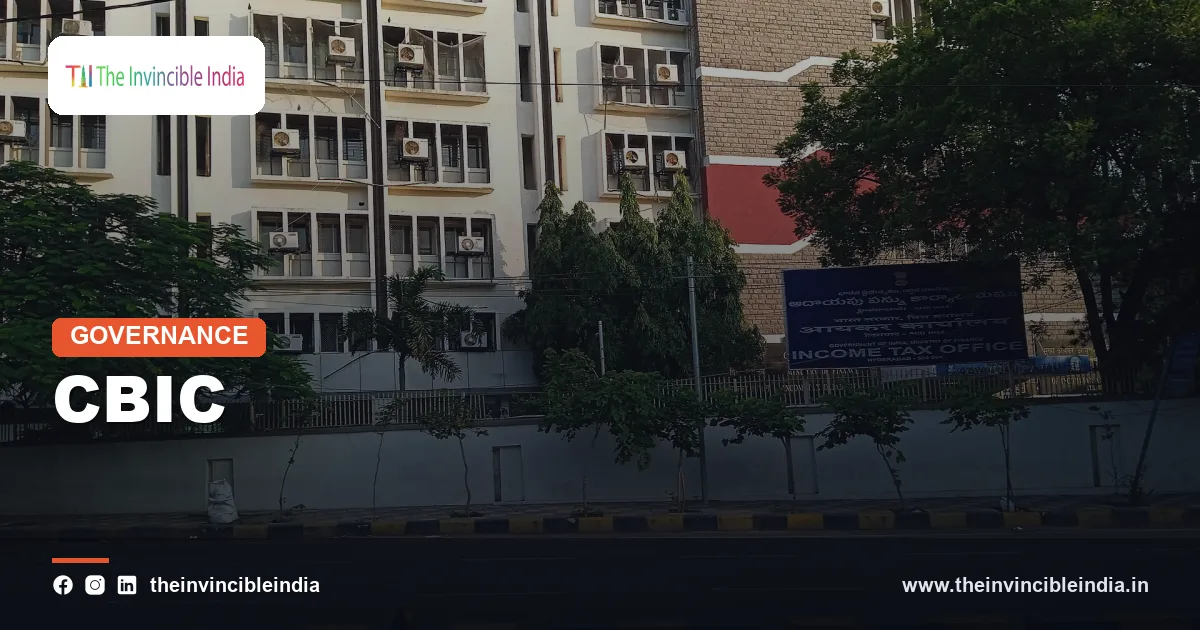
The Central Board of Indirect Taxes and Customs (CBIC) is the apex statutory body in India that administers the Goods and Services Tax (GST) at the Union level, along with customs, central excise and narcotics control, as part of the Department of Revenue in the Ministry of Finance. The Central Board of Indirect Taxes and Customs was known as the Central Board of Excise and Customs (CBEC) until it was renamed in 2018, after the introduction of GST in 2017 changed the nature of its work.
Every imported consignment cleared at a port or airport, and every GST registration and return processed under central law, falls within the system that CBIC supervises. The Board formulates policy inputs, supervises field formations, runs enforcement through specialised directorates and works to simplify trade procedures.
| Attribute | Details |
|---|---|
| Full name | Central Board of Indirect Taxes and Customs (CBIC) |
| Former name | Central Board of Excise and Customs (CBEC); renamed in 2018 |
| Established | 1 January 1964 as a separate board, after the Central Board of Revenue was split under the Central Boards of Revenue Act, 1963 |
| Parent ministry | Department of Revenue, Ministry of Finance, Government of India |
| Headed by | Chairperson, supported by Members for areas such as customs, GST, investigation, IT and administration |
| Headquarters | North Block, New Delhi |
| Principal laws | Customs Act, 1962; Central GST Act, 2017; Integrated GST Act, 2017; Central Excise Act, 1944; Customs Tariff Act, 1975 |
| Key enforcement bodies | Directorate of Revenue Intelligence (DRI), Directorate General of GST Intelligence (DGGI) |
| Related body | GST Council, a constitutional body under Article 279A, chaired by the Union Finance Minister |
Key Takeaways
- The Central Board of Indirect Taxes and Customs is the Union Government’s apex authority for GST administration, customs, central excise and narcotics control.
- CBIC was called the Central Board of Excise and Customs until 2018, and its present name reflects the change brought by GST, which took effect on 1 July 2017.
- The Central Board of Indirect Taxes and Customs works under the Department of Revenue but takes policy cues on GST rates and rules from the GST Council, a separate constitutional body.
- The Directorate of Revenue Intelligence (DRI) and the Directorate General of GST Intelligence (DGGI) are the Board’s main intelligence and anti-evasion agencies.
- Customs administration under CBIC covers import and export clearance, valuation, tariff classification and anti-smuggling measures at seaports, airports, land borders and inland container depots.
- Appeals against orders passed by CBIC officers go to the Commissioner (Appeals), then to the Customs, Excise and Service Tax Appellate Tribunal (CESTAT), and eventually to the High Court or Supreme Court on points of law.
What is the Central Board of Indirect Taxes and Customs?
The Central Board of Indirect Taxes and Customs is the Government of India’s administrative body for taxes on goods, services and international trade, and it sits within the Department of Revenue. It is responsible for formulating policy inputs, drafting rules and supervising the officers who implement customs and Union-level indirect tax laws.
The Board is a statutory body, constituted under the Central Boards of Revenue Act, 1963. It is a policy and administrative authority and not a court. The Board’s Chairperson also holds the rank of Special Secretary to the Government of India, and the Members are drawn from the Indian Revenue Service (Customs and Indirect Taxes).
How did CBEC become CBIC?
CBEC became CBIC in 2018 because the Goods and Services Tax, launched on 1 July 2017, subsumed most central excise duty and service tax and made the older name inaccurate. The change in name recognised that the Board now administered a broad indirect tax, GST, in addition to customs.
Key milestones
- 1924: The Central Board of Revenue was created.
- 1944: The Central Excise Act, 1944 was enacted, consolidating excise law.
- 1962: The Customs Act, 1962 replaced the Sea Customs Act, 1878 and related laws.
- 1964: The Central Board of Revenue was split, creating the Central Board of Excise and Customs and the Central Board of Direct Taxes.
- 1994: Service tax was introduced in India and administered by the Board.
- 2016: The 101st Constitution Amendment enabled GST and created the GST Council.
- 2017: GST rolled out on 1 July.
- 2018: CBEC was renamed CBIC.
What taxes and laws does CBIC administer?
CBIC administers the Central GST and Integrated GST laws, the Customs Act, 1962, the Central Excise Act, 1944 for the goods that remain outside GST, and the Narcotic Drugs and Psychotropic Substances Act, 1985 in respect of licit opium and related functions. The Board’s work thus spans domestic taxes and international trade.
- Central GST (CGST): The Union’s share of GST on intra-state supplies.
- Integrated GST (IGST): Tax on inter-state supplies and imports, shared between the Union and states.
- Customs duties: Basic customs duty, IGST on imports, and other duties and cesses such as anti-dumping, countervailing and safeguard duties.
- Central excise: Residual duties on a limited set of items, such as certain tobacco products and some petroleum products, since most excise was subsumed into GST.
- Narcotics control: Oversight of licit opium cultivation, procurement and processing through the Central Bureau of Narcotics.
State GST is administered by state tax departments, so the Board and the states divide the GST taxpayer base for administration.
How is the Central Board of Indirect Taxes and Customs organised?
The Central Board of Indirect Taxes and Customs is organised as a Chairperson-led Board with Members for subjects such as customs, GST, investigation, information technology and administration, supported by directorates and a network of field formations. The exact allocation of portfolios can change by Government order.
Field formations
- Zones: Headed by a Principal Chief Commissioner or Chief Commissioner, covering a region.
- Commissionerates: GST and Central Excise Commissionerates and Customs Commissionerates that administer taxpayers, audit and appeals within a geographic area.
- Customs Houses and ports: Offices at seaports, airports, land customs stations and inland container depots.
- Directorates: Specialised bodies such as the Directorate General of Systems and Data Management, the Directorate General of Taxpayer Services and the Directorate General of Audit.
The National Academy of Customs, Indirect Taxes and Narcotics (NACIN) trains officers of the Board, and the Directorate General of Taxpayer Services runs helpdesks and outreach.
What do DRI and DGGI do?
The Directorate of Revenue Intelligence (DRI) is the apex anti-smuggling and customs intelligence agency in India, while the Directorate General of GST Intelligence (DGGI) is the apex agency for detecting GST evasion. Both work under CBIC and share information with each other and with other enforcement agencies.
| Agency | Main focus | Notes |
|---|---|---|
| Directorate of Revenue Intelligence (DRI) | Smuggling of gold, narcotics, wildlife and other contraband; commercial fraud and customs duty evasion | Established in 1957 |
| Directorate General of GST Intelligence (DGGI) | GST evasion, fake invoicing and input tax credit fraud | Successor to the Directorate General of Central Excise Intelligence (DGCEI), reorganised after GST |
| Customs Preventive Commissionerates | Anti-smuggling along coasts and land borders | Part of field formations |
| Central Bureau of Narcotics | Licit opium and alkaloid regulation | Based in Gwalior |
DRI and DGGI officers hold powers of search, seizure, arrest and summons under the relevant Acts. Safeguards include the requirement of reasons to believe, adherence to arrest guidelines and judicial scrutiny.
How does CBIC facilitate trade?
CBIC facilitates trade by simplifying customs procedures, digitising clearance, and offering schemes that speed up the movement of goods for compliant traders. These measures follow India’s commitments under the World Trade Organization’s Trade Facilitation Agreement, which India ratified in 2016.
- ICEGATE: The Indian Customs EDI Gateway, the portal for electronic filing of bills of entry and shipping bills.
- Indian Customs Single Window: A facility that lets importers and exporters submit one set of documents to multiple regulators, also known as SWIFT.
- Faceless assessment: Customs assessment carried out through a national system and not by a local officer, introduced in stages from 2020.
- Authorised Economic Operator (AEO) programme: Benefits such as reduced inspections for traders with a good compliance record.
- Time Release Studies: Periodic measurement of how long cargo takes from arrival to release, to find bottlenecks.
- Turant Customs: A reform initiative to enable faster, paperless clearance.
These efforts have reduced clearance times at major ports and airports, though outcomes vary across locations and product types.
What is the impact of GST on CBIC’s role?
GST transformed CBIC’s role by replacing a patchwork of central and state indirect taxes with a single destination-based tax, and by shifting the Board’s focus towards technology-based compliance and data analytics. Taxes subsumed included central excise duty, service tax, additional customs duties and, on the state side, value added tax, octroi and entry tax.
The Goods and Services Tax Network (GSTN), a technology company, runs the common portal for registration, returns and payments. CBIC uses the data from this portal for risk analysis, returns scrutiny and audits.
GST rates and exemptions are decided by the GST Council, which includes the Union Finance Minister and the finance ministers of states. The Council has revised the rate structure over time, and in 2025 it moved towards a simpler set of main rates with a special higher rate for select goods. CBIC then implements these decisions through notifications and circulars.
How are disputes under CBIC laws resolved?
Disputes under CBIC laws are resolved through adjudication by officers, then appeals to the Commissioner (Appeals), the appellate tribunal, the High Court and the Supreme Court. The Board itself does not adjudicate individual disputes, but it issues circulars to ensure uniform interpretation.
- Adjudicating authority: A proper officer issues a show cause notice and passes an order.
- Commissioner (Appeals): The first appeal, with a pre-deposit requirement.
- CESTAT and GSTAT: The Customs, Excise and Service Tax Appellate Tribunal hears customs and excise matters, and the GST Appellate Tribunal has been set up for GST disputes.
- High Court and Supreme Court: Appeals on substantial questions of law, and writ petitions in limited circumstances.
- Advance rulings: The Authority for Advance Rulings gives binding advance rulings on GST questions to applicants.
The Board’s circulars bind its own officers, but they do not bind courts and cannot override the statute.
Why does CBIC matter for the economy?
CBIC matters because GST and customs duties form a large share of the Union Government’s tax receipts, and because smooth customs clearance is essential to India’s imports, exports and manufacturing supply chains. Its policies affect the cost of doing business and the prices consumers pay.
The Board also plays a security role, since customs officers are often the first line of defence against smuggling of narcotics, arms, wildlife and counterfeit goods. Meanwhile, anti-evasion work helps protect revenue and level the field for honest businesses.
Critics and traders have pointed to compliance complexity under GST and occasional disputes over enforcement. Reforms such as simplified returns, invoice-matching and automation aim to address those concerns.
What challenges and reforms shape the Central Board of Indirect Taxes and Customs today?
The Central Board of Indirect Taxes and Customs faces the twin challenge of making compliance easier for honest taxpayers while detecting sophisticated evasion, such as fake invoices and misclassified imports. Reforms therefore focus on technology, risk-based scrutiny and reduced personal contact between officers and traders.
Main areas of reform
- Data analytics: The Board uses data from GST returns, e-invoices, e-way bills and customs filings to identify risky taxpayers and consignments instead of checking every case.
- E-invoicing and e-way bills: Electronic invoicing for larger businesses and electronic movement documents for goods give officers a verifiable digital trail.
- Risk-based customs clearance: A risk management system selects only a small share of consignments for physical examination, which speeds up the rest.
- Ease of compliance: Pre-filled returns, simplified registration and refund processes are meant to reduce costs for small businesses.
- Taxpayer rights: Circulars and charters on arrests, summons and recovery try to set clear limits on enforcement action, following court guidance.
Despite these efforts, traders continue to raise issues such as classification disputes, input tax credit mismatches and delays in refunds. The Board responds with clarifications and, where needed, recommendations to the GST Council for legislative or rate changes.
Customs administration faces its own challenges. Rising e-commerce volumes, courier imports and the need to prevent under-invoicing require continuous updating of procedures. Border security and the interception of narcotics also demand close coordination with agencies such as the Narcotics Control Bureau, the Border Security Force and the Coast Guard.
Bottom Line
The Central Board of Indirect Taxes and Customs is the Union Government’s administrator of GST, customs and central excise, evolving from the Central Board of Excise and Customs after the 2017 GST reform. It runs the field machinery, enforcement agencies and trade facilitation programmes that connect tax policy with day-to-day business.
Frequently Asked Questions
What is CBIC in India?
CBIC is the Central Board of Indirect Taxes and Customs, the apex body administering GST, customs and central excise at the Union level. It works under the Department of Revenue in the Ministry of Finance.
What was CBIC called before 2018?
Before 2018, the Board was called the Central Board of Excise and Customs (CBEC). It was renamed CBIC after the introduction of GST in 2017 changed the scope of its work.
What is the difference between CBIC and the GST Council?
CBIC is an administrative body that implements Union-level GST and customs laws, whereas the GST Council is a constitutional body that recommends GST rates, exemptions and rules. The GST Council is chaired by the Union Finance Minister and includes state finance ministers.
What are DRI and DGGI?
DRI is the Directorate of Revenue Intelligence, which fights smuggling and customs fraud, and DGGI is the Directorate General of GST Intelligence, which detects GST evasion. Both function under CBIC and have powers of search, seizure and arrest.
Who handles appeals against CBIC orders?
Appeals against CBIC officers’ orders go first to the Commissioner (Appeals), then to the appropriate appellate tribunal such as CESTAT or the GST Appellate Tribunal. Further appeals on questions of law go to the High Court and Supreme Court.
Does CBIC collect state GST?
No, CBIC administers Central GST and Integrated GST, while State GST is administered by state tax departments. Taxpayers are divided between the Centre and the states for administrative purposes.
{“@context”:”https://schema.org”,”@graph”:[{“@type”:”FAQPage”,”mainEntity”:[{“@type”:”Question”,”name”:”What is CBIC in India?”,”acceptedAnswer”:{“@type”:”Answer”,”text”:”CBIC is the Central Board of Indirect Taxes and Customs, the apex body administering GST, customs and central excise at the Union level. It works under the Department of Revenue in the Ministry of Finance.”}},{“@type”:”Question”,”name”:”What was CBIC called before 2018?”,”acceptedAnswer”:{“@type”:”Answer”,”text”:”Before 2018, the Board was called the Central Board of Excise and Customs (CBEC). It was renamed CBIC after the introduction of GST in 2017 changed the scope of its work.”}},{“@type”:”Question”,”name”:”What is the difference between CBIC and the GST Council?”,”acceptedAnswer”:{“@type”:”Answer”,”text”:”CBIC is an administrative body that implements Union-level GST and customs laws, whereas the GST Council is a constitutional body that recommends GST rates, exemptions and rules. The GST Council is chaired by the Union Finance Minister and includes state finance ministers.”}},{“@type”:”Question”,”name”:”What are DRI and DGGI?”,”acceptedAnswer”:{“@type”:”Answer”,”text”:”DRI is the Directorate of Revenue Intelligence, which fights smuggling and customs fraud, and DGGI is the Directorate General of GST Intelligence, which detects GST evasion. Both function under CBIC and have powers of search, seizure and arrest.”}},{“@type”:”Question”,”name”:”Who handles appeals against CBIC orders?”,”acceptedAnswer”:{“@type”:”Answer”,”text”:”Appeals against CBIC officers’ orders go first to the Commissioner (Appeals), then to the appropriate appellate tribunal such as CESTAT or the GST Appellate Tribunal. Further appeals on questions of law go to the High Court and Supreme Court.”}},{“@type”:”Question”,”name”:”Does CBIC collect state GST?”,”acceptedAnswer”:{“@type”:”Answer”,”text”:”No, CBIC administers Central GST and Integrated GST, while State GST is administered by state tax departments. Taxpayers are divided between the Centre and the states for administrative purposes.”}}]}]}


