

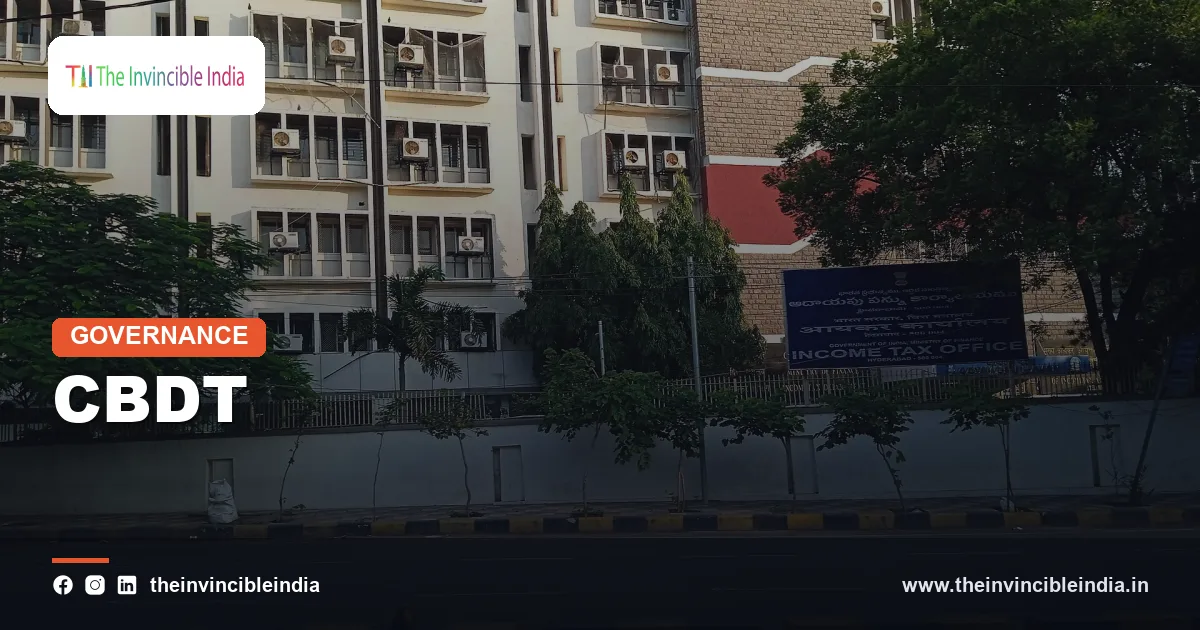
The Central Board of Direct Taxes (CBDT) is the apex statutory body in India that frames policy for, and oversees the administration of, direct taxes such as income tax and corporate tax, working through the Income Tax Department. The Central Board of Direct Taxes was created under the Central Boards of Revenue Act, 1963, functions as part of the Department of Revenue in the Ministry of Finance, and is headquartered in North Block, New Delhi.
When an Indian taxpayer files a return, receives a refund notice or reads a circular on a tax rule, the underlying machinery traces back to CBDT. The Board advises the Government on direct tax legislation, issues binding clarifications to tax officers, and supervises the officers who assess and collect taxes across the country.
| Attribute | Details |
|---|---|
| Full name | Central Board of Direct Taxes (CBDT) |
| Established | 1 January 1964, after the Central Board of Revenue was split under the Central Boards of Revenue Act, 1963 |
| Parent ministry | Department of Revenue, Ministry of Finance, Government of India |
| Type of body | Statutory apex authority for direct taxes; attached to the Department of Revenue |
| Headed by | Chairperson, supported by up to six Members |
| Headquarters | North Block, New Delhi |
| Main law administered | Income-tax Act, 1961 (with the Income-tax Act, 2025 enacted to replace it from 1 April 2026) |
| Field organisation | Income Tax Department, with regions headed by Principal Chief Commissioners |
| Earlier body | Central Board of Revenue, created in 1924 |
Key Takeaways
- The Central Board of Direct Taxes was formed on 1 January 1964, when the Central Board of Revenue was divided into two boards, one for direct taxes and one for indirect taxes.
- CBDT is a statutory body in the Department of Revenue, Ministry of Finance, and it administers direct taxes through the Income Tax Department.
- The Central Board of Direct Taxes is headed by a Chairperson and up to six Members, who are drawn mainly from the Indian Revenue Service (Income Tax).
- Under Section 119 of the Income-tax Act, 1961, CBDT may issue orders, instructions and circulars that bind income-tax authorities but cannot bind the taxpayer or override the Act.
- CBDT also supervises e-filing, faceless assessment, the issue of Permanent Account Numbers (PAN) and the negotiation of tax treaties along with the Ministry of Finance.
- The Income Tax Appellate Tribunal (ITAT) is separate from the Central Board of Direct Taxes and is a quasi-judicial body under the Ministry of Law and Justice.
What is the Central Board of Direct Taxes?
The Central Board of Direct Taxes is the top administrative body for direct taxes in India, responsible for policy inputs, rule-making, and supervision of the Income Tax Department. Its jurisdiction covers taxes levied directly on income and wealth-like transactions, as opposed to taxes on goods and services.
The Board is not a tribunal and does not decide tax disputes in the way a court does. It acts as the Government’s executive arm for direct taxation, translating legislation into rules, forms, procedures and instructions that the officers and staff of the Income Tax Department apply in the field.
It reports to the Union Finance Minister through the Revenue Secretary. The Chairperson also has the rank of a Special Secretary to the Government of India.
When and why was CBDT created?
CBDT was created on 1 January 1964 when the Central Board of Revenue was split into the Central Board of Direct Taxes and the Central Board of Excise and Customs, now the Central Board of Indirect Taxes and Customs. The division was made under the Central Boards of Revenue Act, 1963, because the workload of a single board had become too large and specialised.
Historical background
- 1860: Income tax was first introduced in India by James Wilson, the first Finance Member of the Viceroy’s Council, after the 1857 uprising strained finances. India celebrates Income Tax Day on 24 July to mark this.
- 1922: The Indian Income-tax Act, 1922 established a more permanent framework.
- 1924: The Central Board of Revenue was set up under the Central Board of Revenue Act, 1924.
- 1961: The Income-tax Act, 1961 replaced the 1922 Act and became the main direct tax law for decades.
- 1964: The Board was reorganised and the direct-tax wing became the Central Board of Direct Taxes.
Over time the Board has handled a changing set of direct taxes, as some levies such as wealth tax, fringe benefit tax and banking cash transaction tax were introduced and later withdrawn.
Which taxes does the Central Board of Direct Taxes administer?
The Central Board of Direct Taxes administers income tax, which covers tax on individuals, Hindu Undivided Families, firms, companies and other entities, along with related levies such as securities transaction tax and certain other direct taxes. The principal law is the Income-tax Act, 1961, which the Income-tax Act, 2025 has been enacted to replace.
- Personal income tax: Levied on salaried individuals, professionals and others, with slabs set in the annual Finance Act.
- Corporate tax: Levied on the income of domestic companies and on foreign companies’ Indian-source income.
- Securities Transaction Tax: Levied on transactions in listed securities.
- Tax Deducted at Source (TDS) and Tax Collected at Source (TCS): Mechanisms through which tax is collected at the point of payment.
- Black money and benami laws: CBDT enforces the Black Money (Undisclosed Foreign Income and Assets) and Imposition of Tax Act, 2015 and the Prohibition of Benami Property Transactions Act, 1988, as amended in 2016, through the Income Tax Department.
Wealth tax was abolished from the 2015-16 financial year, and the Finance Act replaced it with a surcharge on high incomes.
How is the Central Board of Direct Taxes organised?
The Central Board of Direct Taxes is organised as a board headed by a Chairperson with up to six Members, each handling a defined set of functions, and it supervises the Income Tax Department’s field offices across India. The Members are drawn mainly from the Indian Revenue Service (Income Tax).
The subjects handled by Members include legislation and computerisation, investigation, revenue, audit and judicial matters, and administration, though the exact portfolio allocation can change by order of the Government. A number of Directorates General and Directorates operate under the Board, including those for investigation, intelligence and criminal investigation, systems, and international taxation.
Field structure
- Regions: Headed by Principal Chief Commissioners or Chief Commissioners of Income Tax.
- Charges: Headed by Principal Commissioners or Commissioners of Income Tax, who supervise assessing officers.
- Assessing Officers: Deputy and Assistant Commissioners or Income Tax Officers who handle returns and assessments.
- Central Processing Centre (CPC), Bengaluru: A centralised facility that processes returns and issues refunds.
What does the Central Board of Direct Taxes do?
The Central Board of Direct Taxes frames tax policy inputs, supervises collection and enforcement, issues circulars and clarifications, and monitors the Income Tax Department’s performance. These functions are mainly administrative and are exercised under powers conferred by the tax statutes.
- Policy and legislation: Advises the Finance Ministry on direct tax proposals made in the annual Union Budget.
- Rules and forms: Makes rules under the Income-tax Act, subject to Parliament, including forms, procedures and timelines.
- Circulars and instructions: Issues clarifications on how provisions should be applied.
- Administration: Posts, transfers and trains officers, and sets performance targets.
- International taxation: Works with the Finance Ministry on Double Taxation Avoidance Agreements, transfer pricing and Advance Pricing Agreements, introduced in 2012.
- Enforcement: Directs searches, surveys and investigations against suspected tax evasion.
The Board has also introduced taxpayer-service measures, including the Taxpayer Charter announced in 2020.
What is the legal force of CBDT circulars?
CBDT circulars are legally binding on income-tax authorities, but they do not bind taxpayers or courts and cannot override or restrict the Income-tax Act. Section 119 of the Income-tax Act, 1961 gives the Board the power to issue orders, instructions and directions for uniform administration of the law.
The Supreme Court has held in several cases that a circular beneficial to the taxpayer is binding on the department even if it goes beyond the strict text, as long as it relaxes the rigour of the law. A circular that imposes a burden not found in the statute can be struck down.
The Board may also use Section 119(2)(b) to relax time limits for specific claims in cases of genuine hardship, and Section 119(2)(a) to authorise relief from certain procedural requirements, within limits set in the Act.
How has CBDT modernised direct tax administration?
CBDT has modernised direct tax administration through centralised processing, online filing, electronic assessment and faceless proceedings, aimed at reducing contact between taxpayers and officers. The reforms were announced and implemented in stages over the last two decades.
| Reform | What it does |
|---|---|
| Permanent Account Number (PAN) | A unique ten-character identifier for taxpayers, widely used for financial transactions |
| Central Processing Centre (Bengaluru) | Centralised processing of returns and issue of refunds |
| E-filing portal | Online filing of returns; a new portal was launched in June 2021 |
| Faceless assessment (2019-2020) | Assessments handled by teams through a national centre without face-to-face contact |
| Faceless appeals (2020) | Appeals before the Commissioner (Appeals) handled through the National Faceless Appeal Centre |
| Annual Information Statement | A consolidated view of financial transactions reported about a taxpayer |
| Vivad se Vishwas (2020) | Settlement scheme to reduce pending direct tax litigation |
On 13 August 2020 the Government launched the platform “Transparent Taxation: Honouring the Honest”, which introduced faceless assessment, faceless appeals and the Taxpayer Charter.
Who resolves tax disputes if not the Central Board of Direct Taxes?
Tax disputes are resolved by the appellate hierarchy of the Commissioner (Appeals), the Income Tax Appellate Tribunal (ITAT), the High Courts and the Supreme Court, not by CBDT. The Board is a part of the executive and cannot adjudicate on the merits of an individual tax dispute.
- Commissioner (Appeals): The first appellate authority for assessment orders, now largely through the faceless system.
- Income Tax Appellate Tribunal (ITAT): The second appellate body and the last fact-finding forum, set up in 1941.
- High Court: Hears appeals on substantial questions of law.
- Supreme Court of India: The final appellate forum.
- Dispute Resolution Panel: An alternative forum for eligible assessees, mainly in transfer pricing and foreign company matters.
The Board does supervise the department’s litigation policy, setting monetary limits below which the department should not appeal, in order to reduce unnecessary litigation.
How is the Central Board of Direct Taxes different from the CBIC?
The Central Board of Direct Taxes differs from the Central Board of Indirect Taxes and Customs in that CBDT handles taxes on income, while CBIC handles GST, customs and central excise. Both are statutory boards in the Department of Revenue and share a common origin in the former Central Board of Revenue.
| Feature | CBDT | CBIC |
|---|---|---|
| Type of tax | Direct taxes (income tax, corporate tax) | Indirect taxes (GST, customs, central excise) |
| Main law | Income-tax Act, 1961 (and the 2025 Act) | CGST Act, 2017; Customs Act, 1962 |
| Field service | Indian Revenue Service (Income Tax) | Indian Revenue Service (Customs and Indirect Taxes) |
| Appellate tribunal | ITAT | CESTAT and GSTAT |
| Year formed as separate board | 1964 | 1964 (as CBEC; renamed CBIC in 2018) |
Why does CBDT matter to taxpayers and the economy?
CBDT matters because it administers a major share of the Union Government’s tax revenue and sets the day-to-day rules by which individuals and companies pay tax. The efficiency of the Board directly influences compliance costs, refund timelines and the climate for investment.
In recent years, direct taxes have accounted for roughly half or more of the Union Government’s gross tax revenue, though the exact share varies from year to year. A shift towards formalisation, digital reporting of transactions and a widening of the taxpayer base has supported this trend.
For ordinary taxpayers, the Board’s instructions decide practical matters such as filing deadlines, prescribed forms, and relief in cases of genuine difficulty. For businesses, its guidance on transfer pricing, withholding and cross-border taxation reduces uncertainty.
What is the Income-tax Act, 2025 and how does it affect the Central Board of Direct Taxes?
The Income-tax Act, 2025 is the new direct tax statute enacted by Parliament to replace the Income-tax Act, 1961, with the aim of using simpler language, fewer provisions and a clearer structure. The Central Board of Direct Taxes continues to be the body that frames rules, forms and clarifications under the new law once it takes effect from 1 April 2026.
The older Act had grown through six decades of amendments, and the Board had to issue a large number of circulars to explain overlapping provisions. The new Act is intended to reduce that burden. Its stated aim is to keep tax rates and the substance of the law broadly the same, while rewriting the text for readability.
- Transition: The Board is responsible for notifying new rules, forms and procedures so that taxpayers and officers can shift smoothly from the old framework.
- Continuity: Pending proceedings and earlier assessment years remain governed by the earlier Act in line with the transitional provisions.
- Guidance: Circulars, FAQs and notifications explain how earlier practices carry into the new law.
Readers should check the Board’s official notifications for the exact operative provisions, since transition rules may be updated.
Bottom Line
The Central Board of Direct Taxes is the policy and administrative head of India’s direct tax system, formed in 1964 and located within the Department of Revenue. It does not adjudicate disputes, but its rules, circulars and reforms shape how income tax is filed, assessed and collected.
Frequently Asked Questions
What is the Central Board of Direct Taxes?
The Central Board of Direct Taxes is India’s apex body for direct taxes, created under the Central Boards of Revenue Act, 1963. It advises on tax policy and supervises the Income Tax Department.
When was CBDT established?
CBDT came into existence on 1 January 1964, when the Central Board of Revenue was divided into two boards. The other board handled indirect taxes and is now the Central Board of Indirect Taxes and Customs.
Who heads the Central Board of Direct Taxes?
The Central Board of Direct Taxes is headed by a Chairperson, who also serves as Special Secretary to the Government of India. The Chairperson is assisted by up to six Members, who are drawn mainly from the senior ranks of the Indian Revenue Service.
Is a CBDT circular binding on taxpayers?
No, a CBDT circular binds income-tax officers but does not bind taxpayers or the courts. A circular that gives a benefit to the taxpayer is generally enforceable against the department, while one that conflicts with the Act can be set aside.
Is CBDT the same as the Income Tax Department?
No, CBDT is the apex policy-making body, whereas the Income Tax Department is the field organisation that assesses and collects tax. The Board supervises the Department and its officers.
Does CBDT decide income tax appeals?
No, CBDT does not decide appeals. Income tax appeals go to the Commissioner (Appeals), then to the Income Tax Appellate Tribunal, followed by the High Court and the Supreme Court.
{“@context”:”https://schema.org”,”@graph”:[{“@type”:”FAQPage”,”mainEntity”:[{“@type”:”Question”,”name”:”What is the Central Board of Direct Taxes?”,”acceptedAnswer”:{“@type”:”Answer”,”text”:”The Central Board of Direct Taxes is India’s apex body for direct taxes, created under the Central Boards of Revenue Act, 1963. It advises on tax policy and supervises the Income Tax Department.”}},{“@type”:”Question”,”name”:”When was CBDT established?”,”acceptedAnswer”:{“@type”:”Answer”,”text”:”CBDT came into existence on 1 January 1964, when the Central Board of Revenue was divided into two boards. The other board handled indirect taxes and is now the Central Board of Indirect Taxes and Customs.”}},{“@type”:”Question”,”name”:”Who heads the Central Board of Direct Taxes?”,”acceptedAnswer”:{“@type”:”Answer”,”text”:”The Central Board of Direct Taxes is headed by a Chairperson, who also serves as Special Secretary to the Government of India. The Chairperson is assisted by up to six Members, who are drawn mainly from the senior ranks of the Indian Revenue Service.”}},{“@type”:”Question”,”name”:”Is a CBDT circular binding on taxpayers?”,”acceptedAnswer”:{“@type”:”Answer”,”text”:”No, a CBDT circular binds income-tax officers but does not bind taxpayers or the courts. A circular that gives a benefit to the taxpayer is generally enforceable against the department, while one that conflicts with the Act can be set aside.”}},{“@type”:”Question”,”name”:”Is CBDT the same as the Income Tax Department?”,”acceptedAnswer”:{“@type”:”Answer”,”text”:”No, CBDT is the apex policy-making body, whereas the Income Tax Department is the field organisation that assesses and collects tax. The Board supervises the Department and its officers.”}},{“@type”:”Question”,”name”:”Does CBDT decide income tax appeals?”,”acceptedAnswer”:{“@type”:”Answer”,”text”:”No, CBDT does not decide appeals. Income tax appeals go to the Commissioner (Appeals), then to the Income Tax Appellate Tribunal, followed by the High Court and the Supreme Court.”}}]}]}


