

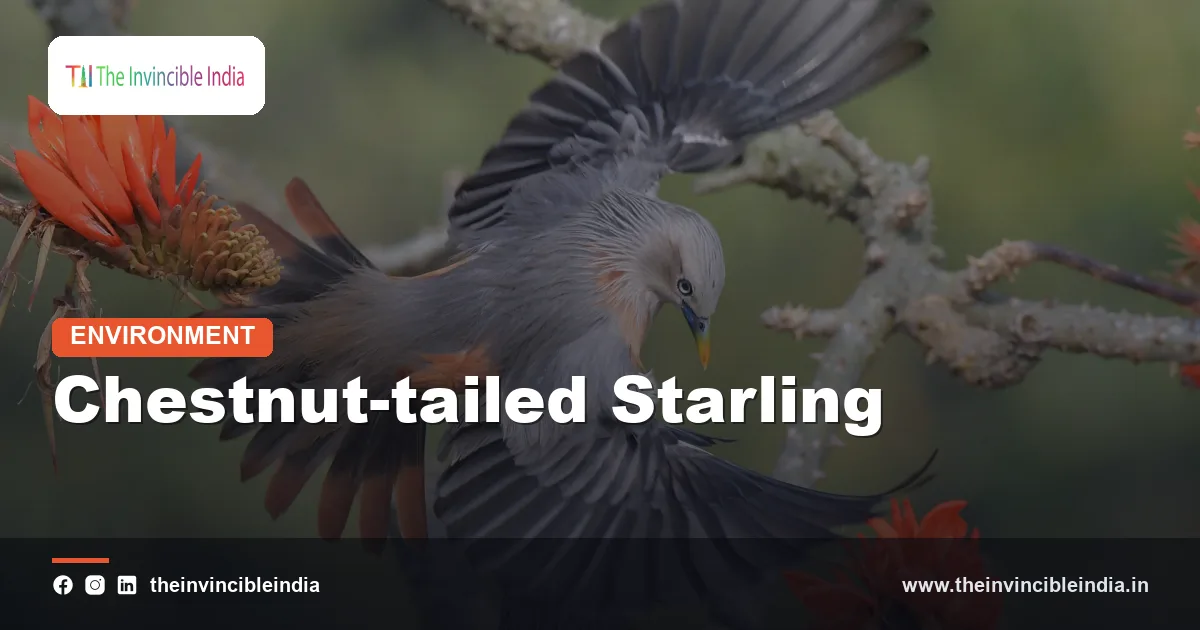
The chestnut-tailed starling (Sturnia malabarica) is a medium-sized, noisy, fruit- and nectar-eating bird of the starling family Sturnidae, easily recognised in India by its pale grey head and upperparts, pale eye, yellowish bill and rusty-chestnut belly, vent and tail edges. It lives in open woodland, groves, orchards and gardens across much of the Indian subcontinent and is usually seen in lively flocks that move from tree to tree in search of flowers and fruit.
Also known as the grey-headed starling, the chestnut-tailed starling is a close relative of the common myna and the Brahminy starling. Its habits, which include communal roosting and a strong liking for flowering silk-cotton and coral trees, make it a familiar sight in India’s deciduous belts and a useful bird to know for anyone beginning to watch garden and woodland birds.
Chestnut-tailed Starling Quick Facts
| Attribute | Detail |
|---|---|
| Common name | Chestnut-tailed starling (also grey-headed starling) |
| Scientific name | Sturnia malabarica (formerly placed in Sturnus) |
| Family | Sturnidae (starlings and mynas) |
| Size | About 20 cm, slightly smaller than a common myna |
| Range in India | Widespread in the Himalayan foothills, the plains, central India and the peninsula; absent from very dry deserts |
| Habitat | Open deciduous woodland, groves, orchards, plantations, gardens and village edges |
| Diet | Fruit, flower nectar, seeds and insects |
| Breeding | Nests in tree holes; lays about three to five pale blue eggs; local movements rather than long migrations |
| Conservation status | Least Concern on the IUCN Red List |
Key Takeaways
- The chestnut-tailed starling is a starling about 20 cm long, scientifically named Sturnia malabarica, with a pale grey head, a pale eye and rusty-chestnut underparts and tail edges.
- The chestnut-tailed starling lives in open woodland, groves and gardens across much of India and is a gregarious bird that forages and roosts in flocks.
- The chestnut-tailed starling feeds on fruit, flower nectar and insects, and it visits flowering trees such as silk-cotton and coral trees in large numbers.
- The chestnut-tailed starling nests in holes in trees, often using old woodpecker or barbet holes, and lays about three to five pale blue eggs.
- The chestnut-tailed starling is a mainly resident bird in India, though some populations make seasonal and local movements, especially from the hills.
- The IUCN lists the chestnut-tailed starling as Least Concern because it is widespread and adapts well to modified habitats.
What is the chestnut-tailed starling?
The chestnut-tailed starling is a medium-sized songbird in the starling and myna family that is found across South and South-East Asia, including most of India. Starlings are sociable, noisy, omnivorous birds with strong legs and straight, pointed bills.
The bird was formerly placed in the genus Sturnus, but it is now placed in the genus Sturnia, together with other Asian starlings such as the Brahminy starling. The species name malabarica refers to the Malabar coast of south-western India, where an early specimen was described.
Some authorities treat the darker, richly coloured birds of the peninsula and the Western Ghats as a separate species, called the Malabar or Blyth’s starling, while others keep them as a subspecies. This reflects slight differences in plumage tone, with the northern birds usually appearing paler and greyer.
What does the chestnut-tailed starling look like?
The chestnut-tailed starling has a pale silvery-grey head, neck and upperparts, a rusty-chestnut lower belly, vent and tail edges, a pale whitish eye and a yellowish bill with a bluish base. The fine pale streaks on the head and neck give it a soft, frosted appearance.
Plumage and bill
The upperparts are grey, with darker wings that show a slight greenish gloss in good light. The tail is dark, with chestnut on the outer feathers and underside. The bill is a distinctive pale yellow, grading to blue-grey at the base, and the legs are yellowish. Males and females look almost alike.
Juveniles and regional variation
Young birds are duller and browner, with less chestnut below and a darker bill. Birds of the Western Ghats and the peninsula are generally richer in colour, while those of the northern plains and the Himalayan foothills are paler. These variations explain why some field guides describe more than one form.
Size and build
The chestnut-tailed starling is about 20 cm long and has a compact body, a short tail and strong legs adapted for walking and hopping. It flies fast and direct, and flocks often move in a loose, rolling group.
Where is the chestnut-tailed starling found in India?
The chestnut-tailed starling is found across much of India, from the Himalayan foothills and the Gangetic plains through central India to the southern peninsula and the Western Ghats. It is common in the east and north-east and thinner in the arid north-west.
Its typical habitats are open and semi-open, and it avoids dense evergreen forest and open treeless land. They include:
- Deciduous forest and open woodland with large, flowering trees.
- Mango, tamarind and other orchards and plantations.
- Village groves, temple trees and avenue trees along roads.
- Large gardens and parks in towns and cities.
- Forest edges and cultivation with scattered big trees.
The bird is also found in Nepal, Bhutan, Bangladesh, Myanmar and parts of mainland South-East Asia. Birds from higher ground often move downhill in winter, and flocks may appear in places where they are absent for the rest of the year.
What does the chestnut-tailed starling eat?
The chestnut-tailed starling eats fruit, flower nectar, seeds and insects, making it an omnivorous bird with a strong preference for fruiting and flowering trees. It forages both in the canopy and on the ground.
Wild and cultivated figs, including banyan and peepal figs, are important foods, as are berries and small fruits. Large flocks gather at flowering trees such as the silk-cotton (Bombax ceiba) and the coral tree (Erythrina), where the birds drink nectar and take petals and insects attracted to the flowers. In doing so, they often act as pollinators.
Insects, including termite alates, grasshoppers and caterpillars, are also eaten, particularly when young are being fed. The bird sometimes hawks insects in the air, and it may follow grazing animals or ploughs to catch disturbed prey.
| Food type | Examples | Role in the diet |
|---|---|---|
| Fruit | Figs, berries, small tree fruits | Main food when trees are fruiting |
| Nectar and petals | Silk-cotton, coral tree, other flowering trees | Important energy source in the dry season |
| Insects | Termites, grasshoppers, caterpillars | Protein for adults and nestlings |
| Seeds and grain | Weed seeds, occasional grain | Minor supplement |
How does the chestnut-tailed starling breed?
The chestnut-tailed starling nests in holes in trees, using natural cavities or old holes made by woodpeckers and barbets, and lays about three to five pale blue eggs. The nest chamber is lined with grass, leaves and feathers.
The breeding season varies by region, though it generally falls in the warmer months before and around the onset of the monsoon. Both parents take part in nest-building, incubation and feeding the chicks, which are fed on insects and fruit. The chicks leave the nest after about three weeks.
Competition for nest holes is common among cavity-nesting birds such as mynas, parakeets and starlings. As a result, the availability of old trees with holes is an important factor in local populations. Dead and decaying trees that offer holes are valuable to this bird.
What is the call and behaviour of the chestnut-tailed starling?
The chestnut-tailed starling is a noisy, gregarious bird that produces a variety of chattering, whistling and squeaky notes, often in chorus when a flock is feeding. It spends most of the day in groups, and the sound of a flock moving between trees is often the first sign of its presence.
The song is a medley of chirps and slurred whistles, and the birds often mimic other sounds to some degree. Flocks forage together, calling to each other, and move in a loose, bounding flight. They roost communally in the evening, sometimes with other starlings and mynas, in trees that may be used for many years.
Outside the breeding season, flocks can number from a few birds to well over a hundred. They are usually wary but become bold in gardens where food is abundant, and they readily join mixed feeding parties with mynas, parakeets and bulbuls at fruiting trees.
How can the chestnut-tailed starling be told from similar birds?
The chestnut-tailed starling can be told from similar birds by its grey head, pale eye, yellow-and-blue bill and chestnut belly and vent. The common myna, Brahminy starling and other starlings differ in head pattern and bill colour.
| Species | How it differs from the chestnut-tailed starling |
|---|---|
| Brahminy starling | Black glossy crest on the head and orange-buff underparts; found in open country and gardens |
| Common myna | Brown body with a black head, bare yellow patch behind the eye and white wing patches in flight |
| Jungle myna | Greyish-brown with a tuft of feathers above the bill and a yellowish bill and legs |
| Asian pied starling | Black-and-white head pattern with a pale orange bill base |
| Rosy starling | Pink body with a glossy black head; a winter visitor to India |
The chestnut tones are most noticeable on the lower belly and vent and when the bird flies, and the pale eye gives a distinctive, rather mild expression in a close view.
Is the chestnut-tailed starling threatened?
The chestnut-tailed starling is not threatened and is rated Least Concern by the IUCN because of its wide range and large population. It tolerates human-modified landscapes and often increases where orchards and gardens provide food.
Local concerns include the loss of large old trees that provide nest holes and flowers, the felling of avenue and grove trees, and the use of pesticides that reduce insect food. Because the species relies on fruiting and flowering trees, planting native species such as figs, silk-cotton and coral trees helps maintain its numbers.
The bird is not widely trapped or kept as a pet, and it has no special legal status beyond general bird protection under Indian wildlife law. Overall, it is a good example of a woodland bird that adapts to semi-urban habitats.
Where and how can the chestnut-tailed starling be watched?
The chestnut-tailed starling is easiest to watch at flowering or fruiting trees in the early morning and late afternoon, when flocks arrive to feed noisily. Large silk-cotton and coral trees in bloom are especially good sites.
- Visit orchards, groves and large garden trees in fruit or flower.
- Listen for chattering flocks and follow the sound to the tree.
- Check mixed flocks of mynas and parakeets for grey-headed birds with pale eyes.
- Watch known evening roost trees from a distance as flocks gather.
- Use binoculars to see the bill colour and the chestnut belly and vent.
It can be seen in many Indian national parks, tiger reserves and city parks, and it is also frequent along forest roads and on village outskirts where large trees remain.
Bottom Line
The chestnut-tailed starling is a lively grey starling with a chestnut belly, vent and tail edges that lives in groves, woodlands and gardens across India. It feeds on fruit, nectar and insects, nests in tree holes and is not at risk, although it needs old trees to thrive.
Frequently Asked Questions
What is a chestnut-tailed starling?
The chestnut-tailed starling is a medium-sized starling, scientifically named Sturnia malabarica, with a pale grey head, pale eye, yellowish bill and chestnut belly, vent and tail edges. It is also called the grey-headed starling. It is common in open woodland, groves and gardens in India.
What does the chestnut-tailed starling eat?
The chestnut-tailed starling eats fruit, flower nectar, seeds and insects. It feeds on figs and berries and visits flowering silk-cotton and coral trees. Insects such as termites and caterpillars are important when it feeds young.
Where does the chestnut-tailed starling nest?
The chestnut-tailed starling nests in holes in trees, often old woodpecker or barbet holes. The nest is lined with grass, leaves and feathers. The female lays about three to five pale blue eggs, and both parents feed the chicks.
Is the chestnut-tailed starling the same as the Brahminy starling?
The chestnut-tailed starling is not the same as the Brahminy starling, although both belong to the genus Sturnia. The Brahminy starling has a black crest and orange-buff underparts, while the chestnut-tailed starling has a grey head and a chestnut belly and vent.
Does the chestnut-tailed starling migrate?
The chestnut-tailed starling is mainly a resident bird in India and does not make long-distance migrations. Some populations, especially from higher ground, move locally with the seasons and the availability of food. Flocks can therefore appear or disappear from an area.
Is the chestnut-tailed starling a threatened species?
The chestnut-tailed starling is not threatened and is listed as Least Concern by the IUCN. It is widespread and adapts well to orchards and gardens. The loss of large old trees with nest holes is a local concern.
{“@context”:”https://schema.org”,”@graph”:[{“@type”:”FAQPage”,”mainEntity”:[{“@type”:”Question”,”name”:”What is a chestnut-tailed starling?”,”acceptedAnswer”:{“@type”:”Answer”,”text”:”The chestnut-tailed starling is a medium-sized starling, scientifically named Sturnia malabarica, with a pale grey head, pale eye, yellowish bill and chestnut belly, vent and tail edges. It is also called the grey-headed starling. It is common in open woodland, groves and gardens in India.”}},{“@type”:”Question”,”name”:”What does the chestnut-tailed starling eat?”,”acceptedAnswer”:{“@type”:”Answer”,”text”:”The chestnut-tailed starling eats fruit, flower nectar, seeds and insects. It feeds on figs and berries and visits flowering silk-cotton and coral trees. Insects such as termites and caterpillars are important when it feeds young.”}},{“@type”:”Question”,”name”:”Where does the chestnut-tailed starling nest?”,”acceptedAnswer”:{“@type”:”Answer”,”text”:”The chestnut-tailed starling nests in holes in trees, often old woodpecker or barbet holes. The nest is lined with grass, leaves and feathers. The female lays about three to five pale blue eggs, and both parents feed the chicks.”}},{“@type”:”Question”,”name”:”Is the chestnut-tailed starling the same as the Brahminy starling?”,”acceptedAnswer”:{“@type”:”Answer”,”text”:”The chestnut-tailed starling is not the same as the Brahminy starling, although both belong to the genus Sturnia. The Brahminy starling has a black crest and orange-buff underparts, while the chestnut-tailed starling has a grey head and a chestnut belly and vent.”}},{“@type”:”Question”,”name”:”Does the chestnut-tailed starling migrate?”,”acceptedAnswer”:{“@type”:”Answer”,”text”:”The chestnut-tailed starling is mainly a resident bird in India and does not make long-distance migrations. Some populations, especially from higher ground, move locally with the seasons and the availability of food. Flocks can therefore appear or disappear from an area.”}},{“@type”:”Question”,”name”:”Is the chestnut-tailed starling a threatened species?”,”acceptedAnswer”:{“@type”:”Answer”,”text”:”The chestnut-tailed starling is not threatened and is listed as Least Concern by the IUCN. It is widespread and adapts well to orchards and gardens. The loss of large old trees with nest holes is a local concern.”}}]}]}


