

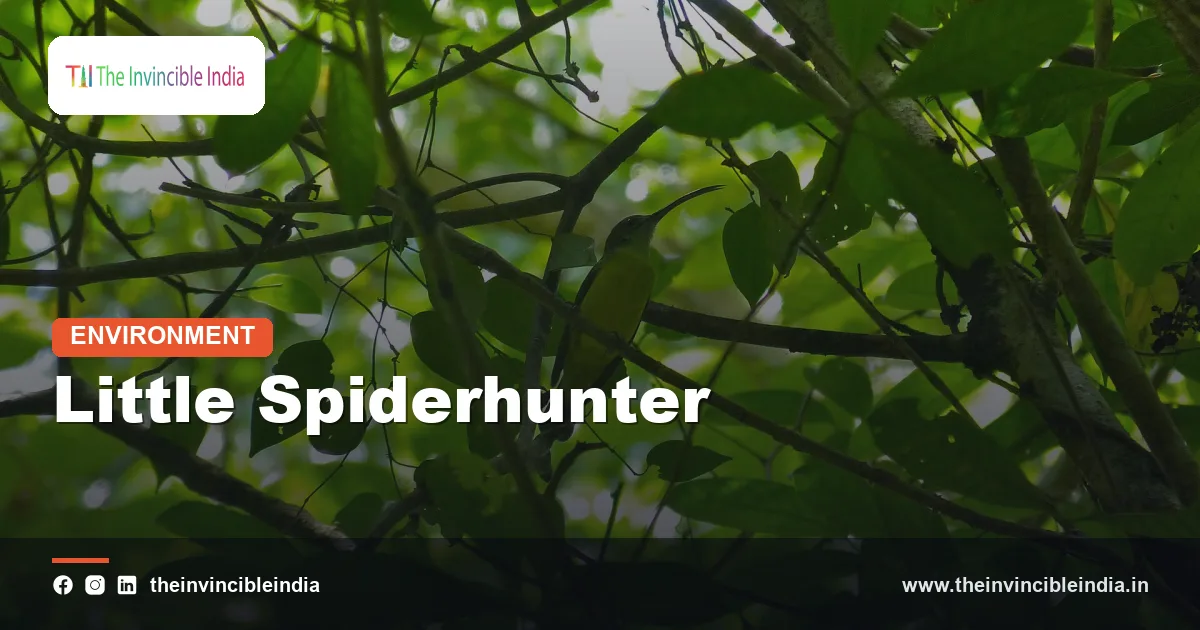
The little spiderhunter (Arachnothera longirostra) is a small olive-coloured nectar-feeding bird of Indian forests, a relative of the sunbirds in the family Nectariniidae that is recognised by a very long, downcurved bill used to probe flowers for nectar and to pick spiders and insects from webs and leaves. It lives in the shade of moist evergreen forest, bamboo and wild banana thickets, and it is usually noticed by its loud, sharp calls before it is seen.
The little spiderhunter is a modest bird in appearance, but its habits are remarkable. It pollinates forest flowers while feeding, and it builds a hanging nest stitched to the underside of a broad leaf with spider silk, a technique that has made the species a favourite of naturalists who study forest ecology in the Western Ghats and the north-east.
Little Spiderhunter Quick Facts
| Attribute | Detail |
|---|---|
| Common name | Little spiderhunter |
| Scientific name | Arachnothera longirostra |
| Family | Nectariniidae (sunbirds and spiderhunters) |
| Size | About 16 cm long, including a bill of roughly 3 cm |
| Range in India | North-east India, the eastern Himalayan foothills and the Western Ghats |
| Habitat | Moist evergreen and semi-evergreen forest, forest edges, bamboo and wild banana or ginger thickets |
| Diet | Nectar from forest flowers, plus spiders and small insects |
| Breeding | Builds a small hanging nest sewn to the underside of a large leaf; lays about two eggs; resident, not migratory |
| Conservation status | Least Concern on the IUCN Red List |
Key Takeaways
- The little spiderhunter is a small sunbird relative, about 16 cm long, with the scientific name Arachnothera longirostra and a very long, downcurved bill.
- The little spiderhunter feeds on nectar from forest flowers such as wild bananas and gingers, and also catches spiders and small insects, which gives the group its name.
- The little spiderhunter builds a small, pendant nest that is stitched to the underside of a large leaf using spider silk and plant fibres.
- The little spiderhunter occurs in India in two separated regions, the forests of the north-east and the Western Ghats, and it is a resident that does not migrate.
- The little spiderhunter acts as a pollinator of forest plants, because pollen is carried on its head and bill as it moves between flowers.
- The IUCN lists the little spiderhunter as Least Concern, although it depends on intact forest and suffers where undergrowth is cleared.
What is the little spiderhunter?
The little spiderhunter is a small, forest-dwelling songbird in the family Nectariniidae, which also includes the sunbirds, and it is placed in the genus Arachnothera. The genus name comes from Greek words meaning “spider” and “hunter”, reflecting the bird’s habit of picking spiders from their webs.
Spiderhunters differ from the glossy sunbirds by their drab plumage and their longer, more curved bills. They are mostly birds of the forest interior and lower storeys, and they rely on large, nectar-rich flowers that are common in tropical rainforest. The little spiderhunter is the smallest of the group found in India, while the streaked spiderhunter is a larger species that shares some of its habitat in the north-east.
The species has a wide distribution across South and South-East Asia, with a range that extends from India and Sri Lanka through Myanmar and Thailand to Malaysia and Indonesia. Different geographic populations are classed as subspecies.
What does the little spiderhunter look like?
The little spiderhunter is an olive-green bird above and pale greyish or yellowish below, with a whitish throat, a faint pale eyebrow and a distinctly long, curved bill. The sexes look alike, and the plumage is plain enough that the bill is usually the first thing to attract attention.
Key features
- Bill: very long, slender and strongly downcurved, blackish above and paler at the base.
- Upperparts: olive-green on the back, wings and tail.
- Underparts: greyish-white to pale yellow, sometimes with faint streaking on the breast.
- Throat: whitish, set off against a slightly darker moustachial area.
- Pectoral tufts: small orange-yellow tufts at the sides of the breast, which can be fluffed up in display.
- Legs: orange or yellowish-orange.
Size and shape
The little spiderhunter is about 16 cm long, with a bill that makes up about a fifth of its length. It has a short tail and a compact body, and it often clings to flower stems or hangs at awkward angles while probing flowers.
Where is the little spiderhunter found in India?
The little spiderhunter is found in India in the forests of the north-east and the eastern Himalayan foothills, and in the Western Ghats of the south-west. The two populations are geographically separate and have been treated as distinct subspecies.
In the north-east, the bird occurs in states such as Sikkim, northern West Bengal, Assam, Arunachal Pradesh, Meghalaya, Nagaland, Manipur, Mizoram and Tripura, mostly in lowland and foothill forests. In the south-west, it lives in the evergreen and moist forests of the Western Ghats, with records in Karnataka, Kerala and Tamil Nadu. It is generally found at low and middle elevations and becomes scarce in the high mountains.
Within these areas, the bird is tied to forest with a good understorey, including:
- Moist evergreen and semi-evergreen forest.
- Bamboo and cane thickets along streams.
- Patches of wild banana and plants of the ginger family.
- Well-wooded gardens and plantations adjoining forest.
It tends to be absent from heavily degraded land, open farmland and dry deciduous forest. Outside India, the bird is also found in Sri Lanka, Bangladesh and across mainland South-East Asia.
What does the little spiderhunter eat?
The little spiderhunter eats nectar from forest flowers and also catches spiders and small insects, so it is both a nectar feeder and an insect-eater. The long bill allows it to reach deep into tubular flowers, while the tongue, which is partly tubular and brush-tipped, draws out the nectar.
Wild bananas, plants of the ginger family and other large-flowered understorey species are important food plants. When feeding, the bird may cling to the flower stalk or hover briefly, and it moves from flower to flower on a regular route. Pollen sticks to its face and bill, which makes it a pollinator.
The animal part of the diet provides protein, particularly for breeding birds and nestlings. The bird picks spiders from webs, gleans insects from the undersides of leaves, and may take small caterpillars and other soft-bodied prey. This flexibility enables it to survive in seasons when flowers are scarce.
How does the little spiderhunter build its nest?
The little spiderhunter builds a small hanging nest that is sewn to the underside of a large leaf, such as a wild banana or a broad-leaved forest plant, using spider silk and plant fibres. The leaf serves as both an attachment point and a roof against rain.
The nest is a small cup or pouch made of fine fibres, moss and bits of plant material, bound together with cobweb. The bird pierces the leaf and threads the silk through the holes, much as a tailorbird sews leaves, so the nest hangs from the leaf as if suspended from a ceiling. The clutch is small, typically about two eggs, which keeps the demand on the parents modest.
The breeding season varies across the range, and it often falls in spring and the early months of summer, before and during the monsoon. Both parents are thought to feed the chicks, and the nest is often placed low enough to be found by patient observers, although it is easily overlooked because the leaf hides it from view.
How does the little spiderhunter help the forest?
The little spiderhunter helps the forest by carrying pollen between the flowers of understorey plants, which allows those plants to set seed. It is one of a small group of nectar-feeding birds that act as specialist pollinators in tropical forests.
Many large-flowered plants of the forest floor, including wild bananas and members of the ginger family, depend on birds and other animals for pollination. Spiderhunters visit these flowers repeatedly in a day, and the pollen that settles on the head and bill is carried to the next flower. This is often called ornithophily, or pollination by birds.
By eating spiders and insects, the bird also helps regulate invertebrate numbers, although its effect on the forest is smaller than that of larger insectivorous birds. The species is therefore a useful indicator of the health of the understorey, because it requires both flowering plants and an invertebrate food supply.
How can the little spiderhunter be told from similar birds?
The little spiderhunter can be told from similar birds by its long, strongly curved bill, plain olive plumage and small size. Sunbirds are often more colourful, and other spiderhunters are larger and more heavily streaked.
| Bird | How it differs from the little spiderhunter |
|---|---|
| Streaked spiderhunter | Larger, with bold dark streaks on the underside and a heavier bill |
| Purple sunbird | Male glossy blue-black in breeding plumage; shorter bill; found in open, drier habitats |
| Purple-rumped sunbird | Smaller bill, a purple rump and a yellow belly in the male; found in gardens and light forest |
| Flowerpeckers | Much smaller, with a short, stout bill and a different feeding style |
| Tailorbirds | Warbler-like, with a short, thin bill and a cocked tail |
The calls are also helpful. The little spiderhunter gives loud, sharp, repeated “chit” notes from the understorey, often while moving between flowers. Since the plumage is dull, the sound and the bill shape are the main clues in dense forest.
Is the little spiderhunter threatened?
The little spiderhunter is not considered threatened and is listed as Least Concern by the IUCN because of its wide range across South and South-East Asia. However, the bird depends on forest understorey and can decline where habitat is degraded.
The main threats in India are loss and fragmentation of evergreen forest through logging, shifting cultivation, plantations, roads and development. Clearing of wild banana and ginger patches, which provide nectar and nest sites, can also reduce local numbers. Birds in the Western Ghats and in the north-east are therefore more secure inside protected forests, national parks and wildlife sanctuaries.
The species is not hunted for food or kept as a cage bird to any significant extent. Conserving continuous forest and understorey vegetation benefits the little spiderhunter along with many other forest birds.
Where and how can the little spiderhunter be watched?
The little spiderhunter is best watched at flowering wild bananas, gingers and other nectar plants in moist forest, particularly in the early morning when the birds feed most actively. Patience at a flowering patch is more productive than walking through the forest.
- Look for flowering banana and ginger plants along forest tracks and streams.
- Listen for sharp “chit” calls from the understorey and follow them quietly.
- Scan the undersides of large leaves for small hanging nests.
- Use binoculars, as the bird often stays in shade and moves quickly.
- Visit protected forests in the Western Ghats or the north-east for the best chances.
Birdwatchers often find the species in places such as the forests of Sikkim, the Duars of North Bengal, Assam and Arunachal Pradesh in the north-east, and in the evergreen belts of the Western Ghats in Karnataka and Kerala.
Bottom Line
The little spiderhunter is a small olive forest bird whose long, curved bill and unusual leaf-sewn nest set it apart. It feeds on nectar and spiders, pollinates understorey plants, and remains secure only where moist forest and its flowering undergrowth survive.
Frequently Asked Questions
What is a little spiderhunter?
The little spiderhunter is a small olive-green forest bird, scientifically called Arachnothera longirostra, in the family Nectariniidae with the sunbirds. It has a very long, downcurved bill. It feeds on nectar and on spiders and small insects.
Why is it called a spiderhunter?
The little spiderhunter is called a spiderhunter because it picks spiders from their webs and from leaves as part of its diet. The genus name Arachnothera comes from Greek words meaning “spider” and “hunter”. The bird also drinks nectar, so the name describes only part of its feeding habits.
Where is the little spiderhunter found in India?
The little spiderhunter is found in India in the moist forests of the north-east and eastern Himalayan foothills and in the Western Ghats. The two populations are separated by a large gap. It also occurs in Sri Lanka and across South-East Asia.
How does the little spiderhunter build its nest?
The little spiderhunter builds a small hanging nest that it stitches to the underside of a large leaf, using spider silk and plant fibres. The leaf acts as a roof against rain. The female usually lays about two eggs.
Does the little spiderhunter migrate?
The little spiderhunter does not migrate and is a resident bird that stays in the same forest areas throughout the year. It may make local movements to follow flowering plants. This habit differs from many other Indian birds that travel long distances.
Is the little spiderhunter endangered?
The little spiderhunter is not endangered and is rated Least Concern by the IUCN. It has a wide range and is fairly common in suitable forest. Loss of forest understorey is the main long-term concern.
{“@context”:”https://schema.org”,”@graph”:[{“@type”:”FAQPage”,”mainEntity”:[{“@type”:”Question”,”name”:”What is a little spiderhunter?”,”acceptedAnswer”:{“@type”:”Answer”,”text”:”The little spiderhunter is a small olive-green forest bird, scientifically called Arachnothera longirostra, in the family Nectariniidae with the sunbirds. It has a very long, downcurved bill. It feeds on nectar and on spiders and small insects.”}},{“@type”:”Question”,”name”:”Why is it called a spiderhunter?”,”acceptedAnswer”:{“@type”:”Answer”,”text”:”The little spiderhunter is called a spiderhunter because it picks spiders from their webs and from leaves as part of its diet. The genus name Arachnothera comes from Greek words meaning “spider” and “hunter”. The bird also drinks nectar, so the name describes only part of its feeding habits.”}},{“@type”:”Question”,”name”:”Where is the little spiderhunter found in India?”,”acceptedAnswer”:{“@type”:”Answer”,”text”:”The little spiderhunter is found in India in the moist forests of the north-east and eastern Himalayan foothills and in the Western Ghats. The two populations are separated by a large gap. It also occurs in Sri Lanka and across South-East Asia.”}},{“@type”:”Question”,”name”:”How does the little spiderhunter build its nest?”,”acceptedAnswer”:{“@type”:”Answer”,”text”:”The little spiderhunter builds a small hanging nest that it stitches to the underside of a large leaf, using spider silk and plant fibres. The leaf acts as a roof against rain. The female usually lays about two eggs.”}},{“@type”:”Question”,”name”:”Does the little spiderhunter migrate?”,”acceptedAnswer”:{“@type”:”Answer”,”text”:”The little spiderhunter does not migrate and is a resident bird that stays in the same forest areas throughout the year. It may make local movements to follow flowering plants. This habit differs from many other Indian birds that travel long distances.”}},{“@type”:”Question”,”name”:”Is the little spiderhunter endangered?”,”acceptedAnswer”:{“@type”:”Answer”,”text”:”The little spiderhunter is not endangered and is rated Least Concern by the IUCN. It has a wide range and is fairly common in suitable forest. Loss of forest understorey is the main long-term concern.”}}]}]}


