

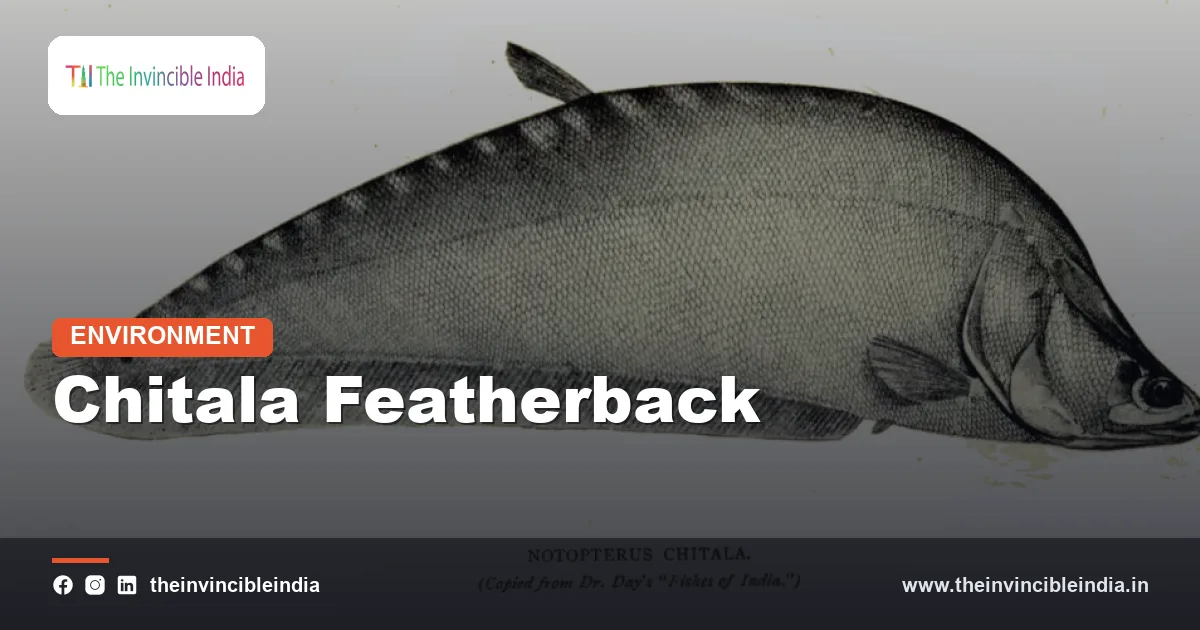
The chitala, also called the Indian featherback or humped featherback (Chitala chitala), is a large, knife-shaped freshwater fish of South Asian rivers, known for its arched back, long rippling fin along the belly and a row of dark, pale-ringed spots near the tail. It belongs to the featherback or knifefish family and is a night-active predator that lives in slow, vegetated stretches of big rivers, floodplain wetlands and oxbow lakes.
The chitala is valued in two very different worlds: as a prized, though very bony, table fish in eastern India and Bangladesh, and as a striking species in the aquarium trade. Its numbers have fallen in many rivers because of overfishing, habitat change and altered water flow, and it is regarded as a species of conservation concern.
| Fact | Detail |
|---|---|
| Common names | Chitala, Indian featherback, humped featherback, knifefish (chital or chitol in Bengali; moh in parts of north India) |
| Scientific name | Chitala chitala |
| Family | Notopteridae (the featherbacks and knifefishes) |
| Size | Commonly around 60 to 90 cm; large specimens can approach or exceed one metre |
| Range and habitat in India | Large rivers, floodplains, beels and oxbow lakes, mainly in the Ganga, Brahmaputra and Mahanadi systems and associated wetlands of northern, eastern and north-eastern India |
| Diet | Carnivorous: small fishes, prawns, insects and other aquatic invertebrates, hunted mostly at night |
| Breeding | Spawns in the monsoon; eggs are laid on hard submerged surfaces and guarded by the male |
| Status and importance | Considered Near Threatened globally; used as food and in the ornamental fish trade |
Key Takeaways
- The chitala (Chitala chitala) is a large freshwater knifefish of the family Notopteridae and is native to rivers of the Indian subcontinent.
- The chitala moves by rippling a long, continuous anal fin, which lets it swim forwards and backwards with its body held almost rigid.
- The chitala is a nocturnal predator that feeds mainly on smaller fishes, prawns and aquatic insects.
- Male chitala guard the eggs and the newly hatched young on a hard surface, a form of parental care uncommon among large river fishes.
- The chitala is a prized food fish in eastern India, famous for fish-ball curries, even though its flesh contains many fine bones.
- Overfishing, wetland loss and river regulation have reduced chitala populations, and the species is listed as Near Threatened by the IUCN.
What is the chitala and why is it called a featherback?
The chitala is a freshwater fish with a compressed, blade-like body, and it is called a featherback because the small, feather-like fin on its back and the strongly arched profile resemble the shape of a feather quill. Another common name, knifefish, refers to the narrow, tapering body that looks like a knife blade when seen from the side.
The fish belongs to the family Notopteridae, a small group of ancient-looking bony fishes found in Africa and South and Southeast Asia. In India the group includes the chitala, the bronze featherback (Notopterus notopterus, widely known as the grey featherback) and, in some regions, related species. The chitala differs from the bronze featherback by its larger size, its humped back and its spots near the tail.
Because common names overlap, it helps to separate two similar-sounding fishes. The clown knifefish (Chitala ornata) is a close relative native to mainland Southeast Asia. It has a similar shape and is popular as an aquarium fish worldwide, but the chitala of Indian rivers is Chitala chitala. People in India sometimes use the word chitala loosely for both.
What does the chitala look like?
The chitala looks like a long, flattened silver or grey fish with a distinct hump behind the head, a tiny dorsal fin, and a very long anal fin that runs from the belly almost to the tail. The head is relatively small, the mouth is large and lined with small teeth, and the eyes are set high on the head.
The most recognisable feature is a series of round dark spots, called ocelli, along the rear of the body. These spots are usually ringed with a lighter edge, and young fish often have more obvious, brighter markings than adults. Colour varies from silvery grey to brownish depending on age, water and habitat, and the belly is paler.
Adult chitala are commonly in the range of 60 to 90 cm, though exceptional individuals can approach or pass a metre. The body is covered with tiny scales, so that the fish feels smooth, and the flesh is sweet but crowded with many small, forked bones.
Where does the chitala live in India?
The chitala lives mainly in the large river systems of northern, eastern and north-eastern India, where it favours slow-flowing water with plenty of vegetation, floodplain lakes and deep pools. It occurs in the Ganga and Brahmaputra basins and in the Mahanadi, and it is associated with wetlands that stay connected to rivers during the monsoon.
Beyond India, the species is native to other parts of the Indian subcontinent, including Bangladesh, Nepal and Pakistan, and records extend into parts of Myanmar. Its distribution has become patchy because dams, barrages and embankments have separated rivers from their floodplains.
The chitala typically prefers:
- Slow, deep stretches of large rivers with submerged logs or vegetation.
- Floodplain wetlands (known as beels in Assam and Bengal) and oxbow lakes.
- Reservoirs and large ponds with cover, where it sometimes survives after being stocked.
- Warm, tropical water with low flow, and it avoids fast, cold mountain streams.
How does the chitala swim and breathe?
The chitala swims by rippling its long anal fin in waves, which propels the fish gently forward or backward while the body stays almost straight. This unusual style of movement, shared by many knifefishes, allows precise manoeuvring in cluttered, weedy water and helps the fish hunt without sudden bursts of noise.
The fish also has a modified swim bladder that is connected to the gut and richly supplied with blood vessels. This structure lets the chitala gulp air at the surface and absorb oxygen from it, which helps the fish survive in warm, oxygen-poor waters of ponds and floodplains. Many featherbacks can be seen rising to take air, particularly in still, summer water.
This ability to supplement gill breathing with air is one reason the fish survives in the shallow, stagnant pools that form when floodplains dry up. It does not, however, make the species immune to threats, because a fish that must surface to breathe is easier to catch.
What does the chitala eat?
The chitala eats mainly small fishes, prawns, shrimps, insects and other aquatic animals, and it hunts most actively at night. During the day it often rests among roots, snags or weeds, hidden from view.
Young chitala feed on zooplankton, insect larvae and tiny crustaceans, then gradually shift to larger prey as they grow. Adults ambush fish that wander near their cover, using the long anal fin to creep forward quietly. Their sensitivity to vibrations in the water helps them locate prey in dark, muddy conditions.
As a predator at the upper end of the food web in many floodplain wetlands, the chitala helps keep populations of smaller fish and insects in balance. Its decline therefore matters for the ecological health of the wetlands where it lives.
How does the chitala breed?
The chitala breeds during the monsoon, when rising water floods vegetation and provides new nesting and feeding areas, and it shows an unusual pattern of parental care in which the male guards the eggs. The fish lays its adhesive eggs on hard, submerged surfaces such as stones, wooden posts, roots or the walls of pits.
The key stages of breeding are as follows:
- A pair selects a clean, hard surface in slow, shallow water at the start of the monsoon.
- The female deposits a batch of sticky eggs, which the male fertilises.
- The male remains near the nest, fanning the eggs with his fins and chasing away intruders.
- The eggs hatch after a few days, and the male often continues to guard the young for a short time.
The number of eggs produced is moderate compared with that of carps and other river fishes, and this limits how quickly chitala numbers can recover. When breeding sites are destroyed by dredging or when brood fish are caught before spawning, the effect on the population can be large.
Why is the chitala important for food and the aquarium trade?
The chitala is important as a traditional food fish in eastern and north-eastern India and Bangladesh, and as an ornamental species in the aquarium trade. In the kitchen, its soft, sweet flesh is scraped from the many bones and made into balls and cakes, rather than being served as plain fillets.
The best-known preparation is the Bengali dish called chitol macher muitha, in which minced chitala flesh is shaped into small dumplings and simmered in a spiced gravy. The fish is also cooked in curries and fried in other parts of eastern India. Because of its fine bones, it is cooked and eaten with care, and many consumers pay a premium for wild-caught fish from rivers and wetlands.
In the ornamental trade, juvenile chitala and its relatives are sold to aquarium hobbyists for their unusual shape. Hobbyists should remember that the species grows very large, needs a spacious tank and will eat smaller tank mates. Buying only captive-bred stock helps reduce pressure on wild populations.
Chitala compared with other Indian featherbacks
| Feature | Chitala | Bronze featherback |
|---|---|---|
| Scientific name | Chitala chitala | Notopterus notopterus |
| Typical size | 60 to 90 cm or more | Usually below 40 cm |
| Body shape | Strongly humped back, larger body | More slender, less humped |
| Marking | Row of pale-ringed dark spots near the tail | Plainer, with a silvery grey or bronze body |
| Fishery value | Prized, higher priced | Common, lower priced |
Is the chitala endangered?
The chitala is not classed as endangered but it is considered Near Threatened by the International Union for Conservation of Nature (IUCN), which means its populations have declined and may become threatened if pressures continue. Local declines in some rivers and wetlands are significant, even though the species still survives across much of its range.
The main threats are:
- Overfishing, including capture of breeding fish and juveniles.
- Loss and drainage of floodplain wetlands and beels for farming and construction.
- Dams, barrages and embankments that disturb seasonal flooding and block movement between habitats.
- Pollution and siltation that degrade nursery areas.
- Destructive fishing methods such as small-mesh nets, dewatering and the use of poisons.
Conservation steps recommended by fisheries scientists include protecting breeding grounds in the monsoon, restricting the capture of brood fish, restoring floodplain connections and developing captive breeding. In several research centres in India and neighbouring countries, chitala has been bred in captivity, which offers a route to stock enhancement and farming.
Can the chitala be farmed?
The chitala can be farmed on a small scale, and induced breeding has been demonstrated in captivity, but farming remains limited compared with carp culture. The main obstacles are the fish’s carnivorous diet, its need for live or protein-rich feed, its relatively slow growth, and the difficulty of producing large quantities of seed.
Researchers have shown that chitala can be raised in ponds with a supply of small fish or formulated feeds, and it can be bred in tanks fitted with hard surfaces for egg laying. As demand for premium river fish grows, interest in captive production is rising. If successful, farmed chitala could reduce pressure on wild stocks and supply both the food market and the ornamental trade.
Bottom Line
The chitala is a distinctive knifefish of Indian rivers and floodplains, notable for its rippling fin, nocturnal hunting and egg-guarding males. Protecting floodplains and breeding grounds is essential if this prized fish is to remain part of India’s river life and cuisine.
Frequently Asked Questions
What is a chitala fish?
The chitala is a large freshwater knifefish, scientifically Chitala chitala, found in the rivers of the Indian subcontinent. It has a humped back, a long rippling anal fin and dark ringed spots near the tail. It is also called the Indian featherback or humped featherback.
Is the chitala the same as the clown knifefish?
The chitala and the clown knifefish are close relatives but they are not the same species. The chitala of Indian rivers is Chitala chitala, while the clown knifefish is Chitala ornata, native to Southeast Asia. Both look alike and the names are sometimes mixed up, particularly in the aquarium trade.
What does the chitala eat?
The chitala is a carnivore that eats small fishes, prawns, insects and other aquatic invertebrates. It hunts mainly at night and ambushes prey from cover. Young fish feed on zooplankton and insect larvae before moving to larger prey.
Can the chitala breathe air?
Yes, the chitala can take in air at the surface, because its swim bladder is modified to help with breathing. This lets it survive in warm, oxygen-poor water in ponds and floodplains. It still depends mainly on its gills for most of its oxygen.
Is the chitala safe to eat?
The chitala is safe and popular to eat when it is taken from clean water and cooked well. Its flesh is sweet but full of small bones, so it is often minced and made into fish balls such as the Bengali chitol macher muitha. Wild fish should be bought from legal, sustainable sources.
Is the chitala endangered in India?
The chitala is listed as Near Threatened by the IUCN rather than endangered. Its numbers have fallen in many rivers because of overfishing, wetland loss and river regulation. Protecting breeding grounds and floodplains is the main conservation priority.
{“@context”:”https://schema.org”,”@graph”:[{“@type”:”FAQPage”,”mainEntity”:[{“@type”:”Question”,”name”:”What is a chitala fish?”,”acceptedAnswer”:{“@type”:”Answer”,”text”:”The chitala is a large freshwater knifefish, scientifically Chitala chitala, found in the rivers of the Indian subcontinent. It has a humped back, a long rippling anal fin and dark ringed spots near the tail. It is also called the Indian featherback or humped featherback.”}},{“@type”:”Question”,”name”:”Is the chitala the same as the clown knifefish?”,”acceptedAnswer”:{“@type”:”Answer”,”text”:”The chitala and the clown knifefish are close relatives but they are not the same species. The chitala of Indian rivers is Chitala chitala, while the clown knifefish is Chitala ornata, native to Southeast Asia. Both look alike and the names are sometimes mixed up, particularly in the aquarium trade.”}},{“@type”:”Question”,”name”:”What does the chitala eat?”,”acceptedAnswer”:{“@type”:”Answer”,”text”:”The chitala is a carnivore that eats small fishes, prawns, insects and other aquatic invertebrates. It hunts mainly at night and ambushes prey from cover. Young fish feed on zooplankton and insect larvae before moving to larger prey.”}},{“@type”:”Question”,”name”:”Can the chitala breathe air?”,”acceptedAnswer”:{“@type”:”Answer”,”text”:”Yes, the chitala can take in air at the surface, because its swim bladder is modified to help with breathing. This lets it survive in warm, oxygen-poor water in ponds and floodplains. It still depends mainly on its gills for most of its oxygen.”}},{“@type”:”Question”,”name”:”Is the chitala safe to eat?”,”acceptedAnswer”:{“@type”:”Answer”,”text”:”The chitala is safe and popular to eat when it is taken from clean water and cooked well. Its flesh is sweet but full of small bones, so it is often minced and made into fish balls such as the Bengali chitol macher muitha. Wild fish should be bought from legal, sustainable sources.”}},{“@type”:”Question”,”name”:”Is the chitala endangered in India?”,”acceptedAnswer”:{“@type”:”Answer”,”text”:”The chitala is listed as Near Threatened by the IUCN rather than endangered. Its numbers have fallen in many rivers because of overfishing, wetland loss and river regulation. Protecting breeding grounds and floodplains is the main conservation priority.”}}]}]}


