

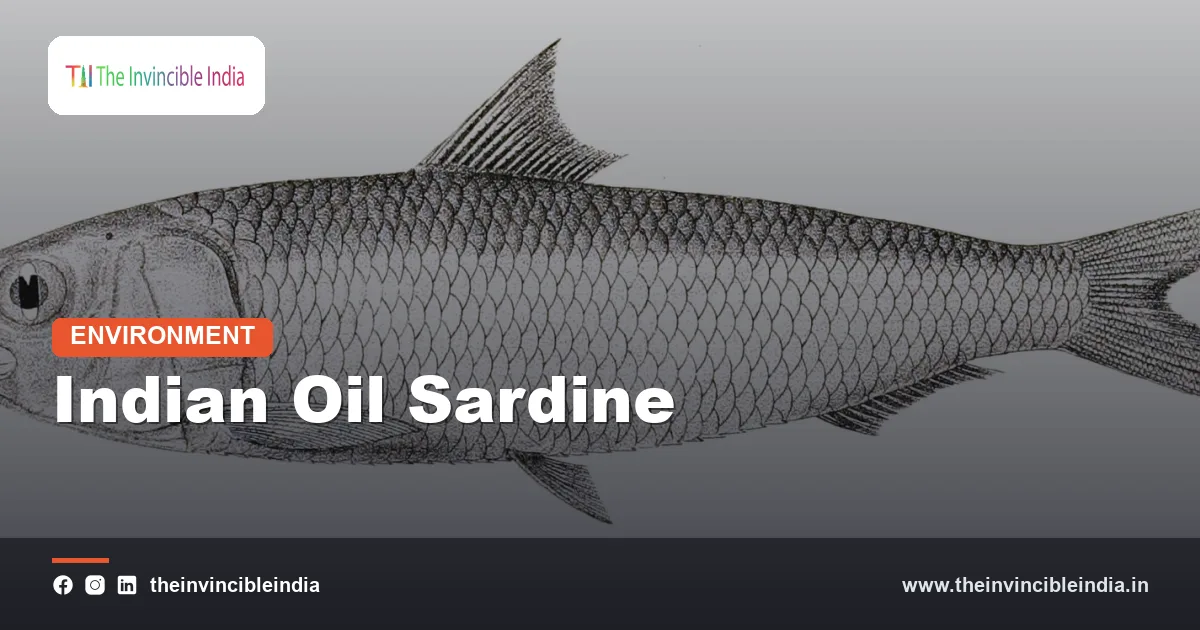
The Indian oil sardine (Sardinella longiceps) is a small, silvery, oil-rich shoaling fish of the Arabian Sea and northern Indian Ocean, and it has long been one of the largest single-species catches along India’s west coast. Known as mathi or chaala in Kerala and tarli in Maharashtra, it is eaten fresh, dried and fried across coastal India and is also processed into fish meal and oil.
The Indian oil sardine lives a short life, feeds on microscopic plankton, and gathers in vast schools that follow the monsoon-driven cycles of the Arabian Sea. Its catch swings sharply from year to year, which makes it a classic example of how ocean conditions can shape both marine life and the livelihoods of coastal communities.
| Fact | Detail |
|---|---|
| Common names | Indian oil sardine; mathi or chaala (Malayalam), tarli (Marathi) |
| Scientific name | Sardinella longiceps |
| Family | Clupeidae (herrings, sardines and shads) |
| Size | Commonly about 10 to 20 cm; maximum around 23 cm |
| Range and habitat | Coastal waters of the Arabian Sea and northern Indian Ocean; abundant off the Malabar coast of Kerala and Karnataka, and also found off Goa, Maharashtra and Gujarat |
| Diet | Filter-feeds on phytoplankton, especially diatoms, and small zooplankton |
| Breeding | Spawns mainly during the south-west monsoon, roughly June to September; matures at about one year of age |
| Economic importance | One of India’s biggest marine fish catches; important for food, drying, fish meal and fish oil; catches fluctuate widely |
Key Takeaways
- The Indian oil sardine (Sardinella longiceps) is a small marine fish of the family Clupeidae that has historically ranked among India’s largest marine catches.
- The Indian oil sardine is concentrated off the south-west coast of India, particularly the Malabar coast of Kerala and Karnataka.
- The Indian oil sardine feeds on plankton, spawns mainly during the monsoon, and lives only a few years, so its stock reacts quickly to changes in the ocean.
- Catches of Indian oil sardine have swung sharply between years, and ocean temperature, rainfall and upwelling are all linked to these changes.
- The Indian oil sardine is a rich source of omega-3 fatty acids and is an affordable, nutritious protein for millions of coastal consumers.
- Seasonal fishing bans, size limits and gear regulation are used to protect spawning and young sardines on India’s coasts.
What is the Indian oil sardine?
The Indian oil sardine is a small, fast-swimming schooling fish that belongs to the herring family Clupeidae and lives in the open coastal waters of the northern Indian Ocean. It gets its name from its high body-oil content, which gives the flesh a rich flavour and a supply of beneficial fats.
The fish has a slender, slightly flattened silvery body with a blue-green back, a pale belly and a single dorsal fin placed near the middle of the body. A dark spot behind the gill cover is sometimes visible. The scales are thin and easily rub off, and the fish is delicate, which is why it spoils quickly if not iced or processed promptly.
Several close relatives are also called sardines in India, including the white sardine, the goldstripe sardine and the fringescale sardine. The Indian oil sardine can be separated from the others by its elongated head and more slender body, but fishers usually recognise it by its abundance and its oily smell.
Where does the Indian oil sardine live?
The Indian oil sardine lives in coastal waters of the Arabian Sea and northern Indian Ocean, and it is most abundant along the south-west coast of India. The Malabar coast of Kerala and Karnataka is the traditional heartland, with significant fisheries also found off Goa, Maharashtra and parts of Tamil Nadu and Gujarat.
Outside India, the species occurs along the coasts of the Arabian Peninsula, Pakistan and Sri Lanka. It prefers the upper layers of the sea, usually from the surface to a modest depth, and stays within a few tens of kilometres of the shore. Large schools can be seen as dark patches near the surface in the monsoon and post-monsoon seasons.
The species depends on coastal upwelling, a process in which cold, nutrient-rich water rises toward the surface. Along India’s south-west coast, upwelling intensifies during the south-west monsoon and fuels blooms of microscopic algae that become food for sardines. This tight link between the monsoon and food supply is a defining feature of the species.
What does the Indian oil sardine eat?
The Indian oil sardine eats mainly microscopic floating plants called phytoplankton, with diatoms making up a major part of its diet, along with some small animal plankton known as zooplankton. It feeds by swimming with its mouth open and filtering plankton through comb-like structures on its gills, called gill rakers.
Because it feeds so low in the food web, the sardine converts plankton directly into fish flesh with great efficiency. The oil content of the flesh varies through the year and rises when plankton is abundant, which is why fish caught after a productive monsoon are often fattier than fish caught in lean periods.
Indian oil sardine are in turn eaten by larger predators, including mackerel, tuna, seer fish, sharks and seabirds, as well as by dolphins. The species is therefore an important link between plankton and the larger animals of the Arabian Sea, and changes in sardine numbers affect many other creatures.
How does the Indian oil sardine breed and grow?
The Indian oil sardine breeds mainly in the monsoon months, from about June to September, when the sea is rich in plankton, and the young fish grow rapidly in the first year. Spawning takes place in coastal waters, and the tiny eggs float in the water column before hatching into larvae that drift with currents.
Key points about its life cycle include:
- Maturity: the fish usually matures at around one year of age, when it has reached roughly 14 to 15 cm in length.
- Spawning: a single female releases thousands of small eggs, and spawning is timed with the monsoon.
- Growth: young sardines grow quickly on abundant plankton and join the fishery within months.
- Lifespan: the Indian oil sardine lives only about two to three years, so most of the catch consists of one- and two-year-old fish.
The short life span means that the stock is highly sensitive to a single poor spawning season. If many spawners are caught before they reproduce, or if ocean conditions make larval survival poor, the next year’s population can be small. Equally, a good spawning season followed by high survival can quickly produce a large catch.
How is the Indian oil sardine caught?
The Indian oil sardine is caught mainly with ring seines, purse seines and gill nets operated from mechanised and motorised fishing boats, together with traditional craft along the coast. These nets encircle the schools near the surface and haul them aboard in large numbers.
The fishery has a long history. Traditional beach seines and small canoes used to land the fish from the shore, and the sardine season was an important event in fishing villages. Modern fleets later adopted ring seines and mechanised craft, which increased the efficiency and range of the fishery. Landings are sold at harbours and fish markets, and a large share is moved on ice to inland markets.
Why does the catch change so much?
Catches of the Indian oil sardine change sharply because the species is short-lived and strongly influenced by the ocean environment. Scientific studies have linked variation in sardine catches with sea surface temperature, monsoon rainfall, upwelling strength and plankton availability, as well as with fishing pressure.
There have been years of record landings followed by steep declines, including sharp drops in recent years in some coastal states. These swings do not always mean overfishing, since natural variability is large, but they show the risk of heavy dependence on a single species. Fisheries researchers therefore track catches, fish size and spawning condition closely.
Why is the Indian oil sardine important to India’s food and economy?
The Indian oil sardine is important because it is among the most affordable animal proteins available to coastal communities and because it supports a very large number of fishers, traders and processors. It is eaten fresh, dried, salted, smoked and fried, and in Kerala it is a staple of the daily meal.
Economic uses are wide:
- Fresh consumption: sold whole at markets, usually at lower prices than larger fishes.
- Curries and fry: cooked in coconut, tamarind and chilli gravies in Kerala, or marinated and shallow-fried along the whole coast.
- Drying and curing: sun-dried or salted for storage and transport, supplying inland markets.
- Fish meal and fish oil: surplus catches are processed into meal for poultry and aquaculture feed, and into oil.
- Bait: smaller quantities serve as bait for line fisheries for larger fish.
Beyond direct income, the sardine fishery shapes the seasonal rhythm of life in many fishing villages, from boat-building and net-making to ice supply and transport.
Is the Indian oil sardine good for health?
Yes, the Indian oil sardine is good for health because it is rich in omega-3 fatty acids, high-quality protein, vitamin D, calcium and other minerals. These nutrients support heart, brain and bone health, and they make small oily fish an important and inexpensive part of a balanced diet.
The small bones of the fish are soft when cooked and can be eaten, which adds calcium. Compared with large predatory fishes such as tuna and swordfish, sardines are low in the food chain and generally carry lower levels of mercury. As with all fish, freshness matters: sardines should have bright eyes, red gills, firm flesh and a clean sea smell, and they should be kept on ice.
Indian oil sardine compared with other common small fishes
| Fish | Scientific name | Typical feature |
|---|---|---|
| Indian oil sardine | Sardinella longiceps | Slender, very oily, concentrated on the south-west coast |
| Indian mackerel | Rastrelliger kanagurta | Larger, with a broad mouth and black spots on the back |
| Anchovies | Stolephorus species | Very small, translucent, widely dried |
| Bombay duck | Harpadon nehereus | Elongated, soft-bodied, famous in Maharashtra and Gujarat |
How is the Indian oil sardine fishery managed?
The Indian oil sardine fishery is managed through a mix of seasonal fishing bans, gear rules, minimum legal sizes in some states and monitoring by fisheries research institutions. The aim is to protect spawning fish and juveniles so that the stock can renew itself each year.
A key measure is the monsoon fishing ban, a period of roughly two months, usually from June to July on the west coast, during which mechanised fishing is stopped in the sea off the coast. The ban coincides with the main breeding season of many fishes, including the sardine. Traditional non-mechanised boats are generally allowed to fish.
Other measures include:
- Minimum legal size rules in some coastal states, intended to stop the capture of juvenile sardines before they spawn.
- Restrictions on mesh size and certain destructive nets.
- Regular stock assessment and catch monitoring by marine fisheries institutes.
- Efforts to improve post-harvest handling, so that more of the catch reaches human consumers instead of being turned into low-value meal.
What threatens the Indian oil sardine?
The Indian oil sardine is threatened chiefly by warming seas and changing monsoon patterns, heavy fishing pressure on juveniles and spawners, and pollution and habitat change in coastal waters. These pressures can act together, making already variable stocks more unpredictable.
Researchers highlight the following concerns:
- Ocean warming: higher sea temperatures can alter plankton production and push fish toward cooler waters.
- Monsoon variability: weak or erratic upwelling reduces food for the sardine and its larvae.
- Catch of juveniles: harvesting small sardines before they breed lowers future spawning.
- Coastal pollution: runoff, plastic and industrial discharge degrade nursery areas.
- Overcapacity: too many fishing boats chasing one seasonal resource increases pressure.
Because the species is short-lived, it can also recover quickly when conditions improve, and managers aim to keep enough spawners in the sea to take advantage of good years.
Bottom Line
The Indian oil sardine is a small plankton-eating fish that feeds millions of Indians and sustains coastal livelihoods, yet its stock rises and falls with the monsoon and the temperature of the sea. Careful management and protection of spawning seasons are the key to keeping this affordable, nutritious catch available.
Frequently Asked Questions
What is the Indian oil sardine?
The Indian oil sardine is a small, silvery, oil-rich shoaling fish, scientifically Sardinella longiceps, found in the Arabian Sea and northern Indian Ocean. It is one of the largest marine catches in India, especially along the south-west coast. In Kerala it is known as mathi or chaala.
Where is the Indian oil sardine mostly found?
The Indian oil sardine is found mostly along the south-west coast of India, especially the Malabar coast of Kerala and Karnataka. It also occurs off Goa, Maharashtra and other coastal areas of the Arabian Sea. The species depends on monsoon-driven upwelling that supplies its plankton food.
Why does the Indian oil sardine catch fluctuate so much?
The catch fluctuates because the fish is short-lived and very sensitive to ocean conditions. Sea temperature, monsoon rainfall, upwelling and plankton supply all influence how many young sardines survive, and fishing pressure adds to the effect. A poor spawning year can therefore lead to low landings the next season.
Is the Indian oil sardine healthy to eat?
Yes, the Indian oil sardine is healthy to eat. It is rich in omega-3 fatty acids, protein, vitamin D and calcium, and it is low in mercury because it feeds on plankton. Fresh fish kept on ice is best for taste and safety.
When does the Indian oil sardine spawn?
The Indian oil sardine spawns mainly during the south-west monsoon, roughly from June to September. The fish usually matures at about one year of age. Spawning at this time takes advantage of the plankton-rich waters created by monsoon upwelling.
Why is there a monsoon fishing ban on India’s west coast?
The monsoon fishing ban exists to protect breeding fish and juveniles during the main spawning season. For about two months, usually June and July, mechanised fishing is stopped on the west coast. The pause helps sardines and other species to reproduce and rebuild their stocks.
{“@context”:”https://schema.org”,”@graph”:[{“@type”:”FAQPage”,”mainEntity”:[{“@type”:”Question”,”name”:”What is the Indian oil sardine?”,”acceptedAnswer”:{“@type”:”Answer”,”text”:”The Indian oil sardine is a small, silvery, oil-rich shoaling fish, scientifically Sardinella longiceps, found in the Arabian Sea and northern Indian Ocean. It is one of the largest marine catches in India, especially along the south-west coast. In Kerala it is known as mathi or chaala.”}},{“@type”:”Question”,”name”:”Where is the Indian oil sardine mostly found?”,”acceptedAnswer”:{“@type”:”Answer”,”text”:”The Indian oil sardine is found mostly along the south-west coast of India, especially the Malabar coast of Kerala and Karnataka. It also occurs off Goa, Maharashtra and other coastal areas of the Arabian Sea. The species depends on monsoon-driven upwelling that supplies its plankton food.”}},{“@type”:”Question”,”name”:”Why does the Indian oil sardine catch fluctuate so much?”,”acceptedAnswer”:{“@type”:”Answer”,”text”:”The catch fluctuates because the fish is short-lived and very sensitive to ocean conditions. Sea temperature, monsoon rainfall, upwelling and plankton supply all influence how many young sardines survive, and fishing pressure adds to the effect. A poor spawning year can therefore lead to low landings the next season.”}},{“@type”:”Question”,”name”:”Is the Indian oil sardine healthy to eat?”,”acceptedAnswer”:{“@type”:”Answer”,”text”:”Yes, the Indian oil sardine is healthy to eat. It is rich in omega-3 fatty acids, protein, vitamin D and calcium, and it is low in mercury because it feeds on plankton. Fresh fish kept on ice is best for taste and safety.”}},{“@type”:”Question”,”name”:”When does the Indian oil sardine spawn?”,”acceptedAnswer”:{“@type”:”Answer”,”text”:”The Indian oil sardine spawns mainly during the south-west monsoon, roughly from June to September. The fish usually matures at about one year of age. Spawning at this time takes advantage of the plankton-rich waters created by monsoon upwelling.”}},{“@type”:”Question”,”name”:”Why is there a monsoon fishing ban on India’s west coast?”,”acceptedAnswer”:{“@type”:”Answer”,”text”:”The monsoon fishing ban exists to protect breeding fish and juveniles during the main spawning season. For about two months, usually June and July, mechanised fishing is stopped on the west coast. The pause helps sardines and other species to reproduce and rebuild their stocks.”}}]}]}


