

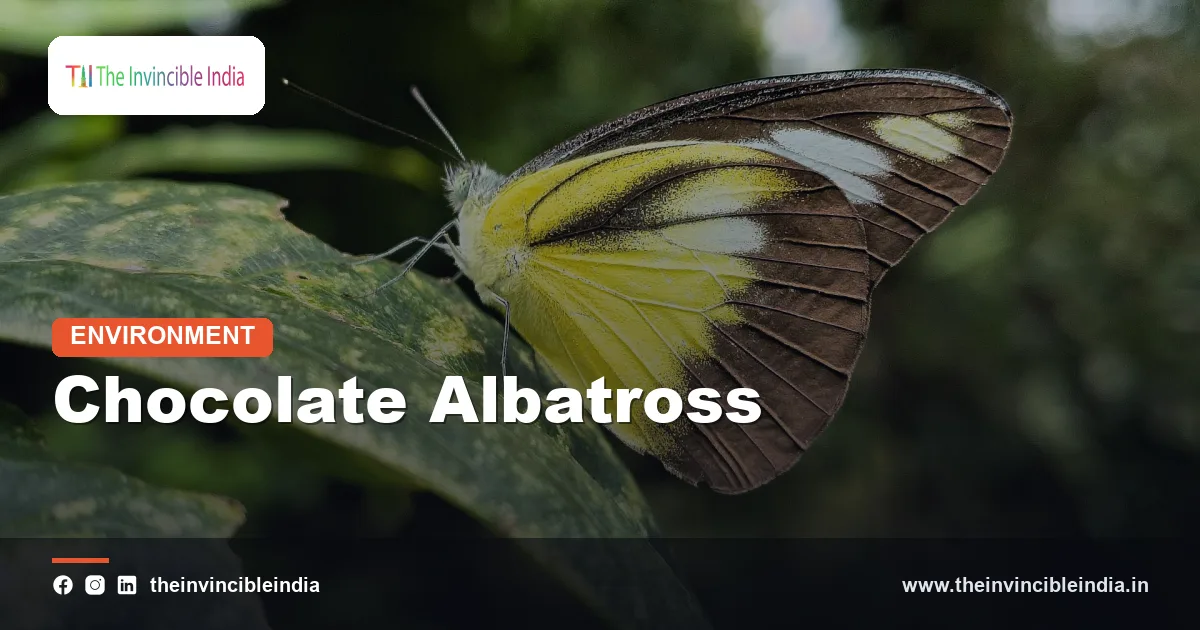
The chocolate albatross (Appias lyncida) is a medium-sized white butterfly of the family Pieridae, found in the humid forests of India, whose upper side is white with dark borders and whose underside is washed with chocolate-brown and yellow. It is a strong, fast flier of shaded forest paths and stream banks, and it is best known for the large gatherings of males that sip minerals from wet mud.
The chocolate albatross belongs to the albatross group of the genus Appias, a set of white pierids whose common name is thought to refer to their pale colour and powerful flight. This article explains how to recognise the species, what its caterpillars eat, where it lives in India, how it behaves, and how it compares with other albatrosses and whites.
| Common name | Chocolate albatross |
|---|---|
| Scientific name | Appias lyncida (Cramer, 1777) |
| Family and subfamily | Pieridae (whites and yellows), subfamily Pierinae |
| Wingspan | Roughly 55 to 70 mm |
| Larval host plants | Members of the caper family (Capparaceae), including Capparis species |
| Range and habitat in India | Humid evergreen and moist deciduous forest, forest edges and streams; the Western Ghats and parts of peninsular India, and the Himalayan foothills and Northeast India |
| Flight season and broods | Several broods a year; most abundant during and after the monsoon |
| Notable features | Chocolate-brown and yellow underside; males gather in groups to mud-puddle; seasonal differences in markings |
Key Takeaways
- The chocolate albatross (Appias lyncida) is a medium-sized pierid butterfly with a wingspan of roughly 55 to 70 mm, found in forested regions of India.
- Chocolate albatross butterflies are white above with dark wing borders, and the underside is washed with chocolate-brown and yellow.
- Caterpillars of the chocolate albatross feed on plants of the caper family (Capparaceae), such as Capparis species.
- Male chocolate albatrosses gather on wet sand and mud to drink dissolved minerals, a behaviour called mud-puddling.
- The chocolate albatross flies fast and strongly along forest paths, streams and clearings, and breeds in several generations a year.
- The chocolate albatross is generally not considered threatened in India, but depends on intact moist forest and its caper-family host plants.
What is the chocolate albatross butterfly?
The chocolate albatross is a forest butterfly in the family Pieridae, the family that also includes the common emigrant, the common gull and the many white and yellow butterflies of Indian gardens. It was described by the Dutch naturalist Pieter Cramer in 1777 as Appias lyncida, and its species name has remained stable since.
The genus Appias, known in English as the albatrosses and puffins, contains several species in India. All are stoutly built, fast-flying whites that favour shaded ground in or near forest. The chocolate albatross is distinguished within this group by the rich brown and yellow colouring on the underside, which gives the species its common name.
Because it is a butterfly of forest and forest edge, the chocolate albatross is not as widely seen in towns as the common emigrant or the lemon pansy. Naturalists meet it most often on trails, near streams and on damp forest roads.
How can you identify a chocolate albatross?
A chocolate albatross can be identified by its white upper side with a dark apex and border, its strong direct flight, and, once it settles, the distinctive chocolate-brown and yellow pattern on the underside of the wings. Observers seldom see the underside while the butterfly is flying, so a perched individual is the easiest to confirm.
Upper side
The male is white with a black tip and a dark edge on the forewing, while the hindwing is largely white with a faint marginal border. The female is similar in shape but usually has broader and heavier dark borders and may look more smoky. Seen in flight, both sexes look like flashes of white against the dark forest floor.
Under side
The underside is the key feature. The ground colour of the wings is washed with yellow, and the veins and margins are lined with chocolate-brown, giving the butterfly a mottled, shaded appearance that blends well into leaf litter and sun-dappled foliage. The intensity of the brown and yellow varies between individuals and between seasons.
Seasonal variation
Like many tropical butterflies, the chocolate albatross shows differences between the wet-season and dry-season generations. The wet-season form is generally more strongly marked, while dry-season individuals can look paler or more worn. These differences can make field identification tricky, so size, flight and habitat should be considered together with colour.
What do chocolate albatross caterpillars eat?
Chocolate albatross caterpillars feed on plants of the caper family, Capparaceae, including scrambling and climbing species of Capparis. Caper-family plants contain mustard-oil compounds, and many pierid butterflies have evolved to feed on them while avoiding the plants’ chemical defences.
The female lays her eggs on the tender growth of the host plant. The eggs are small, pale and spindle-shaped, standing upright on the leaf surface, which is a typical feature of the pierid family. The caterpillar is green and slender, and it rests along the leaf midrib, where it is hard to see.
Adults feed on nectar from a range of flowers, particularly in sunlit clearings and along forest edges. The male needs minerals as well as nectar, which is where mud-puddling comes in.
Why do chocolate albatross butterflies gather at mud?
Male chocolate albatrosses gather on damp sand, mud and animal droppings because they use these sites to take in sodium and other minerals that nectar does not supply. This behaviour, known as mud-puddling, is common among butterflies, and it is especially noticeable in the whites and swallowtails of Indian forests.
A puddling party can include a dozen or more butterflies, often of several species at once. The chocolate albatross usually settles with its wings closed or slightly open, drinking with its proboscis, and flies up in a flurry when disturbed before returning to the same spot.
Researchers believe that males pass some of the minerals to the female during mating, which may help in egg production. The gathering is also a convenient time for a naturalist to count and photograph the species, since the butterflies are more settled than they are in flight.
How does the chocolate albatross grow from egg to adult?
The chocolate albatross passes through four life stages: egg, caterpillar, pupa and adult. In warm and humid conditions the cycle is quick, and the species produces several generations in a year.
- Egg: Upright, narrow and ribbed, laid on young leaves of the host plant.
- Caterpillar: Slender and green, feeding on the leaves and moulting several times.
- Pupa: A slender chrysalis held upright on a twig or stem by a silk girdle and a pad of silk at the tail, typical of pierids.
- Adult: A fast-flying white butterfly that feeds on nectar and, in the male, on mud and damp ground.
The pupa usually matches the colour of the plant stem on which it hangs, which reduces its chance of being found by birds and wasps.
Where in India is the chocolate albatross found?
The chocolate albatross is found in the humid forests of India, mainly in the Western Ghats and parts of peninsular India, and along the Himalayan foothills eastwards into Northeast India. It prefers evergreen and moist deciduous forest and is seldom seen far from tree cover.
The species also occurs in neighbouring countries, including Sri Lanka, Bangladesh, Myanmar, and much of Southeast Asia, where several regional subspecies are recognised. The overall distribution follows the belt of warm, damp forest that stretches through South and Southeast Asia.
Typical habitats include:
- Shaded forest trails and stream banks
- Sunny clearings and forest edges with flowering shrubs
- Damp sandy patches beside rivulets, where males puddle
- Plantation edges and forest-fringe gardens where host plants survive
When is the chocolate albatross on the wing?
The chocolate albatross is on the wing for much of the year in warm regions, with the largest numbers seen during and just after the monsoon, when new growth of the host plants supports many caterpillars. In regions with a cooler winter, such as the foothills of the Himalaya, fewer adults are seen in the colder months.
Through the day, the butterfly is most active in the morning and in mild weather, patrolling forest paths and open stream beds. Males are far more often noticed than females, partly because they gather at puddling sites while females tend to stay near host plants and the forest canopy.
How is the chocolate albatross different from other albatrosses?
The chocolate albatross differs from other albatrosses mainly in its brown-and-yellow underside, its forest habit and its host plants. The table below compares it with related Indian whites that are often confused with it.
| Butterfly | Scientific name | Typical habitat | Key distinguishing feature |
|---|---|---|---|
| Chocolate albatross | Appias lyncida | Humid forest, streams | Chocolate-brown and yellow underside; males mud-puddle |
| Common albatross | Appias albina | Forest edge, gardens, coastal areas | Mostly white above and below; males have a thin dark border |
| Striped albatross | Appias libythea | Forest and forest edge | Distinct dark lines along the veins on the underside |
| Common gull | Cepora nerissa | Open scrub, gardens | Smaller; broad dark border and a strong seasonal pattern of black and yellow |
When identifying albatrosses, it helps to remember that the underside of a perched individual gives more information than the upper side of one in flight.
How can you watch and photograph a chocolate albatross?
The easiest way to watch a chocolate albatross is to visit a damp forest stream bank or trail in the morning and wait quietly near a patch of wet sand where butterflies are already settled. Males at a puddling site become tolerant of slow, steady movement, which makes them far easier to observe than individuals in flight.
A few simple habits improve both the experience and the pictures:
- Approach slowly from the side with the sun behind you, so that your shadow does not fall across the group.
- Use a modest zoom rather than crowding the butterflies, since sudden movement sends the whole party into the air.
- Photograph the underside whenever possible, because the chocolate-brown and yellow pattern settles the identification.
- Avoid trampling the damp patch, and never add salt, urine or other substances to attract butterflies, as this can harm the site.
- Note the date, place and weather, which turns a casual photograph into a useful record for citizen-science projects.
Because the species is a fast flier, a chase through the forest seldom succeeds. Patience at a good puddling site is nearly always more productive than walking long distances.
Why does the chocolate albatross matter?
The chocolate albatross matters because it is a pollinator, a source of food for forest predators and an indicator of intact moist forest with its host plants. Where the species is common, forest paths, streams and edge vegetation are usually in reasonable condition.
The butterfly is also valuable for education and ecotourism. Its mud-puddling aggregations are easy to watch and photograph, and they offer a clear lesson in how butterflies meet their mineral needs. Forest departments and nature clubs across the Western Ghats and Northeast India often include puddling sites in butterfly walks.
Like all butterflies, the chocolate albatross is a link in a larger food chain. Its caterpillars and adults are eaten by birds, lizards, spiders and wasps, and the species depends on a healthy supply of nectar plants.
Is the chocolate albatross threatened, and how can it be protected?
The chocolate albatross is not generally regarded as a threatened species, but it depends on forest and forest-edge habitat, so loss of moist forest, clearing of undergrowth and heavy pesticide use can reduce local numbers. Because its host plants are wild members of the caper family, removing roadside and forest-edge shrubs also affects it.
Practical steps that help include:
- Protecting damp forest trails and stream banks from heavy disturbance
- Retaining native caper-family shrubs along forest edges and plantation margins
- Avoiding the collection of butterflies, particularly from puddling sites
- Reporting sightings to citizen-science projects to improve distribution records
Bottom Line
The chocolate albatross is a handsome forest white whose brown-and-yellow underside, fast flight and mud-puddling habit make it easy to recognise once its features are known. Protecting moist forest and its caper-family host plants keeps the species flying.
Frequently Asked Questions
What is the scientific name of the chocolate albatross?
The scientific name of the chocolate albatross is Appias lyncida, described by Pieter Cramer in 1777. It belongs to the family Pieridae and to the genus Appias, which contains the albatrosses and puffins. Several regional subspecies are recognised across its range.
Why is it called a chocolate albatross?
The chocolate albatross gets its name from the chocolate-brown shading on the underside of its wings, while “albatross” refers to the white colour and strong flight of the genus. The brown is set against yellow, which makes the underside look shaded and mottled. The upper side, by contrast, is mostly white with dark borders.
What do chocolate albatross caterpillars eat?
Chocolate albatross caterpillars eat the leaves of plants in the caper family, Capparaceae, including Capparis species. Females lay small, upright eggs on young leaves. The green caterpillars rest along the midrib and are hard to spot.
Why do chocolate albatross butterflies gather at mud?
Chocolate albatross butterflies gather at mud because the males need sodium and other minerals that nectar does not provide. This behaviour is called mud-puddling. Large groups often gather on damp sand beside forest streams and are easy to approach.
Where can I see a chocolate albatross in India?
You can see a chocolate albatross in humid forests, particularly in the Western Ghats and parts of peninsular India, and in the Himalayan foothills and Northeast India. Shaded forest trails, stream banks and damp sandy patches are the best places. Early morning during or after the monsoon is usually the most rewarding time.
Is the chocolate albatross a rare butterfly?
The chocolate albatross is not considered rare or endangered in India, although it is largely confined to forest habitats. Local numbers depend on the condition of moist forest and the availability of caper-family host plants. Habitat loss and pesticide use are the main concerns.
{“@context”:”https://schema.org”,”@graph”:[{“@type”:”FAQPage”,”mainEntity”:[{“@type”:”Question”,”name”:”What is the scientific name of the chocolate albatross?”,”acceptedAnswer”:{“@type”:”Answer”,”text”:”The scientific name of the chocolate albatross is Appias lyncida, described by Pieter Cramer in 1777. It belongs to the family Pieridae and to the genus Appias, which contains the albatrosses and puffins. Several regional subspecies are recognised across its range.”}},{“@type”:”Question”,”name”:”Why is it called a chocolate albatross?”,”acceptedAnswer”:{“@type”:”Answer”,”text”:”The chocolate albatross gets its name from the chocolate-brown shading on the underside of its wings, while “albatross” refers to the white colour and strong flight of the genus. The brown is set against yellow, which makes the underside look shaded and mottled. The upper side, by contrast, is mostly white with dark borders.”}},{“@type”:”Question”,”name”:”What do chocolate albatross caterpillars eat?”,”acceptedAnswer”:{“@type”:”Answer”,”text”:”Chocolate albatross caterpillars eat the leaves of plants in the caper family, Capparaceae, including Capparis species. Females lay small, upright eggs on young leaves. The green caterpillars rest along the midrib and are hard to spot.”}},{“@type”:”Question”,”name”:”Why do chocolate albatross butterflies gather at mud?”,”acceptedAnswer”:{“@type”:”Answer”,”text”:”Chocolate albatross butterflies gather at mud because the males need sodium and other minerals that nectar does not provide. This behaviour is called mud-puddling. Large groups often gather on damp sand beside forest streams and are easy to approach.”}},{“@type”:”Question”,”name”:”Where can I see a chocolate albatross in India?”,”acceptedAnswer”:{“@type”:”Answer”,”text”:”You can see a chocolate albatross in humid forests, particularly in the Western Ghats and parts of peninsular India, and in the Himalayan foothills and Northeast India. Shaded forest trails, stream banks and damp sandy patches are the best places. Early morning during or after the monsoon is usually the most rewarding time.”}},{“@type”:”Question”,”name”:”Is the chocolate albatross a rare butterfly?”,”acceptedAnswer”:{“@type”:”Answer”,”text”:”The chocolate albatross is not considered rare or endangered in India, although it is largely confined to forest habitats. Local numbers depend on the condition of moist forest and the availability of caper-family host plants. Habitat loss and pesticide use are the main concerns.”}}]}]}


