

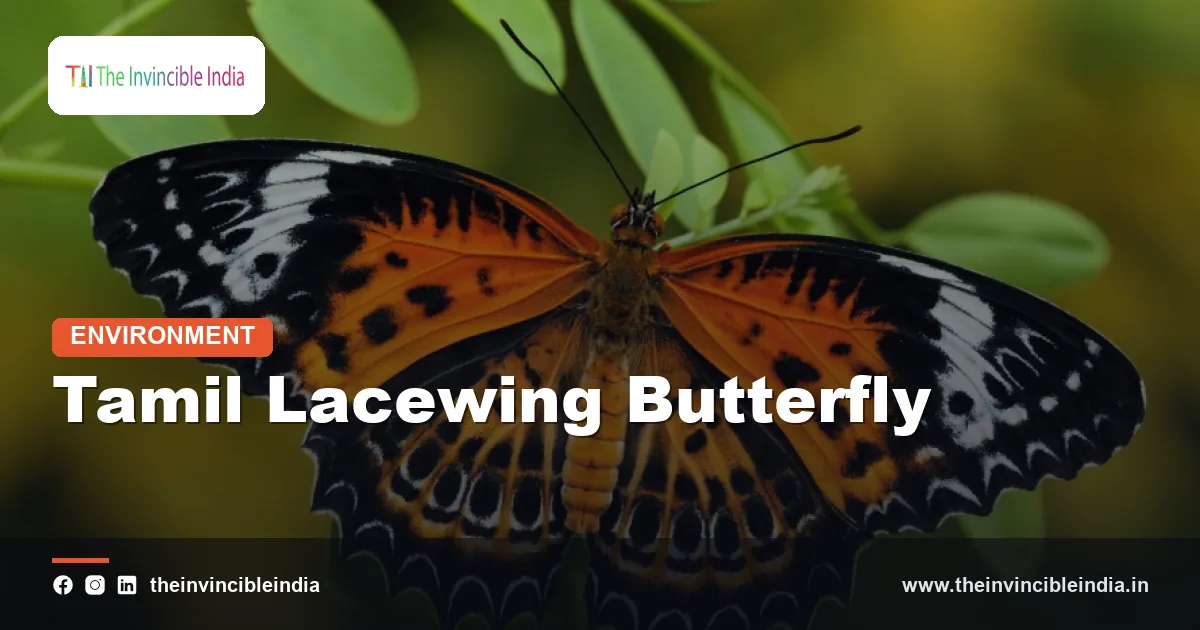
The Tamil lacewing (Cethosia nietneri) is a medium-sized orange-and-black butterfly of the family Nymphalidae, named for the delicate lace-like pattern on its underside, and it lives in the forests of the Western Ghats and the hills of southern India. It is a slow, gliding flier of forest edges, clearings and stream banks, and its caterpillars feed on a climbing plant that is toxic to most animals.
The Tamil lacewing is one of the most striking butterflies of peninsular India, and one of the few that southern naturalists can recognise at a glance, even from a distance. This article explains what the butterfly looks like, how it lives, what its caterpillars eat, where it is found, and how it differs from the lacewings of northern and eastern India.
| Common name | Tamil lacewing |
|---|---|
| Scientific name | Cethosia nietneri (C. and R. Felder, 1867) |
| Family and subfamily | Nymphalidae (brush-footed butterflies), subfamily Heliconiinae |
| Wingspan | Roughly 70 to 85 mm |
| Larval host plants | Adenia hondala and other Adenia climbers (passion-flower family, Passifloraceae) |
| Range and habitat in India | Western Ghats and hill forests of southern India; evergreen and moist deciduous forest edges, clearings and stream banks |
| Flight season and broods | Several broods a year; most commonly seen during and after the monsoon |
| Notable features | Orange-red upper side with black borders; underside patterned like lace; gregarious, spiny, toxic caterpillars |
Key Takeaways
- The Tamil lacewing (Cethosia nietneri) is a medium-sized nymphalid butterfly of the Western Ghats and hill forests of southern India.
- Tamil lacewing butterflies have an orange-red upper side with black borders and white-edged scalloped margins, and a cream and reddish-brown lace-like underside.
- Caterpillars of the Tamil lacewing feed on Adenia climbers, particularly Adenia hondala, plants that contain defensive chemicals.
- The Tamil lacewing flies slowly, alternating flaps and glides, along forest edges, clearings and streams.
- The striking colours of the Tamil lacewing act as a warning to predators that the insect carries unpleasant chemicals.
- The Tamil lacewing is closely related to the leopard lacewing and red lacewing of northern and eastern India, but occurs in a different part of the country.
What is the Tamil lacewing butterfly?
The Tamil lacewing is a brush-footed butterfly in the family Nymphalidae and the subfamily Heliconiinae, the same broad group that includes the longwings of the Americas. It was named Cethosia nietneri by the entomologists Cajetan and Rudolf Felder in 1867, and the species was described from Sri Lanka, where a distinct subspecies lives.
The word “lacewing” refers to the underside pattern of the wings, which resembles fine, intricate lace. The word “Tamil” points to the southern part of the subcontinent where the species is found, and works here as a geographical label.
The genus Cethosia contains several species across South and Southeast Asia. In India, three lacewings occur, each in a different region, and the Tamil lacewing is the one that belongs to the south.
How can you identify a Tamil lacewing?
A Tamil lacewing can be identified by its bright orange-red upper wings with black borders, the scalloped wing margins edged in white, and the pale lace-patterned underside that is revealed when the butterfly perches. The slow, gliding flight and the medium size, bigger than a common tiger but smaller than most swallowtails, also help in the field.
Upper side
The upper side is a rich orange-red. The forewing has a broad black apex with a band of white or pale spots, and the outer margins of both wings carry a black border dotted with white marks and edged with a scalloped outline. The females are generally similar in pattern but may look slightly duller or broader-winged.
Under side
The underside is the feature that gives the lacewings their name. The ground colour is pale cream to pinkish-white, overlaid with reddish-brown and black markings, rings, lines and white spots that form an intricate, lace-like network. When the butterfly closes its wings on a leaf, the pattern breaks up its outline and makes it look more like a patch of mottled light than a living insect.
Flight and posture
The Tamil lacewing has a slow, deliberate flight of a few quick flaps followed by a glide, which is typical of toxic butterflies that have little need to flee quickly. It often settles on leaves with its wings closed, but also basks with its wings open in sun, revealing the bright upper side.
What do Tamil lacewing caterpillars eat?
Tamil lacewing caterpillars eat the leaves of Adenia climbers, especially Adenia hondala, which belong to the passion-flower family, Passifloraceae. The caterpillars cannot develop on most other plants, so the butterfly is found only where the climbers grow.
Adenia plants contain toxic compounds, including cyanogenic substances that protect them from most grazers. The caterpillars of the Tamil lacewing have adapted to tolerate these chemicals, and they probably retain some of them in their bodies, which makes both caterpillars and butterflies distasteful to predators.
The female lays her eggs in groups on the host plant. The caterpillars live together in the early stages and feed side by side, a habit that makes their bright colour more noticeable to predators and strengthens the warning signal. In the field, a cluster of spiny orange-and-black caterpillars on a climbing vine is a good sign that a Tamil lacewing breeding colony is nearby.
How does the Tamil lacewing grow from egg to adult?
The Tamil lacewing grows through four stages, egg, caterpillar, pupa and adult, with each stage adapted to forest life. Several generations are produced in a year, which allows the species to take advantage of fresh growth of its host plants after rain.
- Egg: Laid in clusters on the leaves, tendrils or stems of the host plant.
- Caterpillar: Spiny, brightly coloured and gregarious in the early stages, with branched spines that deter predators. It moults several times as it grows.
- Pupa: The chrysalis hangs head-down from a twig or leaf, and its irregular, leaf-like shape and mottled colour help it to resemble dead plant matter.
- Adult: The butterfly feeds on nectar from forest-edge flowers and can live for several weeks.
Adults feed on nectar from a variety of flowers, including common shrubs of forest edges and clearings. They are less often seen at mud than many whites and swallowtails, and they tend to spend more time circling around the host climbers.
Where in India is the Tamil lacewing found?
The Tamil lacewing is found in the Western Ghats and the hill forests of southern India, in a range that stretches from the lower slopes up into cooler hill country. It is a butterfly of evergreen and moist deciduous forest, and it is generally not seen in dry plains or arid scrub.
A related population lives in Sri Lanka, where the species was first described, which fits the pattern of shared wildlife between the southern Indian hills and the island. Within India, the butterfly is most frequently reported from hill ranges and forest reserves of the southern states.
Habitats where the Tamil lacewing may be seen include:
- Forest edges and sunlit clearings with flowering shrubs
- Streamside paths and damp ravines where Adenia climbers hang from trees
- Plantation margins, particularly near tea, coffee and cardamom country where native forest is retained
- Protected areas and wildlife sanctuaries of the Western Ghats
When can you see the Tamil lacewing?
The Tamil lacewing can be seen for much of the year in the southern hills, with the best sightings during and after the monsoon, when new leaves on the host plants support many caterpillars. In drier months, adults become fewer and more concentrated near streams and patches of shade.
Within a day, the species is most active in warm, sunny conditions in the morning and midday. On cloudy or wet days, it settles among foliage, closes its wings and can be hard to find. Quiet forest trails, edges of coffee estates and bridges over forest streams are good places to wait.
Why are Tamil lacewings so brightly coloured?
Tamil lacewings are brightly coloured because their colours warn predators that the butterfly is distasteful, a strategy called aposematism. Birds and lizards that sample such butterflies learn to avoid similar patterns, and this protects the lacewings even when they fly slowly in open view.
The strategy works because the caterpillars take up chemicals from their toxic host plants. Bright orange, red and black are among the most common warning colours in nature, found in many unrelated butterflies, moths, beetles and bugs. The lace-like underside gives a second form of protection, since it works as camouflage when the butterfly is at rest.
The combination of a bold upper side and a disruptive underside means the Tamil lacewing can both advertise its toxicity in flight and conceal itself when resting. Biologists often point to such butterflies as examples of how different defences can be layered in one species.
How is the Tamil lacewing different from other lacewings?
The Tamil lacewing differs from the other Indian lacewings mainly in its range, since it occurs in the south while the others are found in the north-east, and in details of the wing pattern. The table below compares the three lacewings found in India.
| Butterfly | Scientific name | Region in India | Key features |
|---|---|---|---|
| Tamil lacewing | Cethosia nietneri | Western Ghats and southern hill forests | Orange-red upper side with black borders; lace-patterned underside |
| Leopard lacewing | Cethosia cyane | Northeast India and parts of the eastern Himalaya | Bolder, leopard-like black spotting on the upper side; underside with lace pattern |
| Red lacewing | Cethosia biblis | Himalayan foothills and Northeast India | Rich red upper side with black borders; strongly scalloped wings |
Because their ranges barely overlap, location is the quickest guide to which lacewing has been seen. A lacewing photographed in the Western Ghats is almost certainly the Tamil lacewing.
How can you watch and photograph a Tamil lacewing?
The best way to watch a Tamil lacewing is to walk slowly along a sunny forest edge or stream path in the morning and look for flashes of orange among the foliage. Because the butterfly flies slowly and settles often, it is more approachable than many fast-flying forest species.
These habits help observers and photographers:
- Look near Adenia climbers, since females return to them to lay eggs and caterpillars are found there.
- Photograph both the upper side and the underside, as the lace pattern is the clearest identification feature.
- Stay on the trail and avoid trampling the climbers, seedlings and leaf litter that support the next generation.
- Do not handle the butterflies or move caterpillars, since touching wings removes scales and disturbs colonies.
Visits during or just after the monsoon usually give the best chances, when new growth feeds many caterpillars and adults are on the wing in good numbers.
Why does the Tamil lacewing matter?
The Tamil lacewing matters because it is a showpiece species of southern Indian forests, a pollinator, and an indicator of intact forest edges with their native climbers. A healthy population implies that both the Adenia host plants and the nectar sources around them survive.
The butterfly is also valuable in education and tourism. It is easy for beginners to learn, striking enough to photograph and often found in accessible places such as forest trails and plantation edges. Many butterfly counts and nature walks in the Western Ghats list it as a highlight.
The species is also a subject of scientific interest. The combination of toxic host plants, gregarious caterpillars, warning colours and camouflage makes the lacewings useful examples when teaching about chemical defence and co-evolution between plants and insects.
Is the Tamil lacewing threatened, and how can it be protected?
The Tamil lacewing is not regarded as globally threatened, but it depends on forest and forest-edge habitat, so loss of native forest, clearing of climbers and heavy pesticide use can reduce local populations. Because its caterpillars use only Adenia, removing these plants removes the butterfly with them.
Helpful actions include:
- Retaining native climbers on forest edges, road verges and estate boundaries
- Limiting pesticide use near forest fringes and plantations
- Avoiding the collection of butterflies, eggs or caterpillars from the wild
- Recording sightings with date and place in citizen-science platforms
Wild butterflies in India are covered by wildlife protection laws in various ways, and collecting from protected areas is prohibited. Observing and photographing is the safest and most useful way to enjoy the species.
Bottom Line
The Tamil lacewing is an orange-and-black butterfly of southern Indian forests, with a lace-patterned underside, toxic caterpillars and a slow, confident flight. Protecting forest edges and their native Adenia climbers keeps this striking species in the hills.
Frequently Asked Questions
What is the scientific name of the Tamil lacewing?
The scientific name of the Tamil lacewing is Cethosia nietneri, described by Cajetan and Rudolf Felder in 1867. It belongs to the family Nymphalidae and the subfamily Heliconiinae. A distinct subspecies lives in Sri Lanka.
Why is it called a lacewing?
The Tamil lacewing is called a lacewing because the underside of its wings has a pattern of fine lines, rings and spots that looks like lace. The pattern is cream, red-brown and black. It also helps to camouflage the butterfly when it rests with its wings closed.
What do Tamil lacewing caterpillars eat?
Tamil lacewing caterpillars eat the leaves of Adenia climbers, especially Adenia hondala, which belong to the passion-flower family. These plants contain defensive chemicals that the caterpillars tolerate. The caterpillars feed in groups and are brightly coloured and spiny.
Where is the Tamil lacewing found in India?
The Tamil lacewing is found in the Western Ghats and hill forests of southern India. It prefers evergreen and moist deciduous forest edges, clearings and stream banks. It is not seen in dry plains or arid scrub.
Is the Tamil lacewing poisonous?
The Tamil lacewing is distasteful to many predators because its caterpillars take up defensive chemicals from their toxic host plants, but it is not dangerous to humans. Touching the butterfly is harmless, although handling wild butterflies can damage their wings. Its bright colours warn predators to leave it alone.
How is the Tamil lacewing different from the leopard lacewing?
The Tamil lacewing differs from the leopard lacewing (Cethosia cyane) mainly in range and wing pattern. The Tamil lacewing lives in the Western Ghats and southern hills, while the leopard lacewing is found in the north-east and parts of the eastern Himalaya. The leopard lacewing’s upper side carries a bolder, leopard-like pattern of black spots.
{“@context”:”https://schema.org”,”@graph”:[{“@type”:”FAQPage”,”mainEntity”:[{“@type”:”Question”,”name”:”What is the scientific name of the Tamil lacewing?”,”acceptedAnswer”:{“@type”:”Answer”,”text”:”The scientific name of the Tamil lacewing is Cethosia nietneri, described by Cajetan and Rudolf Felder in 1867. It belongs to the family Nymphalidae and the subfamily Heliconiinae. A distinct subspecies lives in Sri Lanka.”}},{“@type”:”Question”,”name”:”Why is it called a lacewing?”,”acceptedAnswer”:{“@type”:”Answer”,”text”:”The Tamil lacewing is called a lacewing because the underside of its wings has a pattern of fine lines, rings and spots that looks like lace. The pattern is cream, red-brown and black. It also helps to camouflage the butterfly when it rests with its wings closed.”}},{“@type”:”Question”,”name”:”What do Tamil lacewing caterpillars eat?”,”acceptedAnswer”:{“@type”:”Answer”,”text”:”Tamil lacewing caterpillars eat the leaves of Adenia climbers, especially Adenia hondala, which belong to the passion-flower family. These plants contain defensive chemicals that the caterpillars tolerate. The caterpillars feed in groups and are brightly coloured and spiny.”}},{“@type”:”Question”,”name”:”Where is the Tamil lacewing found in India?”,”acceptedAnswer”:{“@type”:”Answer”,”text”:”The Tamil lacewing is found in the Western Ghats and hill forests of southern India. It prefers evergreen and moist deciduous forest edges, clearings and stream banks. It is not seen in dry plains or arid scrub.”}},{“@type”:”Question”,”name”:”Is the Tamil lacewing poisonous?”,”acceptedAnswer”:{“@type”:”Answer”,”text”:”The Tamil lacewing is distasteful to many predators because its caterpillars take up defensive chemicals from their toxic host plants, but it is not dangerous to humans. Touching the butterfly is harmless, although handling wild butterflies can damage their wings. Its bright colours warn predators to leave it alone.”}},{“@type”:”Question”,”name”:”How is the Tamil lacewing different from the leopard lacewing?”,”acceptedAnswer”:{“@type”:”Answer”,”text”:”The Tamil lacewing differs from the leopard lacewing (Cethosia cyane) mainly in range and wing pattern. The Tamil lacewing lives in the Western Ghats and southern hills, while the leopard lacewing is found in the north-east and parts of the eastern Himalaya. The leopard lacewing’s upper side carries a bolder, leopard-like pattern of black spots.”}}]}]}


