

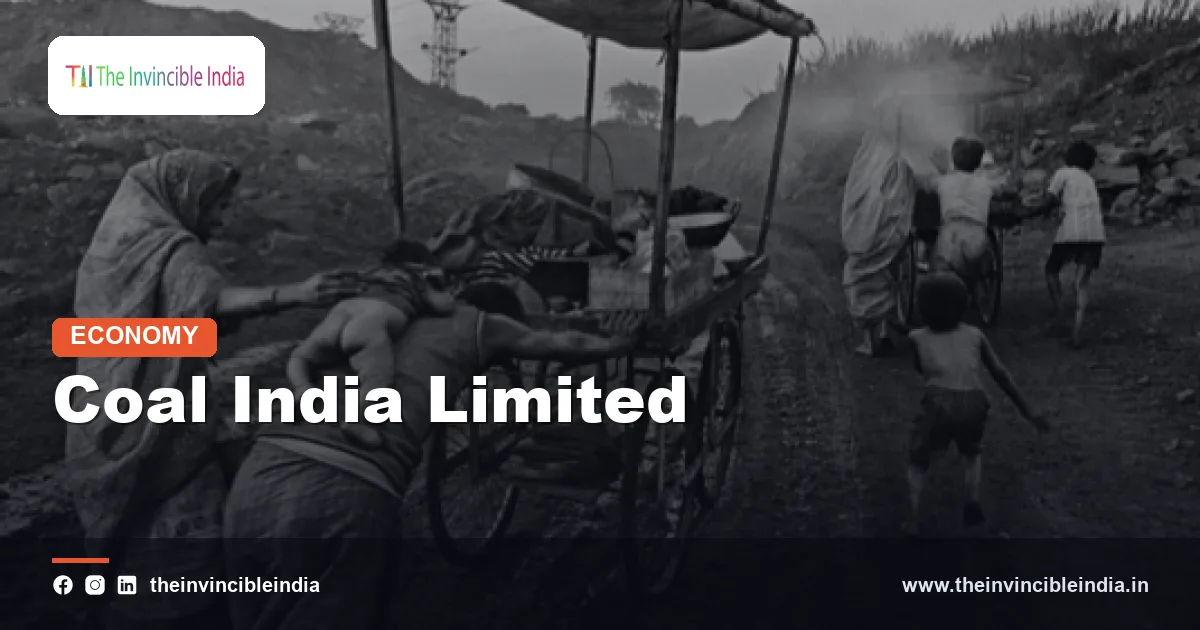
Coal India Limited (CIL) is a Maharatna public sector undertaking headquartered in Kolkata that is the world’s largest coal-producing company and mines the large majority of the coal produced in India. Formed in 1975 under the Ministry of Coal, Coal India Limited works through a set of wholly owned subsidiaries, each responsible for a coalfield region, and supplies fuel to power stations, steel plants, cement units and other industries across the country.
Because coal still generates the largest share of India’s electricity, the performance of Coal India Limited shapes power availability, industrial costs and the national import bill. At the same time, the company sits at the centre of India’s debate on climate commitments, land use, mine-affected communities and the future of coal-dependent regions. This explainer, last updated 17 October 2026, covers how Coal India Limited was created, how it is organised, what it produces and the challenges it faces.
| Attribute | Details |
|---|---|
| Full name | Coal India Limited (CIL) |
| Established | 1975 (following the nationalisation of coal mines in 1971-73) |
| Headquarters | Kolkata, West Bengal |
| Administrative ministry | Ministry of Coal, Government of India |
| Status | Maharatna central public sector enterprise (granted in 2011) |
| Stock market listing | Initial public offering in October 2010; shares trade on the NSE and BSE |
| Core business | Opencast and underground coal mining, coal washing and sales |
| Scale | Roughly three-quarters of India’s coal output and several hundred mines, with annual production of well over 700 million tonnes in recent years |
| Research and planning arm | Central Mine Planning and Design Institute Limited (CMPDI), Ranchi |
Key Takeaways
- Coal India Limited, set up in 1975 and headquartered in Kolkata, is a Maharatna public sector undertaking under the Ministry of Coal.
- Coal India Limited is widely described as the largest coal-producing company in the world by volume and supplies most of the coal mined in India.
- Coal India Limited operates through seven coal-producing subsidiaries, including Eastern Coalfields, Bharat Coking Coal, Central Coalfields, Northern Coalfields, Western Coalfields, South Eastern Coalfields and Mahanadi Coalfields.
- Coal India Limited was built on the Coal Mines (Nationalisation) Act, 1973, which brought private coal mining under state ownership.
- Coal-fired plants generate well over half of India’s electricity, and Coal India Limited is the principal domestic fuel supplier to these plants.
- Coal India Limited is diversifying into solar power, coal gasification and critical minerals as India works towards its net-zero target for 2070.
What is Coal India Limited?
Coal India Limited is a central public sector enterprise that explores, mines, processes and sells coal, and it is the single biggest producer of the fuel in India. The company is a listed entity, but the Government of India remains its majority shareholder and sets the broad policy framework for the coal sector.
The corporation is a holding company, which means that the mining work is done by its subsidiaries. Coal India Limited itself provides strategic planning, capital allocation, safety and environmental oversight, technology adoption and coordination with the Ministry of Coal. Its status as a Maharatna company, which is the highest category of central public sector enterprise, gives its board considerably greater financial autonomy to invest and form joint ventures without prior government approval up to prescribed limits.
How and when was Coal India Limited formed?
Coal India Limited was formed in November 1975 as a holding company after the Government of India took over India’s coal mines in two phases in the early 1970s. Before nationalisation, coal mining was largely in private hands, with uneven safety standards, fragmented ownership and poor investment in the sector.
Key steps in the nationalisation
- 1971-72: The government took over the coking coal mines, which supply the steel industry, and the Bharat Coking Coal Limited was created to manage them.
- 1973: Non-coking coal mines were nationalised through the Coal Mines (Nationalisation) Act, 1973, and Coal Mines Authority Limited was formed.
- 1975: Coal India Limited was set up as the umbrella company, taking over Bharat Coking Coal and Coal Mines Authority, and operations were organised into regional subsidiaries.
- 2010: The government sold a minority stake through an initial public offering, which was among the largest in India at that time.
- 2011: Coal India Limited was granted Maharatna status.
The nationalisation gave the state a monopoly over commercial coal mining for decades. This monopoly was gradually loosened from the 2010s, as described later in this article.
How is Coal India Limited organised?
Coal India Limited is organised as a holding company with seven coal-producing subsidiaries and a mine-planning and design institute. Each subsidiary operates in a defined geographical area and reports to the Coal India Limited board.
| Subsidiary | Abbreviation | Headquarters | Main operating region |
|---|---|---|---|
| Eastern Coalfields Limited | ECL | Sanctoria (West Bengal) | Raniganj coalfield in West Bengal and parts of Jharkhand |
| Bharat Coking Coal Limited | BCCL | Dhanbad (Jharkhand) | Jharia coalfield, the main source of prime coking coal |
| Central Coalfields Limited | CCL | Ranchi (Jharkhand) | North Karanpura, South Karanpura, Bokaro and Ramgarh coalfields |
| Northern Coalfields Limited | NCL | Singrauli (Madhya Pradesh) | Singrauli coalfield across Madhya Pradesh and Uttar Pradesh |
| Western Coalfields Limited | WCL | Nagpur (Maharashtra) | Coalfields in Maharashtra and Madhya Pradesh |
| South Eastern Coalfields Limited | SECL | Bilaspur (Chhattisgarh) | Korba, Raigarh and other coalfields of Chhattisgarh and Madhya Pradesh |
| Mahanadi Coalfields Limited | MCL | Sambalpur (Odisha) | Talcher and Ib Valley coalfields in Odisha |
Coal India Limited also has a small operation in the north-east, known as North Eastern Coalfields and based at Margherita in Assam. Central Mine Planning and Design Institute Limited in Ranchi is the consultancy and exploration arm that prepares mine plans and geological reports for the group. Singareni Collieries Company Limited, which operates in Telangana, is a separate company jointly owned by the Government of Telangana and the Government of India and is not a subsidiary of Coal India Limited.
How much coal does Coal India Limited produce?
Coal India Limited produces roughly three-quarters of India’s total coal output, with annual production of well over 700 million tonnes in recent years. India as a whole crossed the one billion tonne annual production mark in the 2020s, and Coal India Limited has been the main contributor to that milestone, although captive and commercial mines have been raising their share.
Most of the production is from opencast mines, which account for the overwhelming majority of the company’s output, while underground mines contribute a small and declining share. Large opencast projects in Chhattisgarh, Odisha, Jharkhand and Madhya Pradesh dominate the output. Gevra and Kusmunda in the Korba region of Chhattisgarh are among the largest opencast coal mines in India by volume.
Types of coal mined
- Non-coking coal: used mainly in thermal power generation, cement and other industries. This is the bulk of Coal India Limited’s output.
- Coking coal: used to make coke for blast-furnace steelmaking. Prime coking coal is concentrated in the Jharia coalfield, and Coal India Limited operates washeries to improve its quality.
Domestic coking coal is of limited quantity and high ash content, so India imports a significant part of its coking coal requirement. India also imports some non-coking coal, mainly for blending and for coastal power plants designed for imported fuel.
Why does Coal India Limited matter for India’s economy?
Coal India Limited matters because coal remains the backbone of India’s power sector and heavy industry, and the company supplies the largest share of that coal. Coal-based plants produce well over half of the electricity generated in the country, so stable supply from Coal India Limited affects tariffs, grid reliability and industrial output.
- Power sector: Thermal power stations buy coal from Coal India Limited, mostly under long-term Fuel Supply Agreements with defined quantities and grades.
- Steel and cement: Steelmakers rely on washed coking coal, while cement and sponge-iron plants use non-coking coal.
- Railways: Coal is the largest single commodity carried by Indian Railways by volume, which makes coal movement a major source of freight earnings and a driver of rail capacity expansion.
- Government revenue: Royalties, taxes, cess, the District Mineral Foundation contribution and dividends make Coal India Limited a major contributor to state and central finances.
- Employment: The company and its contractors support a large workforce, in many mining districts the largest source of organised employment.
How is coal sold and priced by Coal India Limited?
Coal India Limited sells coal through two main routes: long-term Fuel Supply Agreements at notified prices and e-auctions at market-linked prices. Notified prices are set by the company for different grades of coal, while e-auctions are conducted online and allow buyers to bid for additional quantities.
Non-coking coal is graded by gross calorific value (GCV), the measure of heat energy contained in the coal, while coking coal is graded on ash content. Because grade determines price, the quality of coal received at power plants has long been a topic of discussion between buyers and suppliers, and Coal India Limited has introduced third-party sampling and improved washing and crushing to address this.
What is the role of commercial coal mining and competition?
Commercial coal mining by private and non-Coal-India companies was opened up in 2020, ending the long-standing monopoly of Coal India Limited over sale of coal. Earlier steps included the Coal Mines (Special Provisions) Act, 2015, which allowed the auction of coal blocks to companies for their own use (captive mining), and amendments to the Mines and Minerals (Development and Regulation) Act, 1957.
The reforms have increased the number of players but Coal India Limited remains by far the largest. The company continues to plan new capacity, expand railway sidings and first-mile connectivity projects that load coal directly into wagons using mechanised systems, and increase the use of mass-production technologies such as surface miners.
What are the environmental challenges of Coal India Limited?
The main environmental challenges of Coal India Limited are land degradation, air and water pollution, mine fires, methane emissions and the greenhouse gases produced when its coal is burned. Opencast mining disturbs large areas of land and forest and creates overburden dumps, while coal handling and transport generate dust.
Specific issues
- Jharia coalfield fires: Underground fires, first reported in the early twentieth century in the Jharia coalfield, have burned for decades and affect safety, land use and nearby settlements. A master plan approved by the government in 2009 aims to tackle the fires and relocate affected families.
- Land acquisition and resettlement: Coal mining requires land that is acquired under statutes such as the Coal Bearing Areas (Acquisition and Development) Act, 1957. Fair compensation, rehabilitation and resettlement of displaced families remain key concerns.
- Forest and biodiversity impact: Many coal blocks overlap with forest areas, so forest clearance and compensatory afforestation become important parts of project approval.
- Water: Mining affects groundwater, and discharge of mine water requires treatment.
- Methane: Coal seams release methane, a potent greenhouse gas, and measuring and reducing these emissions is an emerging priority.
Coal India Limited reports that it undertakes plantation, reclamation of mined-out land, use of mine water for community supply and conversion of former mines into eco-parks. The scale of these measures is regularly assessed by regulators, courts and civil society groups.
How is Coal India Limited responding to the energy transition?
Coal India Limited is responding to the energy transition by diversifying into solar power, coal gasification, critical minerals and other non-coal businesses while continuing to meet high domestic coal demand. India has announced a goal of net-zero emissions by 2070 and a target of 500 gigawatts of non-fossil electricity capacity by 2030, but government planning also assumes that coal will remain important for several decades.
- Solar and renewables: Coal India Limited has announced plans to set up solar capacity on its land and has formed joint ventures for renewable projects.
- Coal gasification and conversion: The company has proposed surface coal gasification projects, in partnership with other public sector companies, to convert coal into synthetic gas and chemicals instead of burning it.
- Critical minerals and other metals: Coal India Limited has expressed interest in critical mineral assets and aluminium-related ventures to diversify its portfolio.
- Mine closure: The Ministry of Coal has issued guidelines on mine closure that require planning for land reclamation and community needs before a mine is shut.
- Efficiency: Coal washing, mechanised transport and covered conveyors cut pollution and fuel use in logistics.
What is the just transition challenge for coal regions?
The just transition challenge refers to the need to protect the livelihoods of workers and communities who depend on coal as the economy moves towards cleaner energy. In districts such as Dhanbad, Korba, Singrauli and Angul, coal supports direct jobs, contract work, transport, small businesses and local government finances through royalties and the District Mineral Foundation.
Planning for a just transition includes skilling programmes, economic diversification, repurposing of mined-out land for solar parks, tourism or agriculture, and careful use of District Mineral Foundation funds for local development. These measures are still at an early stage in most coalfields, and there is no single agreed national roadmap for the phase-down of coal mining. Experts generally agree that the transition will be gradual, because India’s electricity demand continues to grow and the country has a large fleet of relatively young coal-fired plants.
What are the main milestones of Coal India Limited?
The main milestones of Coal India Limited trace the shift from nationalised mining to a listed, partly diversified corporation. The table below summarises the key dates.
| Period | Milestone |
|---|---|
| 1971-72 | Coking coal mines taken over by the government; Bharat Coking Coal Limited formed |
| 1973 | Coal Mines (Nationalisation) Act, 1973 brings non-coking coal mines under state control |
| 1975 | Coal India Limited incorporated as the holding company |
| 2010 | Initial public offering and stock market listing |
| 2011 | Maharatna status conferred |
| 2015 | Coal Mines (Special Provisions) Act enables auction of coal blocks |
| 2020 | Commercial coal mining opened to private participation |
| 2020s | Expansion into solar, coal gasification and critical minerals |
Bottom Line
Coal India Limited is the backbone of India’s coal supply and a Maharatna public sector undertaking that powers much of the country’s electricity and industry. Its future depends on balancing high near-term demand for coal with environmental responsibilities, new competition and a gradual diversification towards cleaner energy and other minerals.
Frequently Asked Questions
What is Coal India Limited known for?
Coal India Limited is known as the largest coal-producing company in the world by volume and the main supplier of coal in India. It is a Maharatna public sector undertaking headquartered in Kolkata and operates through seven coal-producing subsidiaries. Its coal fuels power stations, steel plants and cement factories across the country.
When was Coal India Limited established?
Coal India Limited was established in 1975, after coal mines were nationalised in 1971-73. The company was set up as a holding company for the nationalised mines and was later reorganised into regional subsidiaries. It was listed on the stock exchanges in October 2010 and received Maharatna status in 2011.
What are the subsidiaries of Coal India Limited?
Coal India Limited has seven coal-producing subsidiaries: Eastern Coalfields, Bharat Coking Coal, Central Coalfields, Northern Coalfields, Western Coalfields, South Eastern Coalfields and Mahanadi Coalfields. In addition, the Central Mine Planning and Design Institute in Ranchi provides exploration and mine-planning services. Each producing subsidiary is responsible for coalfields in a particular region.
Does Coal India Limited produce all of India’s coal?
No, Coal India Limited produces roughly three-quarters of India’s coal but not all of it. The rest comes from Singareni Collieries, captive mines operated by power, steel and other companies, and commercial mines allotted through auctions. The share of non-Coal-India sources has been rising since the 2015 and 2020 reforms.
Is Coal India Limited a government company?
Yes, Coal India Limited is a central public sector enterprise in which the Government of India holds the majority stake, and it functions under the Ministry of Coal. Although its shares are listed and traded on stock exchanges, the government retains control and sets policy direction. Its Maharatna status gives it greater operational and investment autonomy than ordinary public sector companies.
How is Coal India Limited preparing for the energy transition?
Coal India Limited is preparing by investing in solar power, planning coal gasification projects and exploring critical minerals, while also reclaiming mined land. The company continues to expand coal production because India’s electricity and steel demand remain high. The pace of its diversification will depend on policy, finance and the speed of India’s wider shift to cleaner energy.
{“@context”:”https://schema.org”,”@graph”:[{“@type”:”FAQPage”,”mainEntity”:[{“@type”:”Question”,”name”:”What is Coal India Limited known for?”,”acceptedAnswer”:{“@type”:”Answer”,”text”:”Coal India Limited is known as the largest coal-producing company in the world by volume and the main supplier of coal in India. It is a Maharatna public sector undertaking headquartered in Kolkata and operates through seven coal-producing subsidiaries. Its coal fuels power stations, steel plants and cement factories across the country.”}},{“@type”:”Question”,”name”:”When was Coal India Limited established?”,”acceptedAnswer”:{“@type”:”Answer”,”text”:”Coal India Limited was established in 1975, after coal mines were nationalised in 1971-73. The company was set up as a holding company for the nationalised mines and was later reorganised into regional subsidiaries. It was listed on the stock exchanges in October 2010 and received Maharatna status in 2011.”}},{“@type”:”Question”,”name”:”What are the subsidiaries of Coal India Limited?”,”acceptedAnswer”:{“@type”:”Answer”,”text”:”Coal India Limited has seven coal-producing subsidiaries: Eastern Coalfields, Bharat Coking Coal, Central Coalfields, Northern Coalfields, Western Coalfields, South Eastern Coalfields and Mahanadi Coalfields. In addition, the Central Mine Planning and Design Institute in Ranchi provides exploration and mine-planning services. Each producing subsidiary is responsible for coalfields in a particular region.”}},{“@type”:”Question”,”name”:”Does Coal India Limited produce all of India’s coal?”,”acceptedAnswer”:{“@type”:”Answer”,”text”:”No, Coal India Limited produces roughly three-quarters of India’s coal but not all of it. The rest comes from Singareni Collieries, captive mines operated by power, steel and other companies, and commercial mines allotted through auctions. The share of non-Coal-India sources has been rising since the 2015 and 2020 reforms.”}},{“@type”:”Question”,”name”:”Is Coal India Limited a government company?”,”acceptedAnswer”:{“@type”:”Answer”,”text”:”Yes, Coal India Limited is a central public sector enterprise in which the Government of India holds the majority stake, and it functions under the Ministry of Coal. Although its shares are listed and traded on stock exchanges, the government retains control and sets policy direction. Its Maharatna status gives it greater operational and investment autonomy than ordinary public sector companies.”}},{“@type”:”Question”,”name”:”How is Coal India Limited preparing for the energy transition?”,”acceptedAnswer”:{“@type”:”Answer”,”text”:”Coal India Limited is preparing by investing in solar power, planning coal gasification projects and exploring critical minerals, while also reclaiming mined land. The company continues to expand coal production because India’s electricity and steel demand remain high. The pace of its diversification will depend on policy, finance and the speed of India’s wider shift to cleaner energy.”}}]}]}


