

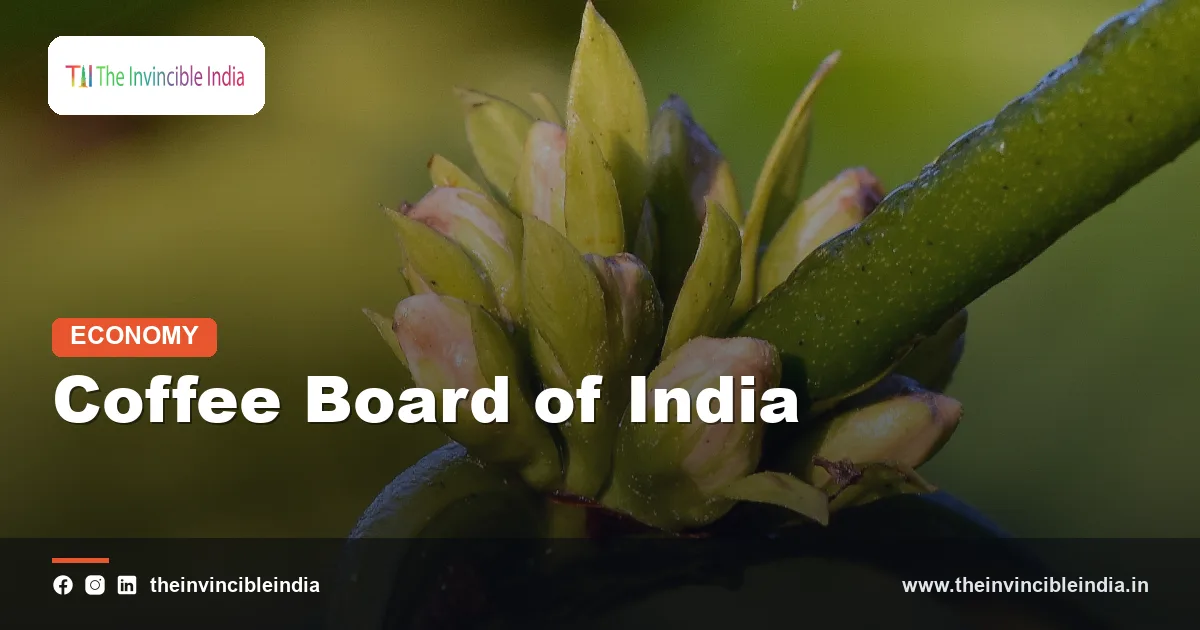
The Coffee Board of India is the statutory body, established in 1942 and headquartered in Bengaluru, that promotes the growing, research, quality and export of Indian coffee under the Ministry of Commerce and Industry. The Coffee Board of India supports a crop that is grown mainly in Karnataka, Kerala and Tamil Nadu, largely by smallholders working under shade in the hill ranges of the Western Ghats and Eastern Ghats.
India is one of the world’s major coffee producers and is distinctive for growing most of its coffee under a layered shade canopy, alongside spices and fruit trees. This explainer sets out what the Coffee Board of India is, how its role has changed since the pooling era, how coffee research is organised, what the specialty and single-origin push involves, which Indian coffees carry GI status, and how exports work. Last reviewed: 19 October 2026.
| Attribute | Details |
|---|---|
| Full name | Coffee Board of India |
| Established | 1942, under the Coffee Act of 1942 |
| Governing law | Coffee Act, 1942 |
| Parent ministry | Ministry of Commerce and Industry, Government of India |
| Type | Statutory development, research and promotion body |
| Headquarters | Bengaluru, Karnataka |
| Main coffee regions | Karnataka (Kodagu, Chikmagalur, Hassan), Kerala (Wayanad), Tamil Nadu (Nilgiris, Shevaroys, Pulneys), plus emerging areas such as Andhra Pradesh, Odisha and the North East |
| Varieties grown | Arabica and Robusta |
| Research arm | Central Coffee Research Institute (CCRI), Balehonnur, Chikmagalur district |
Key Takeaways
- The Coffee Board of India was established in 1942 under the Coffee Act, 1942, is headquartered in Bengaluru and functions under the Ministry of Commerce and Industry.
- The Coffee Board of India moved away from compulsory pooling and marketing of coffee in the 1990s and now concentrates on research, extension, quality, market information and export promotion.
- Indian coffee is grown predominantly in Karnataka, Kerala and Tamil Nadu, with Karnataka accounting for the largest share of national output.
- The Central Coffee Research Institute (CCRI) at Balehonnur in Chikmagalur district is the Coffee Board of India’s research centre for coffee agronomy, breeding and processing.
- Indian coffee is notable for being grown mostly under shade, and several regional coffees, such as Coorg Arabica, Wayanad Robusta, Chikmagalur Arabica and Monsooned Malabar, have geographical indication status.
- India produces both Arabica and Robusta coffee, and a large portion of the crop is exported, with a growing domestic café and consumption market.
What is the Coffee Board of India?
The Coffee Board of India is a statutory organisation of the Government of India that is responsible for the development of the Indian coffee industry, including research, extension services to growers, quality improvement and the promotion of coffee in India and abroad. It operates under the Coffee Act, 1942, and is administratively linked to the Ministry of Commerce and Industry.
The Coffee Board of India is headed by a chairperson, supported by a chief executive officer and a board of members drawn from growers, curers, exporters, labour, the government and Parliament. Its head office is in Bengaluru, and it maintains regional and sub-regional offices in coffee-growing districts to serve farmers directly. The Board also runs coffee-related facilities such as research stations, laboratories and promotional outlets.
Coffee in India is a plantation crop that supports a large number of growers, most of them small, and a significant workforce employed on estates, in curing works and in related trade. It is one of the country’s notable agricultural exports and a crop closely tied to the ecology of the Western Ghats.
When was the Coffee Board of India established, and how has its role changed?
The Coffee Board of India was established in 1942 when the Coffee Act, 1942, was enacted, and its role has shifted from compulsory pooling and marketing of coffee to a promotional and developmental role since liberalisation in the 1990s. In its early decades the Board bought coffee from growers, pooled it and sold it in domestic and export markets, giving growers a guaranteed system but limiting their direct market access.
The pooling system was designed in a period when the government wanted to stabilise prices and ensure orderly marketing. As India liberalised its economy, this structure was gradually dismantled, and from the mid-1990s growers were free to sell their coffee directly in the market. The Board, which had been a trading agency, was reoriented towards research, extension, quality control, statistics and promotion.
This change made the Board less of a buyer and more of a facilitator. Growers gained the freedom to negotiate prices and build their own brands, while the Board retained responsibilities that benefit the entire sector, such as plant-breeding research and market intelligence.
What does the Coffee Board of India do today?
The Coffee Board of India today carries out five main kinds of work: research and technology development, extension and grower support, quality and market information, promotion of Indian coffee at home and abroad, and administration of registration and trade-related requirements. Some of these functions are carried out directly, and others in partnership with state agencies, growers’ associations and trade bodies.
Research and extension
The Board funds and manages coffee research through the CCRI and its sub-stations. It also provides advisory services to growers on pests such as the white stem borer and coffee berry borer, on diseases such as leaf rust, on soil and water management and on harvesting and processing.
Quality and curing
The Board promotes better post-harvest practices, such as washed (wet) processing for Arabica and sun-dried natural processing for Robusta and some Arabica. It supports laboratories that evaluate cup quality and monitors standards for exports.
Market information and promotion
The Board collects and publishes statistics on production, prices and trade, helping growers and exporters make decisions. It participates in international trade fairs, runs promotional campaigns, and organises coffee events to build awareness of Indian origins.
Support schemes
Over the years, the Board has implemented schemes for replanting and rejuvenation of old plantations, water conservation, mechanisation, small grower support and market development. Eligibility and subsidy rates change with each scheme period.
How is Indian coffee grown?
Indian coffee is grown mainly in the hill districts of the Western Ghats under a canopy of shade trees, often interplanted with pepper, cardamom, areca nut, oranges or bananas, which gives the crop a distinctive ecological profile. The shade canopy moderates temperature, protects soil, supports biodiversity and contributes to flavour development through slower bean maturation.
Two species dominate. Arabica (Coffea arabica) grows at higher altitudes, generally prized for its aroma and acidity. Robusta (Coffea canephora) grows at lower elevations, tolerates warmer conditions and has higher caffeine content and body. India produces both, and Robusta accounts for a larger share of the national crop by volume than Arabica in recent years.
Harvesting is mostly done by hand, with pickers collecting ripe cherries selectively. After picking, the coffee is processed using either the wet method, in which the pulp is removed and the beans are fermented and washed, or the dry (natural) method, in which the whole cherry is dried. Many estates in Kodagu and Chikmagalur are family-owned and have been in cultivation for generations.
Where is coffee grown in India?
Coffee in India is grown mostly in three southern states: Karnataka, Kerala and Tamil Nadu, with Karnataka alone typically accounting for the majority of national output. The table below summarises the major regions.
| State | Key districts or hills | Notes |
|---|---|---|
| Karnataka | Kodagu (Coorg), Chikmagalur, Hassan | Largest producer; both Arabica and Robusta; home of the Baba Budan hills |
| Kerala | Wayanad, Idukki, Travancore hills | Predominantly Robusta; Wayanad Robusta is a GI coffee |
| Tamil Nadu | Nilgiris, Shevaroys (Yercaud), Pulneys (Kodaikanal), Anamalais | Mix of Arabica and Robusta; many small growers including tribal farmers |
| Non-traditional areas | Araku Valley (Andhra Pradesh and Odisha), North East | Newer plantations, often with tribal cooperatives and a specialty focus |
The Baba Budan Giri hills in Chikmagalur are linked in tradition to the introduction of coffee to India by a Sufi saint, Baba Budan, who is said to have brought seeds from Yemen several centuries ago. The story is part of local lore, and historians treat the exact details with caution, but the hills remain symbolic of Indian coffee’s origins.
What is the Central Coffee Research Institute?
The Central Coffee Research Institute (CCRI) is the Coffee Board of India’s main research institution, located at Balehonnur in Chikmagalur district, Karnataka, and it carries out research on coffee breeding, agronomy, pests, diseases and post-harvest technology. Research on coffee in this area dates back to the early twentieth century, and the institute has produced many of the improved varieties used by Indian growers.
CCRI has developed Arabica selections with resistance to leaf rust, such as the Chandragiri variety, and improved Robusta lines that offer higher yield and better quality. It also works on shade management, drought and climate resilience, integrated pest management and water-saving practices.
Alongside CCRI, the Board maintains regional research stations and extension units in different coffee zones. Their work aims to translate research findings into practical advice for growers through demonstration plots, training programmes and publications.
What is the specialty and single-origin coffee push?
The specialty and single-origin push is the Coffee Board of India’s effort to position Indian coffee as high-quality, traceable and regionally distinct, rather than as a bulk commodity. Specialty coffee is typically graded on cup quality, and single-origin coffee comes from a single farm or region, allowing buyers to trace flavour back to place.
Several features support this positioning. Shade-grown coffee appeals to buyers interested in environmental sustainability. Distinct micro-regions such as Chikmagalur, Coorg, Wayanad, the Nilgiris and Araku offer different flavour profiles. Cup-quality competitions, tasting events and awards help estates gain recognition and higher prices. Coffee Board initiatives such as promotional festivals and quality labs support that effort.
Indian coffee also includes unique products, including Monsooned Malabar, a coffee whose beans are exposed to the moist monsoon winds on the Malabar coast, causing them to swell and lose acidity, giving a mellow and earthy cup. It is a historically significant export coffee and has a GI tag.
Which Indian coffees have GI status?
Several Indian coffees have geographical indication (GI) status, including Coorg Arabica, Wayanad Robusta, Chikmagalur Arabica, Bababudangiri Arabica, Araku Valley Arabica and Monsooned Malabar coffee. A GI recognises that the product’s qualities derive from its place of origin and prevents others from using the name falsely.
- Coorg Arabica from Kodagu district, Karnataka, grown under shade at moderate elevations.
- Chikmagalur Arabica from Chikmagalur district, Karnataka, where Indian coffee cultivation traditionally began.
- Bababudangiri Arabica from the Baba Budan Giri hills in Karnataka.
- Wayanad Robusta from Wayanad district, Kerala.
- Araku Valley Arabica from the Eastern Ghats region of Andhra Pradesh, grown with tribal communities.
- Monsooned Malabar Arabica and Robusta, processed on the Malabar coast of Kerala and Karnataka.
The Coffee Board of India has supported GI applications and promotes these names in its marketing. GI tags help growers differentiate their coffee, and may support better prices where buyers recognise the origin.
How does India export coffee?
India exports a large share of its coffee, both as green beans and as processed products such as roasted, ground and instant coffee, and exporters usually register with the Coffee Board of India as part of the trade process. Major destinations have historically included Italy, Germany, Belgium, Russia and other European and Middle Eastern markets.
A notable portion of exports is Robusta, which is widely used in espresso blends and instant coffee, while Arabica and specialty lots serve premium buyers. India also imports some coffee for re-export in value-added forms under certain schemes. Export competitiveness depends on global prices, production in competing countries such as Brazil and Vietnam, currency movement and compliance with food-safety rules abroad, including the European Union’s regulations on deforestation-free supply chains and residue limits.
Domestic consumption has been growing, driven by café chains, urbanisation and rising interest in filter coffee, instant coffee and specialty brews. South India has a long-standing filter coffee culture, and consumption elsewhere is expanding.
Bottom Line
The Coffee Board of India is the institution that keeps Indian coffee competitive. Since the end of pooling, it has focused on science, extension, quality and promotion, backing a shade-grown crop whose regional identities, such as Coorg, Chikmagalur, Wayanad, Araku and Monsooned Malabar, are increasingly valued in global specialty markets.
Frequently Asked Questions
What is the Coffee Board of India?
The Coffee Board of India is a statutory body under the Ministry of Commerce and Industry that develops and promotes Indian coffee. It was established in 1942 under the Coffee Act and is headquartered in Bengaluru. Its work covers research, extension services, quality, market information and export promotion.
Where is the Coffee Board of India located?
The Coffee Board of India is headquartered in Bengaluru, Karnataka. It has regional and sub-regional offices in coffee-growing districts across Karnataka, Kerala and Tamil Nadu. Its research arm, the Central Coffee Research Institute, is at Balehonnur in Chikmagalur district.
Which states grow coffee in India?
Karnataka, Kerala and Tamil Nadu are the main coffee-growing states in India, with Karnataka producing the largest share. Within these states, the key areas include Kodagu, Chikmagalur, Hassan, Wayanad, the Nilgiris, the Shevaroys and the Pulneys. Smaller plantations exist in Andhra Pradesh, Odisha and the North East.
Does the Coffee Board of India still buy and sell coffee?
No, the Coffee Board of India no longer runs the compulsory pooling and marketing system that it operated in earlier decades. That system was phased out in the 1990s as the economy was liberalised. Growers now sell their coffee freely, while the Board focuses on research, quality, promotion and information.
Which Indian coffees have a GI tag?
Indian coffees with GI status include Coorg Arabica, Chikmagalur Arabica, Bababudangiri Arabica, Wayanad Robusta, Araku Valley Arabica and Monsooned Malabar coffee. These tags link each coffee to its region of origin. The Coffee Board of India supports and promotes these origins.
Is Indian coffee shade-grown?
Yes, most Indian coffee is grown under a canopy of shade trees, often mixed with spices and fruit trees. This system supports biodiversity, protects soil and moderates temperature. Shade-grown status is one reason Indian coffee is promoted in specialty and sustainability-minded markets.
{“@context”:”https://schema.org”,”@graph”:[{“@type”:”FAQPage”,”mainEntity”:[{“@type”:”Question”,”name”:”What is the Coffee Board of India?”,”acceptedAnswer”:{“@type”:”Answer”,”text”:”The Coffee Board of India is a statutory body under the Ministry of Commerce and Industry that develops and promotes Indian coffee. It was established in 1942 under the Coffee Act and is headquartered in Bengaluru. Its work covers research, extension services, quality, market information and export promotion.”}},{“@type”:”Question”,”name”:”Where is the Coffee Board of India located?”,”acceptedAnswer”:{“@type”:”Answer”,”text”:”The Coffee Board of India is headquartered in Bengaluru, Karnataka. It has regional and sub-regional offices in coffee-growing districts across Karnataka, Kerala and Tamil Nadu. Its research arm, the Central Coffee Research Institute, is at Balehonnur in Chikmagalur district.”}},{“@type”:”Question”,”name”:”Which states grow coffee in India?”,”acceptedAnswer”:{“@type”:”Answer”,”text”:”Karnataka, Kerala and Tamil Nadu are the main coffee-growing states in India, with Karnataka producing the largest share. Within these states, the key areas include Kodagu, Chikmagalur, Hassan, Wayanad, the Nilgiris, the Shevaroys and the Pulneys. Smaller plantations exist in Andhra Pradesh, Odisha and the North East.”}},{“@type”:”Question”,”name”:”Does the Coffee Board of India still buy and sell coffee?”,”acceptedAnswer”:{“@type”:”Answer”,”text”:”No, the Coffee Board of India no longer runs the compulsory pooling and marketing system that it operated in earlier decades. That system was phased out in the 1990s as the economy was liberalised. Growers now sell their coffee freely, while the Board focuses on research, quality, promotion and information.”}},{“@type”:”Question”,”name”:”Which Indian coffees have a GI tag?”,”acceptedAnswer”:{“@type”:”Answer”,”text”:”Indian coffees with GI status include Coorg Arabica, Chikmagalur Arabica, Bababudangiri Arabica, Wayanad Robusta, Araku Valley Arabica and Monsooned Malabar coffee. These tags link each coffee to its region of origin. The Coffee Board of India supports and promotes these origins.”}},{“@type”:”Question”,”name”:”Is Indian coffee shade-grown?”,”acceptedAnswer”:{“@type”:”Answer”,”text”:”Yes, most Indian coffee is grown under a canopy of shade trees, often mixed with spices and fruit trees. This system supports biodiversity, protects soil and moderates temperature. Shade-grown status is one reason Indian coffee is promoted in specialty and sustainability-minded markets.”}}]}]}


