

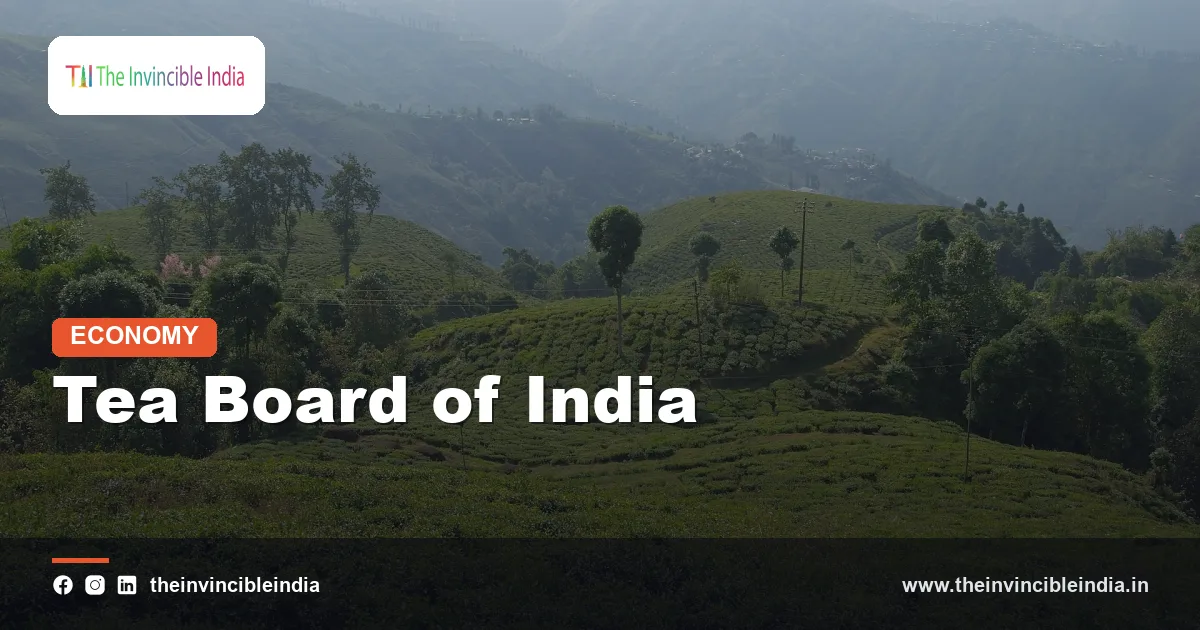
The Tea Board of India is the statutory body, established in 1954 under the Tea Act, 1953, that regulates, develops and promotes the Indian tea industry and its exports. Headquartered in Kolkata and functioning under the Ministry of Commerce and Industry, the Tea Board of India oversees plantations, tea manufacture, auctions, quality standards and the welfare of the people who depend on tea for a living.
India is one of the world’s largest tea producers and also a very large domestic consumer, and the Tea Board of India is the agency that links growers, factories, auction centres and exporters to national policy. This explainer covers what the Board is, what it does, how Darjeeling, Assam and Nilgiri teas are protected, how the auction system works, and how the Board supports research and workers. Last reviewed: 19 October 2026.
| Attribute | Details |
|---|---|
| Full name | Tea Board of India |
| Established | 1954, replacing the earlier Central Tea Board and the Indian Tea Licensing Committee |
| Governing law | Tea Act, 1953 |
| Parent ministry | Ministry of Commerce and Industry, Government of India |
| Type | Statutory regulatory and promotional body |
| Headquarters | Kolkata, West Bengal |
| Main tea regions | Assam, West Bengal (Darjeeling, Terai, Dooars), Tamil Nadu and Kerala (South India) |
| Key functions | Registration and licensing, quality, auctions and marketing orders, research support, export promotion, welfare schemes |
| Protected origins | Darjeeling, Assam Orthodox, Nilgiri, Kangra and other geographical indications |
Key Takeaways
- The Tea Board of India was established in 1954 under the Tea Act, 1953, and is headquartered in Kolkata under the Ministry of Commerce and Industry.
- The Tea Board of India regulates tea plantations, manufacturers, traders and exporters through registration, licensing and marketing control orders.
- Darjeeling tea, which received geographical indication protection in the mid-2000s, is often cited as the first Indian product to receive a GI tag, and the Tea Board of India owns the Darjeeling logo and certification process.
- Indian tea is sold through an auction system with centres including Kolkata, Guwahati, Siliguri, Coonoor, Coimbatore and Kochi, as well as through private sales.
- The Tea Board of India supports research, replanting, small tea grower development and worker welfare, often working with bodies such as the Tea Research Association and UPASI.
- India’s tea industry is concentrated in Assam, West Bengal, Tamil Nadu and Kerala, and a large share of production is consumed domestically.
What is the Tea Board of India?
The Tea Board of India is a statutory body of the Government of India that regulates and promotes the cultivation, manufacture, marketing and export of Indian tea. It was constituted in 1954 under the Tea Act, 1953, and takes its direction from the Ministry of Commerce and Industry.
The Tea Board of India has a chairperson, a vice-chairperson and a body of members drawn from tea growers, manufacturers, traders, consumers, tea-garden workers, Members of Parliament, state governments and relevant ministries. This composition is meant to represent every stakeholder group in the industry. Its head office is in Kolkata, with regional and zonal offices in tea-growing states and offices abroad that have historically been used to promote Indian tea in major markets.
Tea is classified as a plantation crop and is among the oldest organised industries in India. The Tea Board of India therefore combines the functions of a regulator, a development agency and a promotional body, and its work touches rural employment, foreign exchange and the cultural identity of regions such as Darjeeling and Assam.
When and why was the Tea Board of India established?
The Tea Board of India was established in 1954 to replace earlier bodies and create a single statutory authority for the industry after the Tea Act, 1953, was passed. Before this, the Indian Tea Licensing Committee and the Central Tea Board dealt with parts of the industry’s regulation and promotion.
Tea cultivation on a commercial scale in India began in the nineteenth century, mainly in Assam and later in Darjeeling and the Nilgiris, and the industry was historically shaped by colonial-era plantation companies. After independence, the government wanted a body that could manage supply, protect India’s export position, safeguard workers and encourage research. The Tea Act, 1953, gave that framework, and the Board was created the following year.
The Act has been amended over time and is supported by subordinate orders, such as marketing control orders and licensing orders, which allow the Board to set rules on how tea may be sold, exported and registered.
What does the Tea Board of India do?
The Tea Board of India performs several core functions: it registers and regulates tea estates, factories and exporters, issues quality and marketing rules, promotes Indian tea at home and abroad, supports research and plantation development, and runs welfare and subsidy schemes. These functions are carried out through offices in the main growing regions.
Regulation and licensing
Producers and exporters of tea must register with the Board, and the Board maintains records of estates and manufacturing units. Orders issued under the Tea Act regulate aspects such as the sale of tea through auctions and the quality of tea that may be exported.
Quality and standards
The Board works with food-safety authorities and testing laboratories to ensure that tea meets standards for pesticide residues and contaminants. Because importing countries set strict limits, quality control has become a growing focus.
Promotion and branding
The Board promotes Indian tea through trade fairs, buyer-seller meets and generic advertising. It manages certification marks for origin teas, such as the Darjeeling logo, and encourages new product forms such as orthodox, specialty and packaged teas.
Development and welfare
The Board runs development schemes for replanting, rejuvenation, mechanisation, irrigation and small grower support. It also administers worker welfare assistance in the plantation sector, including support for housing, education and healthcare in coordination with the Plantations Labour Act, 1951, and state governments.
Which Indian teas have geographical indication protection?
Several Indian teas have geographical indication (GI) protection, including Darjeeling tea, Assam Orthodox tea, Nilgiri tea and Kangra tea, which links each tea’s name legally to its place of origin. A GI tag protects the name from being used on tea grown elsewhere and helps buyers recognise authentic products.
| Tea | Region | Notable characteristics |
|---|---|---|
| Darjeeling | Hills of Darjeeling district, West Bengal | Light liquor, floral and muscatel notes; often called the “champagne of teas”; first Indian GI |
| Assam | Brahmaputra valley, Assam | Bold, malty, strong tea; large share of Indian CTC production; Assam Orthodox also has a GI |
| Nilgiri | Nilgiri hills, Tamil Nadu | Fragrant, brisk tea grown at high altitude; widely used in blends and as a single-origin tea |
| Kangra | Kangra valley, Himachal Pradesh | Smaller-volume tea with green and black varieties |
The Tea Board of India holds the Darjeeling logo and manages a licensing and certification system to verify that tea sold as Darjeeling genuinely originates from registered gardens. This is intended to combat the widespread problem of blending or mislabelling, because the volume of tea sold worldwide as Darjeeling has historically been far larger than the region’s actual production.
How does the tea auction system work in India?
The tea auction system in India works by having producers consign tea to a registered auction centre, where brokers catalogue the lots and registered buyers bid for them, with the Tea Board of India setting rules for how auctions are conducted. The system provides price discovery and a recognised marketplace for a large portion of Indian tea.
The principal auction centres are Kolkata, Guwahati, Siliguri and Jalpaiguri in the north, and Coonoor, Coimbatore and Kochi in the south. The Kolkata auction is one of the oldest, with a history dating to the nineteenth century. In many auctions, tea is sampled, lots are listed in a catalogue, and bidding takes place in set sessions. In recent years, electronic auctions have been introduced to improve transparency and reduce delays.
Not all tea passes through auctions. Producers also sell directly to buyers through private sales, and the Board’s marketing control orders set norms on how much must be sold through auction and how sales must be reported. The goal is to keep markets orderly and give small growers access to fair prices.
What is the role of small tea growers?
Small tea growers, commonly defined as those with a small landholding who sell green leaf to bought-leaf factories, form a rapidly growing part of Indian tea production, and the Tea Board of India has a dedicated mandate to support them. They are especially prominent in Assam, West Bengal and the Nilgiris.
These growers often lack processing facilities of their own and depend on factories to buy their leaf. The Board encourages them to form self-help groups, farmer producer organisations (FPOs) and cooperatives to improve bargaining power. It provides training in good plucking practices, support for quality inputs, and schemes that promote registration and identity cards so that growers can access benefits.
The rise of small growers has changed the structure of the industry, which was once dominated by large estates. It has also raised issues around leaf quality, price fairness and traceability, which the Board addresses through advisory and regulatory measures.
How does the Tea Board of India support research?
The Tea Board of India supports tea research mainly through grants and collaboration with institutions such as the Tea Research Association (TRA) in Assam and West Bengal, and the United Planters’ Association of Southern India (UPASI) Tea Research Foundation in the south. These bodies work on varieties, pests, soil, climate adaptation and processing technology.
The Tocklai Tea Research Institute near Jorhat, Assam, run by the Tea Research Association, is one of the oldest and most respected tea research stations in the world, established in the early twentieth century. The Darjeeling Tea Research and Management Centre and regional stations in the Nilgiris contribute work tailored to local conditions.
Research priorities include developing clones that tolerate drought and pests, reducing pesticide use, improving yield per hectare and finding sustainable ways to manage ageing bushes, since a significant share of Indian tea bushes are old and less productive. Climate variability is a particular concern for hill tea, where flush timing and quality are sensitive to rainfall and temperature.
What does the Tea Board of India do for tea workers?
The Tea Board of India supports tea-garden workers through welfare schemes and by enforcing industry norms in coordination with labour laws, while the primary legal protections for plantation workers come from the Plantations Labour Act, 1951, and state rules. Workers on tea estates are a large workforce in which women form a significant portion of those who pluck leaf.
Welfare activities historically supported by the Board include educational assistance for workers’ children, health and medical help, and support for housing in plantations. The details of schemes change with budgets and policy, so they should be checked against current official sources. Estates are generally required to provide basic amenities such as housing, drinking water, medical care and schools under the Plantations Labour Act.
Wages and conditions in tea gardens remain a subject of public debate, especially in Assam and North Bengal, and wages are typically negotiated between estate managements and workers’ unions under state oversight rather than set directly by the Board.
How are Indian tea and tea exports performing?
India is generally ranked as the second-largest tea producer in the world after China, producing well over one billion kilograms annually, and it exports a meaningful share while consuming the majority domestically. Exact figures vary year to year with weather and market conditions, so they are best read from the Board’s latest statistics.
Key export markets have historically included Russia and the Commonwealth of Independent States, Iran, the United Arab Emirates, the United States, the United Kingdom and Germany. Export mix includes CTC (crush, tear, curl) tea, orthodox leaf tea, green tea and packaged and value-added products. Competition from other producers such as Kenya, Sri Lanka and China, along with currency movements and payment issues in some markets, affects India’s export performance.
The Tea Board of India responds with market-development activity, quality drives and support for specialty teas, which fetch higher prices than commodity grades.
What are the milestones in the history of the Tea Board of India?
The history of the Tea Board of India reflects a shift from colonial-era plantation regulation to an independent India’s focus on welfare, quality and branding. The table below lists key points.
| Period | Development |
|---|---|
| 19th century | Commercial tea cultivation takes root in Assam, then Darjeeling and the Nilgiris |
| 1911 | Tocklai research station set up in Assam, later run by the Tea Research Association |
| 1951 | Plantations Labour Act enacted to regulate working conditions in plantations |
| 1953 | Tea Act passed by Parliament |
| 1954 | Tea Board of India constituted in Kolkata |
| Mid-2000s | Darjeeling tea receives GI status; other teas follow |
| 2000s onwards | Marketing control orders, small grower programmes and electronic auctions develop |
The sequence shows that the Board’s purpose has widened from licensing and control to include market development, sustainability and geographical branding.
Bottom Line
The Tea Board of India is the statutory regulator and promoter of one of India’s oldest and most visible industries. By licensing the trade, protecting origin names such as Darjeeling, supporting research and small growers, and backing worker welfare, the Tea Board of India shapes how Indian tea is grown, sold and recognised worldwide.
Frequently Asked Questions
What is the Tea Board of India?
The Tea Board of India is a statutory body under the Ministry of Commerce and Industry that regulates and promotes the Indian tea industry. It was established in 1954 under the Tea Act, 1953, and is headquartered in Kolkata. It handles registration, quality, marketing rules, research support and welfare schemes.
Where is the Tea Board of India headquartered?
The Tea Board of India is headquartered in Kolkata, West Bengal. It also has regional and zonal offices in tea-growing areas such as Assam, North Bengal and South India. Some overseas offices have been used to promote Indian tea abroad.
Which Indian teas have a GI tag?
Darjeeling tea, Assam Orthodox tea, Nilgiri tea and Kangra tea are among the Indian teas that have geographical indication protection. Darjeeling tea is often cited as India’s first GI-protected product. The Tea Board of India manages the Darjeeling logo and certification to guard against mislabelling.
How are tea auctions held in India?
Tea auctions in India are held at registered centres such as Kolkata, Guwahati, Siliguri, Coonoor, Coimbatore and Kochi, where brokers list lots and registered buyers bid. The Tea Board of India sets rules for conduct and reporting, and many centres now use electronic bidding. Producers can also sell some tea through private sales.
Does the Tea Board of India support small tea growers?
Yes, the Tea Board of India has programmes for small tea growers, who supply green leaf to bought-leaf factories. It supports them through training, quality inputs, registration and encouragement to form self-help groups and producer organisations. Details of schemes change over time and should be checked with the Board.
Is India the largest tea producer in the world?
No, India is generally the second-largest tea producer in the world, after China. India produces well over a billion kilograms of tea each year, with Assam and West Bengal contributing the largest share. A large part of this tea is consumed within India.
{“@context”:”https://schema.org”,”@graph”:[{“@type”:”FAQPage”,”mainEntity”:[{“@type”:”Question”,”name”:”What is the Tea Board of India?”,”acceptedAnswer”:{“@type”:”Answer”,”text”:”The Tea Board of India is a statutory body under the Ministry of Commerce and Industry that regulates and promotes the Indian tea industry. It was established in 1954 under the Tea Act, 1953, and is headquartered in Kolkata. It handles registration, quality, marketing rules, research support and welfare schemes.”}},{“@type”:”Question”,”name”:”Where is the Tea Board of India headquartered?”,”acceptedAnswer”:{“@type”:”Answer”,”text”:”The Tea Board of India is headquartered in Kolkata, West Bengal. It also has regional and zonal offices in tea-growing areas such as Assam, North Bengal and South India. Some overseas offices have been used to promote Indian tea abroad.”}},{“@type”:”Question”,”name”:”Which Indian teas have a GI tag?”,”acceptedAnswer”:{“@type”:”Answer”,”text”:”Darjeeling tea, Assam Orthodox tea, Nilgiri tea and Kangra tea are among the Indian teas that have geographical indication protection. Darjeeling tea is often cited as India’s first GI-protected product. The Tea Board of India manages the Darjeeling logo and certification to guard against mislabelling.”}},{“@type”:”Question”,”name”:”How are tea auctions held in India?”,”acceptedAnswer”:{“@type”:”Answer”,”text”:”Tea auctions in India are held at registered centres such as Kolkata, Guwahati, Siliguri, Coonoor, Coimbatore and Kochi, where brokers list lots and registered buyers bid. The Tea Board of India sets rules for conduct and reporting, and many centres now use electronic bidding. Producers can also sell some tea through private sales.”}},{“@type”:”Question”,”name”:”Does the Tea Board of India support small tea growers?”,”acceptedAnswer”:{“@type”:”Answer”,”text”:”Yes, the Tea Board of India has programmes for small tea growers, who supply green leaf to bought-leaf factories. It supports them through training, quality inputs, registration and encouragement to form self-help groups and producer organisations. Details of schemes change over time and should be checked with the Board.”}},{“@type”:”Question”,”name”:”Is India the largest tea producer in the world?”,”acceptedAnswer”:{“@type”:”Answer”,”text”:”No, India is generally the second-largest tea producer in the world, after China. India produces well over a billion kilograms of tea each year, with Assam and West Bengal contributing the largest share. A large part of this tea is consumed within India.”}}]}]}


