

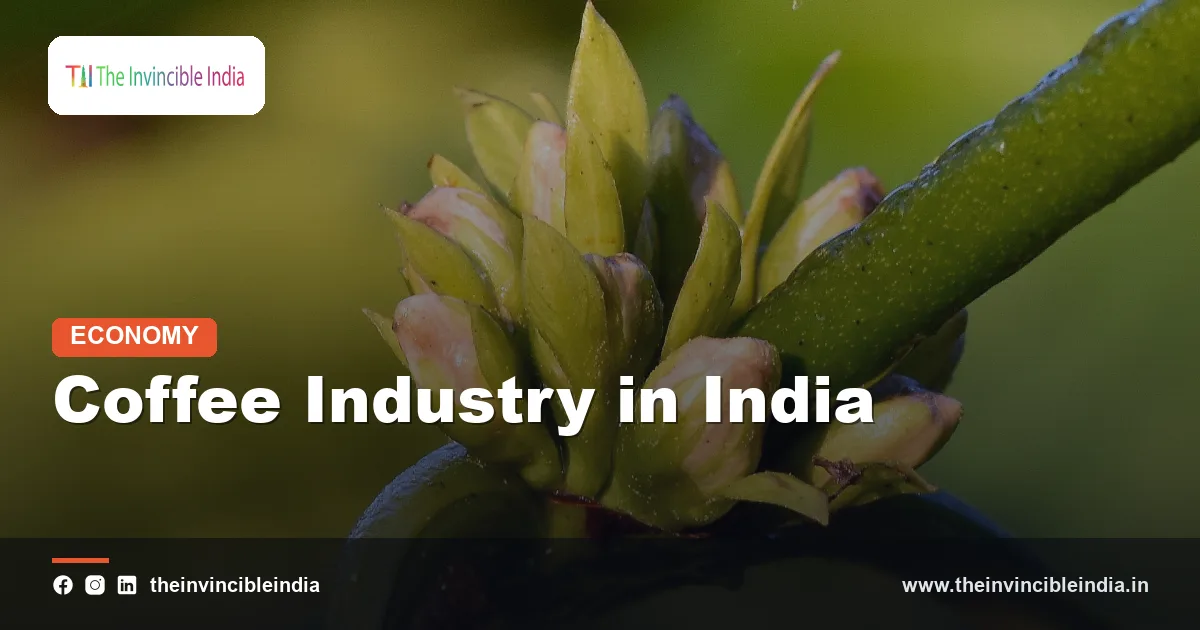
The coffee industry in India is the cultivation, processing, trading, export and retail of coffee beans, grown mainly in the shaded hill regions of the Western Ghats and the Eastern Ghats, and it makes India a notable coffee producer and exporter even though it is not among the very largest globally. The industry is regulated by the Coffee Board of India under the Coffee Act, 1942, and is dominated by small and medium growers rather than large estates.
Coffee in India is grown under a canopy of shade trees, often alongside pepper, cardamom and other spices, and a large share of the harvest is sold abroad. At the same time, a growing urban middle class, a strong tradition of south Indian filter coffee and a fast-expanding cafe culture have made the domestic market increasingly important. This article explains how the Indian coffee sector works, where coffee is grown, what makes Indian coffee distinctive and what challenges the industry faces.
Quick Facts
| Sector | Plantation agriculture, processing, export and retail |
|---|---|
| Origin story | Baba Budan reportedly brought seven beans to the Chikmagalur hills in the 17th century |
| Regulator | Coffee Board of India, under the Ministry of Commerce and Industry |
| Governing law | Coffee Act, 1942 |
| Board headquarters | Bengaluru, Karnataka |
| Largest producing state | Karnataka, followed by Kerala and Tamil Nadu |
| Main species grown | Arabica and robusta, with more robusta than arabica produced |
| Signature product | Monsooned Malabar, a coffee cured by exposure to monsoon winds |
Key Takeaways
- The coffee industry in India is concentrated in the hills of southern India, with Karnataka, Kerala and Tamil Nadu together accounting for the overwhelming majority of the country’s coffee output.
- Indian coffee is traditionally grown under shade trees in mixed plantations, which supports biodiversity in the Western Ghats and distinguishes it from the full-sun coffee farming common in some other countries.
- India grows both arabica and robusta, and robusta makes up the larger share of national production.
- Monsooned Malabar is a distinctive Indian coffee, produced by exposing green beans to the humid monsoon winds of the Malabar coast, and it carries a Geographical Indication (GI) tag.
- The Coffee Board of India, set up under the Coffee Act, 1942, supports research, extension, quality control and the marketing of Indian coffee at home and abroad.
- A large proportion of India’s coffee is exported, with Italy and Germany among the most important buyers, while domestic consumption has been rising steadily.
What is the coffee industry in India and how big is it?
The coffee industry in India is a plantation-based agricultural sector that employs a large rural workforce, mainly in hill districts of southern India, and supplies both domestic and international markets. India is generally counted among the leading coffee-producing countries of the world, though its output is much smaller than that of the largest producers such as Brazil and Vietnam.
The industry is notable less for sheer volume than for the character of its product and its structure. Coffee is grown on hillsides that are otherwise covered by forest, and the plantations form part of a larger mixed landscape of spices, fruit trees and native timber. For many districts in Karnataka, Kerala and Tamil Nadu, coffee is the principal source of rural income and employment.
India’s coffee year runs from October to September, and the sector is usually described in terms of two crops, arabica and robusta, which are harvested in different months and sold through different channels.
How did coffee reach India?
Coffee reached India in the 17th century, when, according to tradition, a Sufi saint named Baba Budan brought seven coffee beans from Yemen and planted them in the hills of Chikmagalur in present-day Karnataka. The range where he is said to have planted them is now known as the Baba Budan Giri hills, and these beans are traditionally regarded as the seed stock of Indian coffee.
For a long time, coffee remained a small-scale crop grown around homes and shrines. Commercial plantation farming began in the 19th century, when European planters established estates in Coorg (Kodagu), Chikmagalur, Wayanad, the Nilgiris and nearby hills. Coffee later became one of the major plantation crops of the colonial economy, alongside tea and rubber.
The industry has also faced setbacks. Coffee leaf rust, a fungal disease, devastated plantations in the region in the late 19th century, and the persistent threat of disease and pests has shaped the choice of coffee varieties ever since.
Key milestones in the history of Indian coffee
| Period | Development |
|---|---|
| 17th century | Baba Budan brings seven beans to the Chikmagalur hills |
| 19th century | Commercial plantations spread across Coorg, Wayanad, the Nilgiris and other hills |
| Late 19th century | Leaf rust damages many plantations and changes cultivation practices |
| 1920s | A research station is established at Balehonnur in Chikmagalur, later the Central Coffee Research Institute |
| 1942 | The Coffee Act is enacted and the Coffee Board is constituted |
| 1990s | Economic reforms dismantle the older pooled marketing system and allow growers to sell more freely |
| 2000s onwards | Branded cafe chains and specialty coffee expand in Indian cities |
Where is coffee grown in India?
Coffee in India is grown mainly in three southern states, Karnataka, Kerala and Tamil Nadu, with Karnataka being by far the largest producer. These states account for the great majority of national output, and their coffee lands lie on the hills of the Western Ghats.
Traditional growing regions
- Karnataka: The state’s coffee is concentrated in Kodagu (Coorg), Chikmagalur and Hassan. Kodagu is especially known for robusta, while Chikmagalur and the Baba Budan Giri area are known for arabica.
- Kerala: Coffee is grown mostly in the Wayanad district, which is known mainly for robusta, with smaller areas in neighbouring hill districts.
- Tamil Nadu: Coffee is grown in the Shevaroy hills near Yercaud, the Nilgiris, the Pulney hills near Kodaikanal and the Anamalai hills.
Non-traditional and emerging regions
Coffee cultivation has also developed outside the southern heartland. The Araku Valley in the Eastern Ghats of Andhra Pradesh and neighbouring parts of Odisha is known for arabica grown largely by tribal farming families, supported by cooperative and government programmes. Parts of the Northeast, including states such as Assam, Mizoram, Nagaland, Manipur and Arunachal Pradesh, are also developing coffee as a hill crop, though their output remains small.
The Coffee Board treats these regions as non-traditional areas and promotes coffee there as a way to diversify farm incomes and encourage sustainable hill farming.
Who grows coffee in India?
Coffee in India is grown overwhelmingly by small growers, with the great majority of coffee holdings being small farms of a few hectares, although a smaller number of larger estates account for a meaningful share of area and output. This smallholder-dominated structure distinguishes the Indian industry from plantation sectors that are controlled by a handful of corporations.
Many small growers are family farms in Kodagu, Chikmagalur, Wayanad and the Nilgiris, and a growing number are tribal families in the Araku Valley and the Northeast. Some growers sell to traders and curing works, some sell through auctions or direct contracts, and others are linked to producer companies and cooperatives that aggregate produce and negotiate better prices.
Large estates and some corporate groups remain important in processing, curing, trading and export. Coffee curing works, which hull, sort and grade the beans before shipment, are an essential link between the farm and the export market.
What is the difference between arabica and robusta coffee in India?
Arabica and robusta are the two commercial coffee species grown in India, and the main difference is that arabica is milder and more aromatic and grows at higher altitudes, while robusta is stronger, more bitter, higher in caffeine and hardier. India produces more robusta than arabica, which sets its profile apart from many other producing countries where arabica dominates.
| Feature | Arabica | Robusta |
|---|---|---|
| Typical altitude in India | Higher hills, generally above about 1,000 metres | Lower elevations, roughly 500 to 1,000 metres |
| Flavour | Smoother, more acidic, aromatic | Stronger, bitter, fuller body |
| Caffeine content | Lower | Higher |
| Disease and pest tolerance | More vulnerable, especially to leaf rust and white stem borer | More resistant and more tolerant of heat |
| Common uses | Filter coffee, specialty and single-origin coffee | Espresso blends, instant coffee, filter coffee blends |
| Main regions | Chikmagalur, Kodagu, Shevaroys, Pulneys, Nilgiris, Araku | Kodagu, Wayanad, Hassan and lower slopes of the Western Ghats |
Arabica varieties grown in India include Kent, S.795 and Chandragiri, among others, many of which were developed or selected by Indian research institutions for disease tolerance. Indian robusta is valued by roasters and blenders because it gives body and crema to espresso, and it is also widely used in the manufacture of instant coffee.
How is coffee grown in India?
Coffee in India is grown mostly as shade-grown coffee, meaning that coffee plants are cultivated beneath a canopy of taller trees rather than in open sun. Common shade trees include silver oak and a variety of native species, and growers often interplant black pepper, cardamom, areca nut, oranges or bananas in the same plots.
This mixed system has several effects. It moderates temperature, protects the soil, retains moisture and provides habitat for birds and other wildlife, which is why many Indian coffee estates are located in biodiversity-rich zones of the Western Ghats. The extra crops also give farmers a second source of income that cushions the impact of low coffee prices.
The coffee growing cycle
- Blossom showers: Pre-monsoon rains in March and April trigger flowering, and well-timed rain is critical to the size of the crop.
- Backing showers: Later showers help the berries develop.
- Monsoon: The heavy rains support growth but also encourage fungal disease, so growers spray and prune to manage it.
- Harvest: Arabica is generally picked in the winter months, with robusta following later, and berries are mostly picked by hand.
- Processing: Coffee is processed either by the wet method, producing washed or plantation coffee, or by the dry method, producing cherry coffee.
What is Monsooned Malabar coffee?
Monsooned Malabar is a distinctive Indian coffee made by exposing dried green coffee beans to the moist monsoon winds of India’s west coast for several weeks, which swells the beans, turns them a pale golden colour and mellows their acidity. The result is a low-acid, heavy-bodied coffee with an earthy, spicy character that is very different from regular washed coffee.
The process has its roots in the era of long sailing voyages. When coffee was shipped around the Cape of Good Hope to Europe, the beans spent months in damp holds and absorbed moisture, and European buyers came to like the resulting flavour. When faster steamships and, later, the Suez Canal shortened the journey, the beans arrived without the same character, so Indian traders began recreating the effect deliberately in open-sided warehouses on the Malabar coast, in places such as Mangalore and Tellicherry.
Monsooned Malabar is protected as a Geographical Indication, and it is used in some espresso blends because it adds body and reduces sharpness. It remains an important differentiator for Indian coffee in European markets.
Who regulates the coffee industry in India?
The Coffee Board of India regulates and supports the Indian coffee industry. It was constituted under the Coffee Act, 1942, works under the Ministry of Commerce and Industry, and is headquartered in Bengaluru.
The Board’s functions have changed over time. In its early decades, it ran a pooled system under which it purchased most of the crop and handled sales. After the economic reforms of the 1990s, this system was dismantled and growers were given freedom to sell their coffee directly in the market. Today, the Board concentrates on development and promotion rather than direct trading.
Main functions of the Coffee Board
- Research on varieties, pests, diseases and agronomy, carried out largely through the Central Coffee Research Institute at Balehonnur in Chikmagalur district
- Extension services that advise growers on cultivation, processing and quality
- Market intelligence, promotion of Indian coffee abroad and support for exporters
- Quality control, including cupping and grading standards
- Financial and technical support schemes for small growers and for expansion in non-traditional areas
- Collection and publication of data on area, production and exports
How much Indian coffee is exported and who buys it?
A large share of India’s coffee production is exported, and Italy and Germany are among the biggest buyers, along with other European countries such as Belgium and Russia and several markets in West Asia and Asia. Exports include green beans, roasted coffee and a significant volume of instant coffee, which is a value-added product.
Italy is a particularly important destination because Italian roasters use Indian robusta in espresso blends and appreciate Monsooned Malabar. Indian coffee competes in these markets with produce from Brazil, Vietnam, Colombia, Indonesia and Ethiopia, and it is generally positioned as a premium, shade-grown and sustainably produced coffee.
Indian exporters earn from both raw and processed forms. Value addition, such as roasting, grinding and making instant coffee, brings higher returns than the sale of green beans alone, and the Coffee Board encourages it as part of its export promotion efforts.
How big is coffee consumption and cafe culture in India?
Domestic coffee consumption in India is growing steadily, and although tea is still the more popular hot drink nationally, coffee has a strong hold in southern India and is rapidly gaining ground in cities across the country. Rising incomes, urbanisation and younger consumers have helped drive this shift.
South India has a long-established filter coffee tradition. Filter coffee is brewed in a metal drip filter from freshly ground coffee, often blended with chicory, and served hot with frothed milk in a steel tumbler and dabarah. The Indian Coffee House network, which began as an initiative linked to the Coffee Board and was later taken over by workers’ cooperative societies, is another well-known institution with a long history.
Modern cafe chains arrived in the 1990s. Cafe Coffee Day opened its first outlet in Bengaluru in 1996, and international chains such as Starbucks entered the Indian market later through partnerships. Alongside these, independent specialty roasters and cafes now promote single-estate and micro-lot coffees, giving growers a way to reach consumers directly and earn better prices.
Ways Indians drink coffee
- South Indian filter coffee, strong decoction mixed with hot milk and sugar
- Instant coffee, widely used for home preparation across the country
- Espresso-based drinks such as cappuccino and latte in cafes
- Cold coffee and iced beverages, popular in summer and among younger consumers
- Specialty pour-over and single-origin brews in independent cafes
Which Indian coffees have Geographical Indication tags?
Several Indian coffees have been granted Geographical Indication (GI) status, which recognises a product as originating from a specific region and having qualities linked to it. The best-known GI-tagged coffees include Coorg Arabica, Chikmagalur Arabica, Bababudangiri Arabica, Wayanad Robusta, Araku Valley Arabica and Monsooned Malabar Arabica and Robusta.
GI tags help protect the names from misuse, support premium pricing and give consumers a reliable indication of origin. They are registered under the Geographical Indications of Goods (Registration and Protection) Act, 1999. For small growers in regions such as Araku, GI recognition has also supported branding and direct sales.
What challenges does the coffee industry in India face?
The coffee industry in India faces four main challenges: volatile prices, climate change, labour shortages and the pressure of pests and diseases. Each of these affects growers’ incomes and the long-term sustainability of the sector.
- Price volatility: Coffee is a globally traded commodity, and Indian prices follow international benchmarks, with arabica and robusta traded on separate international exchanges. When prices fall, small growers with fixed costs are the most affected.
- Climate change: Erratic monsoons, unseasonal rain during flowering, rising temperatures and heavy rainfall events harm yields and quality. Arabica, which prefers cooler conditions, is especially sensitive.
- Labour: Coffee harvesting depends on manual picking, and estates in several districts report difficulty finding enough workers, which pushes up wage costs and has led many to rely on migrant labour.
- Pests and diseases: Leaf rust, white stem borer and berry borer continue to threaten crops and require constant monitoring and the use of resistant varieties.
- Small farm economics: Fragmented holdings limit the ability of growers to invest in mechanisation, irrigation and processing.
Industry bodies and the Coffee Board respond with research on climate-resilient varieties, support for water conservation, promotion of value-added products and efforts to link growers more directly with buyers.
Bottom Line
The coffee industry matters for India because it supports rural livelihoods in ecologically sensitive hill regions, earns foreign exchange through exports and sustains shade canopies in the Western Ghats. The coffee industry in India is a small-farmer, shade-grown, export-oriented sector with deep historical roots in the Western Ghats and a fast-growing domestic market. Its strengths lie in distinctive products such as Monsooned Malabar, its GI-protected regional coffees and its ecological profile, while its main tests are price swings, climate stress and labour availability. Last updated: 12 October 2026.
Frequently Asked Questions
Which state is the largest coffee producer in India?
Karnataka is the largest coffee-producing state in India. Its districts of Kodagu (Coorg), Chikmagalur and Hassan produce the bulk of the country’s coffee. Kerala, mainly Wayanad, and Tamil Nadu follow as the next most important states.
Does India grow more arabica or robusta?
India grows more robusta than arabica by volume. Robusta is hardier and thrives at lower altitudes, especially in Kodagu and Wayanad, while arabica is grown on higher hills such as those of Chikmagalur and the Shevaroys. Both are important, and arabica generally commands a higher price.
What is Monsooned Malabar coffee?
Monsooned Malabar is an Indian coffee in which green beans are exposed to the humid monsoon winds of the Malabar coast for several weeks. This process makes the beans pale and swollen, and it gives the coffee a low-acid, full-bodied, earthy taste. The coffee has a Geographical Indication (GI) tag.
Who brought coffee to India?
According to tradition, Baba Budan, a Sufi saint, brought coffee to India in the 17th century. He is said to have carried seven beans from Yemen and planted them in the hills of Chikmagalur in Karnataka. These plantings are traditionally regarded as the beginning of coffee cultivation in the country.
What is the role of the Coffee Board of India?
The Coffee Board of India is the statutory body that supports and regulates the coffee sector. It was set up under the Coffee Act, 1942, is based in Bengaluru and works under the Ministry of Commerce and Industry. It carries out research, extension, quality control, market promotion and data collection for Indian coffee.
Where does Indian coffee get exported?
Indian coffee is exported to many countries, with Italy and Germany among the largest buyers. Other important markets include Belgium, Russia and several countries in West Asia and Asia. India exports green beans, roasted coffee and instant coffee.
{“@context”:”https://schema.org”,”@graph”:[{“@type”:”FAQPage”,”mainEntity”:[{“@type”:”Question”,”name”:”Which state is the largest coffee producer in India?”,”acceptedAnswer”:{“@type”:”Answer”,”text”:”Karnataka is the largest coffee-producing state in India. Its districts of Kodagu (Coorg), Chikmagalur and Hassan produce the bulk of the country’s coffee. Kerala, mainly Wayanad, and Tamil Nadu follow as the next most important states.”}},{“@type”:”Question”,”name”:”Does India grow more arabica or robusta?”,”acceptedAnswer”:{“@type”:”Answer”,”text”:”India grows more robusta than arabica by volume. Robusta is hardier and thrives at lower altitudes, especially in Kodagu and Wayanad, while arabica is grown on higher hills such as those of Chikmagalur and the Shevaroys. Both are important, and arabica generally commands a higher price.”}},{“@type”:”Question”,”name”:”What is Monsooned Malabar coffee?”,”acceptedAnswer”:{“@type”:”Answer”,”text”:”Monsooned Malabar is an Indian coffee in which green beans are exposed to the humid monsoon winds of the Malabar coast for several weeks. This process makes the beans pale and swollen, and it gives the coffee a low-acid, full-bodied, earthy taste. The coffee has a Geographical Indication (GI) tag.”}},{“@type”:”Question”,”name”:”Who brought coffee to India?”,”acceptedAnswer”:{“@type”:”Answer”,”text”:”According to tradition, Baba Budan, a Sufi saint, brought coffee to India in the 17th century. He is said to have carried seven beans from Yemen and planted them in the hills of Chikmagalur in Karnataka. These plantings are traditionally regarded as the beginning of coffee cultivation in the country.”}},{“@type”:”Question”,”name”:”What is the role of the Coffee Board of India?”,”acceptedAnswer”:{“@type”:”Answer”,”text”:”The Coffee Board of India is the statutory body that supports and regulates the coffee sector. It was set up under the Coffee Act, 1942, is based in Bengaluru and works under the Ministry of Commerce and Industry. It carries out research, extension, quality control, market promotion and data collection for Indian coffee.”}},{“@type”:”Question”,”name”:”Where does Indian coffee get exported?”,”acceptedAnswer”:{“@type”:”Answer”,”text”:”Indian coffee is exported to many countries, with Italy and Germany among the largest buyers. Other important markets include Belgium, Russia and several countries in West Asia and Asia. India exports green beans, roasted coffee and instant coffee.”}}]}]}


