

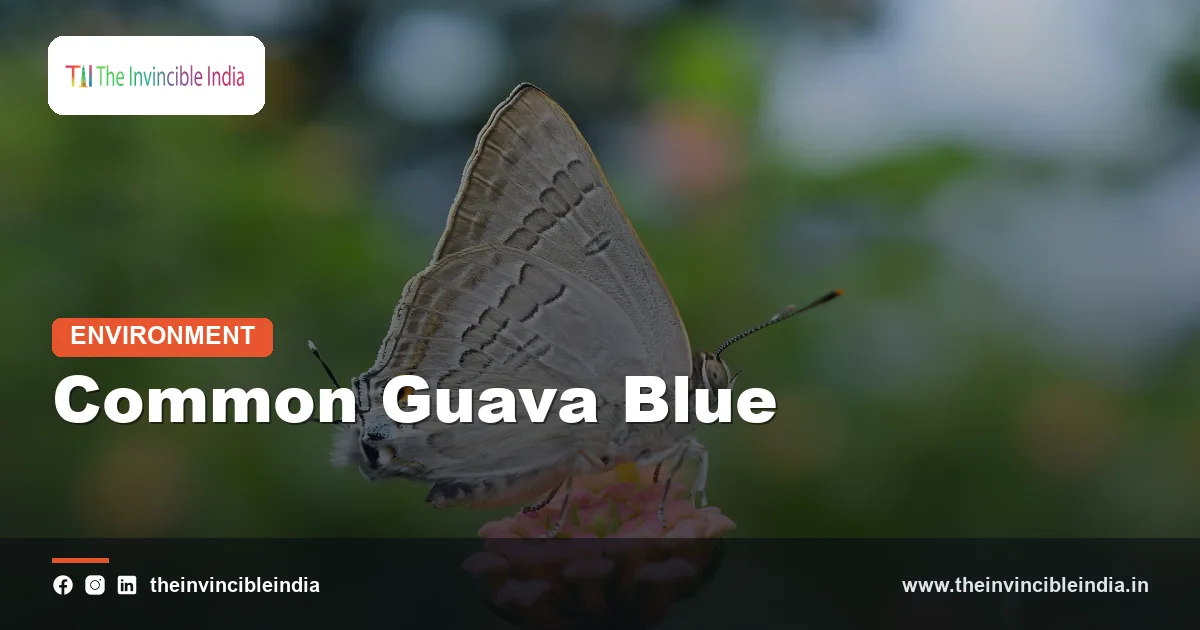
The common guava blue (Virachola isocrates, also placed in the genus Deudorix) is a small, shining butterfly of the family Lycaenidae, found throughout much of India in gardens and orchards, whose caterpillars bore into the fruit of guava, pomegranate and several other plants. The male has a glossy dark blue upperside with a bright orange-red patch on the forewing, and each hindwing ends in a single slender tail, features that make it one of the easier lycaenids to recognise.
The common guava blue is both a pretty garden visitor and a recognised fruit pest, especially in pomegranate orchards, where it is often called the anar butterfly. This explainer covers how to identify it, where it lives, what its caterpillars eat, how its life cycle works and how growers manage the damage.
| Quick Facts | Details |
|---|---|
| Common names | Common guava blue; also guava blue, pomegranate butterfly or anar butterfly |
| Scientific name | Virachola isocrates (also written Deudorix isocrates) |
| Family and subfamily | Lycaenidae (gossamer-winged butterflies); subfamily Theclinae (hairstreaks) |
| Wingspan | Roughly 30 to 40 millimetres |
| Host plants | Guava and pomegranate, plus many other fruiting and pod-bearing plants |
| Range | Much of India and Sri Lanka, extending through South and Southeast Asia |
| Habitat | Gardens, orchards, scrub, forest edges and farmland with fruit trees |
| Broods | Several overlapping broods a year in warm regions |
| Distinctive trait | Caterpillar bores into fruit, feeds inside and pupates in or near it |
Key Takeaways
- The common guava blue, Virachola isocrates, is a small lycaenid butterfly with a wingspan of roughly 30 to 40 millimetres and one slender tail on each hindwing.
- Male common guava blues have a dark blue upperside with a bright orange-red patch on the forewing, while females are duller and browner.
- The caterpillar of the common guava blue bores into developing fruit, mainly guava and pomegranate, and feeds on the pulp and seeds from the inside.
- The common guava blue is found across much of India, from gardens and orchards to forest edges, and it also occurs in Sri Lanka and Southeast Asia.
- In pomegranate orchards the species is a recognised pest, and growers manage it by bagging fruit, removing infested fruit and protecting the crop during flowering and fruit set.
- The butterfly has several broods a year, so damage can build up through the fruiting season wherever host plants are abundant.
What is the common guava blue butterfly?
The common guava blue is a small butterfly of the family Lycaenidae, scientifically named Virachola isocrates, and it is widely seen in Indian gardens, orchards and light woodland. The word blue in the name refers to the shiny blue upperside of the male, although the butterfly is a hairstreak and not one of the true blues that belong to a different group of the family.
The guava in the name comes from the plant on which the caterpillar is most often found in gardens. In some books and orchards, the same butterfly is better known by other names. Growers of pomegranate know it as the anar butterfly or pomegranate butterfly, while scientific literature may list it as Deudorix isocrates because many authorities place Virachola in the genus Deudorix.
Within the family, the species belongs to the subfamily Theclinae, the hairstreaks. Like other lycaenids, it is small, quick and often seen perched on a leaf with its wings folded over its back.
How do you identify the common guava blue?
You can identify the common guava blue by its single tail on each hindwing, the male’s shining dark blue upperside with an orange-red patch on the forewing, and a brownish-grey underside with a fine pale line and a black spot with orange near the tail. These marks distinguish it from many look-alike hairstreaks and blues.
Male
The male’s upperside is a deep, glossy blue or violet-blue, edged with darker brown. The forewing carries a conspicuous orange-red patch, which is often visible when the male basks with his wings partly open. This patch is an easy field mark, and it flashes in sunlight.
Female
The female is less colourful, with a mostly brown upperside and a duller sheen. Females are often seen near the host plants, where they flutter around the fruit and flower buds before laying eggs.
Underside and tail
When the butterfly rests, the underside is what a watcher sees. It is a brownish or greyish tone with a narrow pale line running across both wings. The hindwing carries a black spot with a patch of orange near the base of a single, thin tail. Together these markings form a false head, which can draw a predator’s attack away from the vital parts of the butterfly.
Where is the common guava blue found?
The common guava blue is found across much of India, including plains, hills and coastal regions, and it is also found in Sri Lanka and through South and Southeast Asia. It is one of the more widespread hairstreaks of the Indian subcontinent and is recorded from dry as well as humid regions.
Within India, the butterfly is associated with human-modified landscapes as much as with natural forest. It readily uses gardens, orchards, farm edges, hedges and scrubland where its food plants are available. In dry western and southern states, where pomegranate is grown on a large scale, the butterfly has become a familiar orchard insect.
- Gardens and kitchen plots with guava, pomegranate or other fruit trees.
- Commercial orchards, particularly pomegranate in dry, warm regions.
- Scrub, hedgerows and the edges of dry or moist deciduous forest.
- Hill foothills and wooded areas, where it is usually seen at low elevations.
What do common guava blue caterpillars eat?
Common guava blue caterpillars eat the developing fruit of their host plants, boring into the fruit and feeding on the pulp and seeds from inside. The best-known host plants are guava (Psidium guajava) and pomegranate (Punica granatum), but the species has also been recorded on a number of other fruit trees and on the pods and seeds of various wild and cultivated plants.
Because the caterpillar develops inside the fruit, damage is often hidden at first. A small entry hole may be visible, sometimes plugged with droppings, and the fruit may rot, fall early or be spoiled by fungi and bacteria that enter through the hole. A single fruit can contain one or a few caterpillars.
This unusual feeding habit separates the species from most butterflies, whose caterpillars feed on leaves. Fruit-boring is more typical of moths, and because of it the common guava blue is treated in agricultural manuals as an insect pest, even though the adult is harmless and attractive.
What is the life cycle of the common guava blue?
The life cycle of the common guava blue has four stages, egg, caterpillar, pupa and adult, and in warm conditions the whole cycle can be completed in about a month or a little longer. The cycle repeats several times a year, producing overlapping generations whenever the host plants are in flower and fruit.
- Egg: the female lays small, whitish eggs singly on flower buds, young fruit, calyx or tender parts of the host plant.
- Caterpillar: the newly hatched caterpillar bores into the fruit, feeds inside and grows through several moults.
- Pupa: when fully grown, the caterpillar pupates inside the fruit, or sometimes on the plant, and often leaves the fruit hanging from its stalk.
- Adult: the butterfly emerges through the exit hole, expands its wings and flies off to feed on nectar and mate.
An infested fruit often does not fall. The caterpillar spins silk to attach the damaged fruit to the branch, so it hangs on the tree, which makes it easy for growers to recognise and remove.
Why is the common guava blue called a pest?
The common guava blue is called a pest because its caterpillars spoil fruit, particularly pomegranate, by boring in and feeding on the pulp and seeds, which makes the fruit unfit for sale. The species is a recognised problem in pomegranate-growing regions of India, and damage can be heavy in orchards where the crop flowers and fruits over a long period and the butterfly breeds repeatedly.
The damage is mainly an economic issue and not an ecological one. In wild settings the butterfly feeds on a mix of native plants and is part of a normal food web, serving as prey for birds, lizards and spiders. The adult is a pollinator of a modest kind, since it takes nectar from flowers and may carry pollen between them.
| Aspect | Common guava blue as pest | Common guava blue in nature |
|---|---|---|
| Caterpillar | Bores into cultivated fruit and spoils it | Feeds on seeds and fruit of wild plants |
| Adult | Lays eggs on flower buds and young fruit | Visits flowers for nectar and may carry pollen |
| Population | Builds up where fruit is available for long periods | Kept in check by predators, parasites and seasonal food supply |
How do growers manage the common guava blue?
Growers manage the common guava blue mainly by protecting the fruit, removing infested fruit and combining good orchard hygiene with careful use of pesticides when needed. Because the caterpillar lives inside the fruit, sprays reach it poorly, and prevention is far more effective than cure.
- Fruit bagging: covering young fruit with paper or cloth bags prevents the female from laying eggs on it.
- Collecting infested fruit: damaged, hanging or fallen fruit should be removed and destroyed, which kills the caterpillars and pupae inside.
- Orchard cleanliness: clearing fallen fruit and weeds reduces shelter and egg-laying sites.
- Avoiding staggered flowering where possible: continuous flowering and fruiting give the butterfly a long breeding period.
- Natural enemies: parasitic wasps and predators help to reduce numbers, and indiscriminate spraying can harm them.
- Targeted treatment: when sprays are used, they are timed for the egg-laying period on buds and small fruit, following the advice of agricultural extension services.
Home gardeners with a guava tree can limit damage by picking off bored fruit early and bagging a few fruit. Accepting a small loss is often the simplest option, because the adult butterfly is harmless and beautiful.
How does the common guava blue behave?
The common guava blue is a quick and restless butterfly that flies in short, darting bursts, settles on leaves or twigs with its wings closed and often rubs its hindwings together to draw attention to its tail. Males frequently perch on shrubs and small trees from which they watch for females and chase away rivals.
Adults feed on nectar from small flowers and are often seen in the morning and late afternoon. They can be found in sunny spots of a garden, around fruit trees, or at the edge of a hedge. Males often bask with their wings partly open, showing the blue upperside and the orange-red patch, then close them swiftly when disturbed.
Females spend time near host plants, inspecting buds and young fruit before laying eggs one at a time. The species may be seen throughout the year in warm parts of India, with numbers rising when fruit is available.
How is the common guava blue different from other blues?
The common guava blue differs from true blues mainly in being a hairstreak with a single hindwing tail, a male upperside with an orange-red forewing patch and a fruit-boring caterpillar. Many small blue-coloured butterflies in Indian gardens look similar at a glance, but the details of tail, colour and habit separate them.
- Pea blues and grass blues: small and pale underneath, with banded patterns and usually a different upperside; caterpillars feed on leaves and flowers of legumes and other plants.
- Other hairstreaks: some have two tails or lack the orange-red forewing patch in males.
- Common guava blue: a single tail, a glossy blue male with an orange-red forewing patch and a caterpillar that bores into fruit.
Good photographs of the underside, taken from the side, are the surest way to confirm a sighting.
Bottom Line
The common guava blue is a small, bright hairstreak that is both a pleasing garden visitor and a fruit-boring pest. Recognising its single tail, the male’s orange-red patch and the hanging bored fruit helps gardeners and growers tell what is happening on their trees and respond sensibly.
Frequently Asked Questions
What is the scientific name of the common guava blue?
The scientific name of the common guava blue is Virachola isocrates, and many authorities also place it in the genus Deudorix as Deudorix isocrates. It belongs to the family Lycaenidae and the subfamily Theclinae, the hairstreaks.
What does the common guava blue caterpillar eat?
The common guava blue caterpillar eats the pulp and seeds of developing fruit from the inside. Guava and pomegranate are its best-known hosts, and it has also been recorded on several other fruits and pods.
Is the common guava blue a pest?
Yes, the common guava blue is considered a pest of pomegranate and guava because its caterpillars bore into the fruit and spoil it. The adult butterfly is harmless, and it feeds only on nectar.
How can you tell a male common guava blue from a female?
A male common guava blue has a glossy dark blue upperside with an orange-red patch on the forewing, while a female is duller and mostly brown. Both sexes have a single slender tail on each hindwing and a similar brownish-grey underside.
How do you protect fruit from the common guava blue?
The most effective way to protect fruit from the common guava blue is to cover young fruit with bags before the butterfly can lay eggs on them. Growers also remove and destroy infested fruit, keep the orchard clean and use targeted sprays only when needed.
Where is the common guava blue found in India?
The common guava blue is found across much of India, in gardens, orchards, scrub and forest edges. It also occurs in Sri Lanka and parts of Southeast Asia, and it is especially noticeable in regions where pomegranate and guava are grown.
{“@context”:”https://schema.org”,”@graph”:[{“@type”:”FAQPage”,”mainEntity”:[{“@type”:”Question”,”name”:”What is the scientific name of the common guava blue?”,”acceptedAnswer”:{“@type”:”Answer”,”text”:”The scientific name of the common guava blue is Virachola isocrates, and many authorities also place it in the genus Deudorix as Deudorix isocrates. It belongs to the family Lycaenidae and the subfamily Theclinae, the hairstreaks.”}},{“@type”:”Question”,”name”:”What does the common guava blue caterpillar eat?”,”acceptedAnswer”:{“@type”:”Answer”,”text”:”The common guava blue caterpillar eats the pulp and seeds of developing fruit from the inside. Guava and pomegranate are its best-known hosts, and it has also been recorded on several other fruits and pods.”}},{“@type”:”Question”,”name”:”Is the common guava blue a pest?”,”acceptedAnswer”:{“@type”:”Answer”,”text”:”Yes, the common guava blue is considered a pest of pomegranate and guava because its caterpillars bore into the fruit and spoil it. The adult butterfly is harmless, and it feeds only on nectar.”}},{“@type”:”Question”,”name”:”How can you tell a male common guava blue from a female?”,”acceptedAnswer”:{“@type”:”Answer”,”text”:”A male common guava blue has a glossy dark blue upperside with an orange-red patch on the forewing, while a female is duller and mostly brown. Both sexes have a single slender tail on each hindwing and a similar brownish-grey underside.”}},{“@type”:”Question”,”name”:”How do you protect fruit from the common guava blue?”,”acceptedAnswer”:{“@type”:”Answer”,”text”:”The most effective way to protect fruit from the common guava blue is to cover young fruit with bags before the butterfly can lay eggs on them. Growers also remove and destroy infested fruit, keep the orchard clean and use targeted sprays only when needed.”}},{“@type”:”Question”,”name”:”Where is the common guava blue found in India?”,”acceptedAnswer”:{“@type”:”Answer”,”text”:”The common guava blue is found across much of India, in gardens, orchards, scrub and forest edges. It also occurs in Sri Lanka and parts of Southeast Asia, and it is especially noticeable in regions where pomegranate and guava are grown.”}}]}]}


