

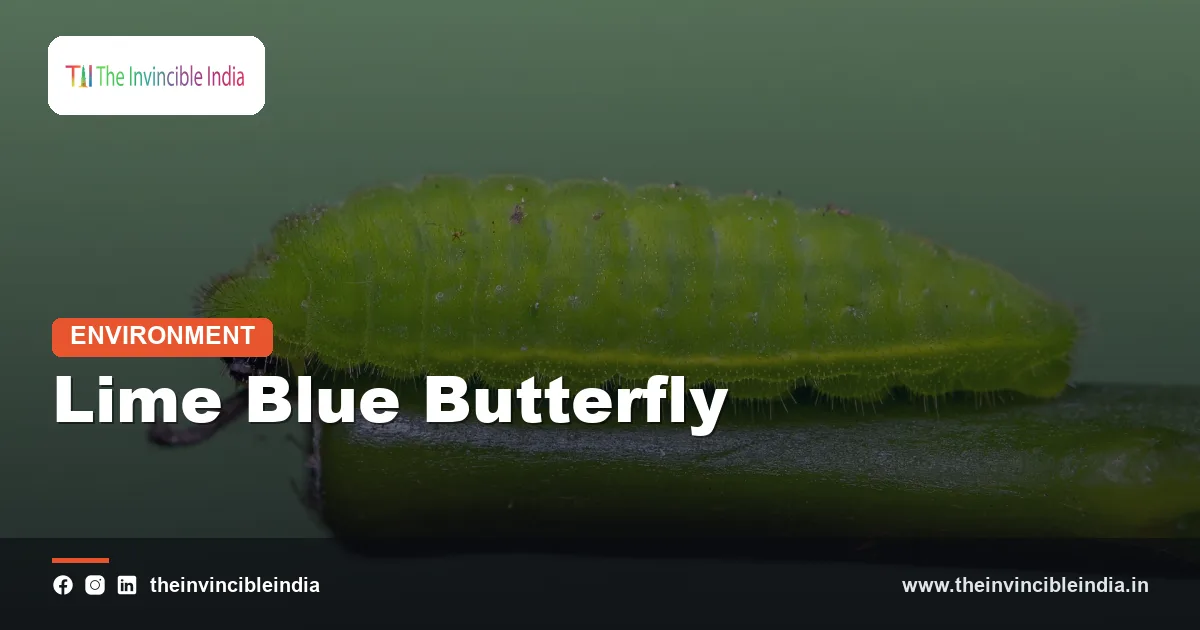
The lime blue (Chilades lajus) is a small, fast-flying blue butterfly of the family Lycaenidae that is common across India, especially around gardens, orchards and forest edges where citrus and other plants of the rue family grow. Its caterpillars feed on the tender new leaves of lime, lemon and related trees, which explains the common name. The adult butterfly is easy to miss because it is small, but its restless, low flight and habit of settling on wet ground make it one of the most frequently recorded blues in Indian towns and villages.
This article explains how to recognise the lime blue, where it lives, what its caterpillars eat, why ants follow the young stages, and how it differs from other small blue butterflies seen in the same places. It is written for gardeners, students and beginner butterfly watchers who want reliable, stable facts rather than local folklore.
| Common name | Lime blue |
|---|---|
| Scientific name | Chilades lajus |
| Family and subfamily | Lycaenidae (gossamer-winged butterflies), subfamily Polyommatinae (the blues) |
| Wingspan | Roughly 2.5 to 3 cm, a small butterfly |
| Larval host plants | Citrus species such as lime, lemon and orange, and other members of the rue family (Rutaceae) |
| Range and habitat in India | Widespread across most of peninsular India, the Gangetic plains, the north-east and Himalayan foothills; gardens, orchards, scrub and forest edges |
| Flight season and broods | Flies for much of the year in warm regions, with several overlapping broods and peaks in and after the monsoon |
| Notable features | Pale underside with fine dark markings, a short hindwing tail, fast low flight, mud-puddling and caterpillars tended by ants |
Key Takeaways
- The lime blue, scientific name Chilades lajus, is a small lycaenid butterfly with a wingspan of roughly 2.5 to 3 cm.
- Lime blue caterpillars feed mainly on the young leaves of citrus trees and other rue-family plants, which gives the butterfly its name.
- The lime blue is widespread in India and is regularly seen in gardens, orchards, scrub and forest edges, from the plains into the foothills.
- Lime blue caterpillars and pupae are often attended by ants, which are rewarded with sugary secretions from a special gland on the caterpillar.
- Adult lime blues often settle on damp soil or mud to take up salts and minerals, a behaviour known as mud-puddling.
- The lime blue is not endangered and is among the more common small blues in India, so it is a good first species for beginners to learn.
What is the lime blue butterfly?
The lime blue butterfly is a small member of the gossamer-winged butterfly family, Lycaenidae, placed in the subfamily Polyommatinae, the group that contains most of the world’s blues. Its scientific name is Chilades lajus, and the species was described in the eighteenth century from material collected in Asia. The name “lime” refers to its host plants, since the caterpillars feed on citrus, while “blue” refers to the colour seen on the upper wings of the males.
Like other lycaenids, the lime blue has short legs that are not obviously useful for walking, large eyes ringed with a thin pale line, and a habit of rubbing the hindwings against each other when it is settled. This rubbing movement draws the eye of a predator towards the tail end of the hindwing rather than the head, which is a common defensive trick among small butterflies.
The lime blue is widely distributed from the Indian subcontinent across South-East Asia and into northern Australia. Within India it is not considered a rare species, and in many suburbs it is one of the few blues that can be seen without leaving the garden.
How can you identify a lime blue?
A lime blue can be identified by its small size, a blue upperside in males, a pale underside covered with fine dark markings, and a short tail on the hindwing. The butterfly is usually seen with its wings closed, so the underside pattern is the most useful feature in the field.
Upperside
The male has a clear, pale to bright blue upperside with a narrow dark border. The female is duller, with broader brown areas and less blue, and is often mistaken for a different species because the colour is muted. In flight both sexes can appear as a flickering pale grey-blue speck.
Underside
The underside is whitish to pale grey, marked with brown or black streaks, short bars and spots. Near the tail end of the hindwing there are dark spots with metallic or orange-toned scaling, and a short, fine tail projects from the hindwing. These tail-end markings, together with the small size, separate the lime blue from most other garden blues.
Behaviour as a clue
The lime blue flies low and fast, often only a few feet above the ground or around the fresh growth of citrus shrubs. It pauses frequently on leaves, twigs and damp patches. Males often hold small territories around fresh growth where females may come to lay eggs.
Where is the lime blue found in India?
The lime blue is found across most of India, in peninsular regions, the Gangetic plains, the north-east and the lower Himalayan foothills, wherever its host plants grow. It is most common in humid and semi-humid country with gardens, village orchards, scrub and forest edges, and it is less common in the driest desert regions.
Because citrus and its relatives are planted in home gardens and orchards across the country, the lime blue has benefited from human settlement. It is often found in towns where little else of the original forest remains, as long as there are a few citrus plants, curry leaf bushes or other rue-family shrubs.
In hilly regions, the species usually occurs at low and middle elevations rather than in cold high-altitude areas. In very dry country it follows irrigated gardens and orchards, which act as islands of suitable habitat.
What does the lime blue caterpillar eat?
The lime blue caterpillar eats the tender new leaves, shoots and sometimes flower buds of citrus trees and other plants of the rue family, Rutaceae. Gardeners usually notice this on lime, lemon, pomelo and orange plants, and on young potted citrus that put out a lot of fresh growth.
The female lime blue lays her eggs singly on the soft new flush of leaves and shoots, because the older leaves are too tough for the newly hatched caterpillars to chew. After hatching, the tiny caterpillar bites into the tender tissue and often hides within the folds of young leaves or among flower buds.
Some other rue-family plants are also used, and local records vary by region. This is a general feature of lycaenids, which tend to be fairly specific about plant families but can use several species within them.
How does the lime blue life cycle work?
The lime blue passes through four stages: egg, caterpillar, pupa and adult, as all butterflies do, and in warm parts of India the complete cycle takes roughly a month. Several broods can overlap in a year, which is why adults may be seen in most months in the south and plains.
| Stage | What happens |
|---|---|
| Egg | Tiny, flattened, whitish eggs are laid singly on young shoots and fresh leaves of the host plant |
| Caterpillar | A slug-like, woodlouse-shaped caterpillar feeds on tender leaves and buds, often under ant guard, and moults several times |
| Pupa | A short, stout pupa forms on the plant or close to it, and may also be attended by ants |
| Adult | The butterfly emerges, dries its wings, feeds on nectar and damp soil, mates and starts the next generation |
The caterpillars of blues are typically short and broad, with a flattened body that tapers at both ends. They are often green or pale, matching the colour of new leaves, which makes them hard to spot unless the observer is looking for them.
In regions with a strong dry or cold season, the number of adults falls, and the species survives mainly as slower-developing stages until fresh growth appears. After the monsoon, when citrus and other plants put out new shoots, the number of butterflies visibly increases.
Why do lime blue caterpillars live with ants?
Lime blue caterpillars live with ants because the caterpillar produces sugary secretions that ants eat, and the ants in return help to protect the caterpillar from predators and parasites. This type of partnership is called myrmecophily and is common in the family Lycaenidae.
The caterpillar has a small gland on its back, often called a honey gland, which releases a sweet droplet. It may also have other organs that produce chemical signals the ants respond to. Ants that visit the caterpillar are often seen stroking it with their antennae while collecting the secretion.
Observers sometimes find a cluster of small ants on a citrus shoot and, on looking closer, discover a lime blue caterpillar or pupa among them. The ants are not harmed by the arrangement, and the caterpillar receives some protection from predatory wasps, bugs and spiders. The degree of ant association varies between lycaenid species, but for the lime blue it is a regular and well-recorded part of the life history.
Why do lime blue butterflies sit on wet mud?
Lime blue butterflies sit on wet mud because they need to absorb salts, minerals and moisture that are scarce in nectar, a behaviour known as mud-puddling. Mud-puddling is most commonly done by males, which use the minerals to support their body functions and, in many butterfly groups, mating.
The behaviour is easy to observe at the edges of puddles, damp roadside patches, drains, riverbanks and garden spots wetted by a hose. Lime blues may be joined by other small butterflies such as grass blues and yellows, and a group can include several species feeding side by side.
Butterfly watchers can take advantage of this by approaching slowly and photographing the butterflies while they are occupied. Puddling butterflies are usually less skittish than ones that are flying or nectaring. They should not be handled or crowded, because their wings are delicate.
How is the lime blue different from similar small blues?
The lime blue differs from similar small blues mainly in its underside pattern, its size and the presence of a short tail. Several other small blues share the same garden habitat, so comparing a few features helps in making a reliable identification.
| Butterfly | Key difference from the lime blue |
|---|---|
| Pea blue (Lampides boeticus) | Larger, with wavy brown-and-white lines on the underside and a more noticeable pair of hindwing tail spots |
| Zebra blue (Leptotes plinius) | Underside with bold zebra-like bands, and a stronger tail |
| Dark grass blue (Zizeeria karsandra) | Smaller and tailless, with a spotted rather than streaked underside |
| Tiny grass blue (Zizula hylax) | Very small, tailless, and usually seen close to the ground in grass |
| Common cerulean (Jamides celeno) | Larger, with a brighter blue upperside and clear dark bands on the underside |
The simplest approach is to check four things in order: the size, whether a tail is present, the overall tone of the underside, and the dark spots at the tail end of the hindwing. A good photograph of the underside, taken with the wings closed, is usually enough for experts to confirm the species.
How can you attract and watch lime blues?
You can attract lime blues by planting citrus or curry-leaf shrubs in a sunny spot, avoiding pesticide sprays, and keeping a damp patch of soil nearby. A few potted lime or lemon plants are often enough to bring the butterfly to a balcony or terrace garden.
- Plant lime, lemon or other rue-family shrubs in a sheltered, sunny position so that fresh shoots appear regularly.
- Avoid broad-spectrum insecticides, which kill eggs, caterpillars and the ants that accompany them.
- Keep a shallow dish of damp sand or soil in a shaded corner as a mud-puddling spot.
- Provide small nectar flowers such as lantana, tridax, basil and marigold for adults.
- Check new shoots in the morning for tiny eggs, small caterpillars and clusters of ants.
- Photograph the underside of the wings and note the date and place, which is useful for citizen-science records.
The best time to look is the warmer part of the morning, when the butterflies are active but not yet in the harshest sun. In the monsoon and post-monsoon months, when new growth is abundant, the numbers are usually highest.
Is the lime blue a pest of citrus?
The lime blue can be a minor pest of citrus nurseries and young plants, because its caterpillars eat the tender new growth, but it is rarely a serious problem on established trees. The damage is mostly limited to young shoots and leaves, and healthy plants usually recover.
In commercial nurseries, where many young citrus seedlings are grown close together, repeated egg-laying on new flush can slow the growth of the plants. Gardeners are generally advised to hand-pick caterpillars from small plants rather than spray, since sprays also harm beneficial insects.
For a home gardener, a few chewed shoots are usually a fair price for a visible butterfly population. Established lime and lemon trees put out new shoots several times a year, and the lime blue uses only a small portion of this growth. Natural enemies, including wasps, spiders and parasitic insects, also keep the numbers of caterpillars in check.
Bottom Line
The lime blue is a small, adaptable butterfly that lives alongside people in Indian gardens, orchards and forest edges. Its link with citrus, ants and damp soil makes it a useful species for learning how butterflies depend on plants and on other insects. With a little habitat and few chemicals, it is one of the easiest butterflies to watch at home.
Frequently Asked Questions
What is the scientific name of the lime blue butterfly?
The scientific name of the lime blue butterfly is Chilades lajus. It belongs to the family Lycaenidae and the subfamily Polyommatinae, the group of true blues. The species is widespread from India through South-East Asia to northern Australia.
What do lime blue caterpillars eat?
Lime blue caterpillars eat the young leaves and shoots of citrus plants and other members of the rue family, Rutaceae. They are commonly found on lime, lemon and orange plants with fresh growth. The female lays eggs on soft new shoots because mature leaves are too tough for the hatchlings.
How big is a lime blue butterfly?
A lime blue butterfly has a wingspan of roughly 2.5 to 3 cm, which makes it a small butterfly. The males show pale to bright blue on the upperside, while the females are browner. The underside is pale with fine dark markings and a short tail on the hindwing.
Why are ants found near lime blue caterpillars?
Ants are found near lime blue caterpillars because the caterpillars secrete a sugary liquid that the ants feed on. In exchange, the ants help guard the caterpillars and pupae from predators and parasites. This kind of partnership, called myrmecophily, is common among lycaenid butterflies.
Is the lime blue butterfly rare in India?
No, the lime blue butterfly is not rare in India and is among the more commonly seen small blues. It lives in gardens, orchards, scrub and forest edges across much of the country wherever citrus and related plants grow. It is less common in very dry desert regions and at high altitudes.
How can I attract lime blue butterflies to my garden?
You can attract lime blue butterflies by growing citrus or other rue-family shrubs in a sunny spot and avoiding pesticides. Adding nectar flowers and a damp patch of soil for mud-puddling also helps. Even a few potted lime or lemon plants on a terrace can bring the butterfly in.
{“@context”:”https://schema.org”,”@graph”:[{“@type”:”FAQPage”,”mainEntity”:[{“@type”:”Question”,”name”:”What is the scientific name of the lime blue butterfly?”,”acceptedAnswer”:{“@type”:”Answer”,”text”:”The scientific name of the lime blue butterfly is Chilades lajus. It belongs to the family Lycaenidae and the subfamily Polyommatinae, the group of true blues. The species is widespread from India through South-East Asia to northern Australia.”}},{“@type”:”Question”,”name”:”What do lime blue caterpillars eat?”,”acceptedAnswer”:{“@type”:”Answer”,”text”:”Lime blue caterpillars eat the young leaves and shoots of citrus plants and other members of the rue family, Rutaceae. They are commonly found on lime, lemon and orange plants with fresh growth. The female lays eggs on soft new shoots because mature leaves are too tough for the hatchlings.”}},{“@type”:”Question”,”name”:”How big is a lime blue butterfly?”,”acceptedAnswer”:{“@type”:”Answer”,”text”:”A lime blue butterfly has a wingspan of roughly 2.5 to 3 cm, which makes it a small butterfly. The males show pale to bright blue on the upperside, while the females are browner. The underside is pale with fine dark markings and a short tail on the hindwing.”}},{“@type”:”Question”,”name”:”Why are ants found near lime blue caterpillars?”,”acceptedAnswer”:{“@type”:”Answer”,”text”:”Ants are found near lime blue caterpillars because the caterpillars secrete a sugary liquid that the ants feed on. In exchange, the ants help guard the caterpillars and pupae from predators and parasites. This kind of partnership, called myrmecophily, is common among lycaenid butterflies.”}},{“@type”:”Question”,”name”:”Is the lime blue butterfly rare in India?”,”acceptedAnswer”:{“@type”:”Answer”,”text”:”No, the lime blue butterfly is not rare in India and is among the more commonly seen small blues. It lives in gardens, orchards, scrub and forest edges across much of the country wherever citrus and related plants grow. It is less common in very dry desert regions and at high altitudes.”}},{“@type”:”Question”,”name”:”How can I attract lime blue butterflies to my garden?”,”acceptedAnswer”:{“@type”:”Answer”,”text”:”You can attract lime blue butterflies by growing citrus or other rue-family shrubs in a sunny spot and avoiding pesticides. Adding nectar flowers and a damp patch of soil for mud-puddling also helps. Even a few potted lime or lemon plants on a terrace can bring the butterfly in.”}}]}]}


