

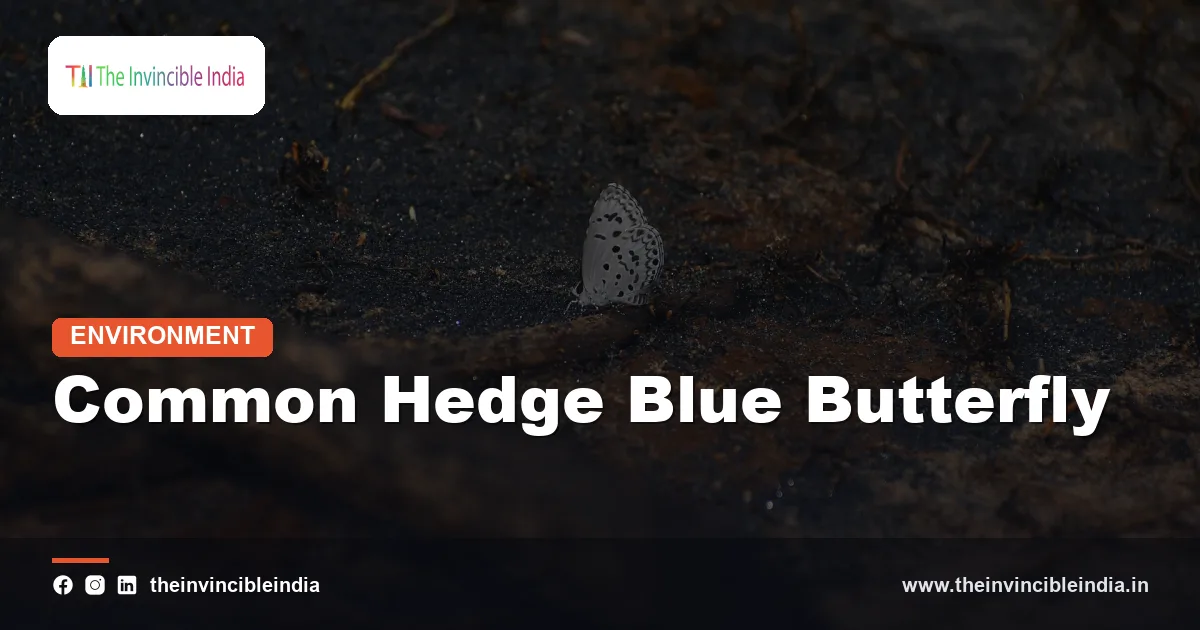
The common hedge blue (Acytolepis puspa) is a small pale-blue butterfly of the family Lycaenidae, widespread in Indian gardens, scrub and forest edges, where groups of males often gather on damp ground to drink minerals. The common hedge blue is delicate and easy to overlook, but it is one of the most frequently seen blues in the Indian subcontinent and a good first species for beginners learning to identify lycaenids.
This article explains how to recognise the common hedge blue, what its caterpillars eat, why males crowd at mud puddles, how ants figure in the lives of blues and where the species lives across India.
| Quick Facts | Common hedge blue (Acytolepis puspa) |
|---|---|
| Scientific name | Acytolepis puspa |
| Family | Lycaenidae (blues, coppers and hairstreaks), subfamily Polyommatinae |
| Common name | Common hedge blue |
| Wingspan | About 22 to 30 mm |
| Caterpillar host plants | Flower buds and young shoots of many trees, shrubs and climbers, including legumes |
| Range | Peninsular India, the Himalayan foothills and the north-east, Sri Lanka and much of South-East Asia |
| Broods | Several overlapping broods a year, peaking in and after the monsoon |
| Habit | Males gather in groups at damp soil to mud-puddle; both sexes feed on small flowers |
| Habitat | Gardens, hedgerows, scrub, forest edges and clearings |
Key Takeaways
- The common hedge blue (Acytolepis puspa) is a small butterfly of the family Lycaenidae with a wingspan of roughly 22 to 30 mm.
- The male common hedge blue is pale blue above, while the female is whiter with a broader dark border on the wings.
- Common hedge blue caterpillars eat flower buds and tender shoots of many different woody plants rather than one single host.
- Male common hedge blues often gather in groups on wet soil or mud to absorb salts and minerals, a behaviour called mud-puddling.
- Common hedge blue caterpillars are short and slug-like, and many lycaenid larvae are tended by ants for the sweet liquid they produce.
- The common hedge blue is found across much of India and is harmless to people and to most garden plants.
What is the common hedge blue butterfly?
The common hedge blue is a tiny blue butterfly, scientifically named Acytolepis puspa, that belongs to the family Lycaenidae, which also includes the coppers, hairstreaks and other blues. It is one of the most widespread blues of the Indian region, found in many habitats from villages to forest clearings.
Lycaenidae is a very large butterfly family. It accounts for roughly a third of all known butterfly species, and many of its members are small, delicate insects with iridescent upper wings. Within India, the family includes the common cerulean, the lime blue, the zebra blue and several hedge blues.
The word “hedge” in the name refers to the places where such butterflies are commonly seen: hedges, garden edges and thickets. The butterfly was once placed in the genus Celastrina, which is why some older books list it under another name. Today the common hedge blue is placed in the genus Acytolepis.
Because it is so small, the common hedge blue is seldom noticed unless it settles. When it does, a quiet scene opens up: a flicker of pale sky-blue at ankle height, on a leaf, a flower or a patch of wet earth.
How do you identify a common hedge blue?
You identify a common hedge blue by its small size, pale silvery-blue upper wings in the male, white underside with fine grey markings and the absence of long tails on the hindwings. The wingspan is only about 22 to 30 mm, so the butterfly is smaller than most garden visitors.
Male and female
The male has an even, pale violet-blue to sky-blue upperside edged with a thin dark line. The female is paler, appearing whitish-blue, with a broader dark band along the outer wing edge, particularly on the forewing. The difference is called sexual dimorphism, and it helps observers tell the sexes apart.
Underside
The underside of both sexes is greyish white, covered with fine dark lines and small spots. This pattern is the most reliable guide for identification, because blues usually rest with their wings closed. The hindwing carries a few tiny dark marks near its lower margin but no prominent tails.
Similar species
Several close relatives look alike and confuse beginners. Careful attention to the underside pattern is needed.
| Species | Typical clue |
|---|---|
| Common hedge blue (Acytolepis puspa) | Small; white underside with fine, evenly spaced grey markings |
| Hampson’s hedge blue (Acytolepis lilacea) | Similar build; differs in underside spotting and local range |
| Pale hedge blue (Udara dilecta) | Pale underside with distinct banding pattern |
| Dark cerulean and similar blues | Often larger, with deeper blue upperside or tails |
Experienced butterfly watchers often use photographs of the underside to confirm identity.
What do common hedge blue caterpillars eat?
Common hedge blue caterpillars eat the flower buds, young leaves and tender shoots of many woody plants, and the species is not limited to a single host. Records include trees and shrubs of several plant families, among them legumes of the pea family, Fabaceae.
The habit of using many hosts is called polyphagy, and it helps explain why the common hedge blue is so widespread. A butterfly that depends on one plant can live only where that plant grows, but a butterfly that accepts many plants can live in farmland, towns, scrub and forest alike.
How the female chooses
The female lays tiny, flattened, white to greenish eggs, usually one at a time, on flower buds or young growth. Newly hatched caterpillars chew into buds or feed on soft tissue. Because many host trees flower and flush with new leaves at particular seasons, egg-laying often follows these growth pulses.
What the caterpillar looks like
The caterpillar is short, flattened and slug-like, often described as woodlouse-shaped. It is typically green or pinkish and blends in with buds. Its head is small and can be withdrawn under the front of its body. This body plan is common among lycaenid larvae.
Is the damage serious?
Feeding by the common hedge blue is hardly ever serious. The caterpillars take a few buds or shoots, and the plants usually recover. The butterfly is not known as a significant pest of crops, and its impact on hedges and ornamental trees is generally negligible.
Why do male common hedge blues gather at mud puddles?
Male common hedge blues gather at damp soil because they need sodium and other minerals that are scarce in nectar, and wet earth provides them. This behaviour is called mud-puddling and is seen in many butterflies, most often in males.
A group at a puddle can include dozens of common hedge blues, sometimes mixed with other blues, sulphurs and swallowtails. The butterflies sip moisture through the proboscis, a hollow tongue, and in some cases pass fluid through their bodies as they feed. The minerals they absorb are thought to be passed to females during mating, which may improve egg survival.
Good places to see mud-puddling include:
- Damp patches beside forest tracks, especially after rain.
- Sandy banks of small streams and ponds.
- Leaking water pipes and wet roadside soil.
- Animal dung or urine-stained earth, which is also rich in salts.
Mud-puddling is easiest to watch in the post-monsoon period, when streams are low and exposed banks are damp. Visitors to a puddle should move slowly, because a sudden shadow sends the whole group flying.
How do ants relate to the common hedge blue?
Ants often have close relationships with lycaenid caterpillars, including blues, because many of these larvae produce a sweet secretion that ants drink and in return the ants guard them. Whether a particular species, such as the common hedge blue, is attended by ants varies, and the details are still being studied for many Indian blues.
This kind of partnership is a form of mutualism. A gland on the back of many lycaenid caterpillars releases sugary droplets, and other organs may produce chemical signals that calm or attract ants. The ants gain food, and the caterpillar gains protection from small parasitic wasps and predators.
Why it matters
Ant tending explains why lycaenid caterpillars often feed in exposed places, such as flowers and buds, that would be risky for an undefended larva. It also shows that a butterfly garden is more than plants and butterflies: the ants living in it influence which insects survive.
A gardener who sees ants moving steadily around buds on a shrub may be watching this relationship. Disturbing the ants can leave the caterpillars more exposed. Although some lycaenids are associated with ants throughout their lives, others have only loose connections, so observers should avoid assuming that every common hedge blue larva has ant attendants.
Where is the common hedge blue found in India?
The common hedge blue is found across peninsular India, the Western Ghats, the Himalayan foothills and the north-east, and also in Sri Lanka and many parts of South-East Asia. It occupies a broad range of altitudes, from lowland plains to hill forests.
It favours habitats with a mix of flowering shrubs, open edges and shade, including:
- Gardens, farm hedges and village edges.
- Scrub forest and moist deciduous forest margins.
- Roadsides, clearings and plantation tracks.
- Hill streams and wooded ravines.
The species is generally commoner in humid regions than in very dry ones. Seasonal patterns vary by region: in much of India it is most abundant during and after the monsoon, while colder northern areas see it mainly in the warmer months.
What is the life cycle of the common hedge blue?
The common hedge blue passes through four stages: egg, caterpillar, pupa and adult. Warm conditions make development quick, allowing several overlapping broods each year.
| Stage | What happens |
|---|---|
| Egg | Tiny and flattened, laid singly on buds or tender growth |
| Caterpillar | Short and slug-like; eats buds and young shoots, moulting several times |
| Pupa | Small and compact, formed on the host plant or nearby; lasts about a week or more |
| Adult | Emerges, feeds on small flowers, mates and lays eggs; males visit damp soil |
The speed of the cycle depends on temperature. In warm lowland areas, a full generation may take roughly a month or less, which allows the population to grow quickly when conditions are good. In cooler hills development is slower.
Adults are short-lived, usually surviving a few weeks. Their short life and rapid breeding mean that numbers can rise and fall quickly with weather, flowering of host plants and the activity of predators and parasites.
Why is the common hedge blue important?
The common hedge blue is important because it is a pollinator of small flowers, a food source for other animals and an indicator of how well a landscape supports small insects. Though tiny, such butterflies are part of the everyday ecology of Indian gardens and woodlands.
Adults visit small flowers, including those of herbs and shrubs, and carry pollen on their legs and bodies. While butterflies are less efficient pollinators than bees, they help in the cross-pollination of many wild plants that bees visit less often.
The caterpillars and adults are also food for spiders, lizards, birds, dragonflies and parasitic wasps. A healthy population is part of the food web that supports these predators.
How to help blues in a garden
- Plant a mix of native flowering shrubs and small trees.
- Leave a damp, sandy patch in the shade for mud-puddling.
- Avoid spraying insecticides on flowering hedges.
- Allow a corner of the garden to grow wild so that ants and other insects can thrive.
Bottom Line
The common hedge blue (Acytolepis puspa) is a tiny, pale-blue lycaenid whose males crowd at damp ground and whose caterpillars feed on buds of many woody plants. It is harmless, common and a rewarding species to learn.
Frequently Asked Questions
What is the common hedge blue?
The common hedge blue is a small pale-blue butterfly, scientifically named Acytolepis puspa, in the family Lycaenidae. It has a wingspan of about 22 to 30 mm. It is widespread in India and found in gardens, scrub and forest edges.
How can I tell a male common hedge blue from a female?
The male is evenly pale blue on the upperside with a thin dark edge, while the female is whiter with a broader dark border. Both have a greyish-white underside with fine markings. The difference is easiest to see when the wings are open in sunlight.
What do common hedge blue caterpillars eat?
Common hedge blue caterpillars eat flower buds and young shoots of many trees, shrubs and climbers. They are not restricted to one host plant, and records include legumes. Their feeding rarely harms plants.
Why do hedge blue butterflies sit on mud?
Hedge blue males sit on mud to take in salts and minerals that are scarce in nectar. This behaviour is called mud-puddling and is common among butterflies. The minerals are thought to help in reproduction.
Do ants really look after blue butterfly caterpillars?
Yes, many lycaenid caterpillars are tended by ants, which feed on sweet droplets the larvae produce and protect them from enemies. The strength of the link differs between species. For the common hedge blue, the detail of ant association is still being documented.
Is the common hedge blue harmful to garden plants?
No, the common hedge blue is not a significant garden pest. Its caterpillars feed on a few buds and shoots, and plants normally recover. The butterfly itself feeds on nectar and does no damage.
{“@context”:”https://schema.org”,”@graph”:[{“@type”:”FAQPage”,”mainEntity”:[{“@type”:”Question”,”name”:”What is the common hedge blue?”,”acceptedAnswer”:{“@type”:”Answer”,”text”:”The common hedge blue is a small pale-blue butterfly, scientifically named Acytolepis puspa, in the family Lycaenidae. It has a wingspan of about 22 to 30 mm. It is widespread in India and found in gardens, scrub and forest edges.”}},{“@type”:”Question”,”name”:”How can I tell a male common hedge blue from a female?”,”acceptedAnswer”:{“@type”:”Answer”,”text”:”The male is evenly pale blue on the upperside with a thin dark edge, while the female is whiter with a broader dark border. Both have a greyish-white underside with fine markings. The difference is easiest to see when the wings are open in sunlight.”}},{“@type”:”Question”,”name”:”What do common hedge blue caterpillars eat?”,”acceptedAnswer”:{“@type”:”Answer”,”text”:”Common hedge blue caterpillars eat flower buds and young shoots of many trees, shrubs and climbers. They are not restricted to one host plant, and records include legumes. Their feeding rarely harms plants.”}},{“@type”:”Question”,”name”:”Why do hedge blue butterflies sit on mud?”,”acceptedAnswer”:{“@type”:”Answer”,”text”:”Hedge blue males sit on mud to take in salts and minerals that are scarce in nectar. This behaviour is called mud-puddling and is common among butterflies. The minerals are thought to help in reproduction.”}},{“@type”:”Question”,”name”:”Do ants really look after blue butterfly caterpillars?”,”acceptedAnswer”:{“@type”:”Answer”,”text”:”Yes, many lycaenid caterpillars are tended by ants, which feed on sweet droplets the larvae produce and protect them from enemies. The strength of the link differs between species. For the common hedge blue, the detail of ant association is still being documented.”}},{“@type”:”Question”,”name”:”Is the common hedge blue harmful to garden plants?”,”acceptedAnswer”:{“@type”:”Answer”,”text”:”No, the common hedge blue is not a significant garden pest. Its caterpillars feed on a few buds and shoots, and plants normally recover. The butterfly itself feeds on nectar and does no damage.”}}]}]}


