

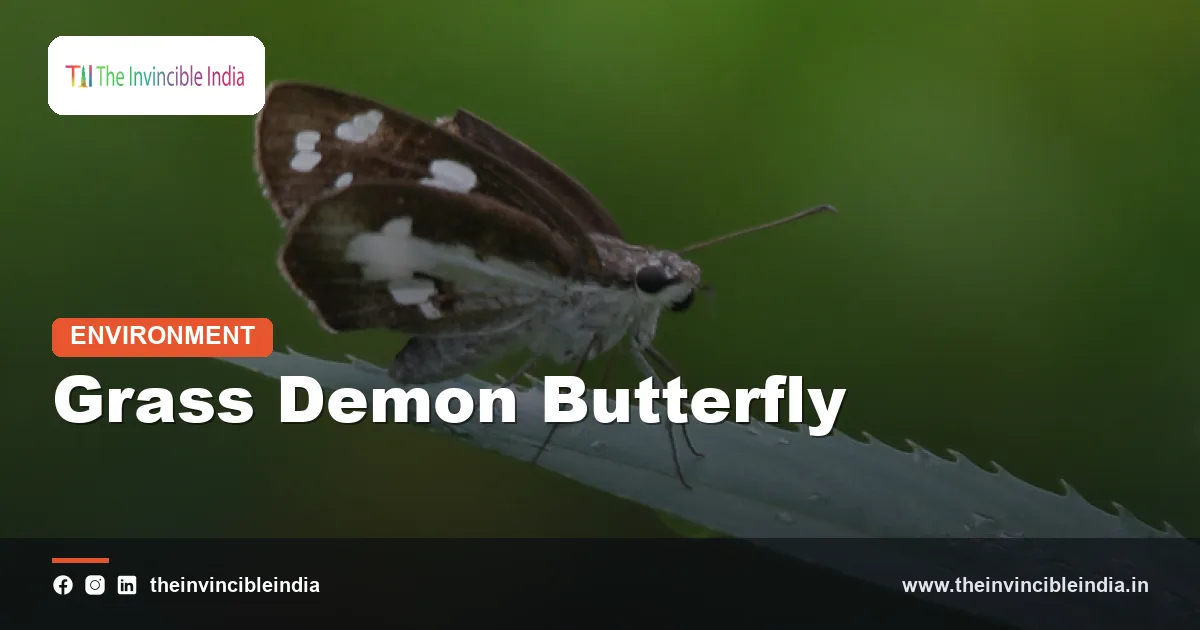
The grass demon (Udaspes folus) is a small, dark brown skipper butterfly of the family Hesperiidae, common in Indian gardens, whose caterpillars live inside folded and rolled leaves of turmeric, ginger and other plants of the ginger family. Despite its dramatic name, the grass demon is a harmless insect that does not feed on grass and poses no danger to people.
The grass demon is one of the easiest skippers to meet in an Indian town, because turmeric, ginger, canna and other ornamental relatives grow in so many courtyards, kitchen gardens and roadside beds. This article explains how to recognise the butterfly, what its caterpillars do with leaves, where it lives and why it matters.
| Quick Facts | Grass demon (Udaspes folus) |
|---|---|
| Scientific name | Udaspes folus |
| Family | Hesperiidae (skippers), subfamily Hesperiinae |
| Common names | Grass demon; also called the grass demon skipper |
| Wingspan | About 40 to 50 mm |
| Caterpillar host plants | Turmeric, ginger and other members of the ginger family (Zingiberaceae); also recorded on canna and related ornamentals |
| Range | Across much of India, Sri Lanka and South-East Asia; found in gardens, forest edges and plantations |
| Broods | Several broods a year, most numerous in the monsoon months |
| Activity | Mostly active at dawn and dusk, with a fast, darting flight |
| Pest status | Minor; leaf-folding damage is usually light and rarely serious |
Key Takeaways
- The grass demon (Udaspes folus) is a dark brown skipper butterfly of the family Hesperiidae, found widely across India.
- Grass demon caterpillars feed on the leaves of turmeric, ginger and other plants of the ginger family, not on grass.
- Each grass demon caterpillar hides in a shelter made by cutting and folding a leaf, which protects it from birds, wasps and the sun.
- The adult grass demon has a wingspan of roughly 40 to 50 mm and shows pale, glassy spots on dark brown wings.
- The grass demon is most active at dawn and dusk and flies in short, fast, darting bursts, like other skippers.
- The grass demon is harmless to humans and is generally a minor garden visitor rather than a serious crop pest.
What is the grass demon butterfly?
The grass demon butterfly is a small skipper, a member of the large butterfly family Hesperiidae, scientifically named Udaspes folus. Skippers form a distinct group among butterflies and number several thousand species worldwide. They are named for their quick, skipping flight, which looks very different from the floating, flapping glide of swallowtails or the lazy flutter of many pierrots and crows.
The grass demon belongs to the subfamily Hesperiinae, often called the grass skippers. The word “grass” in the name of the grass demon is therefore a family reference rather than a food clue. Many skippers do breed on grasses, but this particular species lays its eggs on broad-leaved plants of the ginger family.
The name “demon” probably refers to the dark, brooding look of the adult, which is almost black-brown with only a few pale markings, and to its habit of shooting out of shade at dusk. Older Indian butterfly guides group the grass demon with other common, unspectacular skippers that most people overlook, even though it is among the most frequently recorded butterflies in urban gardens.
Because it is so tied to cultivated and ornamental ginger relatives, the grass demon is often called a butterfly that has followed people. Wherever turmeric, ginger, canna, hedychium (ginger lily) or similar plants are grown, the grass demon tends to appear.
How do you identify a grass demon butterfly?
You identify a grass demon by its dark chocolate-brown wings, a small group of pale glassy spots on each forewing and a conspicuous pale patch on the hindwing. The wingspan is about 40 to 50 mm, so the butterfly is roughly the size of a large coin when its wings are open.
Upperside
On the upperside, the forewing carries a short row of small, translucent, whitish to pale-yellow spots near the middle and tip. The hindwing is darker, with a clearly lighter patch in the centre. In flight, this pale hindwing patch can flash and make the otherwise dark insect easier to follow.
Underside
The underside of the grass demon is paler and duller, with a brownish ground colour and a washed-out look over the hindwing. Skippers are usually identified by how they hold their wings at rest, and the grass demon often rests with the forewings partly raised and the hindwings held flat, a posture typical of many skippers.
Body and antennae
The body of the grass demon is stout and furry, with a large head and big eyes compared with most butterflies. The antennae end in a club with a small, curved hook at the tip, a feature shared by skippers and used by entomologists to separate them from other butterflies.
The table below lists how the grass demon differs from other butterflies a gardener might confuse it with.
| Feature | Grass demon | Typical garden butterfly (such as a pierrot or lime butterfly) |
|---|---|---|
| Flight | Fast and darting, short bursts | Slow, flapping or gliding |
| Body | Stout, hairy, big-headed | Slender and smooth |
| Antennae tip | Club with a small hooked tip | Club without a hook |
| Main active time | Dawn and dusk | Bright daytime |
| Typical colour | Dark brown with pale spots | Often bright or strongly patterned |
What do grass demon caterpillars eat?
Grass demon caterpillars eat the leaves of plants in the ginger family, Zingiberaceae, and, in gardens, are best known on turmeric and ginger. They have also been recorded on related ornamental plants such as hedychium and on cannas, which are not true gingers but have similar broad, paddle-shaped leaves.
The ginger family is a group of tropical herbs that grow from fleshy underground stems called rhizomes. Turmeric (Curcuma longa) and ginger (Zingiber officinale) are the two best-known culinary members, but wild gingers also grow in forests, hill streams and the shaded floor of plantations. The grass demon uses both cultivated and wild hosts, which helps it survive even where gardens are few.
Why host plants matter
A butterfly caterpillar can generally eat only a limited set of plants. The mother butterfly must therefore find the right plant before laying. The grass demon female tests leaves by touch and scent, then places a single egg on the underside of a suitable leaf. Eggs are laid one at a time rather than in clusters, which spreads the risk of predators finding them all.
What the caterpillar looks like
The grass demon caterpillar is smooth and plump with a darker head, usually with a pale green or yellowish body. It is soft and defenceless in the open, which explains why it lives in a leaf shelter from the time it is small. Each caterpillar grows through several stages, called instars, shedding its skin between each stage.
How does the grass demon build its leaf shelter?
The grass demon caterpillar builds its shelter by cutting a flap in the edge of a leaf, folding that flap over the leaf surface and fastening it with strands of silk. This produces a pocket where the caterpillar rests during the day and from which it emerges to feed, usually at night or in low light.
As the caterpillar grows, it makes larger shelters. Older caterpillars roll sections of leaf into a tube, binding the rolled edge with silk threads. A gardener can often spot the work before seeing the caterpillar, because a neatly folded leaf with a cut edge on a turmeric or ginger plant is a strong sign.
The shelter has several uses. It hides the caterpillar from birds, lizards and predatory wasps. It reduces water loss, which matters for a soft-bodied larva in hot weather. It also gives the caterpillar a protected place to moult and, later, to pupate.
- The caterpillar cuts a flap from the leaf margin using its jaws.
- The caterpillar folds the flap over and anchors it with silk.
- The caterpillar feeds on nearby leaf tissue and returns to the shelter.
- Larger caterpillars build new, bigger shelters or roll a longer section of leaf.
- The final shelter holds the pupa until the adult emerges.
This behaviour of making shelters from leaves is shared by many skipper caterpillars across the world, and it is one of the main reasons skippers survive in places with many predators.
Where is the grass demon found in India?
The grass demon is found across much of India, from the plains and peninsular hills to the foothills of the Himalaya and the north-east, wherever its host plants grow. Outside India it extends to Sri Lanka and through large parts of South-East Asia, so it is considered a widely distributed Oriental species.
The grass demon prefers warm, humid and shaded places, including:
- Home gardens and courtyards with turmeric, ginger or canna.
- Edges of evergreen and moist deciduous forests, where wild gingers grow.
- Plantations of spices, coffee and areca nut, where gingers are often grown beneath taller trees.
- Parks, nurseries and botanical gardens that grow ornamental gingers.
- Stream banks and shaded ravines in hilly country.
The grass demon is rarely a butterfly of open, dry scrubland. It tends to stay close to its host plants and shaded cover, which is also why many people only notice it during the monsoon, when gardens are lush and its numbers are highest.
When is the grass demon active, and how does it behave?
The grass demon is most active in the early morning and at dusk, which makes it a crepuscular butterfly, unlike most butterflies that fly in bright midday sun. During the heat of the day, an adult usually rests under a leaf in shade with its wings partly open.
The flight of the grass demon is fast, low and erratic. It darts from one perch to another, often returning to the same leaf. Males are territorial in a small way and may chase intruders away from a favoured perch. Both sexes visit flowers for nectar, usually small, easily accessible blooms, and males sometimes sip moisture from damp soil.
How to watch it
The best way to see a grass demon is to walk slowly past turmeric or ginger plants in the first hour after sunrise or in the last hour of light. Look beneath the leaves rather than above them. A dark butterfly hurrying out and coming back to the same perch is a typical skipper pattern.
Seasonal pattern
Numbers of the grass demon rise as the rains arrive and plants put out fresh growth. Monsoon months generally bring the largest populations, while the cooler, drier months see fewer adults. In warm, humid regions of southern and eastern India, adults may be seen almost throughout the year.
What does the life cycle of the grass demon look like?
The grass demon goes through complete metamorphosis in four stages: egg, caterpillar, pupa and adult. The whole cycle, from egg to adult, usually takes a few weeks in warm weather, and several generations can follow each other within one year.
| Stage | What happens | Where it takes place |
|---|---|---|
| Egg | The female lays single, small eggs and the egg hatches in a few days | Underside of a host plant leaf |
| Caterpillar | The larva feeds and moults several times, building larger shelters as it grows | Folded or rolled leaf of turmeric, ginger or a relative |
| Pupa | The caterpillar stops feeding, seals itself in a shelter and transforms | Inside the leaf shelter |
| Adult | The butterfly emerges, dries its wings, mates and begins egg-laying | Garden, forest edge or plantation |
The pupa of the grass demon is formed inside the leaf shelter and is often dusted with a pale waxy powder, a trait seen in many skippers. The pupal stage lasts roughly a week or two in warm weather, though it can be longer in cooler conditions.
Because the generations overlap in the monsoon, a single patch of ginger plants may hold eggs, caterpillars, pupae and adults at the same time. This continuous breeding is why the grass demon can appear suddenly in a garden after the first rains.
Is the grass demon a pest of turmeric and ginger?
The grass demon is generally a minor pest of turmeric and ginger, because the damage it causes is usually limited to a few folded or rolled leaves. A healthy plant easily tolerates this loss, and serious outbreaks are uncommon.
Farmers who grow turmeric or ginger commercially may notice leaf-folding when caterpillar numbers are high. Even then, the harvested part of these crops is the underground rhizome, which is not directly eaten by the grass demon. Leaf loss may slightly reduce the energy the plant can store, but the effect is mild unless many leaves are damaged.
For a home gardener, a few practical steps are enough:
- Look for neatly folded or rolled leaves and open one gently to check for a caterpillar.
- Remove only heavily damaged leaves if the plant looks stressed.
- Avoid broad-spectrum insecticides, which also kill the wasps, spiders and other insects that keep caterpillar numbers in check.
- Encourage natural enemies, including birds, small wasps and spiders, by keeping some mixed planting around.
Many gardeners choose to accept the grass demon as part of a healthy garden, because the butterfly is a sign that a food web is working in the space.
Why does the grass demon matter for gardens and biodiversity?
The grass demon matters because it links garden plants to the wider food web, serving as prey for birds, lizards, spiders and wasps while adults also feed on nectar from small flowers. Even a plain brown skipper contributes to the balance of a garden ecosystem.
Caterpillars are among the main foods fed to nestling birds, since they are soft, protein-rich and plentiful in the rainy season, which is also the nesting season for many Indian birds. Each grass demon caterpillar is therefore a small but real part of the energy that moves from plants into birds.
The grass demon also helps people learn about butterflies. Because it is so widespread and so tied to familiar kitchen plants, it is often among the first skippers that beginners can identify. Citizen-science projects and school nature clubs in India regularly record it in butterfly counts, which helps track which species still live in cities.
Skippers as a group are also good indicators of habitat quality. A garden that supports several skipper species usually has a mix of host plants, shade and shelter, which also benefits other insects.
Bottom Line
The grass demon (Udaspes folus) is a modest, dark brown skipper whose caterpillars shelter in folded leaves of turmeric, ginger and their relatives. It is harmless, widespread across India and a useful marker of a living garden.
Frequently Asked Questions
What is a grass demon butterfly?
A grass demon is a small dark brown skipper butterfly, scientifically named Udaspes folus, belonging to the family Hesperiidae. It has a wingspan of about 40 to 50 mm and pale glassy spots on its forewings. It is common in Indian gardens where turmeric, ginger or canna grow.
Is the grass demon dangerous?
No, the grass demon is completely harmless to people. It does not bite, sting or carry any known disease, and its caterpillars are not poisonous. The word “demon” in its name refers only to its dark colour and quick flight.
What plants do grass demon caterpillars feed on?
Grass demon caterpillars feed mainly on plants of the ginger family, including turmeric and ginger. They have also been recorded on related ornamental plants such as hedychium and canna. They do not feed on grass despite the name.
Why do the leaves of my turmeric or ginger plant look folded?
Folded or rolled leaves on turmeric or ginger are often the work of a grass demon caterpillar. The caterpillar cuts and folds a flap of leaf, then fastens it with silk to make a hiding place. Opening the fold gently usually reveals a small green or yellowish caterpillar inside.
Is the grass demon a serious pest of turmeric or ginger?
No, the grass demon is generally a minor pest. It damages only a few leaves, and the harvested rhizome is not eaten by the caterpillar. Heavy infestations are uncommon, and most healthy plants recover without any treatment.
When is the best time to see a grass demon butterfly?
The best time to see a grass demon is shortly after sunrise or just before sunset. The butterfly is most active at dawn and dusk and rests in shade during the hot hours. Numbers are highest in the monsoon months, when host plants are growing fresh leaves.
{“@context”:”https://schema.org”,”@graph”:[{“@type”:”FAQPage”,”mainEntity”:[{“@type”:”Question”,”name”:”What is a grass demon butterfly?”,”acceptedAnswer”:{“@type”:”Answer”,”text”:”A grass demon is a small dark brown skipper butterfly, scientifically named Udaspes folus, belonging to the family Hesperiidae. It has a wingspan of about 40 to 50 mm and pale glassy spots on its forewings. It is common in Indian gardens where turmeric, ginger or canna grow.”}},{“@type”:”Question”,”name”:”Is the grass demon dangerous?”,”acceptedAnswer”:{“@type”:”Answer”,”text”:”No, the grass demon is completely harmless to people. It does not bite, sting or carry any known disease, and its caterpillars are not poisonous. The word “demon” in its name refers only to its dark colour and quick flight.”}},{“@type”:”Question”,”name”:”What plants do grass demon caterpillars feed on?”,”acceptedAnswer”:{“@type”:”Answer”,”text”:”Grass demon caterpillars feed mainly on plants of the ginger family, including turmeric and ginger. They have also been recorded on related ornamental plants such as hedychium and canna. They do not feed on grass despite the name.”}},{“@type”:”Question”,”name”:”Why do the leaves of my turmeric or ginger plant look folded?”,”acceptedAnswer”:{“@type”:”Answer”,”text”:”Folded or rolled leaves on turmeric or ginger are often the work of a grass demon caterpillar. The caterpillar cuts and folds a flap of leaf, then fastens it with silk to make a hiding place. Opening the fold gently usually reveals a small green or yellowish caterpillar inside.”}},{“@type”:”Question”,”name”:”Is the grass demon a serious pest of turmeric or ginger?”,”acceptedAnswer”:{“@type”:”Answer”,”text”:”No, the grass demon is generally a minor pest. It damages only a few leaves, and the harvested rhizome is not eaten by the caterpillar. Heavy infestations are uncommon, and most healthy plants recover without any treatment.”}},{“@type”:”Question”,”name”:”When is the best time to see a grass demon butterfly?”,”acceptedAnswer”:{“@type”:”Answer”,”text”:”The best time to see a grass demon is shortly after sunrise or just before sunset. The butterfly is most active at dawn and dusk and rests in shade during the hot hours. Numbers are highest in the monsoon months, when host plants are growing fresh leaves.”}}]}]}


