

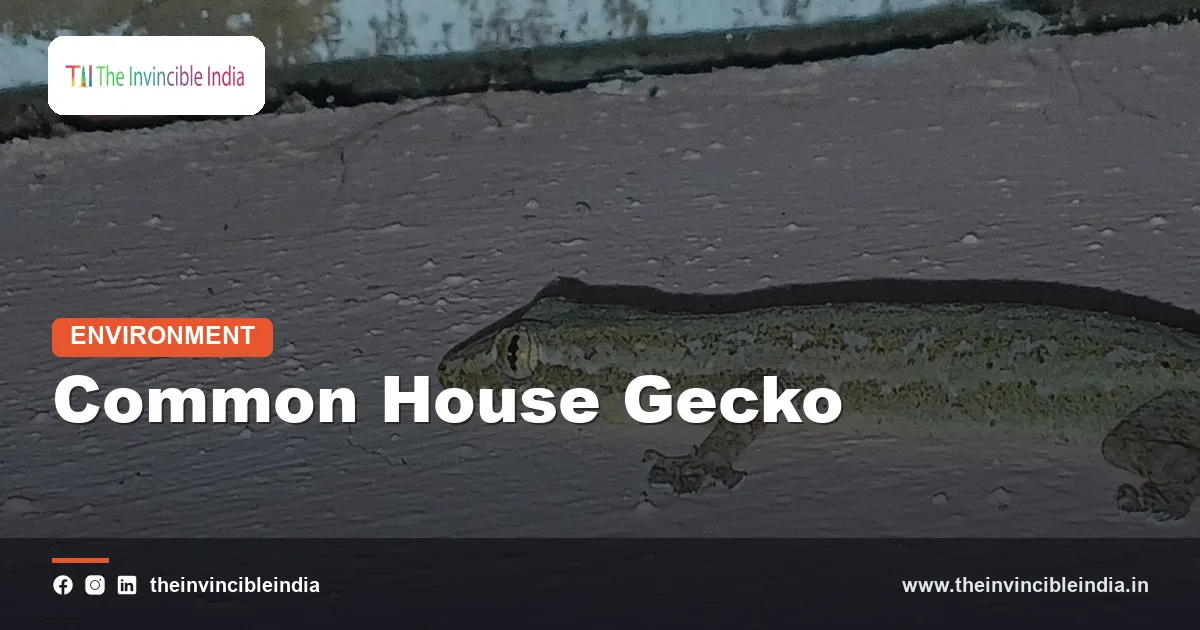
The common house gecko is a small, pale, nocturnal lizard of the genus Hemidactylus that lives on the walls and ceilings of Indian homes, where it hunts mosquitoes, moths, flies and other insects that gather around lights at night. The species most often meant in India is Hemidactylus frenatus, the Asian house gecko, although the larger Hemidactylus flaviviridis is the usual wall gecko across much of northern and western India.
The common house gecko is harmless to people. It is not venomous, it bites only when handled roughly, and it removes many of the insects that spoil food and spread disease. Its sticky toes, detachable tail and chirping calls are all well understood by biologists, and each is explained below.
| Quick Fact | Detail |
|---|---|
| Common names | Common house gecko, Asian house gecko, wall lizard (in everyday speech), chhipkali (Hindi), balli or palli (several South Indian languages) |
| Scientific name | Hemidactylus frenatus (Asian house gecko); Hemidactylus flaviviridis (yellow-bellied or Indian house gecko) |
| Family | Gekkonidae, the true geckos |
| Typical total length | About 10 to 15 cm for Hemidactylus frenatus; H. flaviviridis grows larger, often around 15 to 20 cm |
| Activity | Nocturnal; hunts near lights that attract insects |
| Diet | Insects and small spiders, including mosquitoes, moths, flies, cockroaches and ants |
| Reproduction | Hard-shelled eggs, usually two per clutch, glued to a sheltered surface |
| Danger to humans | None; non-venomous and shy, though droppings can carry bacteria, as with many reptiles |
Key Takeaways
- The common house gecko (Hemidactylus frenatus) is a non-venomous, insect-eating lizard that is harmless to humans and widely found inside Indian homes.
- A common house gecko clings to walls and ceilings through millions of microscopic hairs on its toes that grip surfaces using van der Waals forces rather than glue or suction.
- A common house gecko can drop its tail on purpose, a defence called caudal autotomy, and grows a replacement tail that is made of cartilage instead of bone.
- Male house geckos make the familiar chirping or clicking calls, which are mainly used to defend territory and to attract mates.
- A single common house gecko can eat many mosquitoes, moths, flies and cockroaches in a night, so the lizard acts as free, chemical-free pest control for households.
- The only practical health precaution around a common house gecko is hygiene: keep food covered and wash hands after cleaning up droppings.
What is the common house gecko?
The common house gecko is a small gecko that has adapted so well to human buildings that it is now one of the most familiar wild animals in an Indian home. The name Hemidactylus means “half-fingered” and refers to the partly divided, widened toe pads that the whole genus shares. The species name frenatus is Latin for “bridled”, a reference to the faint dark streak that runs from the snout through the eye.
Hemidactylus frenatus is native to South and Southeast Asia and has spread across the tropics, travelling in cargo and building materials, so it is now also established in Africa, the Pacific, Australia and the Americas. Within India the common house gecko lives alongside other Hemidactylus species, and most people simply call all of them “chhipkali” or “palli” without distinguishing between them.
Geckos are a very old group of lizards, with more than a thousand species worldwide. The house gecko belongs to the family Gekkonidae, and what sets this family apart from most other lizards is its large eyes without movable eyelids, its soft skin, and above all its ability to walk on vertical and overhead surfaces.
What does a common house gecko look like?
A common house gecko is a slender, flat-headed lizard with pale pinkish-grey, beige or semi-translucent skin, large dark eyes with vertical slit pupils, and a long tail that is roughly as long as the body. The skin on the back is dotted with tiny bumps called tubercles, and the belly is usually whitish or cream coloured. The underside is paler and slightly see-through, which is why a gecko against a lit tubelight sometimes shows a dark shadow of its internal organs.
Individual geckos can change their shade a little. At night, when they are active, the skin often looks lighter and more mottled, and during the day, resting in a crack, the same animal may look darker and plainer. This is a modest adjustment, not the dramatic colour change of a chameleon.
Eyes that never blink
Geckos have no movable eyelids. Each eye is covered by a clear, fixed scale called a spectacle, and the lizard cleans it by licking it with its long, fleshy tongue, which is a common sight if you watch a house gecko closely. In dim light the vertical pupil opens wide, giving the animal excellent night vision, and research on related geckos shows they can distinguish colours even at very low light levels.
Skin, shedding and size
The common house gecko sheds its skin in thin flakes or patches several times a year and usually eats the shed skin, which recovers some nutrients. Adults of Hemidactylus frenatus usually measure about 10 to 15 cm from nose to tail tip, while the yellow-bellied house gecko, Hemidactylus flaviviridis, is generally bulkier and may reach about 20 cm.
How does a common house gecko walk up walls and across ceilings?
A common house gecko sticks to walls because the undersides of its toes carry millions of microscopic hairs, called setae, that cling to surfaces through van der Waals forces, the weak attraction that acts between any two molecules that come very close together. There is no glue, suction or wet adhesive involved, and that is why a gecko can run across a dry glass pane and leave no mark behind.
Each toe has a row of broad ridges called lamellae or scansors. On these ridges sit the setae, which are tiny keratin hairs, and each seta splits at its tip into hundreds of even smaller, flattened endings called spatulae. Because so many spatulae touch the surface at once, the tiny individual attractions add up to a force strong enough to hold the whole animal. A research team led by Kellar Autumn published the key experiments in the journal Nature in 2000, showing that van der Waals forces, rather than water-based capillary attraction, are the main source of gecko adhesion.
Sticking is easy, letting go is the clever part
The adhesion is switched on and off by the angle of the toe. When a gecko pushes its toe down and drags it slightly inward, the setae bend into contact and grip. When the animal peels its toe from the tip backwards, with the toe curling upward, the grip releases. Because of this, a gecko can run at speed without wasting energy on pulling hard against its own stickiness.
The setae are also largely self-cleaning, so dust that collects on the toes is shed within a few steps. Engineers have copied this design to build reversible dry adhesives, wall-climbing robots and medical tapes. Geckos still struggle on very low-energy surfaces such as Teflon, and on wet or very dusty surfaces, which is why a house gecko will occasionally slip off a freshly mopped tile or a greasy kitchen wall.
Why does a common house gecko drop its tail?
A common house gecko drops its tail to escape a predator, a process called caudal autotomy, in which the tail breaks off at a pre-formed weak point and keeps wriggling to distract the attacker while the lizard runs away. The break happens at fracture planes built into the tail vertebrae, and the surrounding muscles and blood vessels contract so that very little blood is lost.
The detached tail can twitch for several minutes because the nerves in it continue to fire. A cat, snake, bird or large spider that grabs the moving tail often ends up with only that, while the gecko hides in a crevice. The animal then regrows the tail over the following weeks.
What does the new tail look like?
A regenerated tail is usually shorter, blunter and differently coloured from the original, and its skeleton is a tube of cartilage rather than the bony vertebrae of the first tail. The scales are smoother and often show a different pattern. The tail also stores fat, so losing it costs the lizard energy reserves and some balance, which is why geckos use this trick as a last resort and not a first reaction.
Occasionally a partly broken tail regrows as a fork, giving a gecko with two tails. This is rare but entirely natural. Many geckos that people see with a stubby or oddly coloured tail have simply survived an earlier encounter with a predator or a door.
Why do house geckos chirp?
House geckos chirp mainly to communicate with other geckos, and the repeated “chik-chik-chik” or clicking sound is used by males to claim territory and to attract females. The calls are loudest at night, when the animals are active, and they often rise when two males meet near a good hunting spot such as a lit wall.
Geckos are unusual among lizards because most species are vocal, whereas the majority of lizards are silent. A house gecko produces its sounds with its larynx and mouth, and different calls seem to carry different messages, from a short click that signals alarm to a longer series that signals dominance. Squeaks may also be heard during fights.
Folk belief and what science says
In many parts of India, especially in the south, a gecko’s chirp or a lizard falling on a person is traditionally read as an omen, and a body of folk lore known as pallisastram (lizard-lore) interprets the signs. Devotees visiting the Varadaraja Perumal temple at Kanchipuram touch images of a gold and a silver lizard in the belief that this removes the ill effects of such an event. These are matters of tradition and faith, and there is no scientific evidence that a gecko’s call predicts anything. Biologically, the chirp is simply a social signal between lizards.
What does the common house gecko eat?
The common house gecko eats insects and other small invertebrates, and it favours moths, mosquitoes, flies, cockroaches, ants, termites and small spiders. It hunts mostly at night, waiting motionless near a lamp and then lunging at prey that comes within reach. A good hunting site is one that insects visit again and again, which is why geckos stay close to tubelights and bulbs.
A gecko usually swallows its prey whole after a quick bite, and larger insects may be beaten against a surface first. The animal also laps up small amounts of water and may drink condensation or droplets from a wall.
Occasional unusual meals
In rare cases, adult house geckos eat smaller geckos or their own eggs, and they have been seen taking the sugary fluid from fruit or nectar. Such behaviour is a minor part of the diet. The vast majority of what the common house gecko eats is the insects that people find annoying.
Why is the common house gecko a helpful houseguest?
The common house gecko is a helpful houseguest because it eats the insects that bother households, including mosquitoes that can carry dengue, malaria and chikungunya, along with cockroaches and flies that contaminate food. A gecko does not damage wiring, fabric, walls or stored grain, and it needs no feeding or care.
Scientists caution that a gecko is not a replacement for proper mosquito control such as clearing stagnant water, using nets and screens, and maintaining drains. Even so, an adult gecko removes a meaningful number of insects every night at no cost, and it takes the place of sprays that would otherwise add chemicals to indoor air.
| Household pest | Role of the gecko |
|---|---|
| Mosquitoes | Caught while resting on walls or circling lights |
| Moths and flying termites | Eaten when they gather around bulbs after the first rains |
| Cockroaches | Young cockroaches are eaten when the gecko finds them at night |
| Houseflies | Taken from walls and window frames |
| Small spiders and ants | Eaten opportunistically |
Is the common house gecko poisonous or dangerous?
The common house gecko is not poisonous and not venomous; it has no venom glands and poses no danger to people or pets under normal circumstances. The old belief that a gecko’s touch, saliva or droppings make food poisonous has no scientific basis, and no case of a house gecko injecting venom has ever been recorded.
A gecko may bite if it is grabbed, but its jaws are tiny and the bite is usually too weak to break the skin. The more reasonable concern is hygiene. Like many reptiles, geckos can carry Salmonella bacteria in their gut, and the droppings, which look like a dark pellet with a white tip, can contaminate surfaces.
Simple precautions
- Keep cooked food, milk and drinking water covered, especially overnight.
- Wipe droppings from shelves and counters with a damp cloth and a disinfectant, then wash hands with soap.
- Throw out any food in which a gecko has fallen, as with any other contamination, and do not blame the animal for a medical problem that has another cause.
- Seal gaps in window screens and doors if you would rather keep geckos in the garden than inside.
How does the common house gecko breed and live?
The common house gecko breeds by laying small, hard-shelled eggs, usually two at a time, which the female glues to a sheltered spot such as behind a picture frame, in a wall crevice or under furniture. A female can lay several clutches in a year in warm climates, and the eggs typically hatch in roughly one to two months, depending on temperature.
The eggs are white or off-white and about the size of a small pea. Newly hatched geckos measure only a few centimetres, look like miniature adults, and begin hunting very small insects within days. Females can store sperm and lay fertile eggs for some time after mating, which is one reason a small population can build up quickly in a house.
In the wild, house geckos usually live for around five years or a little more, though predators such as cats, snakes, owls and larger lizards shorten the lives of many. Males defend small territories and may fight, circling and biting at each other, during the breeding season.
Where does the common house gecko live in India, and which look-alikes exist?
The common house gecko lives throughout India, from coastal towns and metropolitan flats to hill stations and villages, wherever there are buildings with sheltered cracks and lights that attract insects. It is rare only at very high altitudes and in very cold, dry regions. Indoors, it favours the upper parts of walls, window frames, behind cupboards and around outdoor lamps.
India has dozens of gecko species, and a few are easy to confuse with the house gecko.
| Species | Common name | How it differs |
|---|---|---|
| Hemidactylus frenatus | Common or Asian house gecko | Small and pale, with rows of bumps on the back; most common in homes |
| Hemidactylus flaviviridis | Yellow-bellied or Indian house gecko | Larger and sturdier, with a yellowish tint under the body; common in northern and western India |
| Hemidactylus brookii | Brooke’s house gecko | Slimmer and greyer, often seen on trees and old walls; found in both homes and gardens |
| Hemidactylus leschenaultii | Bark gecko | Mottled grey, mostly on tree trunks and outer walls |
| Gekko gecko | Tokay gecko | Much larger, bluish with orange spots; forest species of northeastern India, not a typical house resident |
Only the Hemidactylus group matters for most households. The tokay gecko is a forest animal and is not part of the ordinary house gecko story.
How should people live with house geckos?
People can live comfortably with house geckos by leaving them alone, keeping food covered, and reducing the insects that draw them in. Geckos are shy, usually flee when approached, and do not need to be caught or removed. If a gecko must be moved, a cup and a piece of card are enough to carry it outdoors, and it should never be pulled by the tail, which may break off.
Avoid sticky glue traps, as they trap geckos in the same way as insects and cause a slow death. Sprays and powders marketed as gecko repellents are rarely effective and are unnecessary. Reducing the number of insects around the house, for example by using warm-toned bulbs, closing windows at dusk and keeping the kitchen clean, will naturally lower the number of geckos that stay.
- Do not use chemical sprays near walls where geckos rest, because a gecko that eats a poisoned insect can also be harmed.
- Do not touch or chase geckos with bare hands; wash hands afterwards if you do.
- Teach children that the lizard is a helper, not a threat.
Bottom Line
The common house gecko is a small, shy, non-venomous lizard that quietly eats the insects Indian households would rather not have. Its sticky toes, its expendable tail and its chirp are remarkable pieces of natural engineering, and its presence is a sign of an ordinary, healthy home rather than a problem to be fixed.
Frequently Asked Questions
Is the common house gecko poisonous to humans?
No, the common house gecko is not poisonous or venomous. It has no venom glands, and a bite from one is rare and trivial. The only real precaution is hygiene, since geckos, like many reptiles, may carry Salmonella in their droppings, so food should be kept covered and hands washed after cleaning.
How can a gecko walk on ceilings and glass?
A gecko walks on ceilings and glass because its toes carry millions of microscopic hairs that grip surfaces through van der Waals forces. These forces are weak individually but strong in total. The gecko peels its toes off at an angle, which releases the grip instantly.
Why does a house gecko leave its tail behind?
A house gecko leaves its tail behind as a defence called tail autotomy. The tail snaps off at a built-in weak point and twitches, distracting the predator while the gecko escapes. A new tail grows back in a few weeks, though it is made of cartilage and looks different from the original.
What does a common house gecko eat?
A common house gecko eats insects and small spiders, such as mosquitoes, moths, flies, cockroaches and ants. It hunts at night near lights where insects gather. It rarely touches human food, so its diet is overwhelmingly made up of household pests.
Why do geckos make chirping sounds?
Geckos chirp to communicate with each other, mostly to claim territory and to attract mates. The sound is a repeated clicking or “chik-chik-chik” produced mainly by males at night. In Indian folk tradition the sound is also treated as an omen, but that belief has no scientific support.
Should I remove house geckos from my home?
No, there is usually no need to remove house geckos from a home. They help control mosquitoes, flies and cockroaches and cause no structural damage. If you prefer fewer geckos, reduce the insects around your lights, keep food covered and seal gaps, and gently carry any unwanted gecko outdoors in a cup.
{“@context”:”https://schema.org”,”@graph”:[{“@type”:”FAQPage”,”mainEntity”:[{“@type”:”Question”,”name”:”Is the common house gecko poisonous to humans?”,”acceptedAnswer”:{“@type”:”Answer”,”text”:”No, the common house gecko is not poisonous or venomous. It has no venom glands, and a bite from one is rare and trivial. The only real precaution is hygiene, since geckos, like many reptiles, may carry Salmonella in their droppings, so food should be kept covered and hands washed after cleaning.”}},{“@type”:”Question”,”name”:”How can a gecko walk on ceilings and glass?”,”acceptedAnswer”:{“@type”:”Answer”,”text”:”A gecko walks on ceilings and glass because its toes carry millions of microscopic hairs that grip surfaces through van der Waals forces. These forces are weak individually but strong in total. The gecko peels its toes off at an angle, which releases the grip instantly.”}},{“@type”:”Question”,”name”:”Why does a house gecko leave its tail behind?”,”acceptedAnswer”:{“@type”:”Answer”,”text”:”A house gecko leaves its tail behind as a defence called tail autotomy. The tail snaps off at a built-in weak point and twitches, distracting the predator while the gecko escapes. A new tail grows back in a few weeks, though it is made of cartilage and looks different from the original.”}},{“@type”:”Question”,”name”:”What does a common house gecko eat?”,”acceptedAnswer”:{“@type”:”Answer”,”text”:”A common house gecko eats insects and small spiders, such as mosquitoes, moths, flies, cockroaches and ants. It hunts at night near lights where insects gather. It rarely touches human food, so its diet is overwhelmingly made up of household pests.”}},{“@type”:”Question”,”name”:”Why do geckos make chirping sounds?”,”acceptedAnswer”:{“@type”:”Answer”,”text”:”Geckos chirp to communicate with each other, mostly to claim territory and to attract mates. The sound is a repeated clicking or “chik-chik-chik” produced mainly by males at night. In Indian folk tradition the sound is also treated as an omen, but that belief has no scientific support.”}},{“@type”:”Question”,”name”:”Should I remove house geckos from my home?”,”acceptedAnswer”:{“@type”:”Answer”,”text”:”No, there is usually no need to remove house geckos from a home. They help control mosquitoes, flies and cockroaches and cause no structural damage. If you prefer fewer geckos, reduce the insects around your lights, keep food covered and seal gaps, and gently carry any unwanted gecko outdoors in a cup.”}}]}]}


