

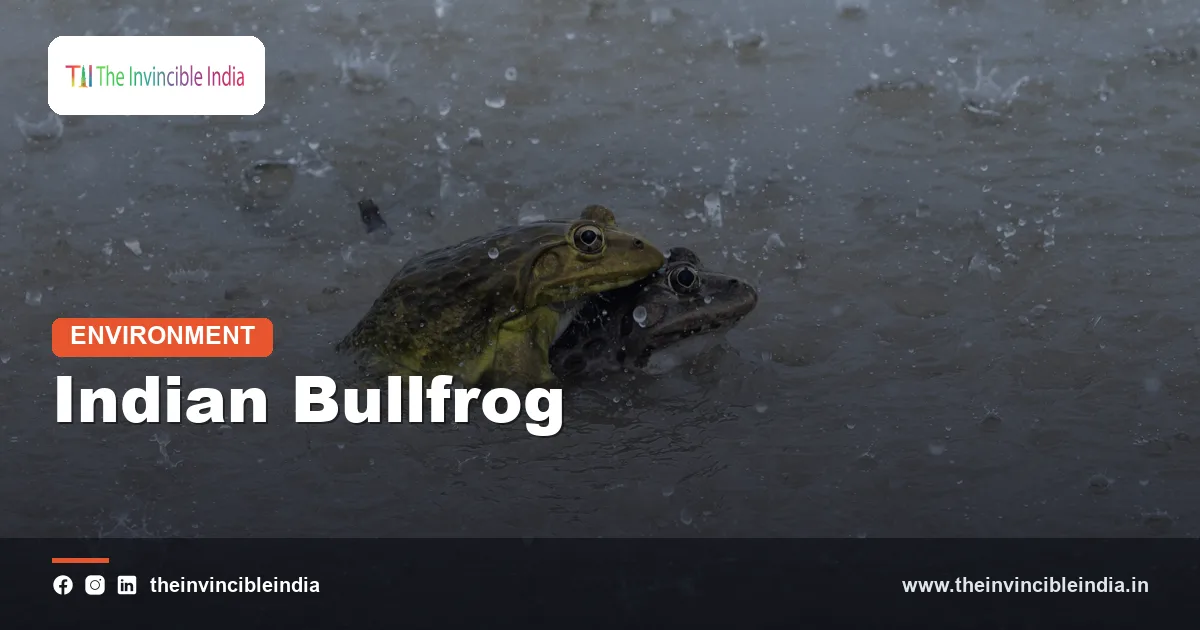
The Indian bullfrog (Hoplobatrachus tigerinus), also called the tiger frog, is a large, powerful frog of South Asia whose breeding males turn bright yellow with blue vocal sacs during the monsoon. The Indian bullfrog is one of the biggest frogs in India, and its loud, hollow chorus in flooded fields and ponds is among the clearest sounds of the rainy season.
For most of the year the Indian bullfrog is an olive-brown, easily overlooked animal that spends dry months buried underground. After the first heavy rains it emerges in a rush, breeds in a few frantic days and returns to its usual life as an appetite on legs. It was also at the centre of a large frog-legs export trade in the twentieth century, whose ban became a textbook case in Indian conservation. This explainer, last reviewed 23 October 2026, covers the species in plain terms.
| Attribute | Detail |
|---|---|
| Scientific name | Hoplobatrachus tigerinus |
| Family and order | Dicroglossidae; order Anura (frogs and toads) |
| Size | Large; adults commonly reach roughly 12 to 17 cm in body length, with females bigger than males |
| Appearance | Olive-green to brown with dark blotches, ridged back, strong webbed hind feet |
| Breeding colour | Males turn bright yellow with a pair of blue vocal sacs in the monsoon |
| Diet | Insects, snails, crabs, fish, other frogs, small snakes, rodents and birds |
| Survival strategy | Burrows into moist soil and aestivates through the dry season |
| Conservation status | Least Concern on the IUCN Red List (global assessment); regulated under Indian wildlife law |
Key Takeaways
- The Indian bullfrog (Hoplobatrachus tigerinus) is a large South Asian frog that can grow to roughly 17 cm and is among the biggest frogs in India.
- Breeding male Indian bullfrogs turn bright yellow and develop blue vocal sacs for a few days at the onset of the monsoon.
- The Indian bullfrog survives dry seasons by burrowing into the soil and aestivating, a state of dormancy that conserves water and energy.
- The Indian bullfrog eats almost anything it can swallow, including insects, snails, fish, other frogs, small rodents and even small snakes.
- India banned the export of frog legs in the late 1980s after concerns that the trade was depleting frogs and harming agriculture.
- The Indian bullfrog is Least Concern globally, but wetland loss, pesticides and collection for food still affect local populations.
What is the Indian bullfrog?
The Indian bullfrog is a large, robust true frog in the family Dicroglossidae, found across the Indian subcontinent and neighbouring countries, and it is the species most Indians mean when they talk about a “big monsoon frog”. It is also known as the tiger frog because of the dark stripes and bars on its legs.
The species lives in India, Nepal, Bangladesh, Pakistan, Sri Lanka, Myanmar and parts of Afghanistan and Southeast Asia. It has also been introduced to places such as the Andaman Islands and Madagascar, where it has become a concern as an invasive predator. A related species, Jerdon’s bullfrog (Hoplobatrachus crassus), occurs in parts of the subcontinent too, and the two are sometimes confused.
Unlike tiny tree frogs, the Indian bullfrog is a ground-and-water frog with a heavy body, large head and a wide mouth. It sits at the top of the food chain among local amphibians and takes on prey that most frogs would avoid.
How do you identify an Indian bullfrog?
An Indian bullfrog is identified by its large size, olive-green to brownish skin with dark blotches, prominent ridges along its back and fully webbed hind feet. A pale line often runs down the middle of the back, and the hind legs show dark crossbars that give the tiger-frog name.
The snout is rounded, the eyes sit high on the head and the eardrums (tympana) are clearly visible. Females are generally larger and plainer. Males are slimmer and have paired vocal sacs, which are dark or bluish and inflate like twin balloons when calling. In the breeding season the male’s body turns lemon to golden yellow, which is sharp enough that observers sometimes mistake the animal for a different species.
| Frog | How it differs from the Indian bullfrog |
|---|---|
| Jerdon’s bullfrog | A related species with a different range and skin-fold pattern; the two are told apart by experts using fine details |
| Indian skipper frog | Smaller, slim, and skips across the surface of ponds |
| Indian burrowing frog (Sphaerotheca) | Rounder, shorter-legged and a more dedicated digger |
| Common Indian toad | Warty, dry skin and a slow walking gait instead of long leaps |
| Tree frogs | Much smaller, with sticky disc-shaped toe tips |
Why do male Indian bullfrogs turn yellow?
Male Indian bullfrogs turn yellow because the colour is a breeding signal that helps males stand out to females and warns rival males during the short, intense mating season at the start of the monsoon. The yellow develops under the influence of breeding hormones and lasts only a few days to a couple of weeks.
The spectacle can be startling. Dozens of males gather in a flooded field or roadside pool, their bodies glowing yellow in the water and their paired blue vocal sacs bulging as they call. Females, who remain olive-green, move through the group to choose a mate. After spawning, the males gradually revert to their duller colouring.
Scientists see this as an example of sexual dichromatism, where males and females look different in the breeding season. The bright colour probably makes males easier to see in murky, rain-churned water and may also reflect health. It also makes them more visible to predators, but the brief window and the sheer numbers help limit the cost.
How do Indian bullfrogs breed during the monsoon?
Indian bullfrogs breed explosively: after the first heavy rains of the monsoon, large numbers gather at temporary pools, males call loudly for a few nights and females lay eggs in shallow water. This “explosive breeding” strategy is common among frogs that depend on seasonal rain, because suitable pools may exist for only a short time.
The male clasps the female from behind in a hold called amplexus, and as she lays eggs he fertilises them externally. The eggs form floating clumps or films on the water surface, often attached to grass. A female can lay hundreds to a few thousand eggs, depending on size. Eggs hatch in a day or two into tiny tadpoles that feed on algae and plant matter and then on small animals as they grow.
- Breeding peaks within a few days of the first heavy downpour.
- Males compete for position and may wrestle or clasp the wrong partner by mistake.
- Tadpoles must finish their development before the pools dry up.
- Metamorphosis can take several weeks, and juveniles then disperse to damp ground.
Because the breeding window is so brief, a change in rainfall pattern, the draining of a wetland or the filling of a pond can wipe out a whole season of tadpoles.
Why is the Indian bullfrog so loud?
The Indian bullfrog is loud because males use deep, resonant calls to attract females and to announce territory, and the paired vocal sacs act as amplifiers so the sound carries across wet fields at night. A chorus of many males can be heard from a long distance and can sound like a chorus of hollow, bouncing “wok-wok” or “honk” notes.
Calling is energetically costly, so males keep it for the peak of the breeding season. Calls serve at least two purposes. An advertisement call tells females that a male is present, and an aggressive call warns other males to stay away. Loud chorusing also helps frogs synchronise breeding, so that many eggs hatch together and overwhelm predators.
Chorusing is a seasonal phenomenon. Outside the monsoon the species is mostly silent, and many people who hear the noise never see the frogs responsible, which are often hidden in grass at the water’s edge.
Where does the Indian bullfrog go in the dry season?
In the dry season the Indian bullfrog digs into moist soil and enters aestivation, a dormant state in which its metabolism slows and it survives on stored energy until the rains return. Aestivation is the heat-and-drought counterpart of hibernation, and it is a key reason the frog can live in seasonal landscapes such as the plains and the dry deccan.
The frog uses its strong hind limbs to dig backwards into the ground, sometimes well below the surface. They emerge when heavy rain softens the soil and triggers the surge in activity that marks the start of the breeding season.
This ability explains why bullfrogs seem to appear from nowhere after the first downpour. Many of them have been below the ground for months, within a few metres of where people walk and farm.
What does the Indian bullfrog eat?
The Indian bullfrog eats nearly any animal it can overpower and swallow, including beetles, grasshoppers, moths, snails, crabs, small fish, other frogs, lizards, small snakes, rodents and even small birds. It is a sit-and-wait ambush predator that lunges at movement, grabs prey with its wide mouth and swallows it whole.
Adults often eat smaller frogs, including their own species, so cannibalism is common. In farmland, the bullfrog takes insects that damage crops, as well as rodents, which links it to pest control. Tadpoles are mostly herbivores and detritus feeders at first but become increasingly carnivorous as they grow.
The same appetite gives the species an invasive side where it has been introduced. In Madagascar, studies have raised concern that Indian bullfrogs could prey on native amphibians and compete with them. This is a reminder that a beneficial predator in its homeland can become a problem elsewhere.
What was the frog-legs trade and why was it banned?
The frog-legs trade was a commercial export industry in which large numbers of Indian bullfrogs, along with related frogs, were caught, their hind legs removed and the meat exported, mostly to Europe and North America, until India banned it in the late 1980s. The ban is commonly dated to 1987, although its details are best verified in official records.
In the peak years of the trade, thousands of tonnes of frog legs were exported annually, which implies the capture of an enormous number of animals. Collectors worked at night during the monsoon, when frogs were concentrated and easy to find. Naturalists and scientists argued that stripping fields of frogs removed an important predator of insects and that farmers had to use more pesticides in response. Whether the link was as strong as claimed has been debated, but the argument helped to build public support for restrictions.
| Period | Development |
|---|---|
| 1960s-1970s | Frog-legs exports grow into a significant foreign-exchange earner |
| 1970s-1980s | Naturalists and researchers warn of falling frog numbers and rising pest and pesticide problems |
| Late 1980s | India bans frog-legs export; the bullfrog gains protection under wildlife rules |
| Since then | Local collection and illegal trade continue in some areas, and the species remains common in many regions |
Today the trade is a historical case study in how overharvesting of a common animal can have knock-on effects on agriculture and ecosystems.
Is the Indian bullfrog protected in India?
The Indian bullfrog has been listed under India’s Wildlife (Protection) Act, 1972, which regulates hunting and trade, and the frog-legs export ban remains the best-known measure. Schedule placements have been revised over time, including through the 2022 amendment, so the current schedule should be checked in the latest official text.
At the global level, the International Union for Conservation of Nature (IUCN) assesses the Indian bullfrog as Least Concern, reflecting its wide range and its ability to use ponds, paddy fields and ditches. Even so, local populations may fall when wetlands are drained, when paddy fields are heavily sprayed or when frogs are collected for food. Frogs absorb chemicals through their skin, which makes them vulnerable to pesticides and fertiliser runoff.
- Wetland loss removes breeding pools.
- Agrochemicals poison adults and tadpoles.
- Road traffic kills many frogs on rainy nights.
- Collection for food, bait and sometimes traditional medicine continues in places.
Why does the Indian bullfrog matter to ecosystems and farmers?
The Indian bullfrog matters because it is both a predator of crop pests and prey for snakes, birds, fish and mammals, so it carries energy through paddy fields, ponds and wetlands. Amphibians are also sensitive to pollution, which makes frogs useful indicators of environmental health.
In paddy landscapes, the frog helps reduce numbers of insects such as grasshoppers and beetles, while its tadpoles consume algae and organic debris. Its eggs and tadpoles feed fish and insects, and adult frogs feed snakes, herons, kites and mongooses. If frogs vanish, these links break.
Farmers who understand this tend to treat frogs as allies. Practices such as reducing pesticide spraying, keeping field edges and bunds intact, and retaining small ponds can all help frogs persist. The Indian bullfrog’s story shows how a familiar animal can quietly support food production.
Can you see Indian bullfrogs and how should you treat them?
You can see Indian bullfrogs most easily at night during the first weeks of the monsoon, near flooded fields, village ponds, roadside ditches and rain pools, and they should be watched without handling. A torch with a soft beam, a respectful distance and a quiet approach are usually enough.
- Do not collect or sell frogs, because this can be illegal and harms local populations.
- If you must handle a frog, wet your clean hands first, because dry hands and lotions can harm its sensitive skin.
- Drive slowly on wet nights, as frogs cross roads in large numbers.
- Wash hands after contact, since wild amphibians can carry bacteria such as Salmonella.
- Do not move frogs to new ponds or regions, as this spreads disease and upsets local balance.
The Indian bullfrog is not poisonous to humans, though like most frogs it has skin secretions that can irritate the eyes and mouth. Most field guides suggest simply enjoying the sight and sound.
Bottom Line
The Indian bullfrog is a large, adaptable amphibian that spends months underground and then erupts into a loud, yellow-and-blue breeding spectacle with the monsoon. It controls pests, feeds other wildlife and signals healthy wetlands, and its history shows why overharvesting even a common species can backfire.
Frequently Asked Questions
Why do male Indian bullfrogs turn yellow?
Male Indian bullfrogs turn yellow because the colour is a breeding signal that appears at the start of the monsoon. It helps males attract females and warn rivals during a short, intense breeding period. The yellow fades after a few days to weeks, and the males return to an olive-brown colour.
How big does an Indian bullfrog get?
An Indian bullfrog commonly grows to about 12 to 17 cm in body length, and females are usually larger than males. This makes it one of the largest frogs in India. Exact sizes vary with region and food supply.
Is the Indian bullfrog poisonous?
No, the Indian bullfrog is not dangerous to humans, although its skin secretions can irritate the eyes and mouth. It has no venom and does not bite aggressively, though a large frog may snap if handled. Washing hands after touching any wild frog is sensible.
What does the Indian bullfrog eat?
The Indian bullfrog eats insects, snails, crabs, fish, other frogs, small snakes, rodents and sometimes small birds. It is an ambush predator that swallows prey whole. Tadpoles feed mostly on plant matter before becoming more carnivorous.
Where does the Indian bullfrog go in summer?
In summer and other dry periods the Indian bullfrog burrows into moist soil and goes into aestivation, a dormant state that saves water and energy. It emerges again when heavy monsoon rain softens the ground. This is why large numbers seem to appear suddenly after the first rains.
Why was the frog-legs trade banned in India?
India banned the export of frog legs in the late 1980s, commonly dated to 1987, because heavy collection was reducing frog numbers. Naturalists argued that fewer frogs meant more crop pests and greater pesticide use. The ban became a landmark example of a conservation measure linked to agriculture.
{“@context”:”https://schema.org”,”@graph”:[{“@type”:”FAQPage”,”mainEntity”:[{“@type”:”Question”,”name”:”Why do male Indian bullfrogs turn yellow?”,”acceptedAnswer”:{“@type”:”Answer”,”text”:”Male Indian bullfrogs turn yellow because the colour is a breeding signal that appears at the start of the monsoon. It helps males attract females and warn rivals during a short, intense breeding period. The yellow fades after a few days to weeks, and the males return to an olive-brown colour.”}},{“@type”:”Question”,”name”:”How big does an Indian bullfrog get?”,”acceptedAnswer”:{“@type”:”Answer”,”text”:”An Indian bullfrog commonly grows to about 12 to 17 cm in body length, and females are usually larger than males. This makes it one of the largest frogs in India. Exact sizes vary with region and food supply.”}},{“@type”:”Question”,”name”:”Is the Indian bullfrog poisonous?”,”acceptedAnswer”:{“@type”:”Answer”,”text”:”No, the Indian bullfrog is not dangerous to humans, although its skin secretions can irritate the eyes and mouth. It has no venom and does not bite aggressively, though a large frog may snap if handled. Washing hands after touching any wild frog is sensible.”}},{“@type”:”Question”,”name”:”What does the Indian bullfrog eat?”,”acceptedAnswer”:{“@type”:”Answer”,”text”:”The Indian bullfrog eats insects, snails, crabs, fish, other frogs, small snakes, rodents and sometimes small birds. It is an ambush predator that swallows prey whole. Tadpoles feed mostly on plant matter before becoming more carnivorous.”}},{“@type”:”Question”,”name”:”Where does the Indian bullfrog go in summer?”,”acceptedAnswer”:{“@type”:”Answer”,”text”:”In summer and other dry periods the Indian bullfrog burrows into moist soil and goes into aestivation, a dormant state that saves water and energy. It emerges again when heavy monsoon rain softens the ground. This is why large numbers seem to appear suddenly after the first rains.”}},{“@type”:”Question”,”name”:”Why was the frog-legs trade banned in India?”,”acceptedAnswer”:{“@type”:”Answer”,”text”:”India banned the export of frog legs in the late 1980s, commonly dated to 1987, because heavy collection was reducing frog numbers. Naturalists argued that fewer frogs meant more crop pests and greater pesticide use. The ban became a landmark example of a conservation measure linked to agriculture.”}}]}]}


