

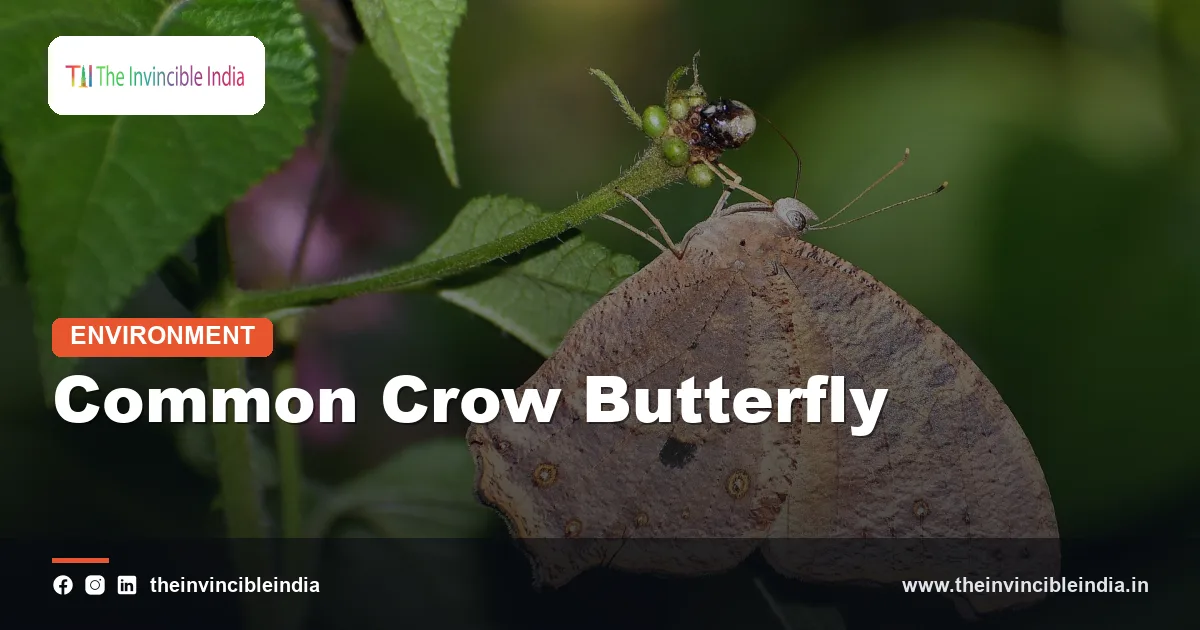
The common crow butterfly (Euploea core), also called the common Indian crow, is a glossy brown-black butterfly with white spots along the wing margins that flies slowly and low, and it is unpalatable to birds because of toxins from its food plants. It is one of the most frequently seen butterflies in India, found from city gardens to forest edges.
The common crow butterfly is also known for gathering in groups to roost and for being copied by harmless lookalikes. This explainer covers how to identify the common crow butterfly, where it lives, what it eats, its life cycle, its chemical defences, its mimics, and the seasonal movements in which it takes part.
| Attribute | Detail |
|---|---|
| Common name | Common crow butterfly, also called common Indian crow |
| Scientific name | Euploea core |
| Family | Nymphalidae (brush-footed butterflies), subfamily Danainae |
| Wingspan | Roughly 8 to 10 cm |
| Range | South Asia, including most of India, and eastward across Southeast Asia to Australia |
| Caterpillar food plants | Latex-bearing plants such as oleander and wild fig species |
| Defence | Toxic chemicals, warning colours and a tough, flexible body |
| Habitat | Gardens, scrub, farmland, forest edges and coastal areas |
| Conservation status | Common and widespread, not considered threatened |
Key Takeaways
- The common crow butterfly is a glossy brown-black butterfly with white spots along the wing margins and a wingspan of roughly 8 to 10 cm.
- The common crow butterfly belongs to the milkweed butterfly group Danainae and is widespread in India, from plains and coasts to forest edges.
- The common crow butterfly is unpalatable to birds because it stores toxins from plants eaten as a caterpillar, and it advertises this with slow flight.
- The common crow butterfly caterpillar feeds on latex-bearing plants such as oleander and wild fig species.
- The common crow butterfly is copied by harmless mimics such as the common mime, a swallowtail that gains protection from the resemblance.
- The common crow butterfly is common and not threatened, and it takes part in seasonal movements, notably alongside tiger butterflies in parts of southern India.
What is the common crow butterfly?
The common crow butterfly is a medium-sized butterfly in the subfamily Danainae, the group that also contains the tigers and the monarch. Its scientific name is Euploea core, and the English name refers to its dark, crow-like colour.
The Danainae are often called milkweed butterflies because many of their caterpillars feed on milkweed-type plants with milky sap. The common crow is the commonest member of the crows (genus Euploea) in India, and in many places it is the first of the group that a beginner sees.
The species has several local subspecies across its large range. In India the butterfly is simply called the common Indian crow, and the name appears in field guides, garden checklists and butterfly walks across the country.
How can you identify the common crow butterfly?
The common crow butterfly can be identified by its uniformly dark chocolate-brown wings, a border of small white spots on both wings and its slow, gliding flight. It looks black from a distance and brown in good light, and the wings may show a faint purplish sheen.
- Colour: Dark brown to black, glossy on the upperside, with a slightly paler underside.
- Spots: Rows of white spots along the wing edges, plus a few spots near the forewing tip.
- Shape: Rounded, broad wings without tails.
- Flight: Slow, floating and often low, with long glides on outstretched wings.
- Underside: Brown with a double row of white spots, and some brightness near the base of the wing.
Other crows in India look similar, for example the double-branded crow and the king crow, so careful viewing of the spot pattern and underside is useful. The common crow is the one that is most likely to be encountered in garden settings.
Where does the common crow butterfly live in India?
The common crow butterfly lives across most of India, from the coastal belt and plains to the Western Ghats, the Eastern Ghats and the lower Himalayan foothills. It adapts well to human-made habitats and appears in city parks, village gardens, farm borders and scrub.
The butterfly flies for much of the year in warm regions, with peaks around the monsoon and the months that follow. In drier parts of the country it can be scarce in the hottest weeks and then reappear when rains revive the plants.
Outside India, the species ranges across South Asia, Southeast Asia and into northern Australia. This broad range shows how adaptable the butterfly is. Its numbers are generally healthy, though local populations vary with rainfall and the abundance of host plants.
What does the common crow butterfly eat?
The adult common crow butterfly drinks nectar from flowers and takes minerals from plant sources, while its caterpillars eat the leaves of latex-bearing plants. Different life stages therefore need different resources.
Adults visit many flowers, including lantana, heliotrope, ixora and various wild blossoms. Males are also drawn to certain withered plants and to plants of the borage family, such as heliotrope, from which they take alkaloids. These chemicals are used in making the male’s courtship scent.
The caterpillars feed on plants such as oleander (Nerium oleander) and several wild figs and related trees. These plants contain sap with chemicals that deter most other insects, but crow caterpillars can tolerate and store them. The adult butterfly retains some of these chemicals, which contributes to its unpleasant taste.
What is the life cycle of the common crow butterfly?
The common crow butterfly goes through four stages, egg, caterpillar, pupa and adult, and the cycle generally takes a month or more depending on temperature. The stages are summarised below.
| Stage | Description |
|---|---|
| Egg | A small, pale, ribbed egg laid singly on the underside of a host plant leaf |
| Caterpillar | Brown or dark body with bright bands and fleshy filaments; feeds on host plant leaves |
| Pupa | A compact chrysalis hanging from a twig, with metallic spots, a typical feature of the group |
| Adult | Dark butterfly that feeds on nectar, mates and lays eggs |
The female lays eggs on a suitable host plant and usually places only one or a few eggs at a time. The caterpillar grows by shedding its skin several times. It has paired fleshy filaments and warning bands, which discourage predators.
When fully grown, the caterpillar attaches itself to a twig and becomes a pupa. Many members of the group have a pupa with shiny, metallic marks. After about a week or two the adult emerges, spreads its wings to dry and begins its slow, floating life as a butterfly.
Why is the common crow butterfly toxic to birds?
The common crow butterfly is toxic to many birds because it stores chemical compounds taken from the plants its caterpillars eat, and it combines these with its slow, easily seen flight as a warning. Predators that try one often reject it and learn to avoid similar butterflies.
Plants such as oleander contain cardiac glycosides, chemicals that disturb the heartbeat of animals that eat them. Crow caterpillars can accumulate these or similar plant compounds, and the chemicals persist in the pupa and adult. The butterfly is therefore a poor meal for birds and lizards.
The butterfly’s body also has a tough, leathery, flexible structure, so that a predator may release it after a peck and leave it alive. This pairing of chemical defence and physical resilience makes the common crow a good example of a protected butterfly. These details help explain why it can fly slowly and openly without constantly fleeing.
Which butterflies mimic the common crow?
The best known mimic of the common crow butterfly is the common mime (Papilio clytia), a swallowtail with a dark form that resembles the crow and the blue tiger. The mimic gains protection by looking like a species that predators avoid.
This is Batesian mimicry, in which a palatable species copies the appearance of an unpalatable one. The mimic usually has some small difference, such as tails on the hindwing or a different flight style, which can help an attentive observer tell them apart.
- Common crow: Brown-black, tailless, spotted at the margins, with a floating flight.
- Common mime: A swallowtail form that has a more rapid, fluttering flight and a body shaped differently.
- Danaid eggfly (female): Mimics other milkweed butterflies, such as the plain tiger.
Mimicry works best when models are common, as the common crow is. Because the crow is widespread, birds meet it often and learn to avoid it, a benefit that extends to its lookalikes.
Does the common crow butterfly migrate or roost in groups?
The common crow butterfly makes local seasonal movements and often roosts in groups, particularly in the dry season and before the monsoon. In parts of southern India, crows and tigers have been recorded gathering and moving together in the months around the monsoon.
Group roosting may occur in shaded spots with moisture, such as ravines and wooded streams. Dozens of butterflies may cluster on shrubs or low branches at night, then spread out in the morning. The behaviour may protect them from heat and predators, although the reasons are still being studied.
In the Western Ghats and nearby areas, observers have recorded large seasonal movements of several milkweed butterfly species, often described as tiger and crow migrations. These are not fully understood, and details differ from year to year, so records from volunteers and naturalists are valuable.
How can people help the common crow butterfly?
People can help the common crow butterfly by growing nectar flowers, keeping some native host trees and shrubs, and avoiding pesticides in gardens and farm edges. These steps support all stages of the butterfly’s life.
- Plant lantana, heliotrope and other nectar flowers in sunny places.
- Retain native fig trees and similar host plants in parks and village edges.
- Do not spray insecticides on flowering shrubs, as these harm butterflies and caterpillars.
- Leave some leaf litter and shrubby corners for resting and roosting.
- Record sightings through citizen science projects and local butterfly counts.
Oleander is common in Indian gardens and roadsides, and the common crow often uses it. Because the plant is poisonous to people and animals, gardeners should handle it carefully and keep it away from children and livestock.
What other crow butterflies occur in India?
India has several other crow butterflies in the genus Euploea, including the double-branded crow, the brown king crow, the striped blue crow and the spotted black crow, and each is separated from the common crow by size, spot pattern and sheen. The common crow is the most widespread and the easiest to meet in ordinary surroundings.
| Crow butterfly | How it differs from the common crow |
|---|---|
| Common crow (Euploea core) | Dark brown, glossy, with white marginal spots; found in most habitats |
| Double-branded crow (Euploea sylvester) | Often shows a bluish sheen and a pattern of spots that differs from the common crow |
| Brown king crow (Euploea klugii) | Larger and darker, associated more with forested regions |
| Striped blue crow (Euploea mulciber) | Shows bright blue streaks on the forewing, a clear contrast with the common crow |
| Spotted black crow (Euploea crameri) | Black with larger white spots, more typical of wetter forests |
The range of each species differs, and some are mostly confined to hill forests or the north-east. A beginner in a city garden will almost always be looking at the common crow unless the butterfly shows blue streaks or very heavy spotting.
How does the common crow differ from the plain tiger?
The common crow differs from the plain tiger mainly in colour: the crow is dark brown-black with white spots, while the plain tiger is orange-brown with black wing tips and white spots. Both are milkweed butterflies and both are unpalatable.
The two species often share the same gardens and fly in the same slow manner. Their shared warning strategy means that birds learn to avoid both, and this overlap is why researchers often study them together when they examine group movements and mimicry in the Danainae.
Why does the common crow butterfly matter to people?
The common crow butterfly matters to people because it is a pollinator, an easy gateway species for butterfly watching and a living example of how food plants, toxins and mimicry shape wildlife. It is a good subject for school projects and for citizen science.
Butterfly counts and photo records of common species help build long-term datasets on how insect numbers change with climate, urban growth and land use. Because the common crow is visible in nearly all seasons, it is among the species that volunteers record most often, and these records add up to useful information for researchers.
Bottom Line
The common crow butterfly is a glossy, brown-black, white-spotted butterfly that is common across India and protected by toxins from its caterpillar food plants. It flies slowly, roosts in groups, is copied by mimics such as the common mime, and can be supported with nectar flowers and native host plants.
Frequently Asked Questions
What is the common crow butterfly?
The common crow butterfly is a glossy brown-black butterfly with white spots at the wing edges, scientifically named Euploea core. It is common across India and flies slowly and low. It belongs to the milkweed butterfly group Danainae.
Is the common crow butterfly poisonous?
Yes, the common crow butterfly is unpalatable to many predators. Its caterpillars eat latex-bearing plants such as oleander and store chemicals from them. The butterfly is harmless to people who simply handle it gently or watch it.
What does the common crow butterfly caterpillar eat?
The caterpillar of the common crow butterfly eats the leaves of latex-bearing plants, including oleander and several wild fig species. These plants contain chemicals that most insects avoid. The caterpillar stores them for defence.
Which butterfly looks like the common crow?
The common mime looks like the common crow in one of its forms. The mime is a swallowtail that copies the crow’s dark pattern to avoid predators. Differences in flight speed and hindwing shape help observers tell them apart.
Why do common crow butterflies gather in groups?
Common crow butterflies gather in groups to roost, especially in the dry season and before the monsoon. Shaded, moist places such as ravines attract dozens of butterflies. The exact reasons are still studied, but shelter and protection are suggested.
How can I attract common crow butterflies to my garden?
You can attract common crow butterflies by growing nectar plants such as lantana and heliotrope and keeping native host plants like wild figs. Avoid spraying pesticides on flowering plants. If you grow oleander, keep it away from children and pets since it is poisonous.
{“@context”:”https://schema.org”,”@graph”:[{“@type”:”FAQPage”,”mainEntity”:[{“@type”:”Question”,”name”:”What is the common crow butterfly?”,”acceptedAnswer”:{“@type”:”Answer”,”text”:”The common crow butterfly is a glossy brown-black butterfly with white spots at the wing edges, scientifically named Euploea core. It is common across India and flies slowly and low. It belongs to the milkweed butterfly group Danainae.”}},{“@type”:”Question”,”name”:”Is the common crow butterfly poisonous?”,”acceptedAnswer”:{“@type”:”Answer”,”text”:”Yes, the common crow butterfly is unpalatable to many predators. Its caterpillars eat latex-bearing plants such as oleander and store chemicals from them. The butterfly is harmless to people who simply handle it gently or watch it.”}},{“@type”:”Question”,”name”:”What does the common crow butterfly caterpillar eat?”,”acceptedAnswer”:{“@type”:”Answer”,”text”:”The caterpillar of the common crow butterfly eats the leaves of latex-bearing plants, including oleander and several wild fig species. These plants contain chemicals that most insects avoid. The caterpillar stores them for defence.”}},{“@type”:”Question”,”name”:”Which butterfly looks like the common crow?”,”acceptedAnswer”:{“@type”:”Answer”,”text”:”The common mime looks like the common crow in one of its forms. The mime is a swallowtail that copies the crow’s dark pattern to avoid predators. Differences in flight speed and hindwing shape help observers tell them apart.”}},{“@type”:”Question”,”name”:”Why do common crow butterflies gather in groups?”,”acceptedAnswer”:{“@type”:”Answer”,”text”:”Common crow butterflies gather in groups to roost, especially in the dry season and before the monsoon. Shaded, moist places such as ravines attract dozens of butterflies. The exact reasons are still studied, but shelter and protection are suggested.”}},{“@type”:”Question”,”name”:”How can I attract common crow butterflies to my garden?”,”acceptedAnswer”:{“@type”:”Answer”,”text”:”You can attract common crow butterflies by growing nectar plants such as lantana and heliotrope and keeping native host plants like wild figs. Avoid spraying pesticides on flowering plants. If you grow oleander, keep it away from children and pets since it is poisonous.”}}]}]}


