

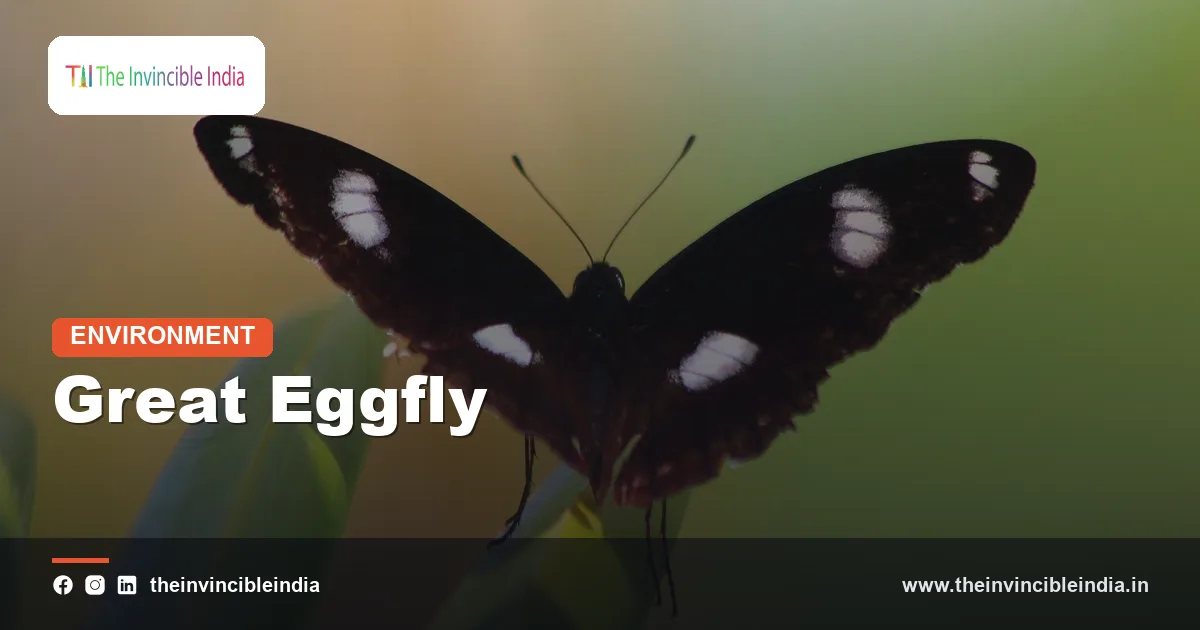
The great eggfly (Hypolimnas bolina) is a large, strongly sexually dimorphic brush-footed butterfly in which the male is velvety black with glowing blue-white “egg” spots and the female is a variable brown mimic of toxic crows, found across India’s gardens, scrub, coasts and forest edges. Among the more eye-catching butterflies of the Indian plains, the great eggfly is also a favourite of scientists because of its mimicry and an unusual bacterial infection that has shaped its populations.
This guide explains how to recognise the great eggfly, why the two sexes look so different, what the caterpillars eat, where the species lives in India, and how gardeners and nature walkers can encounter it.
| Attribute | Detail |
|---|---|
| Scientific name | Hypolimnas bolina |
| Family | Nymphalidae (brush-footed butterflies), subfamily Nymphalinae |
| Other common names | Common eggfly, blue moon butterfly |
| Typical wingspan | Roughly 7 to 10 cm, with females usually larger |
| Male appearance | Velvety black above with large white spots ringed by blue-violet iridescence |
| Female appearance | Variable dark brown with white and orange markings; mimics toxic crow butterflies |
| Caterpillar food plants | Low herbs and weeds such as Asystasia, Sida and Portulaca |
| Distribution | Africa and Madagascar through South and South-East Asia to Australia and the Pacific; widespread in India |
| Conservation concern | Common and widespread; not regarded as threatened in India |
Key Takeaways
- The great eggfly (Hypolimnas bolina) is a large Indian butterfly in the family Nymphalidae with a wingspan of roughly 7 to 10 centimetres.
- Male great eggflies are black above with big white spots surrounded by a blue-violet sheen, while females are dark brown with white and orange markings.
- Female great eggflies are well known for Batesian mimicry, copying the look of toxic crow butterflies (genus Euploea) so that birds avoid them.
- Great eggfly caterpillars are spiny and feed on low herbs and weeds, including Asystasia, Sida and purslane (Portulaca).
- In some Pacific populations a male-killing Wolbachia bacterium made the great eggfly one of the best-studied examples of rapid evolution against a sex-ratio parasite.
- The great eggfly is common in gardens, scrub and coastal areas of India, and it benefits from leaving weedy patches unweeded.
What is the great eggfly butterfly?
The great eggfly is a medium-to-large butterfly of the family Nymphalidae, the family of brush-footed butterflies, which also includes the crows, tigers, pansies, leopards and sailers. The scientific name is Hypolimnas bolina, and the butterfly is also called the common eggfly or, in some regions, the blue moon butterfly.
The name “eggfly” is generally explained by the rounded white spots on the wings, which look like clusters of eggs, especially on the underside. Nymphalids are called brush-footed because the forelegs of adults are small and brush-like, so the butterfly appears to walk on only four legs. This is a quick feature to check on a perched great eggfly if the light is good.
The great eggfly belongs to the genus Hypolimnas, a group famous for mimicry and for large differences between the sexes. In India the genus is represented by two species that gardeners and photographers regularly confuse: the great eggfly and the Danaid eggfly (Hypolimnas misippus). Both are discussed in the comparison table later in this article.
How can you identify a male great eggfly?
A male great eggfly can be identified by its velvety black-brown upper wings carrying large white spots that are surrounded by an iridescent blue-violet glow, which changes colour as the angle of light changes. The forewing usually shows a prominent white spot near the centre and a smaller series along the edge, while the hindwing carries a large white patch and a scatter of smaller ones.
The blue sheen is not a pigment. It is structural colour produced by the microscopic architecture of the wing scales, so it flashes brightly in direct sun and almost vanishes in shade. This is why photographs of the same butterfly can look very different from one frame to the next.
Underside of the male
When the male closes its wings, the underside is brown with a pattern of white spots outlined in darker tones, which helps it blend into leaf litter and dry vegetation. Observers who see only the closed wings should look for the spotted pattern and the relatively broad, rounded wing shape.
Field marks to check
- Large, broad wings with a smoothly scalloped outline and a size noticeably bigger than a common crow.
- White spots on both fore and hind wings, each ringed by blue-violet on the upperside.
- A fast, strong, darting flight with sudden changes of direction, often returning to the same perch.
Why does the female great eggfly look so different from the male?
The female great eggfly looks different because she is selected for survival and egg-laying rather than display, and she mimics distasteful crow butterflies so that predators such as birds leave her alone. In Indian populations the female is generally dark brown with white spots and bands on the forewing and a mix of white and orange-brown markings on the hindwing, giving a broad resemblance to a common crow (Euploea core).
This strategy is called Batesian mimicry, named after the nineteenth-century naturalist Henry Walter Bates. In Batesian mimicry, a palatable species gains protection by resembling an unpalatable or toxic species. Crow butterflies are distasteful because their caterpillars feed on toxic plants of the dogbane and fig families and store the chemicals, so birds learn to avoid their pattern.
Female great eggflies are also notably polymorphic across their global range. Different regions show different female forms, and in some Pacific islands several forms coexist. Because the male is always the same black-and-blue type, the sexes are easy to mistake for two different species.
A practical tip for identification is size and flight. The female is usually larger than the male, a little heavier on the wing, and flies lower and more slowly than the male, which patrols a territory vigorously.
Where does the great eggfly live in India?
The great eggfly lives across most of peninsular and northern India below the higher mountains, favouring gardens, open scrub, cultivated land, roadsides, coastal vegetation and forest edges. The species is also recorded from the Andaman and Nicobar Islands and from many other tropical islands, which suits a butterfly with good dispersal ability.
Its global range is among the widest of any butterfly: it extends from Madagascar and the African mainland across South and South-East Asia, to Australia and many Pacific island groups. Because the great eggfly can use many weedy plants as caterpillar food, human-modified landscapes do not exclude it.
Seasonally, the butterfly can be seen throughout much of the year in warm, humid regions. In drier parts of the country, numbers are highest during and after the monsoon, when fresh growth of host plants is plentiful. Individuals are often noticed at flowering shrubs and, in the case of males, on low perches along paths.
What do great eggfly caterpillars eat?
Great eggfly caterpillars eat the leaves of low herbs and weeds, and recorded food plants include Asystasia (Chinese violet), Sida (country mallows), Portulaca (purslane), and members of the nettle and morning-glory families. Because many of these plants grow wild on waste ground, a lightly weeded garden can host the species without any special planting.
The caterpillar is dark with branched spines, a typical armour for nymphalid larvae. Spines do not usually sting, but they discourage predators and, for people, are best left untouched. Caterpillars feed mainly at night or in the shade of the plant and rest on the underside of leaves during hot hours.
- Asystasia gangetica, a common spreading garden weed in the acanthus family.
- Sida species, small wild mallows of fields and roadsides.
- Portulaca oleracea, edible purslane, a succulent ground-cover herb.
- Other herbs in the nettle (Urticaceae) and morning-glory (Convolvulaceae) families in some regions.
Gardeners sometimes worry when caterpillars chew a few leaves. In the case of the great eggfly, the host plants are mostly plentiful weeds, so the damage is rarely a concern for ornamental plantings.
What is the life cycle of the great eggfly?
The great eggfly goes through complete metamorphosis in four stages: egg, caterpillar (larva), pupa (chrysalis) and adult. In warm conditions the whole cycle can be completed in roughly a month or somewhat longer, and several generations can follow each other in a single year.
Egg
The female lays small green, ribbed eggs singly or in small groups on the leaves of the host plant. She chooses leaves that are fresh and tender because young caterpillars are weak feeders.
Caterpillar
The caterpillar passes through several moults, called instars, growing steadily as it feeds. Each moult sheds the old skin, and after the final instar the caterpillar stops feeding and seeks a place to pupate.
Pupa and adult
The pupa hangs head-down from a stem or leaf and has a brownish, textured surface that looks like a dead leaf or twig. After one to two weeks, depending on temperature, the adult emerges, pumps fluid into its crumpled wings and waits for them to harden before the first flight. Adults feed on nectar and on fermenting fruit, and males also visit damp ground.
How does the great eggfly behave?
The great eggfly behaves as a territorial, fast-flying butterfly: males defend a patch of habitat from a low perch, chase intruders, and return to the same spot repeatedly. Territorial behaviour is most obvious in the warm part of the day, when males dart out at passing butterflies, rival males and even small birds.
Females spend more time searching for host plants and tend to move lower and more steadily. Mating takes place after the male courts a female near the host plants or along flyways.
- Basking: males often open their wings partly in morning sun to warm the flight muscles.
- Feeding: adults take nectar from flowers such as lantana and visit rotting fruit and sap flows.
- Mud-puddling: males sometimes sip minerals from damp soil, which helps with reproduction.
- Roosting: adults usually rest in vegetation at night, often in sheltered spots at moderate height.
What is the Wolbachia story behind the great eggfly?
The Wolbachia story is that some great eggfly populations in the Pacific carried a bacterium called Wolbachia that killed male embryos, leaving almost entirely female populations, until genetic changes spread that suppressed the killing and restored a balanced sex ratio. This made the great eggfly a textbook example of evolution observed in action.
Wolbachia is a bacterium that lives inside the cells of many insects and passes from mother to offspring. Some strains manipulate their hosts to favour the survival and spread of infected females, which is a form of sex-ratio distortion. In affected great eggfly populations, researchers reported in the mid-2000s that a suppressor spread through the population within only a few years of generations.
This is relevant for general readers because it shows that even a common garden butterfly can reveal fundamental biology. Indian populations are not known as the classic example of male killing, but the species as a whole is a valuable subject for studies on mimicry, genetics and host-parasite evolution.
How does the great eggfly compare with similar butterflies?
The great eggfly differs from its look-alikes mainly by the number and arrangement of white spots, the blue-violet sheen on the male and the colour of the female. The table below compares the great eggfly with the Danaid eggfly and the common crow, the species most often confused with it.
| Butterfly | Male or general look | Female look | Key point |
|---|---|---|---|
| Great eggfly (Hypolimnas bolina) | Black with several large white spots, blue-violet halo | Dark brown with white and orange markings | Female mimics toxic crows |
| Danaid eggfly (Hypolimnas misippus) | Black with one big white-and-violet spot on each wing | Orange-and-black, resembles the plain tiger | Smaller; female mimics Danaus chrysippus |
| Common crow (Euploea core) | Glossy brown-black, small white spots along the edge | Similar to male | Toxic model for mimicry |
| Blue tiger (Tirumala limniace) | Dark with pale blue streaks | Similar to male | Slow, gliding flight |
If a butterfly has a single white-violet spot per wing and an orange female, it is most likely the Danaid eggfly. If the male has several large white spots and a broad wing, the great eggfly is the likely answer.
Is the great eggfly threatened, and how can gardeners help it?
The great eggfly is not considered threatened in India because it is widespread, adaptable and able to breed on common weeds. Its numbers tend to fluctuate with rainfall, and local declines can occur where habitat is paved, sprayed with pesticides or cleared of all wild plants.
Indian law protects wildlife, including butterflies in protected areas, and collecting from sanctuaries and national parks is prohibited. Photography and observation are the recommended ways to enjoy the species.
- Leave patches of native or weedy herbs, such as Asystasia and Sida, unmown during the monsoon.
- Avoid broad-spectrum insecticides, which kill caterpillars and adults.
- Plant nectar sources such as lantana, zinnia and ixora for adults.
- Provide a shallow tray of wet sand or soil for males to puddle.
- Record sightings on citizen-science platforms to build India’s butterfly records.
Bottom Line
The great eggfly is a common but remarkable Indian butterfly, with a glowing blue-and-black male, a mimicking female, weed-eating caterpillars and a place in evolutionary research. Recognising it needs only a few field marks, and supporting it needs only a little tolerance for wild plants.
Frequently Asked Questions
What is the great eggfly?
The great eggfly is a large brush-footed butterfly, Hypolimnas bolina, found across India, Asia, Australia and the Pacific. The male is black with white spots ringed by blue-violet, and the female is brown with white and orange marks. Both sexes belong to the family Nymphalidae.
Why is it called an eggfly?
The name eggfly refers to the round white spots on the wings, which resemble eggs. The spots are most visible on the underside and on the male’s upper wings. The name is shared with other butterflies in the genus Hypolimnas.
Is the great eggfly poisonous?
The great eggfly is not itself toxic, but the female copies the appearance of toxic crow butterflies to avoid being eaten. This protective resemblance is called Batesian mimicry. The butterfly is harmless to people and does not bite or sting.
What do great eggfly caterpillars feed on?
Great eggfly caterpillars feed on low herbs and weeds, including Asystasia, Sida and Portulaca. Some populations also use plants in the nettle and morning-glory families. Because these plants are common, the caterpillars rarely damage garden crops.
How is the great eggfly different from the Danaid eggfly?
The great eggfly has several large white spots on a black male and a brown female, while the Danaid eggfly has one big white-violet spot per wing and an orange female. The Danaid eggfly is also generally smaller. Its female mimics the plain tiger rather than the common crow.
When and where can the great eggfly be seen in India?
The great eggfly can be seen in gardens, scrub, farmland edges and coastal vegetation across much of India, especially during and after the monsoon. Males are often noticed perched low on vegetation in warm sunny hours. The best time to look is mid-morning, when activity is high.
{“@context”:”https://schema.org”,”@graph”:[{“@type”:”FAQPage”,”mainEntity”:[{“@type”:”Question”,”name”:”What is the great eggfly?”,”acceptedAnswer”:{“@type”:”Answer”,”text”:”The great eggfly is a large brush-footed butterfly, Hypolimnas bolina, found across India, Asia, Australia and the Pacific. The male is black with white spots ringed by blue-violet, and the female is brown with white and orange marks. Both sexes belong to the family Nymphalidae.”}},{“@type”:”Question”,”name”:”Why is it called an eggfly?”,”acceptedAnswer”:{“@type”:”Answer”,”text”:”The name eggfly refers to the round white spots on the wings, which resemble eggs. The spots are most visible on the underside and on the male’s upper wings. The name is shared with other butterflies in the genus Hypolimnas.”}},{“@type”:”Question”,”name”:”Is the great eggfly poisonous?”,”acceptedAnswer”:{“@type”:”Answer”,”text”:”The great eggfly is not itself toxic, but the female copies the appearance of toxic crow butterflies to avoid being eaten. This protective resemblance is called Batesian mimicry. The butterfly is harmless to people and does not bite or sting.”}},{“@type”:”Question”,”name”:”What do great eggfly caterpillars feed on?”,”acceptedAnswer”:{“@type”:”Answer”,”text”:”Great eggfly caterpillars feed on low herbs and weeds, including Asystasia, Sida and Portulaca. Some populations also use plants in the nettle and morning-glory families. Because these plants are common, the caterpillars rarely damage garden crops.”}},{“@type”:”Question”,”name”:”How is the great eggfly different from the Danaid eggfly?”,”acceptedAnswer”:{“@type”:”Answer”,”text”:”The great eggfly has several large white spots on a black male and a brown female, while the Danaid eggfly has one big white-violet spot per wing and an orange female. The Danaid eggfly is also generally smaller. Its female mimics the plain tiger rather than the common crow.”}},{“@type”:”Question”,”name”:”When and where can the great eggfly be seen in India?”,”acceptedAnswer”:{“@type”:”Answer”,”text”:”The great eggfly can be seen in gardens, scrub, farmland edges and coastal vegetation across much of India, especially during and after the monsoon. Males are often noticed perched low on vegetation in warm sunny hours. The best time to look is mid-morning, when activity is high.”}}]}]}


