

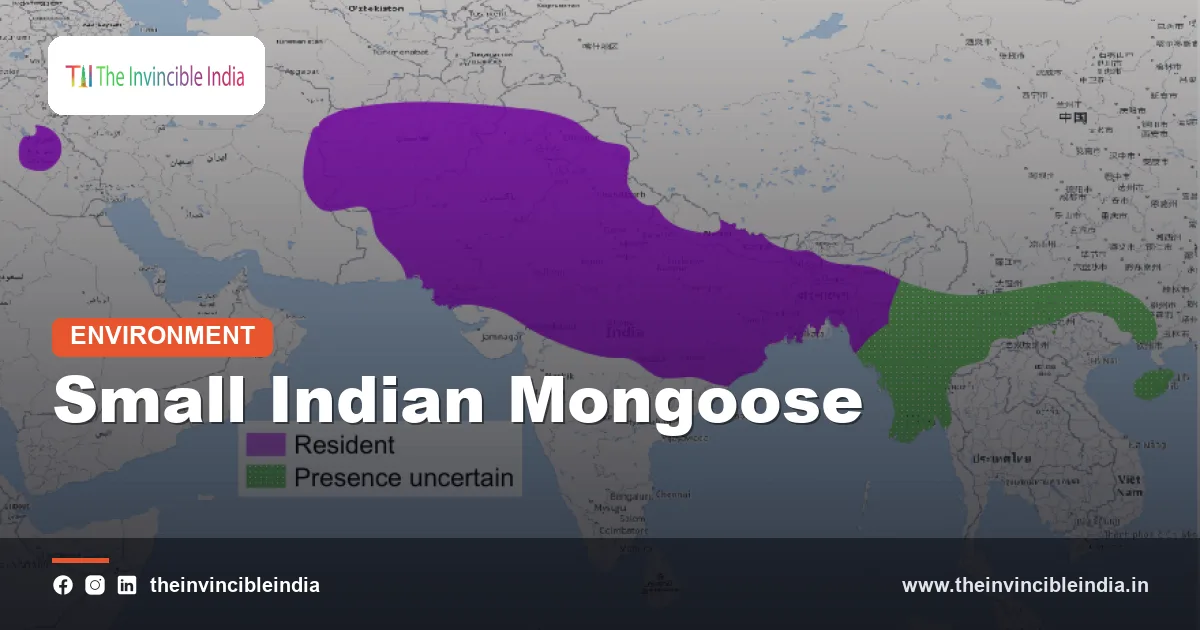
The small Indian mongoose (Urva auropunctata) is a slim, short-legged, brownish carnivore of the mongoose family that lives in fields, scrub, gardens and village edges across much of the Indian subcontinent and hunts rodents, insects, reptiles and eggs. It is one of the most frequently seen small mammals in rural and semi-urban India, usually spotted dashing across a path in daylight with its tail held low.
This explainer covers how the small Indian mongoose looks, where it lives, what it eats, how it breeds and how it differs from the larger Indian grey mongoose. It also looks at the animal’s reputation as a snake fighter, its legal protection in India and its troubled history as an introduced species abroad.
Quick Facts: Small Indian Mongoose
| Scientific name | Urva auropunctata (earlier called Herpestes auropunctatus) |
|---|---|
| Family | Herpestidae (mongooses) |
| Size | Head and body roughly 25 to 37 cm, tail roughly 20 to 27 cm; weight usually under 1 kg |
| Colour | Olive-brown to golden-brown, finely flecked with paler tips on the fur |
| Range and habitat | From West Asia across the Indian subcontinent to Southeast Asia; open scrub, farmland, grassland, forest edges and gardens |
| Diet | Omnivorous: rodents, insects, lizards, snakes, frogs, crabs, birds’ eggs, some fruit |
| Activity | Mainly diurnal and largely solitary or in pairs |
| Breeding | Usually one to two litters a year of about two to four pups after a gestation of roughly seven weeks |
| Conservation status | Least Concern (IUCN); mongooses are protected under India’s Wildlife (Protection) Act, 1972 |
Key Takeaways
- The small Indian mongoose is a diurnal, olive-brown carnivore that weighs well under a kilogram and is much smaller than the Indian grey mongoose.
- The small Indian mongoose eats rodents, insects, reptiles, eggs and other small prey, which makes it a natural controller of crop and household pests.
- Mongooses are resistant to the neurotoxic venom of cobras because of a modified receptor in their nerves, but they are not immune and can die from snakebite.
- The small Indian mongoose was deliberately taken from India to Jamaica in 1872 to kill rats in sugarcane fields and became an invasive pest on many islands.
- In India, the small Indian mongoose is a protected wild animal, and capturing it, keeping it or trading in its hair is an offence under the Wildlife (Protection) Act, 1972.
- The species is listed as Least Concern by the IUCN because it is widespread, adaptable and common across its range.
What is the small Indian mongoose?
The small Indian mongoose is a small carnivorous mammal in the family Herpestidae, found naturally from the Middle East through the Indian subcontinent to Myanmar and parts of mainland Southeast Asia. Its scientific name is Urva auropunctata, and older books and field guides list it as Herpestes auropunctatus. The genus was reorganised in recent years, and many Indian mongooses now sit in the genus Urva.
Mongooses are not related to cats, weasels or civets, although they resemble all three at first glance. They belong to their own family within the order Carnivora and are most closely related to the Malagasy carnivorans and the meerkats and banded mongooses of Africa. The small Indian mongoose is one of several mongoose species recorded in India, and it is the one most associated with open farmland and village outskirts in the north, east and north-east of the country.
The animal has been part of Indian life for centuries. Rudyard Kipling’s story Rikki-Tikki-Tavi made the mongoose famous worldwide, though the hero of that story is generally taken to be the larger Indian grey mongoose. The small Indian mongoose shares the same quick, inquisitive manner and the same reputation for bravery against snakes.
What does the small Indian mongoose look like?
The small Indian mongoose has a long, slim body, short legs, a pointed face, small rounded ears and a tapering tail that is about two-thirds the length of the head and body. Adults weigh usually between a few hundred grams and just under a kilogram, and males are larger than females.
Fur and colour
The coat is coarse and looks olive-brown or golden-brown from a distance. Close up, each hair has pale banding, which gives the fur a speckled or “salt-and-pepper” appearance. The underparts are slightly paler, and the tail has no strong tuft or contrasting tip. This plain, evenly speckled look is a useful clue when comparing it with the grey mongoose, which has a more steel-grey coat and a tail ending in a pale brush.
Feet, claws and teeth
Each foot has five toes with long, non-retractile claws that are well suited for digging out insects, tearing open eggs and moving through leaf litter. The animal has 40 teeth, including sharp carnassial teeth that shear flesh and sturdy canines for killing small prey with a quick bite at the head or neck.
Scent glands
Like other mongooses, the small Indian mongoose has a scent gland near the tail base. It uses the secretion to mark territory, food sources and travel routes, and animals often rub their rear against stones, stems and posts to leave a signal for others.
Where does the small Indian mongoose live in India?
The small Indian mongoose lives in a wide range of habitats across India, including dry scrub, open grassland, farmland, plantation edges, riverbanks, and gardens in and around towns and villages. It is especially common in cultivated landscapes where rodents, insects and field cover are abundant.
The animal prefers places that offer a mix of open ground for foraging and dense cover for shelter. It rests and shelters in burrows dug by other animals, among rocks, in hollow logs, in termite mounds, under bushes, or in drains and old walls. In many Indian villages it is seen along field bunds, hedgerows, canal banks and the edges of sugarcane and paddy fields.
Within India, the small Indian mongoose is more widespread in the north, east and north-east, while the Indian grey mongoose dominates many drier plains and peninsular regions. Where both occur, they can sometimes be seen in the same landscape, though ecological preferences and size differences reduce direct competition. Local range limits are best checked against current field guides and state faunal surveys because mongoose taxonomy has changed in recent years.
The animal is generally found from the plains up to modest hill elevations. It avoids dense, closed rainforest and very high mountains, and it favours places with water, such as streams, ponds and irrigation channels.
What does the small Indian mongoose eat?
The small Indian mongoose is an opportunistic omnivore that mainly eats small animals such as rodents, insects, lizards, frogs, crabs, snakes and the eggs and chicks of ground-nesting birds. It also eats some fruit and carrion when available, so its menu changes with season and place.
Main foods
- Rodents such as mice and young rats, which it hunts in field burrows and grain stores
- Insects including beetles, grasshoppers, crickets, termites and caterpillars
- Reptiles and amphibians such as lizards, skinks, small snakes and frogs
- Crabs, snails and other invertebrates found near water and wet fields
- Eggs and nestlings of birds that nest on or near the ground
- Occasional fruit, seeds and carrion
How it opens eggs
Mongooses are known for their egg-handling technique. A small Indian mongoose usually grips an egg with its forepaws and throws or hurls it between its hind legs against a hard surface until it cracks. It then licks out the contents. This behaviour is common in several mongoose species, and it makes sense for an animal that often cannot open hard shells by biting.
Effect on farms
On balance, the small Indian mongoose is helpful to farmers because rodents and insect pests make up a big share of its diet. It can, however, take eggs and chicks from poultry kept in poorly secured sheds and open yards. Closed coops with fine mesh and secure doors are the usual answer to this problem.
How does the small Indian mongoose hunt and behave?
The small Indian mongoose hunts mostly by day, moving with a quick, low, darting gait while it sniffs along the ground, probes burrows and flushes prey from vegetation. It is alert and curious, and it often stands upright on its hind legs for a moment to survey its surroundings.
The animal is usually solitary or seen in pairs, in contrast with some African mongoose species that live in large groups. Home ranges overlap, and males typically range more widely than females. Individuals communicate through scent marks, chattering, chirps and sharp warning calls.
When it spots a threat, the small Indian mongoose tends to bolt for the nearest hole or thick cover. If cornered it can fight fiercely, hissing, bristling its fur and biting. Its natural predators include large birds of prey such as eagles and owls, large snakes, jackals, feral dogs and domestic cats, with young animals the most vulnerable.
Daily movement follows a rhythm of morning and late-afternoon activity, with a rest during the hottest hours. In hot weather it shelters in burrows or dense shade, and during cooler months it may forage for longer stretches.
Can a mongoose really beat a cobra?
A mongoose can often defeat a cobra, but it is not immune to the venom and does not always win. The small Indian mongoose, like several other mongoose species, has a modified version of the nicotinic acetylcholine receptor, the nerve-muscle docking site that cobra neurotoxins normally lock onto. The change makes the receptor much harder for the toxin to bind, so the animal tolerates a bite that would paralyse a similar-sized mammal.
That biological resistance is only part of the story. A mongoose also relies on speed, agility and a thick coat, and it attacks in short, quick feints that wear down a snake and make it miss. It aims for the head and neck. The resistance is partial and large doses of venom, or several bites, can still kill it.
The popular street spectacle of a staged mongoose-and-snake fight is cruel and illegal in India. It harms both animals, and under wildlife law catching a snake or a mongoose for such shows is a punishable offence. Wildlife officers and animal welfare groups regularly rescue animals used in this way.
How does the small Indian mongoose breed?
The small Indian mongoose breeds once or twice a year, and a female usually gives birth to about two to four pups after a gestation of roughly seven weeks. Timing varies by region and climate, and in many parts of India the breeding season is linked to the warmer, wetter months when food is plentiful.
Females give birth in a burrow, hollow or sheltered den lined with dry grass or leaves. Newborns are small, blind and helpless, and their eyes open after about two to three weeks. The mother nurses and guards them, and young mongooses begin to eat solid food and follow their mother on short trips after the first month or so.
Young animals reach independence at a few months of age, and they become sexually mature at around the end of their first year, or earlier in some populations. In the wild an individual commonly lives for several years, and captive animals can live noticeably longer.
How is the small Indian mongoose different from the Indian grey mongoose?
The small Indian mongoose is smaller, browner and more slender than the Indian grey mongoose (Urva edwardsii), which is the larger, steel-grey species of the Indian plains. The two animals share a family and many habits, but they can be told apart by size, colour and tail shape.
| Feature | Small Indian mongoose | Indian grey mongoose |
|---|---|---|
| Scientific name | Urva auropunctata | Urva edwardsii |
| Body size | Smaller, usually under 1 kg | Larger and heavier, often well over 1 kg |
| Coat colour | Olive or golden brown, finely speckled | Grizzled steel-grey |
| Tail | Tapering, no pronounced tip | Often ends in a pale or reddish tuft |
| Typical setting | Farmland, scrub, gardens, damp grassland | Dry plains, scrub, rural and urban edges |
| Fame | Known as an introduced pest abroad | Often the mongoose of Indian folklore and Kipling’s tale |
India also has other mongooses, including the ruddy mongoose, the stripe-necked mongoose and the crab-eating mongoose in particular regions. Each has distinct colour, size and habitat clues, and a good field guide or photograph is the best way to confirm an identification.
Why did the small Indian mongoose become an invasive species abroad?
The small Indian mongoose became invasive because people introduced it to islands in the 19th century to control rats in sugarcane plantations, and it then preyed heavily on native wildlife. The best-known introduction took place in Jamaica in 1872, when animals were brought from India to protect sugar crops.
The plan appeared sensible at first, but it overlooked a key problem. Rats are active at night, while the mongoose hunts by day, so the two animals rarely met. The mongoose instead turned to ground-nesting birds, reptiles, amphibians and eggs, which had evolved without such a predator. It then spread to Hawaii, Fiji, Puerto Rico, Cuba, Hispaniola, Okinawa and other islands in the Caribbean, Pacific and elsewhere.
Conservation biologists now regard the species as one of the more harmful introduced mammals on islands. It is blamed for population declines and local extinctions among native birds, lizards, snakes and amphibians. It can also carry diseases such as rabies and leptospirosis, which adds a public health concern. Island governments run control and trapping programmes today.
The story is a classic lesson in biological control: an animal that is a modest, balanced part of a food web in its original home can become destructive in a place where prey has no defences.
Is the small Indian mongoose protected in India?
Yes, the small Indian mongoose is a protected wild animal in India under the Wildlife (Protection) Act, 1972. Hunting, capturing, keeping, trading or harming mongooses without legal authority is an offence, and the penalties can include imprisonment and fines. Exact schedule placements have been reorganised by amendments, so officials and legal references should be consulted for the current schedule listing.
Mongoose hair has a long history of use in shaving and paint brushes, and demand for it drove poaching in the past. Indian law treats the trade in mongoose hair and brushes as illegal, and enforcement agencies have seized consignments of such products on several occasions.
The IUCN rates the species as Least Concern, reflecting its wide range, adaptability and large overall numbers. Local threats still exist, including road deaths, dog attacks, habitat loss, poisoning meant for rodents and capture for street shows. In India the main conservation task is enforcement of existing protection rather than the species’ survival as a whole.
How can people live safely alongside the small Indian mongoose?
People can live safely alongside the small Indian mongoose by securing poultry, avoiding contact with wild animals and leaving the animal alone. The species is shy, usually avoids humans and rarely poses a danger if it is not cornered or handled.
- Keep chickens and ducks in closed coops with fine mesh and strong latches at night.
- Do not feed, handle or attempt to keep a mongoose as a pet, as it is illegal and can carry rabies and other diseases.
- Avoid using rodent poison in the open, since poisoned rats can in turn harm mongooses, owls and snakes.
- If bitten or scratched by any wild animal, wash the wound well with soap and running water and seek medical advice about rabies prophylaxis.
- Report injured or trapped animals to the local forest department or a wildlife rescue group instead of attempting to restrain them.
Leaving brush piles, field bunds and hedgerows in place on farms helps the animal persist, and in return the mongoose helps keep rodent numbers in check. This practical give-and-take explains why traditional farming communities in India have long tolerated the animal.
Bottom Line
The small Indian mongoose is a common, useful and well-adapted small carnivore of Indian fields, scrub and gardens. It hunts pests by day, resists snake venom to a degree, and is protected by law, yet its history abroad shows how harmful it can be when moved outside its home range.
Frequently Asked Questions
What is the small Indian mongoose?
The small Indian mongoose is a slim, olive-brown carnivore of the family Herpestidae found across the Indian subcontinent and neighbouring regions. It weighs usually less than a kilogram and lives in farmland, scrub and gardens. It eats rodents, insects, reptiles, eggs and other small foods.
Is the small Indian mongoose the same as the Indian grey mongoose?
No, they are two different species. The small Indian mongoose (Urva auropunctata) is smaller and olive-brown, while the Indian grey mongoose (Urva edwardsii) is larger and steel-grey with a tufted tail tip. Both belong to the family Herpestidae and share many habits.
Can a mongoose kill a cobra?
Yes, a mongoose can kill a cobra, but it is not immune to the venom. A change in the nerve receptor that cobra toxin targets gives mongooses strong resistance, and their speed and agility help them avoid bites. A large dose of venom can still kill a mongoose.
What does a small Indian mongoose eat?
A small Indian mongoose eats mainly rodents, insects, lizards, frogs, crabs, small snakes and the eggs of ground-nesting birds. It also takes some fruit and carrion. Its varied diet allows it to survive in many types of habitat.
Is it legal to keep a mongoose as a pet in India?
No, keeping a mongoose as a pet is illegal in India. The animal is protected under the Wildlife (Protection) Act, 1972, which forbids capturing, keeping or trading wild mongooses. Pet or street-show use is punishable, and wild animals can also carry diseases such as rabies.
Why is the small Indian mongoose a problem outside India?
The small Indian mongoose became a problem outside India because it was introduced to islands such as Jamaica and Hawaii to control rats and then preyed on native wildlife. Native birds, reptiles and amphibians on those islands had no defence against a day-active ground predator. The species is now managed as an invasive pest in many places.
{“@context”:”https://schema.org”,”@graph”:[{“@type”:”FAQPage”,”mainEntity”:[{“@type”:”Question”,”name”:”What is the small Indian mongoose?”,”acceptedAnswer”:{“@type”:”Answer”,”text”:”The small Indian mongoose is a slim, olive-brown carnivore of the family Herpestidae found across the Indian subcontinent and neighbouring regions. It weighs usually less than a kilogram and lives in farmland, scrub and gardens. It eats rodents, insects, reptiles, eggs and other small foods.”}},{“@type”:”Question”,”name”:”Is the small Indian mongoose the same as the Indian grey mongoose?”,”acceptedAnswer”:{“@type”:”Answer”,”text”:”No, they are two different species. The small Indian mongoose (Urva auropunctata) is smaller and olive-brown, while the Indian grey mongoose (Urva edwardsii) is larger and steel-grey with a tufted tail tip. Both belong to the family Herpestidae and share many habits.”}},{“@type”:”Question”,”name”:”Can a mongoose kill a cobra?”,”acceptedAnswer”:{“@type”:”Answer”,”text”:”Yes, a mongoose can kill a cobra, but it is not immune to the venom. A change in the nerve receptor that cobra toxin targets gives mongooses strong resistance, and their speed and agility help them avoid bites. A large dose of venom can still kill a mongoose.”}},{“@type”:”Question”,”name”:”What does a small Indian mongoose eat?”,”acceptedAnswer”:{“@type”:”Answer”,”text”:”A small Indian mongoose eats mainly rodents, insects, lizards, frogs, crabs, small snakes and the eggs of ground-nesting birds. It also takes some fruit and carrion. Its varied diet allows it to survive in many types of habitat.”}},{“@type”:”Question”,”name”:”Is it legal to keep a mongoose as a pet in India?”,”acceptedAnswer”:{“@type”:”Answer”,”text”:”No, keeping a mongoose as a pet is illegal in India. The animal is protected under the Wildlife (Protection) Act, 1972, which forbids capturing, keeping or trading wild mongooses. Pet or street-show use is punishable, and wild animals can also carry diseases such as rabies.”}},{“@type”:”Question”,”name”:”Why is the small Indian mongoose a problem outside India?”,”acceptedAnswer”:{“@type”:”Answer”,”text”:”The small Indian mongoose became a problem outside India because it was introduced to islands such as Jamaica and Hawaii to control rats and then preyed on native wildlife. Native birds, reptiles and amphibians on those islands had no defence against a day-active ground predator. The species is now managed as an invasive pest in many places.”}}]}]}


