

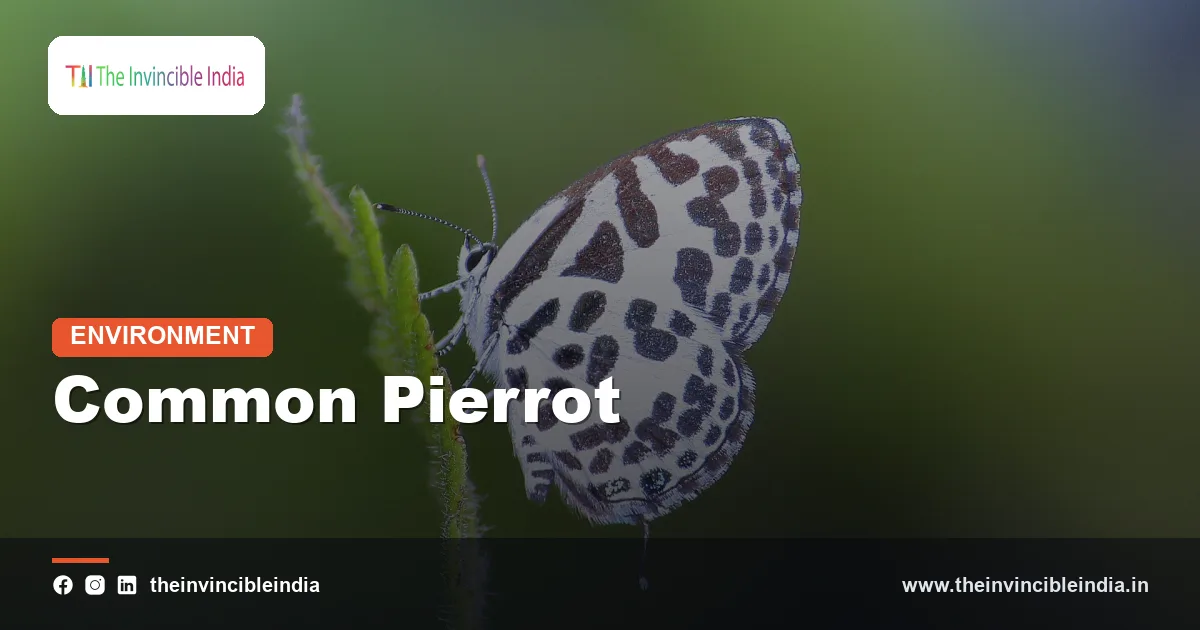
The common pierrot (Castalius rosimon) is a small white butterfly with bold black spots and borders and short tails on its hindwings, found across much of India, where it flutters low over gardens, scrub and forest edges. It belongs to the family Lycaenidae, the group that includes the blues, and its caterpillars live in close partnership with ants.
The common pierrot gets its name from Pierrot, the white-costumed clown of French theatre, because its pale wings with black marks resemble that outfit. This explainer covers how to identify the common pierrot, where it lives, how its ant-associated caterpillars develop and how it differs from other pierrots.
| Quick Facts | Common Pierrot |
|---|---|
| Scientific name | Castalius rosimon |
| Family | Lycaenidae (blues, hairstreaks and allies) |
| Wingspan | Roughly 2.5 to 3.5 centimetres |
| Appearance | White wings with black spots and borders, short hindwing tails and an orange patch below |
| Larval host plants | Ber and relatives (Ziziphus species) |
| Caterpillar partners | Ants, especially Crematogaster species |
| Habitat | Scrub, dry deciduous forest, gardens, farmland edges and open woodland |
| Range | Much of India, Sri Lanka and parts of Southeast Asia |
| Flight | Slow, weak and fluttering, close to the ground |
Key Takeaways
- The common pierrot is a small black-and-white butterfly of the family Lycaenidae, scientifically named Castalius rosimon, found across much of India.
- The name common pierrot comes from Pierrot, the white-costumed clown of French theatre, whose outfit the butterfly’s black-spotted white wings resemble.
- Common pierrot caterpillars feed on the leaves of ber and related Ziziphus plants, and they are tended by ants that guard them in return for a sugary secretion.
- The adult common pierrot flies slowly and low over the ground, often settling with wings open to bask in sunshine.
- The common pierrot completes its life cycle in roughly four to five weeks in warm weather and may breed in several generations a year.
- The common pierrot is widespread and not considered threatened, and it is easy to spot in dry scrub and gardens that contain ber bushes.
What Is the Common Pierrot Butterfly?
The common pierrot is a small lycaenid butterfly, named Castalius rosimon, that is among the most easily recognised of India’s black-and-white butterflies. The Lycaenidae are the family of blues, coppers, hairstreaks and their relatives, and they are generally small, delicate and often brightly coloured.
Despite being a member of the blue butterfly family, the common pierrot is not blue. Its wings are mostly white with strong black patterning, and the family connection shows mainly in its size, body structure and ant-associated life cycle.
The species was described in the 18th century and has several regional subspecies across its range, which stretches from India and Sri Lanka into Southeast Asia. In India it is one of the commonest butterflies in drier lowland regions.
How Can You Identify the Common Pierrot?
You can identify the common pierrot by its small size, white wings broken by black spots and black borders, and its low, slow, fluttering flight. When the wings are open, the black margins and spots form a bold pattern. When the wings are closed, the underside shows a pattern of rows of black spots on a white or pale background.
Upper side
The upper side of the common pierrot is white with a broad black border along the outer edges of the forewing and hindwing. Several black spots and patches sit inside the white area, and the pattern varies slightly with season and sex.
Underside
The underside of the common pierrot is white to pale grey with neat rows of black spots. A bright orange to reddish patch at the rear corner of the hindwing, together with the short tails, gives the butterfly its identifying marks. The orange patch and the black spot beside it may serve as a false head that draws predators away from the real head.
Short tails
The common pierrot has two very short tails on each hindwing, which are tiny projections near the edge. These tails, together with the colour patch, create the look of a second head at the rear of the butterfly, a trick common in the lycaenid family.
- Size: tiny, about the width of a thumbnail to a small coin.
- Colour: white and black, with a small orange patch on the underside.
- Flight: weak and fluttering, rarely far above the ground.
- Posture: often rests with wings open in the sun, or closed with a slow rubbing motion of the hindwings.
Why Is the Butterfly Called a Pierrot?
The butterfly is called a pierrot because Pierrot is a stock character of French pantomime who wears a loose white costume with large black buttons, and the butterfly’s white wings with black spots resemble that outfit. The name was applied by European naturalists and collectors in the colonial period.
The word pierrot became a common name for a group of small black-and-white lycaenid butterflies in South and Southeast Asia. Several Indian species carry the name, which is why the full name common pierrot is used to separate this particular species from the others.
The same naming habit gave India other butterflies with names borrowed from Europe, such as the cardinal, the baron and the commander. These names often describe an appearance rather than any biological link to the person or character named.
Where Is the Common Pierrot Found in India?
The common pierrot is found across much of India, mainly in plains and lower hills, with the highest numbers in peninsular, central and eastern regions and in gardens and scrub with ber bushes. It prefers warm, dry to moderately moist habitats rather than dense wet forest or high mountains.
Typical places to find the common pierrot include:
- Thorn scrub and dry deciduous forest, where ber and other host plants grow.
- Village edges, farm bunds and orchards with ber trees.
- Garden hedges, parks and campuses with open sunny patches.
- Roadsides, railway embankments and wastelands with low flowering weeds.
- Open woodland clearings close to forest paths.
The butterfly is on the wing for most of the year in warm regions, though it is most abundant during and just after the rains when new growth on the host plant is available. In cooler north Indian winters its numbers drop, and in the high Himalaya it does not occur.
What Does the Common Pierrot Eat?
The adult common pierrot drinks nectar from low-growing flowers, while its caterpillars eat the young leaves and flower buds of ber and related Ziziphus plants. The adult stays close to the ground because both its host plants and its favourite flowers are low shrubs or herbs.
Caterpillar food plants
- Ber or Indian jujube (Ziziphus mauritiana), a thorny tree grown for its fruit and common as a wild shrub in dry country.
- Jackal jujube (Ziziphus oenopolia), a smaller thorny shrub of scrub forests.
- Other Ziziphus species, such as Ziziphus jujuba, in some regions.
Adult food
Adult common pierrots visit small, easily reached flowers, and they are often seen on low weeds and garden plants. They also sip moisture from damp soil. Their short proboscis suits shallow flowers better than deep tubular ones.
How Do Ants Help the Common Pierrot Caterpillar?
Ants protect the common pierrot caterpillar from predators and parasites, and the caterpillar rewards them with a sugary liquid made by a special gland on its back. Biologists call this kind of partnership myrmecophily, meaning a close association with ants.
The caterpillar of the common pierrot is slug-shaped, short and flattened, with a tough skin that helps it resist ant bites. It has a honey gland (dorsal nectary organ) and a pair of small retractable tentacle organs. The nectar from the honey gland attracts ants, which then stay close and drive away wasps, flies and other attackers.
- Ants such as Crematogaster species are commonly reported as partners.
- The caterpillar may also produce sounds or chemical signals that keep the ants calm and attentive.
- The ants may stay with the chrysalis too, protecting it while the adult develops inside.
This relationship is not purely one-sided. The ants gain a sugar source, while the caterpillar gains security. In some lycaenids the association is even closer and can verge on parasitism, but in the common pierrot it appears to be a fairly typical, mutually useful arrangement.
What Is the Life Cycle of the Common Pierrot?
The life cycle of the common pierrot has four stages, namely egg, caterpillar, pupa and adult, and the whole cycle takes roughly four to five weeks in warm weather. Several broods can follow each other during a year, especially in the rainy season.
| Stage | What happens | Approximate duration |
|---|---|---|
| Egg | The female lays tiny, flattened eggs singly on young shoots and buds of Ziziphus, often where ants are active | A few days |
| Caterpillar | A slug-like, greenish to pinkish caterpillar feeds on tender leaves and is tended by ants | Two to three weeks |
| Pupa | A short, rounded chrysalis forms on a stem or among leaf litter, often attended by ants | About one week |
| Adult | White-and-black butterfly that mates, feeds and lays eggs | Around one to three weeks |
The female common pierrot lays her eggs on the new growth of ber because the caterpillars cannot chew tough, old leaves. After hatching, the tiny caterpillar nibbles the surface of the leaf and later eats the whole blade.
When it is ready to pupate, the caterpillar fastens itself to a twig or sheltered spot, and the chrysalis hardens. A day or two before emergence, the chrysalis darkens and the pattern of the adult’s wings shows through. The adult then emerges and dries its wings before flight.
How Is the Common Pierrot Different From Other Pierrots?
The common pierrot is different from other pierrots mainly in its pattern of broad black borders, the orange patch on the underside and its generally larger size. Several different butterflies share the pierrot name because they all show black-and-white patterns, but they belong to different genera.
| Butterfly | Genus | Distinguishing feature |
|---|---|---|
| Common pierrot | Castalius | White with broad black borders and spots; orange patch under the hindwing |
| Straight pierrot | Caleta | Black-and-white with fairly straight bands across the underside |
| Angled pierrot | Caleta | Angled black bands on the underside |
| Banded blue pierrot | Discolampa | Bluish upper side with black bands |
| Striped pierrot | Tarucus | Fine zebra-like stripes on the underside |
| Red pierrot | Talicada | Black and white with a red-orange hindwing band |
Because the group is varied, a clear photograph of the underside and of the hindwing is useful for identification. Experienced watchers often note the width of the black border and the shape of the tail to separate the species.
How Does the Common Pierrot Behave in the Wild?
The common pierrot behaves as a sun-loving, low-flying butterfly that spends much of the day basking, feeding on small flowers and searching for mates or host plants. Its weak, wavering flight is easy to follow, and it rarely travels far from the patch of scrub where it emerged.
On cool mornings the butterfly opens its wings flat to the sun to warm its flight muscles. Once warm, it flits between low flowers and settles again within a short distance. Males often perch on a leaf or twig close to the ground and watch for passing females, chasing off other small butterflies that come too close.
The common pierrot is also seen at damp sand, where several individuals may sip moisture together. Gatherings of this kind are small compared with those of larger butterflies, but they are a useful chance to count and compare individuals.
During very hot, dry spells the adults retreat into shade, and they become scarce until the next rains revive the host plants. In the monsoon, fresh growth on ber and jujube bushes allows a rapid increase in numbers, and the butterfly may be seen in dozens along a single scrubby lane.
Is the Common Pierrot Under Threat?
The common pierrot is not under serious threat, because it is widespread, breeds on common plants and tolerates human-altered habitats. It remains one of the more regularly recorded small butterflies in dry parts of India.
Local risks nevertheless exist:
- Clearing of scrub and thorny shrubs, which removes host plants.
- Heavy pesticide use in orchards and farms, which harms caterpillars and the ants that guard them.
- Overly tidy gardens in which weeds and low plants are removed.
Natural enemies of the common pierrot include spiders, praying mantises, lizards and small birds, as well as parasitic wasps that attack the caterpillars. The ant guards reduce parasite pressure, which is part of why the species does well.
How Can You Spot the Common Pierrot in a Garden?
You can spot the common pierrot by looking low among shrubs and weeds in a sunny garden, especially close to ber bushes, in the morning and late afternoon. The butterfly is small and rests low, so slow, careful scanning of the ground-level vegetation works best.
- Plant a ber bush or leave a wild jujube shrub in a sunny corner.
- Keep patches of low flowering weeds, which give nectar.
- Avoid insecticides, which also kill the guard ants.
- Check the underside of leaves and young shoots for tiny eggs and slug-like caterpillars.
- Photograph the butterfly with wings open and closed to record both patterns.
Watching a caterpillar with its ant guards is one of the most interesting sights in a garden, and it can be done without disturbing either insect. A hand lens or a phone camera with a macro mode makes the details much easier to see.
Bottom Line
The common pierrot is a small, white, black-spotted lycaenid butterfly that lives widely across India and relies on ber plants and a partnership with ants. It is easy to recognise, easy to find in dry gardens and a good example of how insects depend on one another.
Frequently Asked Questions
What is the common pierrot butterfly?
The common pierrot is a small white butterfly with black spots and borders, scientifically Castalius rosimon, in the family Lycaenidae. It is found across much of India and flies low and slowly. Its caterpillars feed on ber plants and are guarded by ants.
Why is it called the common pierrot?
It is called the pierrot because its white wings with black spots resemble the white costume with black buttons of Pierrot, a clown character in French theatre. The word common separates it from other pierrot butterflies. The name was given by European naturalists.
Is the common pierrot a blue butterfly?
No, the common pierrot is not blue in colour, although it belongs to the same family as the blues, the Lycaenidae. Its wings are white with black markings. It shares the family’s small size and its association with ants.
What do common pierrot caterpillars eat?
Common pierrot caterpillars eat the young leaves and buds of ber and related Ziziphus plants, such as the Indian jujube and the jackal jujube. They prefer tender new growth. Ants usually stay close and protect them.
Why do ants stay with the common pierrot caterpillar?
Ants stay with the caterpillar because it makes a sugary secretion from a honey gland on its back. In return, the ants drive away predators and parasites. This kind of partnership with ants is called myrmecophily.
Where can I see the common pierrot in India?
You can see the common pierrot in dry scrub, open woodland, farm edges and gardens across much of India, especially where ber bushes grow. It flies low and is most active in sunny weather. It is less common in cold or high-altitude regions.
{“@context”:”https://schema.org”,”@graph”:[{“@type”:”FAQPage”,”mainEntity”:[{“@type”:”Question”,”name”:”What is the common pierrot butterfly?”,”acceptedAnswer”:{“@type”:”Answer”,”text”:”The common pierrot is a small white butterfly with black spots and borders, scientifically Castalius rosimon, in the family Lycaenidae. It is found across much of India and flies low and slowly. Its caterpillars feed on ber plants and are guarded by ants.”}},{“@type”:”Question”,”name”:”Why is it called the common pierrot?”,”acceptedAnswer”:{“@type”:”Answer”,”text”:”It is called the pierrot because its white wings with black spots resemble the white costume with black buttons of Pierrot, a clown character in French theatre. The word common separates it from other pierrot butterflies. The name was given by European naturalists.”}},{“@type”:”Question”,”name”:”Is the common pierrot a blue butterfly?”,”acceptedAnswer”:{“@type”:”Answer”,”text”:”No, the common pierrot is not blue in colour, although it belongs to the same family as the blues, the Lycaenidae. Its wings are white with black markings. It shares the family’s small size and its association with ants.”}},{“@type”:”Question”,”name”:”What do common pierrot caterpillars eat?”,”acceptedAnswer”:{“@type”:”Answer”,”text”:”Common pierrot caterpillars eat the young leaves and buds of ber and related Ziziphus plants, such as the Indian jujube and the jackal jujube. They prefer tender new growth. Ants usually stay close and protect them.”}},{“@type”:”Question”,”name”:”Why do ants stay with the common pierrot caterpillar?”,”acceptedAnswer”:{“@type”:”Answer”,”text”:”Ants stay with the caterpillar because it makes a sugary secretion from a honey gland on its back. In return, the ants drive away predators and parasites. This kind of partnership with ants is called myrmecophily.”}},{“@type”:”Question”,”name”:”Where can I see the common pierrot in India?”,”acceptedAnswer”:{“@type”:”Answer”,”text”:”You can see the common pierrot in dry scrub, open woodland, farm edges and gardens across much of India, especially where ber bushes grow. It flies low and is most active in sunny weather. It is less common in cold or high-altitude regions.”}}]}]}


