

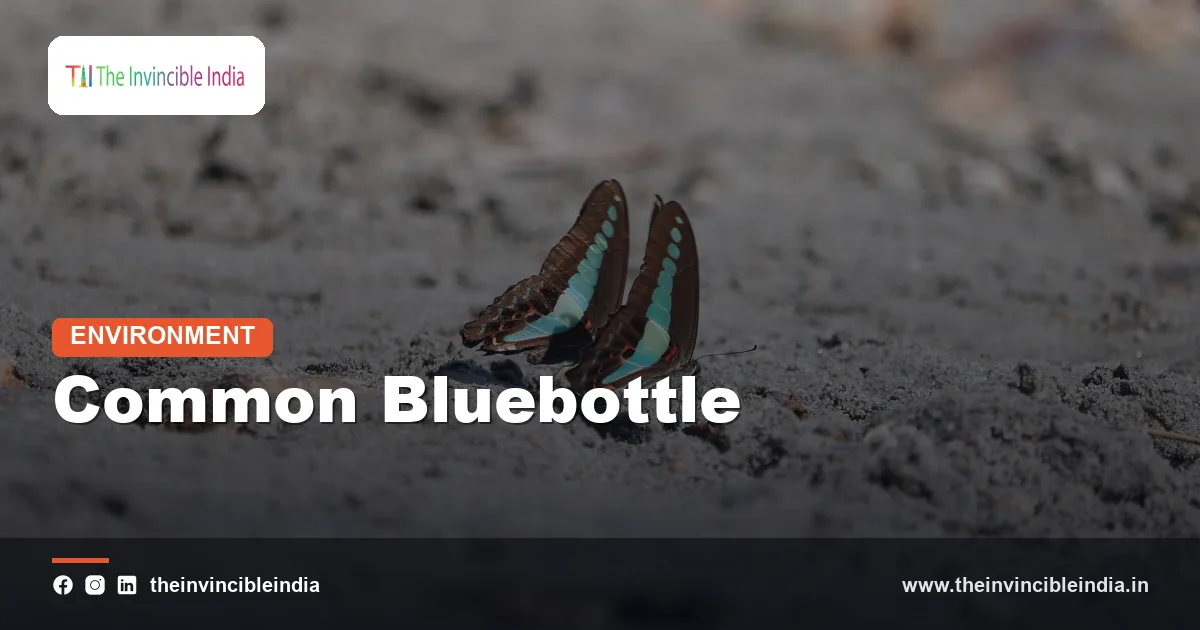
The common bluebottle (Graphium sarpedon) is a fast-flying, tailless swallowtail butterfly with black wings crossed by a band of bright blue-green cells, found across much of India from the Himalayan foothills to the Western Ghats, the northeast and the Andaman and Nicobar Islands. It is one of the most striking butterflies of Indian gardens and forest edges, and it is known for its darting flight and its habit of gathering at muddy puddles.
The common bluebottle belongs to the family Papilionidae, the swallowtails, although it has no tails on its hindwings. Its caterpillars feed on plants of the laurel family, including camphor and cinnamon trees. This explainer covers how to identify the common bluebottle, where it lives, how it breeds and how to watch it.
| Quick Facts | Common Bluebottle |
|---|---|
| Scientific name | Graphium sarpedon |
| Family | Papilionidae (swallowtails) |
| Wingspan | Roughly 7 to 9 centimetres |
| Appearance | Black wings with a band of blue-green translucent patches; no hindwing tails |
| Larval host plants | Laurel family (Lauraceae), including Cinnamomum, Litsea and Persea |
| Habitat | Forest edges, gardens, plantations, hill slopes and stream banks |
| Range | India, Sri Lanka, Southeast Asia, China, Japan and northern Australia |
| Behaviour | Very fast, darting flight; males mud-puddle in groups |
| Similar species | Common jay (Graphium doson), tailed jay (Graphium agamemnon) |
Key Takeaways
- The common bluebottle is a black swallowtail butterfly, scientifically named Graphium sarpedon, with a distinctive band of blue-green translucent cells across its wings.
- Common bluebottle caterpillars feed on plants of the laurel family, such as camphor, cinnamon and Litsea trees.
- The common bluebottle is a tailless swallowtail, so it lacks the long hindwing tails that most other swallowtails have.
- Male common bluebottles gather at damp sand and mud in large groups to take up minerals, a behaviour called mud-puddling.
- The common bluebottle ranges from India through Southeast Asia to Japan and Australia, and in Australia it is known as the blue triangle.
- The common bluebottle is widespread and not considered threatened, though it depends on healthy stands of laurel-family trees.
What Is the Common Bluebottle Butterfly?
The common bluebottle is a medium-sized swallowtail butterfly, named Graphium sarpedon, that is easily recognised by the band of luminous blue-green patches across its black wings. The swallowtails are the family Papilionidae, which includes India’s largest and showiest butterflies, such as the common mormon, the common rose and the southern birdwing.
Within the swallowtails, the common bluebottle belongs to the genus Graphium, a group of fast, strong fliers sometimes called swordtails, jays and bluebottles. Most Graphium species have blue, green or white markings on a dark background, and many have tails. The common bluebottle is an exception, as its hindwings are rounded and tailless.
The butterfly is common in many forested and semi-forested regions of India and is a frequent visitor to hill-station gardens. Its range is one of the largest of any swallowtail, reaching across tropical Asia and into the Pacific region.
How Can You Identify the Common Bluebottle?
You can identify the common bluebottle by the continuous band of pale blue-green cells that runs across the forewing and hindwing against a black or very dark brown background, together with its rapid, direct flight. In sunlight, the band appears to glow, and in flight it flashes as the wings move.
Upper side
The upper side of the common bluebottle is black with a bright blue-green band that runs from the front edge of the forewing down to the hindwing, where it tapers. The band is made of separate translucent patches that look like a row of glassy panes. A series of small pale spots may also run along the outer edge.
Underside
The underside of the common bluebottle is browner and shows the same blue band in a paler form, along with a row of crimson or reddish spots near the base of the hindwing. These red spots are a useful feature when the wings are closed. Common bluebottles often rest with the wings held half open.
Size and flight
- Size: wingspan of roughly seven to nine centimetres, which is medium-large for a swallowtail.
- Flight: very fast and darting, at heights from ground level to the tree canopy.
- Feeding posture: the butterfly keeps its wings fluttering while it takes nectar and seldom closes them completely.
Why Is It Called the Bluebottle?
The butterfly is called the bluebottle because of the bright, bottle-blue colour of the band across its wings. The name is a descriptive one and is shared by several butterfly species in Asia and the Pacific, so the full name common bluebottle is used for Graphium sarpedon.
In Australia the same species is known as the blue triangle or the common blue triangle, after the triangular shape of the blue patch there. These names refer to a single species that varies slightly in size and markings from region to region.
The blue-green colour of the band is unusual. Studies of this group of swallowtails have found that the colour comes largely from pigments related to bile pigments, rather than only from the microscopic wing structures that produce many other blue butterfly colours. This is one reason the colour stays vivid under many lighting conditions.
Where Is the Common Bluebottle Found in India?
The common bluebottle is found in the wetter and forested parts of India, including the Himalayan foothills, the northeast, the Western Ghats, the Eastern Ghats, parts of the peninsula and the Andaman and Nicobar Islands. It is much less common in the dry northwest.
Typical habitats include:
- Evergreen and moist deciduous forest edges and clearings.
- Hill-station gardens and tea, coffee and spice plantations, where laurel-family trees such as cinnamon grow.
- Stream banks, forest roads and shaded paths with damp sand.
- Urban gardens and parks near forest, particularly in the south and the northeast.
The butterfly is a lowland-to-mid-hill species and is found from sea level to moderate elevations, becoming scarcer higher up in the mountains. In southern India it is on the wing in most months, with peaks after the monsoon rains.
What Does the Common Bluebottle Eat?
The adult common bluebottle drinks flower nectar and mineral-rich moisture from mud, while its caterpillars eat the young leaves of laurel-family trees. The caterpillar’s food choice is narrow, but the adult is a more flexible feeder.
Caterpillar host plants
- Camphor tree (Cinnamomum camphora), a fragrant tree grown in gardens and plantations.
- Cinnamon (Cinnamomum verum), grown in the Western Ghats and in spice gardens.
- Indian bay leaf or tejpat (Cinnamomum tamala), common in Himalayan foothill forests.
- Litsea, Persea and Neolitsea species, which are forest and garden trees of the laurel family.
Adult food
Adult common bluebottles visit flowers such as lantana, ixora, jatropha and wild forest flowers, hovering with their wings in rapid motion instead of settling. They also come to rotting fruit on occasion.
What Is Mud-Puddling and Why Do Bluebottles Do It?
Mud-puddling is the behaviour of butterflies gathering at wet soil, sand or dung to drink fluid and take up salts and minerals, and common bluebottles are among the most dedicated puddlers in India. The behaviour is seen mainly in males.
Flower nectar contains sugar but very little sodium, so males seek minerals elsewhere. These minerals appear to be passed to the female during mating, supporting egg production and the next generation. Puddling groups of common bluebottles can include dozens of individuals, often mixed with jays, mormons, grass yellows and other swallowtails.
At a puddle the butterflies lower their abdomens to the wet ground and sometimes expel fluid. They are most wary when the sun is high but often become tolerant of slow, quiet observers. Forest paths near streams in the Western Ghats and the northeast are prime places for this sight.
What Is the Life Cycle of the Common Bluebottle?
The life cycle of the common bluebottle has four stages, namely egg, caterpillar, pupa and adult, and the whole cycle takes roughly five to seven weeks in warm weather. In tropical regions it can repeat several times a year.
| Stage | What it looks like | Approximate duration |
|---|---|---|
| Egg | Small, round, pale and smooth, laid singly on the tender new leaves of a laurel-family tree | A few days |
| Caterpillar | Green, smooth and plump with a humped front; hides on the upper surface of a leaf | Two to three weeks |
| Pupa | Green or brown, angular chrysalis held upright by a silk girdle and tail pad | Around two weeks |
| Adult | Black swallowtail with a blue-green band | Several weeks |
The female common bluebottle lays her eggs on the soft, young growth of the host tree because the caterpillars cannot chew old, tough foliage. The caterpillar is green and blends with the leaf, and like other swallowtail caterpillars it has a hidden, forked organ behind its head called an osmeterium, which it extends to give off a smell when disturbed.
The chrysalis is held against a twig or leaf, and its green or brown colour matches its surroundings. When the adult emerges, it expands and dries its wings before flying away. The first flights are often to nearby flowers.
How Is the Common Bluebottle Different From the Jays and Other Swallowtails?
The common bluebottle differs from the jays mainly in its tailless hindwings and its solid, glowing blue-green band, while the common jay and tailed jay have pale green spots and distinct tails. All three belong to the genus Graphium and are often confused in flight.
| Butterfly | Tails | Main marking | Host plants |
|---|---|---|---|
| Common bluebottle | None | Continuous blue-green band across both wings | Laurel family |
| Common jay | Short tail | Pale green patches in a broken series | Custard apple relatives (Annonaceae) |
| Tailed jay | Long tail | Rows of pale green spots | Annonaceae, such as custard apple and Polyalthia |
| Spot swordtail | Long, narrow tail | Black-and-white pattern with a row of spots | Annonaceae |
The common bluebottle also holds its wings differently when it feeds, keeping them in rapid vibration, while the jays more often hold them half open. When the butterfly is seen at a puddle, the shape and band make identification straightforward.
How Does the Common Bluebottle Fly and Defend Itself?
The common bluebottle flies with rapid, powerful wingbeats in a darting path that makes it one of the hardest Indian butterflies to follow, and this speed is its main defence as an adult. Its thorax carries strong flight muscles, and the butterfly can change direction suddenly, which helps it escape birds and other predators.
Males patrol forest paths and stream banks in search of females and often return to the same route repeatedly. They may defend a favoured puddle or flowering bush against other males by chasing them away. In the heat of the day they glide between sunlit and shaded patches, and they can cover long distances along a river or forest road.
The young stages rely on other defences. The egg and the small caterpillar are hard to see on the pale new leaf. The older caterpillar is green and smooth, and it rests on a silk pad on the upper surface of a leaf, where it matches the leaf colour. If a predator approaches, the caterpillar rears up its front end and may extend the orange or yellow osmeterium, which releases a sharp smell.
The chrysalis is a further example of camouflage. It is shaped and coloured like a broken twig or a curled leaf, depending on the surface to which it is attached.
Is the Common Bluebottle Rare or Protected?
The common bluebottle is not rare, and it is widespread across tropical Asia and the western Pacific. It adapts to plantations and gardens that contain laurel-family trees, which helps it persist near human settlements.
Several risks are worth noting:
- Clearing of forests and removal of laurel-family trees in hill regions.
- Pesticide spraying in plantations, which can kill caterpillars.
- Collection of butterflies for trade, which is prohibited for protected species in India under wildlife law.
Natural predators include birds, mantises, spiders and lizards. The butterfly’s speed and unpredictable flight help adults escape, while caterpillars rely on camouflage and the osmeterium for defence.
How Can You Watch and Photograph Common Bluebottles?
You can watch and photograph common bluebottles best at damp sandy patches along forest streams, where the males settle to drink, and at flowering shrubs such as lantana. Patience and a slow approach are the keys, because the butterfly is quick to take flight.
- Visit in the morning, when the butterflies are active and the light is soft.
- Stay low and move slowly, and let the butterflies settle again after any disturbance.
- Photograph the upper side when the butterfly is feeding, as its wings often stay slightly open.
- Do not touch or handle the butterfly, as the scales on the wings are easily damaged.
- Record the date and place for a citizen-science platform.
Planting for bluebottles
Gardeners in suitable regions can attract common bluebottles by planting laurel-family trees such as camphor or Litsea for the caterpillars, together with nectar plants like lantana and ixora. A bare, damp corner of sand kept moist in the dry season can encourage males to visit.
Bottom Line
The common bluebottle is a striking black swallowtail with a glowing blue-green band, widespread in the forests and gardens of India, and a close partner of laurel-family trees. It is easy to enjoy at forest puddles and flowering shrubs, and its survival depends on keeping host trees and clean streams.
Frequently Asked Questions
What is the common bluebottle butterfly?
The common bluebottle is a black swallowtail butterfly, scientifically Graphium sarpedon, with a band of blue-green translucent patches across its wings. It is found across much of India and tropical Asia. It has no tails on its hindwings and flies very fast.
What do common bluebottle caterpillars eat?
Common bluebottle caterpillars eat the young leaves of laurel-family trees. Typical hosts include camphor, cinnamon, Indian bay leaf, Litsea and Persea. The female lays her eggs on tender new growth.
Is the common bluebottle a swallowtail?
Yes, the common bluebottle is a swallowtail in the family Papilionidae, even though it has no tails. It belongs to the genus Graphium with the jays and swordtails. Its caterpillar also has an osmeterium, a defence organ typical of swallowtails.
Where can I see the common bluebottle in India?
You can see the common bluebottle in forest edges, hill gardens, plantations and along forest streams in the Himalayan foothills, the northeast, the Western Ghats and the Andamans. It is rare in the dry northwest. Damp sandy spots near water are good places to watch males.
Why do bluebottle butterflies gather at mud?
Bluebottle butterflies gather at mud to drink water and take up salts and minerals that are scarce in nectar. This behaviour, called mud-puddling, is mostly done by males. The minerals may be passed to females during mating.
Is the common bluebottle butterfly endangered?
No, the common bluebottle is not endangered. It is widespread across India and tropical Asia and tolerates gardens and plantations. Local numbers can fall where forests are cleared or pesticides are used heavily.
{“@context”:”https://schema.org”,”@graph”:[{“@type”:”FAQPage”,”mainEntity”:[{“@type”:”Question”,”name”:”What is the common bluebottle butterfly?”,”acceptedAnswer”:{“@type”:”Answer”,”text”:”The common bluebottle is a black swallowtail butterfly, scientifically Graphium sarpedon, with a band of blue-green translucent patches across its wings. It is found across much of India and tropical Asia. It has no tails on its hindwings and flies very fast.”}},{“@type”:”Question”,”name”:”What do common bluebottle caterpillars eat?”,”acceptedAnswer”:{“@type”:”Answer”,”text”:”Common bluebottle caterpillars eat the young leaves of laurel-family trees. Typical hosts include camphor, cinnamon, Indian bay leaf, Litsea and Persea. The female lays her eggs on tender new growth.”}},{“@type”:”Question”,”name”:”Is the common bluebottle a swallowtail?”,”acceptedAnswer”:{“@type”:”Answer”,”text”:”Yes, the common bluebottle is a swallowtail in the family Papilionidae, even though it has no tails. It belongs to the genus Graphium with the jays and swordtails. Its caterpillar also has an osmeterium, a defence organ typical of swallowtails.”}},{“@type”:”Question”,”name”:”Where can I see the common bluebottle in India?”,”acceptedAnswer”:{“@type”:”Answer”,”text”:”You can see the common bluebottle in forest edges, hill gardens, plantations and along forest streams in the Himalayan foothills, the northeast, the Western Ghats and the Andamans. It is rare in the dry northwest. Damp sandy spots near water are good places to watch males.”}},{“@type”:”Question”,”name”:”Why do bluebottle butterflies gather at mud?”,”acceptedAnswer”:{“@type”:”Answer”,”text”:”Bluebottle butterflies gather at mud to drink water and take up salts and minerals that are scarce in nectar. This behaviour, called mud-puddling, is mostly done by males. The minerals may be passed to females during mating.”}},{“@type”:”Question”,”name”:”Is the common bluebottle butterfly endangered?”,”acceptedAnswer”:{“@type”:”Answer”,”text”:”No, the common bluebottle is not endangered. It is widespread across India and tropical Asia and tolerates gardens and plantations. Local numbers can fall where forests are cleared or pesticides are used heavily.”}}]}]}


