

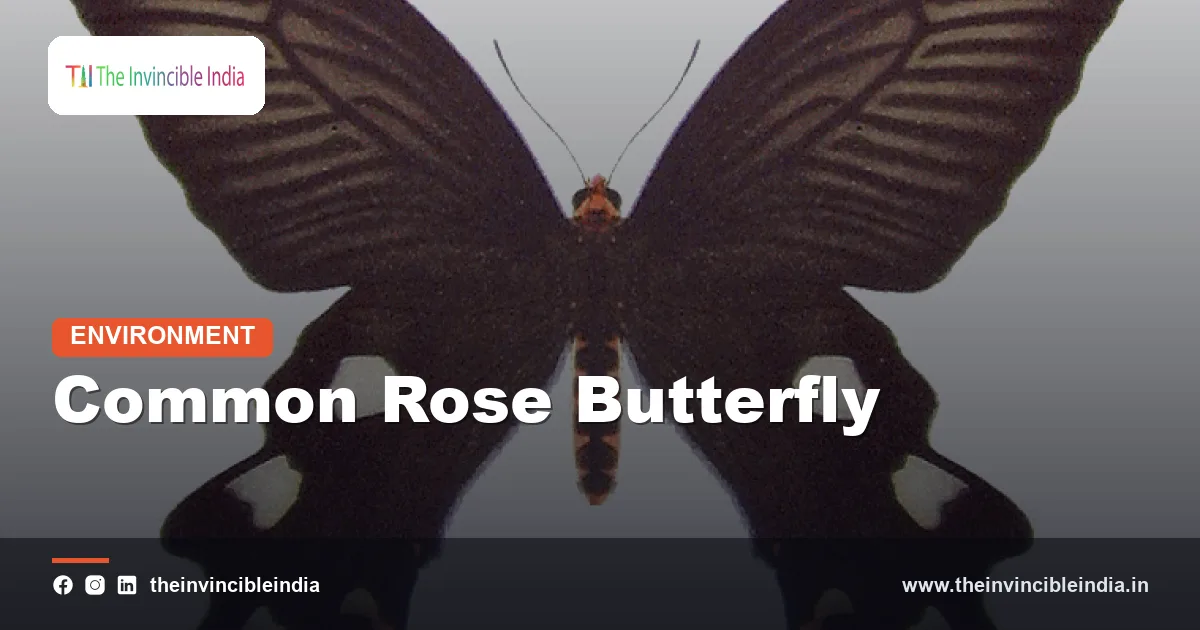
The common rose (Pachliopta aristolochiae) is a black swallowtail butterfly with white patches on the hindwings and a bright red body, widely seen in Indian gardens, and it is toxic to predators because its caterpillars feed on poisonous Aristolochia plants. Its slow, fluttering flight and its warning colours make it one of the most recognisable garden butterflies in the country.
The common rose is also important in ecology, because its unpalatable reputation is copied by other butterflies that gain protection by looking like it. This explainer covers how to identify the common rose, where it lives, its life cycle, how its toxins work, which butterflies mimic it, and how gardeners can support it.
| Attribute | Detail |
|---|---|
| Common name | Common rose |
| Scientific name | Pachliopta aristolochiae |
| Family | Papilionidae (swallowtails) |
| Wingspan | Roughly 8 to 10 cm |
| Range | South Asia, including most of India and Sri Lanka, extending into Southeast Asia |
| Caterpillar food plants | Aristolochia species, known as birthworts |
| Defence | Toxins from food plants and warning colours (aposematism) |
| Habitat | Gardens, scrub, forest edges, farmland and light woodland |
| Conservation status | Common and widespread, not considered threatened |
Key Takeaways
- The common rose is a black swallowtail butterfly with a red body, white patches on the hindwings and a wingspan of roughly 8 to 10 cm.
- The common rose belongs to the swallowtail family Papilionidae and is widespread across India in gardens, scrub and forest edges.
- The common rose is toxic to predators because its caterpillars eat Aristolochia plants, which contain chemicals called aristolochic acids.
- The common rose is a model for Batesian mimicry, and the female common Mormon in its “stichius” form copies its colours to deter predators.
- The common rose lays eggs singly on Aristolochia plants, and its dark caterpillars carry fleshy red filaments along their bodies.
- The common rose is common and not threatened, but it depends on its host plants, so removing wild Aristolochia vines can reduce its numbers locally.
What is the common rose butterfly?
The common rose is a medium-sized swallowtail butterfly of South and Southeast Asia, named for the rose-red colour of its body and the crimson spots on its wings. It belongs to the family Papilionidae, the swallowtails, though unlike many of its relatives it has no long tails on its hindwings.
The genus Pachliopta is often called the roses. India has several members, such as the crimson rose, but the common rose is the most frequently seen. Its Latin species name, aristolochiae, points directly to its caterpillar food plant, the genus Aristolochia.
The common rose is a conspicuous and easily observed species. It flies slowly and steadily rather than darting, which is a feature typical of butterflies that are protected by chemical defences and do not need to flee quickly.
How can you identify the common rose?
The common rose can be identified by its black forewings with pale streaks, hindwings with a white central patch ringed by red spots, and a red head, collar and abdomen. The combination of black, white and crimson is distinctive.
- Forewings: Mostly velvety black, with pale grey or whitish streaks running along the veins.
- Hindwings: A cluster of white areas in the middle, with red spots along the lower margin.
- Body: Bright red on the head, collar and abdomen, a vivid warning signal.
- Tails: The hindwings are tailless or have only a blunt, rounded edge.
- Flight: Slow, gliding and fluttering, usually low among bushes and flowers.
Males and females are similar, though females are generally a little larger and have a fuller body. The crimson rose is similar but is more heavily marked with crimson and has a broader red colour on its wings, and the relative amount of white versus red helps to separate the two.
Where is the common rose found in India?
The common rose is found throughout most of India, from the plains and coasts to forests and hill slopes, as well as in Sri Lanka and parts of Southeast Asia. It is common in many parts of the country and rarely absent where its caterpillar food plants grow.
It occurs in gardens, urban parks, village edges, scrub jungle, dry and moist deciduous forest and the edges of evergreen forest. Because it is found around cities, it is among the butterflies that city residents notice most.
The butterfly is on the wing for much of the year in warm areas, and it tends to be most numerous during and after the monsoon, when fresh growth appears on its host plants. Numbers vary from year to year, and regional abundance depends on local weather and the availability of host plants.
What does the common rose butterfly eat?
The adult common rose drinks nectar from flowers, while its caterpillars eat the leaves of Aristolochia plants. Different life stages therefore need different resources.
Adults visit many garden and wild flowers, hovering or fluttering their wings while feeding. Popular nectar plants include lantana, ixora, zinnia, cosmos, marigold and many wild flowers. Adults may also be seen at damp ground, where males take up minerals in a habit known as mud-puddling.
Caterpillars feed on Indian birthwort (Aristolochia indica) and related climbers. These plants are distasteful or poisonous to most herbivores, but swallowtails in the roses group have evolved the ability to eat them and store the toxins in their bodies.
What is the life cycle of the common rose?
The common rose goes through four stages: egg, caterpillar, pupa and adult, and the whole cycle usually takes several weeks in warm weather. Like all butterflies, it undergoes complete metamorphosis.
| Stage | Description |
|---|---|
| Egg | A small, round, reddish-brown egg laid singly on a leaf or tendril of an Aristolochia plant |
| Caterpillar | Dark brownish-red body with fleshy filaments and whitish bands; feeds on host plant leaves |
| Pupa | A chrysalis attached to a twig or stem by a silk girdle, with a form that blends with the plant |
| Adult | Black, white and red butterfly that feeds on nectar and mates |
The female lays eggs on the host plant, often under leaves or on tender shoots. The caterpillar eats the egg shell first, then the leaves, moulting several times as it grows. Its fleshy filaments, which look like soft spikes, are a warning to predators rather than a real weapon.
Like other swallowtail caterpillars, the larva can extend a forked, smelly organ called an osmeterium behind its head when disturbed. The pupa is held in a head-up position by a silk girdle. After a period of development, the adult emerges and expands its wings to dry before its first flight.
Why is the common rose toxic to predators?
The common rose is toxic to predators because its caterpillars take in poisonous aristolochic acids from the Aristolochia plants they eat, and these substances remain in the caterpillar, pupa and adult. Birds, lizards and other predators that try it learn to avoid it.
This protective strategy is called aposematism, meaning a bright warning colour that advertises unpalatability. The red body and bold wing pattern are easy for predators to remember. A bird that tastes a rose once and finds it unpleasant is likely to avoid similar-looking butterflies in future.
The toxins are not made by the butterfly itself but are acquired from its food. This is a common pattern in nature: some insects sequester plant chemicals to defend themselves. The same chemicals can be harmful to people, and aristolochic acids are associated with kidney damage in herbal products, so the plants should not be consumed.
Which butterflies mimic the common rose?
The best known mimic of the common rose is the female common Mormon (Papilio polytes) in its form “stichius”, which copies the black, white and red pattern even though it is not poisonous itself. Several other butterflies in the region copy rose-like patterns to a lesser degree.
This kind of copying is called Batesian mimicry, named after the naturalist Henry Walter Bates, who described how a harmless species can gain protection by resembling a harmful one. The copying works only when the toxic model is common enough that predators have learned to avoid it.
The common Mormon is an interesting case because its females come in more than one form. One form looks like the male, while others resemble the unpalatable roses. The form depends on a genetic switch that has been studied by scientists as an example of how mimicry evolves. For the observer, the practical lesson is that a butterfly that looks like a rose may be a mimic, so checking the tail shape and body colour helps.
How can gardeners attract the common rose?
Gardeners can attract the common rose by growing nectar flowers for the adults and, where possible, a native Aristolochia vine as a food plant for the caterpillars. Planting both is the most reliable way to keep the butterfly in a garden.
- Grow nectar plants such as lantana, ixora, zinnia and cosmos in sunny spots.
- Plant a native Aristolochia vine in a corner, since it is the larval host.
- Avoid spraying pesticides, which kill caterpillars and adult butterflies alike.
- Accept some leaf damage, because caterpillars feeding on the host plant are normal.
- Leave a shallow, damp patch of soil for mud-puddling.
Butterfly gardens in several Indian cities include birthwort for this purpose. Care is needed because the plant is poisonous to humans and pets if eaten, so it should be placed where children and animals are unlikely to chew it.
Is the common rose threatened?
The common rose is not considered threatened, because it is widespread, adaptable and common in a variety of habitats. It is therefore often used as an everyday example of a successful butterfly in discussions of urban biodiversity.
Its main long-term concern is the loss of its host plants. Aristolochia vines are often removed as weeds or lost when scrub is cleared, and without them the butterfly cannot breed. Pesticide use and habitat clearance also reduce local numbers.
Butterflies as a group are sensitive to environmental change, and counts of common species like the common rose help volunteers and researchers track trends. Citizen science platforms, butterfly walks and local checklists across India record such sightings.
What role does the common rose play in the ecosystem?
The common rose plays several roles in the ecosystem: it pollinates flowers, serves as a model species in mimicry, and acts as food for a few predators that can tolerate its toxins. It is a small but useful link in garden and woodland food webs.
As an adult, the common rose carries pollen on its legs and wings as it moves between flowers. It is not as efficient a pollinator as bees, but flowers with deep tubes or brightly coloured clusters, such as lantana and ixora, benefit from its visits.
The butterfly also shapes the behaviour of predators. By being toxic and highly visible, it teaches birds, lizards and spiders to avoid red-and-black patterns, which indirectly helps harmless lookalikes. Because the species is easy to see, it is also valuable in education, and many schools and nature clubs use it as a first example when teaching children about metamorphosis, food plants and mimicry.
How does the common rose compare with other Indian swallowtails?
The common rose differs from other Indian swallowtails mainly in its red body, lack of long tails and slow flight. Many other swallowtails are larger, have tails and fly more quickly.
- Common Mormon: Black with white or red markings in females, tailless in several forms, with rapid flight.
- Common Mime: Black with white streaks, which can look like a tiger or crow butterfly.
- Lime butterfly: Patterned yellow and black, with a lemon-feeding caterpillar.
- Blue Mormon: Large, velvety black with a blue-green sheen, and the state butterfly of Maharashtra.
- Common Rose: Black with white hindwing patches and a red body, and a slow, fluttering flight.
Comparing wing pattern, body colour and flight speed makes identification easier, and photographing the butterfly from above and from the side can reveal features that are otherwise missed.
Bottom Line
The common rose is a black swallowtail with white hindwing patches and a red body, made toxic by the Aristolochia plants its caterpillars eat. It is common across India, serves as a model for mimics such as the female common Mormon, and can be supported in gardens with nectar flowers and a native host vine.
Frequently Asked Questions
What is the common rose butterfly?
The common rose is a black swallowtail butterfly with white hindwing patches and a red body, found across India. Its scientific name is Pachliopta aristolochiae. It is common in gardens and is protected from predators by its toxins.
Is the common rose butterfly poisonous?
Yes, the common rose is toxic to many predators. Its caterpillars eat Aristolochia plants and store the plant’s aristolochic acids in their bodies. The red body and bold pattern warn birds and lizards to avoid it.
What is the host plant of the common rose?
The host plant of the common rose is Aristolochia, a genus of climbers known as birthworts. In India the Indian birthwort (Aristolochia indica) is a common example. The female lays eggs singly on the leaves and shoots of such plants.
Which butterfly mimics the common rose?
The female common Mormon in its stichius form mimics the common rose. It copies the black, white and red pattern of the rose to gain protection, although it is not poisonous itself. This is an example of Batesian mimicry.
How is the common rose different from the crimson rose?
The common rose has a clear white patch on the hindwing, while the crimson rose is more heavily marked with crimson. Both have red bodies and feed on Aristolochia as caterpillars. The crimson rose is generally less widespread than the common rose.
How can I attract common rose butterflies to my garden?
You can attract common rose butterflies by planting nectar flowers such as lantana, ixora and zinnia, and by growing a native Aristolochia vine for the caterpillars. Avoiding pesticides is essential. The host plant is poisonous to people and pets, so place it carefully.
{“@context”:”https://schema.org”,”@graph”:[{“@type”:”FAQPage”,”mainEntity”:[{“@type”:”Question”,”name”:”What is the common rose butterfly?”,”acceptedAnswer”:{“@type”:”Answer”,”text”:”The common rose is a black swallowtail butterfly with white hindwing patches and a red body, found across India. Its scientific name is Pachliopta aristolochiae. It is common in gardens and is protected from predators by its toxins.”}},{“@type”:”Question”,”name”:”Is the common rose butterfly poisonous?”,”acceptedAnswer”:{“@type”:”Answer”,”text”:”Yes, the common rose is toxic to many predators. Its caterpillars eat Aristolochia plants and store the plant’s aristolochic acids in their bodies. The red body and bold pattern warn birds and lizards to avoid it.”}},{“@type”:”Question”,”name”:”What is the host plant of the common rose?”,”acceptedAnswer”:{“@type”:”Answer”,”text”:”The host plant of the common rose is Aristolochia, a genus of climbers known as birthworts. In India the Indian birthwort (Aristolochia indica) is a common example. The female lays eggs singly on the leaves and shoots of such plants.”}},{“@type”:”Question”,”name”:”Which butterfly mimics the common rose?”,”acceptedAnswer”:{“@type”:”Answer”,”text”:”The female common Mormon in its stichius form mimics the common rose. It copies the black, white and red pattern of the rose to gain protection, although it is not poisonous itself. This is an example of Batesian mimicry.”}},{“@type”:”Question”,”name”:”How is the common rose different from the crimson rose?”,”acceptedAnswer”:{“@type”:”Answer”,”text”:”The common rose has a clear white patch on the hindwing, while the crimson rose is more heavily marked with crimson. Both have red bodies and feed on Aristolochia as caterpillars. The crimson rose is generally less widespread than the common rose.”}},{“@type”:”Question”,”name”:”How can I attract common rose butterflies to my garden?”,”acceptedAnswer”:{“@type”:”Answer”,”text”:”You can attract common rose butterflies by planting nectar flowers such as lantana, ixora and zinnia, and by growing a native Aristolochia vine for the caterpillars. Avoiding pesticides is essential. The host plant is poisonous to people and pets, so place it carefully.”}}]}]}


