

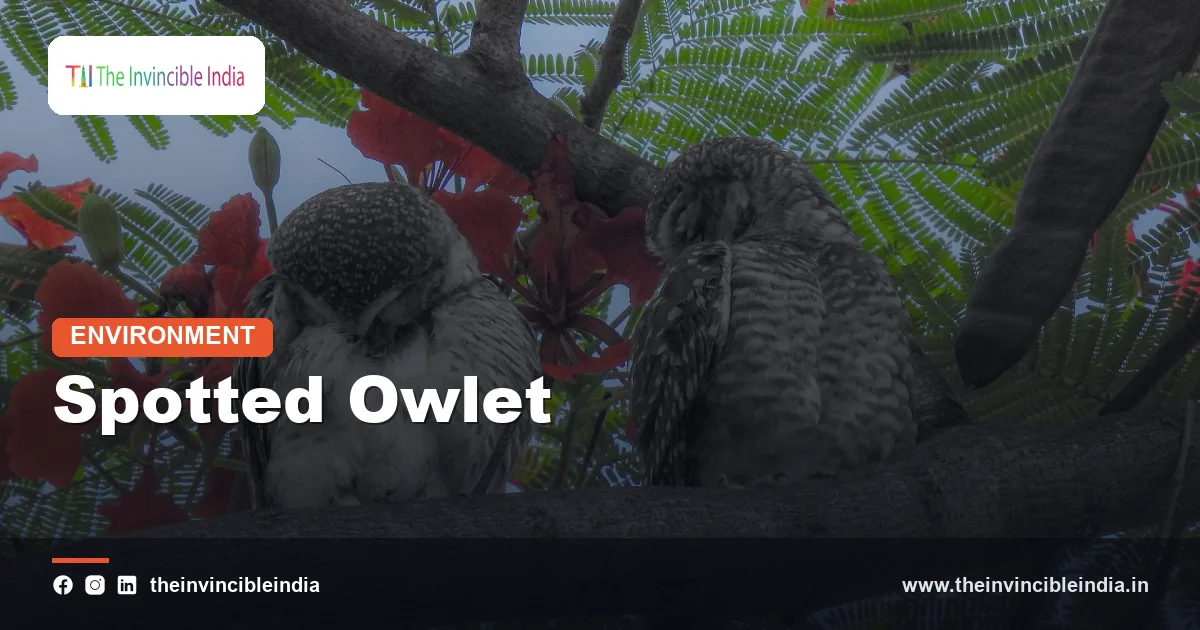
The spotted owlet (Athene brama) is a small, round-headed owl with a grey-brown body speckled with white spots, found across the Indian subcontinent and parts of Southeast Asia, and it is the owl most Indians are likely to see in towns and villages. Unlike many owls, it often sits in plain view in daylight, peering out from a tree hole, an old building or a roof tile.
The spotted owlet is a hardy, adaptable bird that lives close to people, hunts insects and rodents, and is known for its noisy, chattering calls at dusk. This explainer covers how to identify the spotted owlet, where it lives, what it eats, how it breeds, what it sounds like, and how it differs from other small Indian owls.
| Attribute | Detail |
|---|---|
| Common name | Spotted owlet |
| Scientific name | Athene brama |
| Family | Strigidae (typical owls) |
| Size | Roughly 20 to 21 cm long, a small, stocky owl without ear tufts |
| Range | Across the Indian subcontinent and eastward into parts of mainland Southeast Asia |
| Habitat | Farmland, villages, towns, old buildings, orchards and open woodland |
| Diet | Insects, small rodents, lizards, small birds and other small animals |
| Conservation status | Listed as Least Concern by the IUCN |
| Activity | Mainly crepuscular and nocturnal, but often seen resting by day |
Key Takeaways
- The spotted owlet is a small owl, roughly 20 to 21 cm long, with a grey-brown body covered in white spots and a round head without ear tufts.
- The spotted owlet lives in farmland, villages and towns across the Indian subcontinent and is one of the few owls that commonly roosts in the open by day.
- The spotted owlet eats insects, rodents, lizards and small birds, and it helps control crop and household pests.
- The spotted owlet nests in tree holes and cavities in old buildings, laying a few white eggs, usually in the cooler and dry months of the year.
- The spotted owlet is noisy at dusk, giving harsh chattering and screeching duets that often reveal its presence.
- The IUCN lists the spotted owlet as Least Concern, and owls in India are protected by wildlife law despite persistent superstitions about them.
What is the spotted owlet?
The spotted owlet is a small species of owl in the genus Athene, within the family Strigidae, which contains the typical owls. Its scientific name is Athene brama, and the genus name recalls Athena, the Greek goddess associated with wisdom and with owls.
The spotted owlet belongs to the same genus as the little owl of Europe and Asia, and to the forest owlet, a rare Central Indian species that was rediscovered in 1997 after being unrecorded for more than a century. These relatives share the same compact shape, flat-looking head and bold, glaring eyes.
Like other owls, the spotted owlet is a bird of prey that hunts mainly at low light. It has forward-facing eyes, a hooked bill, sharp talons and very soft feathers that make its flight nearly silent. It is a predator of small animals rather than a scavenger.
How can you identify a spotted owlet?
A spotted owlet can be identified by its small size, round head without ear tufts, pale yellow eyes and grey-brown plumage heavily spotted with white. These features distinguish it from larger owls such as the barn owl or the spotted wood owl.
- Head: The head is round and flat-topped, with a pale whitish eyebrow and a broad whitish collar on the hind neck.
- Eyes: The eyes are bright yellow, with dark rims that give the bird an intense stare.
- Body: The back and wings are earthy grey-brown with numerous white spots. The underparts are whitish with brown streaks and bars.
- Tail: The tail is short and barred with pale bands.
- Posture: The bird bobs and swivels its head when disturbed, a behaviour many viewers find comical.
The sexes look alike, and young birds are slightly fluffier and duller. When alarmed the owlet may narrow its body, bob its head and peer fixedly at the intruder, then fly off with an undulating flight to another perch.
Where does the spotted owlet live in India?
The spotted owlet lives across most of India in open, human-influenced habitats, from villages and farmland to the edges of large cities. It is largely a resident bird that stays in the same area throughout the year.
Its preferred places include groves of old trees, mango and neem orchards, avenues of roadside trees, temple compounds, ruined forts, colonial-era buildings, and farmhouses. In cities it uses holes in old walls, gaps beneath eaves and spaces in trees such as peepal and banyan.
The spotted owlet generally avoids dense, closed forest and very dry desert. Its absence in a locality is usually due to the lack of nest cavities rather than the lack of food. Exact population figures are unavailable, but the species is described as common and widespread across its range.
What does the spotted owlet eat?
The spotted owlet eats mainly insects and small vertebrates, including beetles, grasshoppers, crickets, moths, mice, lizards, geckos and small birds. It hunts by watching from a perch and dropping on prey it spots on the ground or in the air.
Insects form a large share of the diet, particularly in the monsoon when flying termites and beetles are abundant under street lights. The bird often hunts around lamps, where insects gather in numbers, and it can be seen swooping from an electric wire or a branch to snatch a moth.
The owlet also takes rats and mice, which makes it valuable to farmers and to households living near fields and granaries. Like all owls, it swallows prey whole or in large pieces and later coughs up an indigestible pellet of fur, bones and insect parts. Researchers study these pellets to learn what the owl has been eating.
How does the spotted owlet breed?
The spotted owlet breeds in cavities and usually lays three to five white, rounded eggs in a hole lined with little more than a few feathers or bits of debris. In much of India breeding takes place in the cooler and drier months, roughly from winter into early spring, though timing varies by region.
Nest sites include natural tree holes, holes in old walls, gaps among roof tiles, hollow pipes and sometimes nest boxes. Pairs often use the same cavity year after year, and several pairs may nest close together when good holes are available.
The female incubates the eggs for a few weeks while the male brings food. After hatching, both parents hunt for the chicks, and the young fledge after about a month. Fledglings may stay near the nest for some time and are often seen sitting side by side on a branch while begging for food.
What sounds does the spotted owlet make?
The spotted owlet makes harsh, chattering calls, often described as a series of squeaky “chirurr-chirurr” notes that build into a loud, scolding duet. Pairs frequently call together at dusk and before dawn, sometimes with several birds joining.
The calls serve to defend a territory, keep a pair in touch and warn rivals. Because the calls are loud and unmusical, they are often noticed by people who hear them at night near houses and trees. The owlet is far more vocal than many large owls, which often give deep hoots.
Listening at sunset is one of the best ways to find the bird. Once the calling begins, the owlets can often be traced to a nearby tree hole or old roof, where one or two birds sit looking out.
Why do spotted owlets appear in the daytime?
Spotted owlets appear in the daytime because they are active at low light and do not need complete darkness, and they often roost in view near their nest hole. The bird is described as crepuscular, meaning most active at dawn and dusk, but it is also partly active by night and sometimes by day.
Other small birds may mob an owlet found in daylight. Crows, mynas and babblers often gather and scold it loudly, because owls are predators of small birds. Birdwatchers can sometimes find a hidden owlet by following such mobbing behaviour.
Sunning is another daytime habit. The owlet may sit at a hole entrance on a cool morning, warming itself. A bird seen by day is not necessarily sick or injured; if it looks alert and perches upright, it is normally just resting, and it should be left alone.
How does the spotted owlet differ from other small Indian owls?
The spotted owlet differs from other small Indian owls mainly in its white-spotted back, plain pale-yellow eyes and lack of strong barring on the back. Several similar owls share its range, so the details matter.
| Owl | Key features | Typical habitat |
|---|---|---|
| Spotted owlet | Grey-brown with white spots; pale collar; no ear tufts | Towns, farmland, villages |
| Jungle owlet | Barred brown back and breast; more forest-loving | Forests and wooded hills |
| Forest owlet | Rare; plain brown with thick bars; limited to parts of Central India | Dry deciduous forest |
| Barn owl | Pale heart-shaped face; much larger; golden-buff and white | Barns, buildings, fields |
| Indian scops owl | Has small ear tufts; cryptic bark-like plumage | Wooded areas |
The easiest rule is to look for open surroundings and a spotted back. If the owl is small, spotted and sitting on an old building in a village or town, it is almost certainly a spotted owlet.
Why are owls surrounded by superstition in India?
Owls are surrounded by superstition in India because their nocturnal habits, silent flight and eerie calls have led to folk beliefs that link them with misfortune or with magic. These beliefs are not supported by evidence, but they have real consequences for the birds.
In some regions owls are viewed as omens of death, while in other traditions they are associated with wealth, as the goddess Lakshmi is traditionally depicted with an owl as her vehicle. This mixture of fear and reverence has meant that owls are sometimes captured, killed or trafficked for use in rituals and black magic.
Wildlife groups and forest departments have campaigned against such practices, especially around festivals when demand rises. India’s wildlife protection law covers owls, and capturing, keeping or trading them is illegal. In truth, the spotted owlet is a harmless neighbour that eats rats and insects.
How can people help the spotted owlet?
People can help the spotted owlet by keeping old trees, leaving suitable cavities undisturbed, avoiding rodenticides and not harassing roosting birds. Each of these steps protects nest sites or the owl’s food supply.
- Retain old trees with natural holes, even in urban areas.
- Avoid sealing small gaps in old buildings during the breeding season.
- Use traps or proofing rather than poison to control rats, since poisoned rodents can kill owls that eat them.
- Offer wooden nest boxes in orchards and large gardens where natural holes are scarce.
- Discourage people from capturing or disturbing owls and report illegal trade to forest officials.
Rodenticide use is one of the more serious hidden threats to owls worldwide, because poisoned mice are slow to die and easy to catch. Reducing such poisons helps owls and other predators that keep rodent numbers in check.
Bottom Line
The spotted owlet is a small, white-spotted, round-headed owl that lives close to people across India, nests in tree holes and old buildings, and controls rodents and insects. It is common, noisy and often visible by day, and it deserves protection rather than fear.
Frequently Asked Questions
Is the spotted owlet common in India?
Yes, the spotted owlet is one of the most common and widespread owls in India. It lives in villages, farmland, orchards and towns across most of the country. The IUCN lists it as Least Concern.
Is the spotted owlet active in the day?
The spotted owlet is mainly active at dusk, dawn and night, but it is often seen resting or sunning in the daytime. A bird sitting at a hole by day is usually healthy. It should be left undisturbed, since mobbing by crows can already stress it.
What does the spotted owlet eat?
The spotted owlet eats mostly insects, along with small rodents, lizards, small birds and other small animals. It hunts from a perch and often works around street lights where insects gather. Its diet makes it useful for pest control.
Are spotted owlets harmful or bad luck?
No, the spotted owlet is harmless to people and is not a bad omen. Beliefs that link owls with misfortune are folk superstitions with no scientific basis. The bird eats rats and insects, and it benefits farmers and householders.
Where does the spotted owlet nest?
The spotted owlet nests in cavities such as tree holes, holes in old walls and gaps under roof tiles. The female usually lays three to five white eggs, often during the cooler months. Pairs commonly reuse the same cavity in later years.
Are owls protected by law in India?
Yes, owls, including the spotted owlet, are protected under India’s Wildlife (Protection) Act, 1972. Capturing, keeping, killing or trading owls is illegal, and offenders can face penalties. People who see suspected trade in owls can report it to the forest department.
{“@context”:”https://schema.org”,”@graph”:[{“@type”:”FAQPage”,”mainEntity”:[{“@type”:”Question”,”name”:”Is the spotted owlet common in India?”,”acceptedAnswer”:{“@type”:”Answer”,”text”:”Yes, the spotted owlet is one of the most common and widespread owls in India. It lives in villages, farmland, orchards and towns across most of the country. The IUCN lists it as Least Concern.”}},{“@type”:”Question”,”name”:”Is the spotted owlet active in the day?”,”acceptedAnswer”:{“@type”:”Answer”,”text”:”The spotted owlet is mainly active at dusk, dawn and night, but it is often seen resting or sunning in the daytime. A bird sitting at a hole by day is usually healthy. It should be left undisturbed, since mobbing by crows can already stress it.”}},{“@type”:”Question”,”name”:”What does the spotted owlet eat?”,”acceptedAnswer”:{“@type”:”Answer”,”text”:”The spotted owlet eats mostly insects, along with small rodents, lizards, small birds and other small animals. It hunts from a perch and often works around street lights where insects gather. Its diet makes it useful for pest control.”}},{“@type”:”Question”,”name”:”Are spotted owlets harmful or bad luck?”,”acceptedAnswer”:{“@type”:”Answer”,”text”:”No, the spotted owlet is harmless to people and is not a bad omen. Beliefs that link owls with misfortune are folk superstitions with no scientific basis. The bird eats rats and insects, and it benefits farmers and householders.”}},{“@type”:”Question”,”name”:”Where does the spotted owlet nest?”,”acceptedAnswer”:{“@type”:”Answer”,”text”:”The spotted owlet nests in cavities such as tree holes, holes in old walls and gaps under roof tiles. The female usually lays three to five white eggs, often during the cooler months. Pairs commonly reuse the same cavity in later years.”}},{“@type”:”Question”,”name”:”Are owls protected by law in India?”,”acceptedAnswer”:{“@type”:”Answer”,”text”:”Yes, owls, including the spotted owlet, are protected under India’s Wildlife (Protection) Act, 1972. Capturing, keeping, killing or trading owls is illegal, and offenders can face penalties. People who see suspected trade in owls can report it to the forest department.”}}]}]}


