

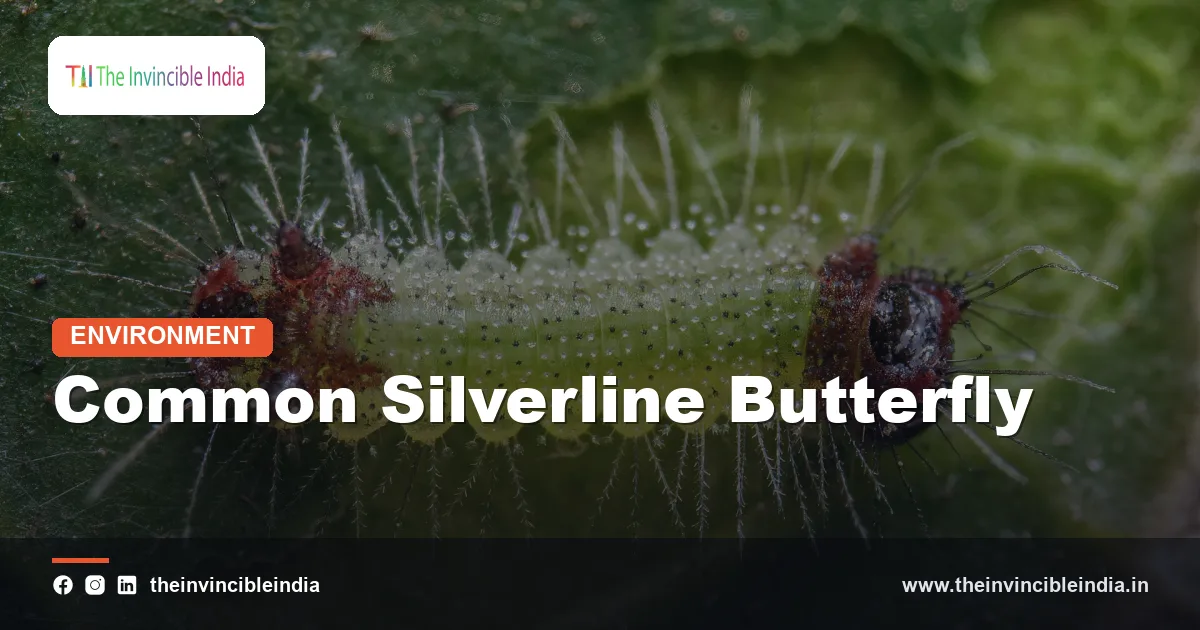
The common silverline (Spindasis vulcanus) is a small orange-and-brown lycaenid butterfly of Indian scrub, gardens and light forest, named for the silver-edged dark streaks on the underside of its wings and recognised by the pair of tiny tails on its hindwings. It belongs to the family Lycaenidae and is found across much of peninsular India and beyond, wherever sunny, bushy country offers flowers and woody host plants.
The common silverline is easy to overlook because it is small and quick, but it rewards a closer look. Its false-head trick, its habit of wiggling its hindwings and the close partnership between its caterpillars and ants make it one of the more interesting small butterflies that an Indian observer can meet on an ordinary walk.
| Quick Fact | Detail |
|---|---|
| Common name | Common silverline |
| Scientific name | Spindasis vulcanus (earlier placed in the genus Cigaritis) |
| Family | Lycaenidae (gossamer-winged butterflies), subfamily Theclinae |
| Wingspan | Roughly 25 to 35 mm |
| Host plants | A range of trees and shrubs; caterpillars feed on buds, flowers and young shoots |
| Range and habitat in India | Peninsular India and the Western Ghats, extending to other regions; dry scrub, gardens, open woodland and forest edges |
| Flight season and broods | On the wing for much of the year, with several broods and peaks around and after the monsoon |
| Notable features | Silver-edged streaks on the underside, two tails and a false head on each hindwing, ant-attended caterpillars |
Key Takeaways
- The common silverline is a small lycaenid butterfly, Spindasis vulcanus, with a wingspan of roughly 25 to 35 mm.
- The common silverline gets its name from the silver-edged dark streaks that run across the pale underside of its wings.
- The common silverline has two tails on each hindwing, one long and one short, and an orange spot that together form a false head.
- Caterpillars of the common silverline are tended by ants, which protect them in exchange for sugary secretions.
- The common silverline lives in dry scrub, gardens and forest edges across much of India and flies through most of the year.
- The common silverline is harmless to people and is not considered an agricultural pest.
What does the common silverline look like?
The common silverline is a small butterfly with a bright orange or reddish-orange upperside and a pale, streaked underside, and it is most easily recognised from below. Most people see it perched with its wings folded upright, which shows the underside pattern that gives the butterfly its name.
The underside is a soft brownish-orange or pale ochre ground colour crossed by darker brown bands. Each band is edged with a thin line of shining silver or white, producing a neat, streaked effect. Near the base of the hindwings there are dark spots, and the margin carries a series of small markings.
The upperside is seen only when the butterfly basks with its wings open. In the male, bright orange covers much of the forewing and a good portion of the hindwing, with a dark tip to the forewing. The female is usually duller and browner. These colours are not always visible in the field, because the butterfly tends to close its wings quickly when approached.
Why does it have tails?
The common silverline has tails because they help to create a false head that confuses predators. On the hindwing there are two thread-like tails, one long and one short, and near them an orange spot and dark markings that resemble an eye. Together these look like a head with antennae at the wrong end of the butterfly.
Where is the common silverline found in India?
The common silverline is found in many parts of India, especially in the peninsula and the Western Ghats, and it extends to parts of the wider Indian region. It prefers warm, open, bushy habitats to dense, shaded forest.
Observers most often record it in these places:
- Dry deciduous woodland and thorn scrub
- Gardens, orchards and tree-lined avenues in towns
- Rocky hillsides and open patches in light forest
- Edges of forest roads and tracks where flowering shrubs grow
Abundance varies from place to place. Where there are flowering shrubs, scattered trees and an active population of ants, the common silverline is likely to be present. It is a regular and widespread species, but it is not as obvious as the larger and showier butterflies of the same landscape.
How does the false head of the common silverline work?
The false head works by drawing a predator’s strike toward the tails and the hindwing edge instead of toward the real head. When the butterfly settles, it often rubs its hindwings against each other so that the tails twitch like antennae, adding to the illusion that the rear end is the front.
A bird or a lizard that strikes at the hindwing will usually snatch only a small piece of wing and miss the body. Butterflies in this group are often seen with a notch or a small bite missing from the hindwing margin, which is evidence that the trick sometimes succeeds.
Several features work together:
- Tails: thread-like projections that look like antennae.
- Eyespot-like marking: a dark and orange patch at the hindwing corner that resembles an eye.
- Wing rubbing: alternating movements of the hindwings that make the tails twitch.
- Upright resting: a posture that keeps the false head pointing away from the real one.
This kind of defence is shared by many butterflies in the subfamily Theclinae, often called hairstreaks, and the common silverline is one of the clearer examples to be seen in India.
What does the common silverline caterpillar eat?
The common silverline caterpillar eats flower buds, flowers and tender young leaves of a range of trees and shrubs. Unlike butterflies that depend on one plant family, this species has been recorded on a variety of woody plants, and local host choices differ from one region to another.
The caterpillar is short, stout and slug-like, a body shape typical of lycaenids. It moves slowly and has a small head that can be drawn back beneath the body. Because the larva is slow, it relies less on speed or camouflage than on the protection of ants.
Female butterflies lay eggs singly, often on or near flower buds or new growth, and often in places where ants are already active. Gardeners who notice small caterpillars among buds on shrubs should look closely before assuming they are pests, since the damage done by a few silverline caterpillars is slight.
How do ants help the common silverline?
Ants help the common silverline by guarding its caterpillars and pupae against predators and parasites, and in return the ants feed on sugary liquid that the caterpillar secretes. This kind of partnership between butterfly larvae and ants is called myrmecophily, and it is widespread in the family Lycaenidae.
A caterpillar attended by ants usually has special organs on its body. One produces a sweet droplet that ants collect, while others may produce chemical or sound signals that keep the ants close and calm. Ants commonly recorded with lycaenids, including silverlines, include species such as Crematogaster, the small acrobat ants that often hold their abdomens upturned.
Is the relationship always a fair exchange?
The relationship is mutually beneficial in many lycaenids, but the details vary from species to species and even from one population to another. In some cases the ants gain more than the caterpillar, and in others the butterfly larva benefits at little cost to the ants. Because the details differ, scientists describe these partnerships as a spectrum, from loose association to close dependence.
For an observer, ants clustering around a small, flat, slug-like caterpillar on a shrub are a good sign that a lycaenid is being tended.
How does the common silverline life cycle work?
The common silverline passes through four stages, egg, caterpillar, pupa and adult, and completes the cycle in about a month or so in warm weather. Like every butterfly, it undergoes complete metamorphosis, so each stage differs sharply from the next.
| Stage | What happens |
|---|---|
| Egg | The female lays single, tiny, rounded eggs on buds or tender growth of a host plant |
| Caterpillar | The larva feeds on buds, flowers and young shoots and is often tended by ants |
| Pupa | The fully grown caterpillar pupates, often hidden among leaves, bark or debris and usually with ants nearby |
| Adult | The butterfly emerges, feeds on nectar and mates; it lives for a few weeks at most |
The exact length of each stage depends on temperature and food supply. In cooler or drier conditions the cycle slows down, while the warm, humid weeks of the monsoon allow faster growth. Because there are several broods in a year, adults are seen in most months in warm regions.
How does the common silverline behave?
The common silverline is a fast, darting little butterfly that spends its time basking, visiting flowers and chasing rivals around a favoured perch. It is alert and often hard to approach, but it tends to return to the same spot after being disturbed.
Typical behaviours include:
- Sunbathing on leaves, with the wings held partly open to warm up in the morning.
- Nectaring on small flowers of shrubs and herbs, usually at low or medium height.
- Males guarding a territory from a perch and darting out to intercept passing butterflies.
- Resting with wings closed and hindwings slowly rubbing together.
Activity peaks in the warm part of the morning and again in the late afternoon. On very hot days, the butterfly often retreats to the shade of leaves in the middle of the day.
How can you tell the common silverline from other silverlines?
The common silverline is told apart from other silverlines by the colour of its underside, the pattern of its bands and its size, and a close look with a camera is often needed. Several members of the genus Spindasis occur in India, and all of them share the silver-edged streaks and the tails.
- Common silverline (Spindasis vulcanus): pale brownish-orange underside with silver-edged dark streaks.
- Long-banded silverline (Spindasis lohita): a related species whose underside bands are laid out in a different pattern.
- Plumbeous silverline (Spindasis schistacea): a related species whose name refers to a leaden, greyish tone.
- Club silverline (Spindasis syama): another related species with its own distinct underside pattern.
- Common shot silverline (Spindasis ictis): a related species that completes the set of widely recorded Indian silverlines.
Beginners are encouraged to photograph the underside in good light, since the band pattern is the surest guide. Photographs can then be compared with a field guide or shared with local butterfly groups.
Is the common silverline a pest or a beneficial insect?
The common silverline is neither a pest nor a major beneficial insect, because its caterpillars cause little damage and the adult butterfly is a minor pollinator. It simply forms part of the food web in scrub and garden habitats, serving as prey for birds, lizards, spiders and mantises.
Its main value lies in what it reveals. A lycaenid with ant-tended caterpillars suggests a habitat that supports both flowering plants and healthy ant communities, which are signs of a reasonably intact small ecosystem. The butterfly also helps to carry pollen between small flowers as it moves from one to another to drink nectar.
How can you attract and protect the common silverline?
You can attract the common silverline by planting flowering shrubs, leaving some wild, bushy patches and avoiding pesticides. The butterfly depends on warm, sunny spots with nectar flowers and woody host plants, and it benefits from ants, so a tidy, sterile garden is a poor home for it.
- Grow a mix of native flowering shrubs and small trees.
- Leave some leaf litter and untrimmed corners for pupae and ants.
- Avoid broad-spectrum insecticides, which harm both caterpillars and ants.
- Provide small, open flowers that suit short-tongued butterflies.
- Do not destroy ant colonies in the garden unless they are a true nuisance.
Protecting scrub and open woodland matters too. These habitats are often seen as wasteland, yet they support many specialised small butterflies, including the common silverline.
What makes the common silverline a good species for beginners?
The common silverline is a good species for beginners because it is widespread, it returns to the same perches and it shows several classic butterfly behaviours in one small animal. A patient observer can see basking, nectaring, territorial chases and the false-head display within a single morning.
A few simple habits help when looking for the butterfly:
- Walk slowly along sunny paths with flowering bushes, and stop when a small orange flash darts out.
- Watch where the butterfly lands, then wait quietly, since it often returns.
- Photograph the underside and the hindwing tails, which are the key identification features.
- Note any ants moving over buds or shoots, as they may point to a tended caterpillar.
Keeping a simple record of the date, place and weather turns casual sightings into useful information. Over many seasons such notes show when the butterfly is most abundant in a given locality, and sharing them with local nature groups adds to the wider picture of how India’s small butterflies are doing.
Bottom Line
The common silverline is a small but fascinating Indian butterfly with a silver-streaked underside, a convincing false head and caterpillars that live in partnership with ants. It needs little more than sunny scrub, flowering shrubs and a tolerance for ants, and it is a good species for learning how butterflies defend themselves.
Frequently Asked Questions
What is the common silverline butterfly?
The common silverline is a small lycaenid butterfly, scientifically named Spindasis vulcanus, found in scrub, gardens and light forest across much of India. Its upperside is orange-brown, while its underside carries dark streaks edged with silver. It has a wingspan of roughly 25 to 35 mm and two tiny tails on each hindwing.
Why is it called the silverline?
It is called the silverline because the dark bands on the underside of its wings are edged with thin lines of shining silver or white. These lines are visible when the butterfly rests with its wings closed. The name is shared by several related butterflies in the genus Spindasis.
What is the false head of the common silverline?
The false head is a set of tails and markings on the hindwing that look like the head and antennae of the butterfly. When the butterfly rubs its hindwings together, the tails twitch like antennae. Predators often strike at this decoy and miss the real head and body.
Do ants really protect common silverline caterpillars?
Yes, ants commonly attend and guard the caterpillars of the common silverline and many related lycaenids. The caterpillar secretes a sweet liquid that the ants feed on, and the ants drive away predators and parasites in return. The exact details vary between species and populations.
What does the common silverline caterpillar eat?
The caterpillar eats flower buds, flowers and young leaves of a variety of trees and shrubs. Records of host plants differ from region to region, so no single plant defines the species. The caterpillar is slow and slug-like and relies on ants for protection.
Is the common silverline rare in India?
No, the common silverline is not rare and is widely distributed across suitable habitats in India. It is simply small and quick, so many people never notice it. It is most easily seen in sunny scrub, gardens and forest edges where flowering shrubs grow.
{“@context”:”https://schema.org”,”@graph”:[{“@type”:”FAQPage”,”mainEntity”:[{“@type”:”Question”,”name”:”What is the common silverline butterfly?”,”acceptedAnswer”:{“@type”:”Answer”,”text”:”The common silverline is a small lycaenid butterfly, scientifically named Spindasis vulcanus, found in scrub, gardens and light forest across much of India. Its upperside is orange-brown, while its underside carries dark streaks edged with silver. It has a wingspan of roughly 25 to 35 mm and two tiny tails on each hindwing.”}},{“@type”:”Question”,”name”:”Why is it called the silverline?”,”acceptedAnswer”:{“@type”:”Answer”,”text”:”It is called the silverline because the dark bands on the underside of its wings are edged with thin lines of shining silver or white. These lines are visible when the butterfly rests with its wings closed. The name is shared by several related butterflies in the genus Spindasis.”}},{“@type”:”Question”,”name”:”What is the false head of the common silverline?”,”acceptedAnswer”:{“@type”:”Answer”,”text”:”The false head is a set of tails and markings on the hindwing that look like the head and antennae of the butterfly. When the butterfly rubs its hindwings together, the tails twitch like antennae. Predators often strike at this decoy and miss the real head and body.”}},{“@type”:”Question”,”name”:”Do ants really protect common silverline caterpillars?”,”acceptedAnswer”:{“@type”:”Answer”,”text”:”Yes, ants commonly attend and guard the caterpillars of the common silverline and many related lycaenids. The caterpillar secretes a sweet liquid that the ants feed on, and the ants drive away predators and parasites in return. The exact details vary between species and populations.”}},{“@type”:”Question”,”name”:”What does the common silverline caterpillar eat?”,”acceptedAnswer”:{“@type”:”Answer”,”text”:”The caterpillar eats flower buds, flowers and young leaves of a variety of trees and shrubs. Records of host plants differ from region to region, so no single plant defines the species. The caterpillar is slow and slug-like and relies on ants for protection.”}},{“@type”:”Question”,”name”:”Is the common silverline rare in India?”,”acceptedAnswer”:{“@type”:”Answer”,”text”:”No, the common silverline is not rare and is widely distributed across suitable habitats in India. It is simply small and quick, so many people never notice it. It is most easily seen in sunny scrub, gardens and forest edges where flowering shrubs grow.”}}]}]}


