

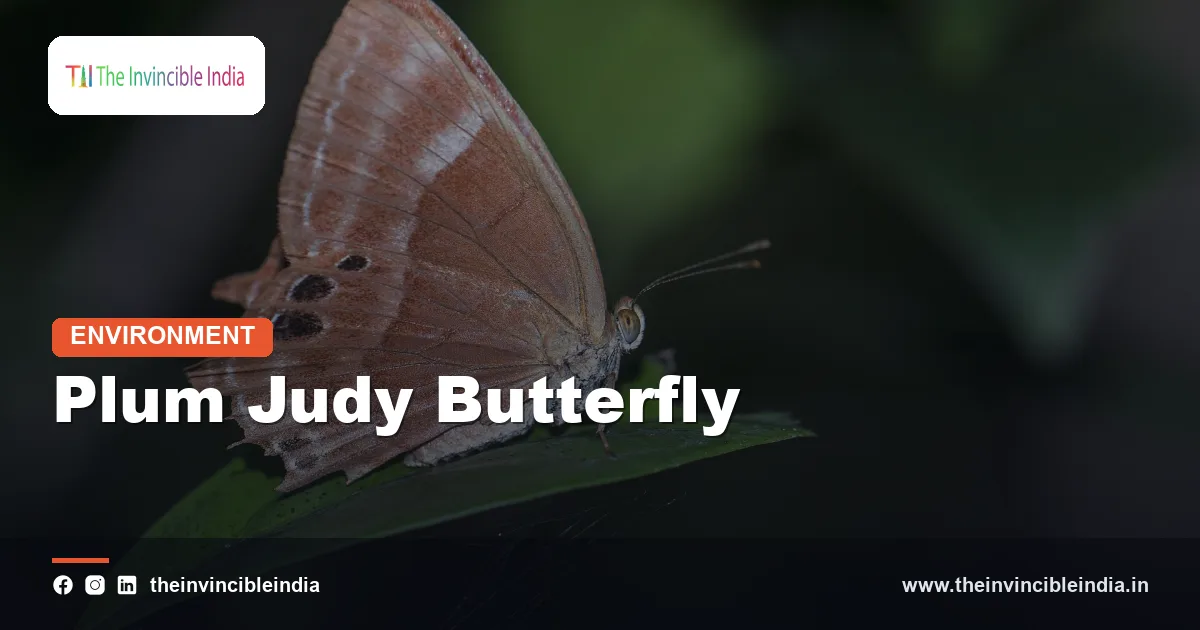
The plum judy (Abisara echerius) is a small brown Indian butterfly of the metalmark family Riodinidae, known for resting upside-down beneath leaves with its wings spread flat and for its habit of sidling sideways along the leaf. It lives in shaded, moist woodland and forest edges, and its caterpillars feed on forest shrubs such as Ardisia and Maesa.
The plum judy does not look like a typical butterfly, and that is part of its appeal. It flies in short, low bursts, spends most of the day tucked beneath foliage and has a pattern that blends into dead leaves and shade. Learning to find it teaches an observer to look under leaves rather than over flowers.
| Quick Fact | Detail |
|---|---|
| Common name | Plum judy |
| Scientific name | Abisara echerius |
| Family | Riodinidae (metalmarks), subfamily Nemeobiinae |
| Wingspan | Roughly 40 to 50 mm |
| Host plants | Forest shrubs of the genera Ardisia and Maesa, in the family Primulaceae (formerly Myrsinaceae) |
| Range and habitat in India | Western Ghats, Himalayan foothills and the north-east; moist deciduous and evergreen forest, shaded streamsides and forest edges |
| Flight season and broods | Seen over much of the year in warm, moist regions, with several broods and peaks during and after the monsoon |
| Notable features | Rests beneath leaves with wings spread, sidles sideways, one of the few Old World metalmarks |
Key Takeaways
- The plum judy is a small brown butterfly, Abisara echerius, with a wingspan of roughly 40 to 50 mm.
- The plum judy belongs to the family Riodinidae, the metalmarks, a mostly tropical American group with only a few species in India.
- The plum judy typically rests on the underside of a leaf with its wings spread flat, instead of folding them upright like most butterflies.
- The plum judy moves with a distinctive sideways sidle across the leaf surface, and then takes off in short, quick flights.
- Caterpillars of the plum judy feed on forest shrubs of the genera Ardisia and Maesa.
- The plum judy is found in shaded, moist habitats, including the Western Ghats, the Himalayan foothills and the north-east.
What does the plum judy look like?
The plum judy is a small, brown butterfly with a purplish or plum-tinted sheen, marked with fine darker lines and an angled wing outline. Its colours are subdued and well suited to shade, which helps it merge with dry leaves and dark undergrowth.
The upperside of the male is a warm brown with a darker line crossing the wings, and the outer edge of the forewing is slightly angled. The hindwing has a small, blunt projection rather than a true tail. The female is somewhat paler and tends to show a lighter band across the wings, so the sexes can be told apart by those with a good view.
The underside is paler brown with delicate, wavy lines and a scattering of small marks. Because the butterfly rests with its wings open and the underside facing upwards when it sits beneath a leaf, an observer looking up from below often sees that pattern against the light.
Why is it called a judy?
The name judy is shared by several butterflies of the genus Abisara, and it is a common name that has been used in the Indian region for a long time. The word plum refers to the plum-brown or purplish tone of the wings, in the same way that other butterflies take colour names from their overall tint.
Is the plum judy a metalmark?
Yes, the plum judy is a metalmark, a member of the butterfly family Riodinidae. The name metalmark was given because many species, especially in tropical America, carry shining metallic spots or lines on their wings, although the plum judy itself is not especially metallic.
Riodinidae is a family with well over a thousand species worldwide, and the great majority live in the American tropics. In the Old World the family is represented by a small number of species. In India the metalmarks are few and mostly confined to forests, and they include the judies of the genus Abisara, the punches of the genus Dodona and the punchinello, Zemeros flegyas.
Metalmarks were once grouped with the lycaenids, and they share some features with that family, including small size and, in many species, a habit of perching in unusual ways. Modern classifications treat them as a separate family, but the relationship remains close.
Where is the plum judy found in India?
The plum judy is found in shaded, humid forest in India, especially in the Western Ghats, the Himalayan foothills and the north-east, and it occurs beyond India in other parts of tropical Asia. It is a butterfly of forest interiors and edges rather than open, dry country.
Typical habitats include:
- Moist deciduous forest with a shrubby understorey
- Evergreen and semi-evergreen forest at low and middle elevations
- Shaded streamsides, ravines and forest tracks
- Plantation edges and well-wooded gardens near forest
The plum judy tends to be local rather than abundant. A site may hold a steady population near its host plants, while the surrounding woodland a few kilometres away has none. This is typical of forest butterflies that depend on a particular type of understorey shrub.
Why does the plum judy rest upside-down under leaves?
The plum judy rests under leaves because the position hides it from predators and keeps it out of direct sun and rain. By tucking itself beneath a leaf with its wings pressed flat against the underside, the butterfly becomes almost invisible to a bird looking down from above.
The behaviour is unusual among butterflies, which normally perch on top of leaves or on flowers. It is, however, common in several metalmarks, and in the plum judy it is one of the best field marks. If you see a small brown butterfly sitting flat beneath a leaf, with its wings fully spread, it is worth checking whether it is a judy.
What is the sidling movement?
The sidling movement is a sideways shuffle across the leaf, made without turning the body. When disturbed, the plum judy often moves around the edge of the leaf to the other side, keeping the leaf between itself and the observer. If the threat continues, it takes off in a short, rapid flight and drops onto another leaf nearby.
This combination of hiding, sidling and brief flight makes the species hard to follow with the eye, and many observers lose sight of it after only a few seconds.
What does the plum judy caterpillar eat?
The plum judy caterpillar eats the leaves of forest shrubs of the genera Ardisia and Maesa, which belong to the family Primulaceae. These shrubs grow in the understorey of moist forests and are the key to finding the butterfly, because the female lays her eggs on them.
Metalmark caterpillars are generally short and stout, and they are often covered in fine hairs. Many are active in the evening or at night and rest on the underside of leaves during the day, a habit that matches the behaviour of the adult. In the plum judy, the larvae have been recorded as feeding on young leaves and as moving to rest in sheltered spots.
The pupa is attached to a leaf or twig, held upright by a silk support. After a short period the adult emerges and, within an hour or so, dries and hardens its wings.
How does the plum judy life cycle work?
The plum judy passes through egg, caterpillar, pupa and adult stages, and the whole cycle takes a few weeks in warm, humid weather. As in all butterflies, the changes are complete, and each stage differs greatly from the one before.
| Stage | What happens |
|---|---|
| Egg | The female lays eggs on the leaves of Ardisia or Maesa shrubs in shaded spots |
| Caterpillar | The hairy larva feeds on leaves and rests beneath them, growing through several moults |
| Pupa | The mature caterpillar attaches itself to a leaf or twig and transforms |
| Adult | The butterfly emerges, feeds and mates; its flight is low and short |
The timing of broods follows the rains. In regions with a marked monsoon, new growth on host shrubs encourages breeding, and adults are more numerous in the months during and after the rains. In drier months, populations fall, and the species may be hard to find.
How does the plum judy compare with a typical butterfly?
The plum judy differs from a typical butterfly in posture, perch and flight. Most familiar butterflies close their wings upright over the back, sit on top of leaves or flowers and glide or flutter in open sunlight. The plum judy keeps its wings spread, sits beneath the leaf and flies in short, whirring dashes through shaded undergrowth.
- Posture: wings held flat and open rather than folded upright.
- Perch: the underside of a leaf rather than the top or a flower.
- Light: shade and dappled sun rather than open sunshine.
- Escape: sidling and short dashes rather than long, wandering flight.
What do adult plum judies feed on?
Adult plum judies feed on a mix of liquids, including moisture from damp ground and occasional nectar from low flowers. Males of many forest butterflies are seen sipping minerals from wet soil, a behaviour called mud-puddling, and judies are recorded doing something similar.
The butterflies seldom stray far from shade. They may visit low flowers at the edge of a forest track, but they spend most of their time at or below eye level, in damp, dim places. This habit, together with their dull colouring, explains why the plum judy is often missed on a casual walk.
Males set up perches beneath leaves and defend small territories. They dart out at passing butterflies and then return to the same leaf, which is why a patient observer can often find the same individual again after only a short wait.
How can you tell the plum judy from other judies?
The plum judy is told apart from other judies by its colour, the lines on its wings and the shape of its hindwing, and by the host shrubs on which it breeds. Several butterflies of the genus Abisara occur in India, and they resemble one another in shape and in the habit of resting under leaves.
- Plum judy (Abisara echerius): brown with a plum tint and a lightly angled wing edge.
- Double-banded judy (Abisara bifasciata): a related species with a different arrangement of bands.
- Tailed judy (Abisara neophron): a related species noted for a more pronounced tail on the hindwing.
- Dark judy (Abisara fylla): a related species with darker upperside colouring.
Other Indian metalmarks, such as the punchinello (Zemeros flegyas), look quite different, with a chestnut-brown ground colour marked with pale spots and a lively, flitting flight. Checking the range and habitat as well as the wing pattern gives the best chance of a correct identification.
Why does the plum judy matter?
The plum judy matters because it represents a rare group in India and because its presence indicates healthy, shaded forest with an intact understorey. A butterfly that depends on specific understorey shrubs is a sensitive guide to how well a forest is preserved.
Clearing the understorey for plantations, tracks or fuelwood removes the host plants and the shade on which the species depends. In contrast, forests that keep their shrub layer, damp patches and streamside vegetation can support a stable plum judy population. The species is not listed as threatened across its range, but local populations can vanish when habitat is cleared.
For those who enjoy watching butterflies, the plum judy is a reminder that not every interesting species is brightly coloured or found on flowers. Looking under leaves, checking shaded corners and noticing small movements often reveals the more secretive residents of a forest.
How can you find and photograph the plum judy?
The best way to find the plum judy is to search the undersides of leaves of low forest shrubs along shaded tracks and streams, moving slowly and scanning at knee to chest height. The butterfly is seldom on flowers, so the usual habit of looking for colour on blossoms does not work for this species.
These steps improve the chance of success:
- Choose moist, shaded forest edges, particularly near streams and damp ravines.
- Look for Ardisia and Maesa shrubs, since females stay close to them.
- Check the undersides of leaves for a small, flat, brown shape with spread wings.
- Approach slowly from the side and avoid casting a shadow over the leaf.
- If the butterfly sidles around the leaf edge, wait quietly, because it often settles again within a few minutes.
Photography is demanding, because the butterfly sits in dim light and moves in quick bursts. A camera with a macro setting and a steady grip, or a small tripod, helps. Photographing the butterfly from below, against the light, shows the wing shape and the lines on the wings well, and these details are what make identification possible later.
Observers should avoid bending or breaking branches to get a better view. The shrubs that shelter the plum judy are also the places where its eggs and caterpillars live, and rough handling can destroy them.
Bottom Line
The plum judy is a modest-looking but unusual Indian butterfly, a metalmark that rests under leaves and sidles sideways to avoid notice. It relies on moist, shaded forest and on Ardisia and Maesa shrubs, so the best way to protect it is to keep forest understorey and streamside vegetation intact.
Frequently Asked Questions
What is the plum judy butterfly?
The plum judy is a small brown butterfly, scientifically named Abisara echerius, found in shaded forests of India. It belongs to the metalmark family Riodinidae and has a wingspan of roughly 40 to 50 mm. Its most unusual habit is resting upside-down beneath leaves with its wings spread flat.
Why does the plum judy sit under leaves?
The plum judy sits under leaves to hide from predators and to shelter from sun and rain. With its wings pressed flat against the underside of the leaf, it is hard to see from above. When disturbed, it sidles to the far side of the leaf and may make a short, rapid flight to another leaf.
What does the plum judy caterpillar eat?
The plum judy caterpillar eats the leaves of forest shrubs of the genera Ardisia and Maesa, in the family Primulaceae. Females lay their eggs on these understorey plants in shaded spots. The caterpillar is short and stout and usually rests beneath leaves during the day.
Is the plum judy a metalmark?
Yes, the plum judy is a metalmark, belonging to the butterfly family Riodinidae. Most metalmarks live in tropical America, and only a small number occur in India. The Indian metalmarks include the judies of the genus Abisara, the punches of the genus Dodona and the punchinello.
Where can I see the plum judy in India?
The plum judy can be seen in moist, shaded forest in the Western Ghats, the Himalayan foothills and the north-east. Look along shaded forest tracks and streamsides, and check the undersides of leaves of low shrubs. Early mornings and the months during and after the monsoon are the best times.
Is the plum judy rare?
No, the plum judy is not considered rare across its range, but it is local and easy to miss. Its dull colouring and under-leaf habit hide it from casual observers. Populations depend on shaded forest with intact understorey shrubs, so they can disappear where that habitat is cleared.
{“@context”:”https://schema.org”,”@graph”:[{“@type”:”FAQPage”,”mainEntity”:[{“@type”:”Question”,”name”:”What is the plum judy butterfly?”,”acceptedAnswer”:{“@type”:”Answer”,”text”:”The plum judy is a small brown butterfly, scientifically named Abisara echerius, found in shaded forests of India. It belongs to the metalmark family Riodinidae and has a wingspan of roughly 40 to 50 mm. Its most unusual habit is resting upside-down beneath leaves with its wings spread flat.”}},{“@type”:”Question”,”name”:”Why does the plum judy sit under leaves?”,”acceptedAnswer”:{“@type”:”Answer”,”text”:”The plum judy sits under leaves to hide from predators and to shelter from sun and rain. With its wings pressed flat against the underside of the leaf, it is hard to see from above. When disturbed, it sidles to the far side of the leaf and may make a short, rapid flight to another leaf.”}},{“@type”:”Question”,”name”:”What does the plum judy caterpillar eat?”,”acceptedAnswer”:{“@type”:”Answer”,”text”:”The plum judy caterpillar eats the leaves of forest shrubs of the genera Ardisia and Maesa, in the family Primulaceae. Females lay their eggs on these understorey plants in shaded spots. The caterpillar is short and stout and usually rests beneath leaves during the day.”}},{“@type”:”Question”,”name”:”Is the plum judy a metalmark?”,”acceptedAnswer”:{“@type”:”Answer”,”text”:”Yes, the plum judy is a metalmark, belonging to the butterfly family Riodinidae. Most metalmarks live in tropical America, and only a small number occur in India. The Indian metalmarks include the judies of the genus Abisara, the punches of the genus Dodona and the punchinello.”}},{“@type”:”Question”,”name”:”Where can I see the plum judy in India?”,”acceptedAnswer”:{“@type”:”Answer”,”text”:”The plum judy can be seen in moist, shaded forest in the Western Ghats, the Himalayan foothills and the north-east. Look along shaded forest tracks and streamsides, and check the undersides of leaves of low shrubs. Early mornings and the months during and after the monsoon are the best times.”}},{“@type”:”Question”,”name”:”Is the plum judy rare?”,”acceptedAnswer”:{“@type”:”Answer”,”text”:”No, the plum judy is not considered rare across its range, but it is local and easy to miss. Its dull colouring and under-leaf habit hide it from casual observers. Populations depend on shaded forest with intact understorey shrubs, so they can disappear where that habitat is cleared.”}}]}]}


