

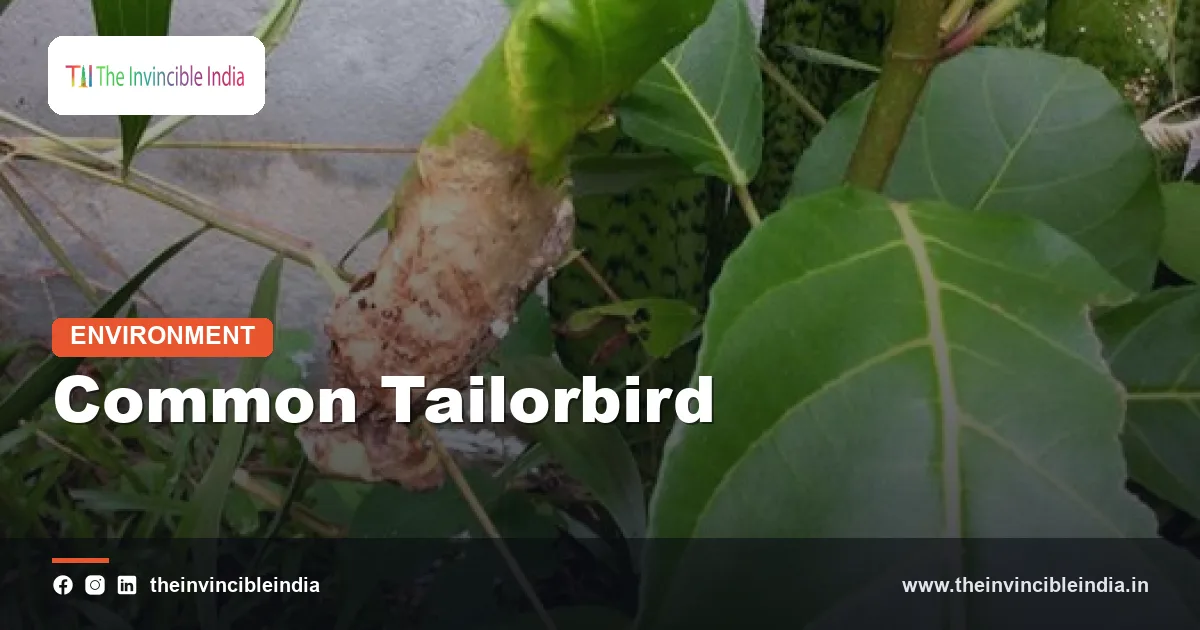
The common tailorbird (Orthotomus sutorius) is a tiny, olive-green warbler-like bird of Indian gardens and scrub that “sews” large leaves together into a cup-shaped nest by piercing the leaf edges and threading plant fibre or spider silk through the holes. It is easy to recognise by its upright, often cocked tail, its rusty-orange forehead and crown, and a loud, repeated call that sounds like “towit-towit-towit”.
This guide explains what the common tailorbird looks like, how it builds its remarkable nest, where it lives in India, what it eats, how it breeds and how to tell it from similar small birds. Last updated: 23 October 2026.
| Attribute | Detail |
|---|---|
| Common name | Common tailorbird (Hindi: darzi, meaning “tailor”) |
| Scientific name | Orthotomus sutorius |
| Family | Cisticolidae (a group of small insect-eating warblers and relatives), formerly placed with the Old World warblers |
| Typical body length | Roughly 10 to 14 cm, including the tail |
| Weight | Only a few grams, usually around 6 to 10 g |
| Famous feature | Stitches leaves together to form a hidden nest |
| Main habitat | Gardens, hedges, scrub, orchards, village edges and light woodland |
| Diet | Small insects, caterpillars and spiders; occasionally nectar |
| IUCN status | Least Concern |
Key Takeaways
- The common tailorbird (Orthotomus sutorius) is a tiny bird, only about 10 to 14 cm long, that is widespread across most of India in gardens, hedges and scrub.
- The common tailorbird builds its nest by piercing holes in the edges of large leaves with its bill and stitching them together with plant fibre, cotton or spider silk.
- The common tailorbird has olive-green upperparts, creamy underparts, a rusty crown and a long tail that it often holds cocked upright.
- The common tailorbird has a loud, penetrating call, often written as “towit-towit-towit”, that makes it much easier to hear than to see.
- The common tailorbird feeds almost entirely on small insects, caterpillars and spiders, and it is a natural pest controller in gardens.
- The common tailorbird is classified as Least Concern by the International Union for Conservation of Nature (IUCN) and often nests close to houses.
What is the common tailorbird?
The common tailorbird is a small, insect-eating songbird of South and South-East Asia, named for its habit of sewing leaves together to make a nest. Its scientific name is Orthotomus sutorius, and the species name comes from a Latin word meaning “of a cobbler or sewer”, a reference to its stitching skill.
The bird belongs to the family Cisticolidae, which includes cisticolas, prinias and their relatives. Older books place it among the Old World warblers, and the bird is still commonly described as a warbler in popular writing. Within India, other tailorbird species also occur, including the dark-necked tailorbird of the north-east and the Andaman Islands, but the common tailorbird is by far the one most people encounter.
The bird is celebrated in Indian popular culture and in Rudyard Kipling’s story “Rikki-Tikki-Tavi”, which features a tailorbird character called Darzee, a name taken from the Hindi word for tailor.
What does the common tailorbird look like?
The common tailorbird looks like a very small, slim bird with olive-green upperparts, whitish or creamy underparts, a rufous-orange forehead and crown, and a thin, slightly curved bill. Its most characteristic feature is a relatively long tail, which it often holds cocked upright over its back or flicks from side to side.
Plumage and size
Adult birds are olive-green on the back and wings, with a pale throat and underparts that look off-white or buffy. The legs are pinkish or light brown, and the eyes are small and dark. The bill is thin, pointed and well suited to picking tiny insects off leaves.
Differences between the sexes and seasons
Male and female common tailorbirds look broadly similar. In the breeding season, the male develops longer central tail feathers, which makes the tail look more elongated. After breeding, these feathers are shed, and the tail looks shorter. The rufous crown is more strongly coloured in some seasons and individuals than in others.
The bird is rarely still. It moves constantly through the foliage in short hops and quick flights, and this constant motion, together with its small size, makes it hard to watch for long.
How does the common tailorbird sew its nest?
The common tailorbird sews its nest by using its sharp bill to pierce small holes along the edges of one or more large leaves, then pulling plant fibre, cotton threads or spider silk through the holes to draw the leaves together into a pouch. The bird has no needle, so it relies entirely on its bill and feet.
The step-by-step process
- The bird chooses a large, flexible leaf, or a pair of leaves, on a shrub or small tree.
- It pulls the leaf edges together with its feet and bill to form a cup or cone shape.
- It pierces holes along the edges of the leaves with its bill.
- It threads fibre, spider silk or cotton through the holes and pulls it tight.
- It makes small knots, or flattens the ends of the fibre, so that the stitches do not pull out.
- It fills the inner pouch with soft material such as cotton, down, grass and fine fibres to make a snug cup.
Why the stitching matters
The leaves stay green and attached to the plant, so the nest looks like an ordinary part of the foliage. This camouflage helps hide eggs and chicks from predators such as crows, snakes, squirrels and cats. The sewn leaves also hold the nest firmly in place, even in wind and rain.
Nests are often built at a fairly low height, in shrubs, hedges, garden plants and small trees, which is why a lucky observer can find one in a courtyard garden or a potted plant on a balcony.
Where does the common tailorbird live in India?
The common tailorbird lives across most of India, from the foothills of the Himalaya to the southern peninsula and the east coast, in gardens, scrub, orchards, hedges and light woodland. It is a resident species, which means it stays in the same area throughout the year, apart from small local movements.
The species is also found in neighbouring countries of the Indian subcontinent, including Sri Lanka, Nepal and Bangladesh, and in parts of South-East Asia, where related forms occur.
Typical habitats include:
- Urban and suburban gardens with shrubs and flowering plants.
- Hedgerows and thickets on farmland and village edges.
- Scrub and open woodland, including secondary forest.
- Orchards, plantations and bamboo clumps.
The common tailorbird generally avoids very dense, mature forest and very dry deserts. It adapts well to human settlements, which has helped it remain common in cities where gardens still offer dense low vegetation.
What does the common tailorbird eat?
The common tailorbird eats small insects, caterpillars, small spiders and insect eggs, which it picks from leaves, twigs and flowers. It sometimes takes nectar from blossoms, and it may also eat tiny berries and seeds.
Its feeding style is active and fast. The bird hops through shrubs and low branches, peering at the underside of leaves and snapping up tiny prey with its thin bill. It sometimes hovers briefly to take an insect from a leaf, and it often joins small mixed groups of birds moving through the vegetation.
Because it eats large numbers of small insects, including aphids and caterpillars, the common tailorbird is a useful natural pest controller. Gardens with a mix of native shrubs, flowering plants and some uncut hedges tend to attract the bird, and the use of strong pesticides can reduce its food supply.
What does the common tailorbird’s call sound like?
The common tailorbird’s call is a loud, sharp and repeated series of notes, often written as “towit-towit-towit” or “pit-pit-pit”, which is surprisingly powerful for such a small bird. The call is usually delivered from a hidden perch inside a shrub or tree.
Males call frequently in the breeding season to defend their territory and attract mates. The sound is often the first sign that a tailorbird is nearby, since the bird itself may stay hidden in thick foliage. Experienced birdwatchers use the call to find and identify the species even when it cannot be seen.
The bird also has other short notes, including contact calls and alarm calls, which it uses to communicate with its mate and young. Its repeated, metallic call can continue for long periods, particularly in the morning and during the monsoon.
How does the common tailorbird breed?
The common tailorbird breeds as a pair in a territory, laying eggs in its sewn leaf nest, and in most of India breeding peaks around the monsoon, though it can occur over a longer period. Pairs may raise more than one brood in a season if conditions are good.
Eggs and chicks
The female usually lays about three or four small eggs, which can be pale blue or whitish with reddish-brown speckles. Both parents take part in feeding the chicks, which are fed on tiny insects and caterpillars. The young grow quickly and leave the nest after about two weeks, although they are fed by their parents for some time afterward.
Threats to nests
Nests may be lost to predators such as crows, snakes, lizards, cats, squirrels and larger birds, and to storms and pruning of hedges. Because the nest is so well camouflaged, many survive, but the birds sometimes build several nests before they settle on one for laying.
Gardeners who find a nest can help by avoiding trimming the shrub until the chicks have left.
How can you tell the common tailorbird from similar birds?
The common tailorbird can be told from similar small birds by its upright tail, rufous crown, green back and loud call. The table below lists look-alikes that are often confused with it in Indian gardens and scrub.
| Bird | Key features | How it differs from the common tailorbird |
|---|---|---|
| Common tailorbird | Olive-green back, rufous crown, creamy underparts, cocked tail | The reference bird; loud “towit” call and leaf-sewn nest |
| Dark-necked tailorbird | Similar shape; dark throat patch in many birds | Occurs in north-eastern India and the Andaman Islands; has a darker throat |
| Plain prinia | Brownish, long and loosely graduated tail | Lacks the rufous crown; builds a woven nest of grass |
| Ashy prinia | Grey-brown with a long tail | Greyer overall; lacks green tones and rufous crown |
| Greenish warbler (winter visitor) | Greenish above with a pale eyebrow stripe | Lacks the cocked tail and rufous crown; forages with a more restless flicking of wings |
If a tiny greenish bird has an upright tail and a rusty cap, and it calls loudly from within a bush, it is almost certainly a common tailorbird.
Is the common tailorbird threatened?
The common tailorbird is not threatened; the IUCN lists it as Least Concern because it is widespread and adapts well to human-modified habitats. Numbers are thought to be large, though precise counts do not exist and local populations can vary.
The bird still faces some local pressures:
- Removal of hedges and shrubs in gardens and farm boundaries.
- Overuse of pesticides, which reduces insect food.
- Predation by domestic cats and other animals.
- Loss of dense, low vegetation to construction and paving.
The common tailorbird is a protected wild bird under India’s Wildlife (Protection) Act, 1972. Simple actions such as keeping a mixed hedge, planting native shrubs and avoiding pruning during the nesting season can help the species remain common in gardens.
Why does the common tailorbird matter?
The common tailorbird matters because it is a natural insect controller, an accessible example of tool-like nest building in birds and an easy gateway for people to start noticing urban wildlife. Its presence is a sign that a garden or hedge still offers the dense, low cover small birds need.
Scientists and naturalists have long been fascinated by its nest-making skill, since it uses only its bill and feet to cut, thread and knot fibres. While the bird does not use a tool in the strict sense, the sewing behaviour is among the most elaborate nest-building techniques seen in any songbird.
For ordinary people, the tailorbird is a reminder that small, ordinary-looking birds can have remarkable habits. A bird no heavier than a few coins can build a stitched home in a garden plant outside a window.
Bottom Line
The common tailorbird is tiny, active and loud, with a talent for stitching leaves into a hidden nest. It is common in Indian gardens and shows that careful craftsmanship and survival do not require size, only skill and a bit of green cover.
Frequently Asked Questions
What is a common tailorbird?
A common tailorbird is a tiny olive-green bird, scientifically named Orthotomus sutorius, that stitches leaves together to make its nest. It lives in gardens, hedges and scrub across India. It has a rusty crown, a long tail often held upright and a loud call.
How does a tailorbird sew its nest?
A tailorbird sews its nest by piercing holes along the edges of large leaves with its bill, then threading plant fibre, cotton or spider silk through the holes to pull the leaves into a pouch. It knots or flattens the ends to hold the stitches. The inside is lined with soft material.
What does the tailorbird’s call sound like?
The tailorbird’s call is a loud, repeated series of sharp notes often written as “towit-towit-towit”. It is surprisingly powerful for such a small bird and is usually given from a hidden perch within a bush. The call often reveals the bird before it is seen.
What does the common tailorbird eat?
The common tailorbird eats small insects, caterpillars, spiders and insect eggs picked from leaves and twigs. It sometimes feeds on nectar and tiny berries. Because it eats many small garden pests, it is considered a helpful bird for gardeners.
Where can I see a common tailorbird in India?
You can see a common tailorbird in gardens, hedges, orchards, scrub and village edges across most of India. Listen for its loud “towit” call and look for a tiny greenish bird with a cocked tail moving through dense shrubs. It is common even in many cities.
Is the tailorbird protected in India?
Yes, the common tailorbird is protected as a wild bird under India’s Wildlife (Protection) Act, 1972. It is also classified as Least Concern by the IUCN because it is widespread and common. Avoiding hedge-trimming during the nesting season helps protect its nests.
{“@context”:”https://schema.org”,”@graph”:[{“@type”:”FAQPage”,”mainEntity”:[{“@type”:”Question”,”name”:”What is a common tailorbird?”,”acceptedAnswer”:{“@type”:”Answer”,”text”:”A common tailorbird is a tiny olive-green bird, scientifically named Orthotomus sutorius, that stitches leaves together to make its nest. It lives in gardens, hedges and scrub across India. It has a rusty crown, a long tail often held upright and a loud call.”}},{“@type”:”Question”,”name”:”How does a tailorbird sew its nest?”,”acceptedAnswer”:{“@type”:”Answer”,”text”:”A tailorbird sews its nest by piercing holes along the edges of large leaves with its bill, then threading plant fibre, cotton or spider silk through the holes to pull the leaves into a pouch. It knots or flattens the ends to hold the stitches. The inside is lined with soft material.”}},{“@type”:”Question”,”name”:”What does the tailorbird’s call sound like?”,”acceptedAnswer”:{“@type”:”Answer”,”text”:”The tailorbird’s call is a loud, repeated series of sharp notes often written as “towit-towit-towit”. It is surprisingly powerful for such a small bird and is usually given from a hidden perch within a bush. The call often reveals the bird before it is seen.”}},{“@type”:”Question”,”name”:”What does the common tailorbird eat?”,”acceptedAnswer”:{“@type”:”Answer”,”text”:”The common tailorbird eats small insects, caterpillars, spiders and insect eggs picked from leaves and twigs. It sometimes feeds on nectar and tiny berries. Because it eats many small garden pests, it is considered a helpful bird for gardeners.”}},{“@type”:”Question”,”name”:”Where can I see a common tailorbird in India?”,”acceptedAnswer”:{“@type”:”Answer”,”text”:”You can see a common tailorbird in gardens, hedges, orchards, scrub and village edges across most of India. Listen for its loud “towit” call and look for a tiny greenish bird with a cocked tail moving through dense shrubs. It is common even in many cities.”}},{“@type”:”Question”,”name”:”Is the tailorbird protected in India?”,”acceptedAnswer”:{“@type”:”Answer”,”text”:”Yes, the common tailorbird is protected as a wild bird under India’s Wildlife (Protection) Act, 1972. It is also classified as Least Concern by the IUCN because it is widespread and common. Avoiding hedge-trimming during the nesting season helps protect its nests.”}}]}]}


