

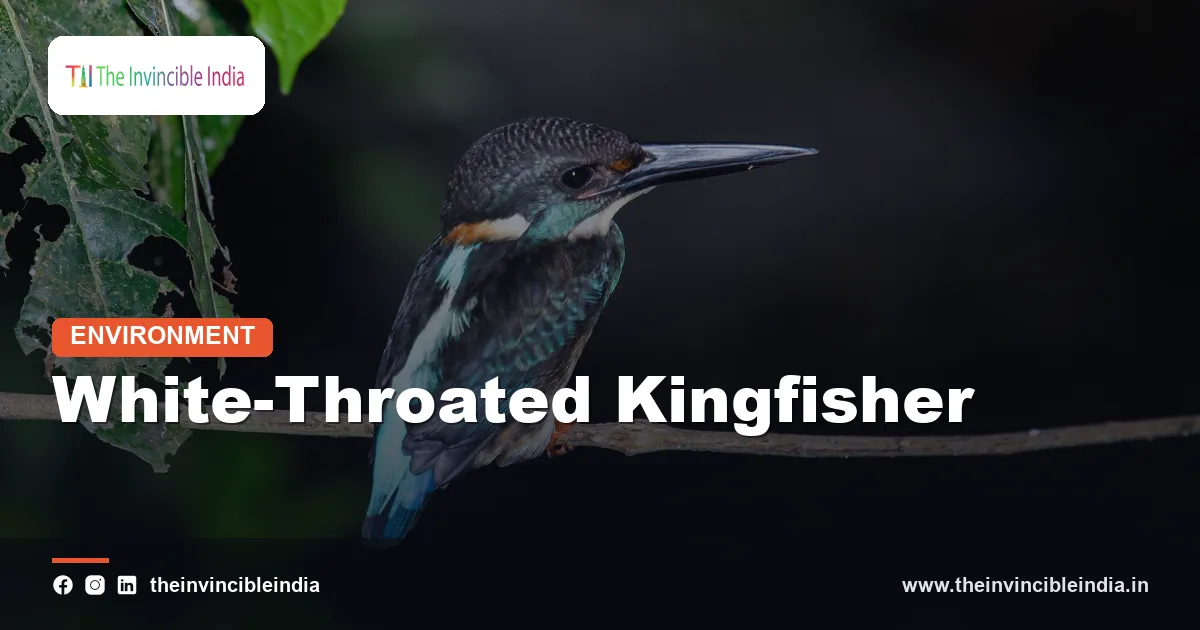
The white-throated kingfisher (Halcyon smyrnensis) is a medium-sized, brilliantly coloured tree kingfisher with a chestnut body, turquoise-blue back and wings, a clean white throat and breast, and a heavy coral-red bill, and it is one of the most widespread and easily recognised birds in India. Despite the family name, the white-throated kingfisher is not tied to rivers: it is just as likely to be seen on a roadside wire, a farm fence or a school playground as beside a pond.
This guide explains how to identify the white-throated kingfisher, where it lives, what it eats, how it hunts and breeds, and how it fits into Indian culture. It is written for beginners, students and anyone who has ever wondered about the blue-and-brown flash that crosses a highway at dawn.
| Attribute | Detail |
|---|---|
| Common name | White-throated kingfisher (also called white-breasted kingfisher) |
| Scientific name | Halcyon smyrnensis |
| Family | Alcedinidae (kingfishers), subfamily Halcyoninae (tree kingfishers) |
| Body length | About 27 to 28 centimetres, roughly the size of a myna |
| Distinctive features | Chestnut head and belly, white throat and breast, turquoise upperparts, large red bill |
| Typical diet | Insects, earthworms, crabs, frogs, lizards, small rodents, small birds and fish |
| Nest type | Tunnel dug into an earthen bank, with a chamber at the end |
| Conservation status | Least Concern on the IUCN Red List |
| Range | Turkey and the Middle East through South Asia to Southeast Asia and the Philippines |
Key Takeaways
- The white-throated kingfisher (Halcyon smyrnensis) is a resident bird across most of India and is considered one of the most common kingfishers in the country.
- The white-throated kingfisher is a tree kingfisher, so it often hunts away from water by dropping onto lizards, insects and rodents from a perch.
- An adult white-throated kingfisher can be identified by its chestnut head and belly, white throat and breast, turquoise back and wings, and thick red bill.
- The white-throated kingfisher usually nests in a tunnel that both partners dig into a sloping earth bank, a mud wall or a cutting.
- The white-throated kingfisher is listed as Least Concern by the IUCN, and the species is protected in India under the Wildlife (Protection) Act, 1972.
- The white-throated kingfisher announces its territory with a loud, rattling call, and the bird has been named the state bird of West Bengal.
What is the white-throated kingfisher?
The white-throated kingfisher is a large-billed, perch-hunting bird in the kingfisher family Alcedinidae, described scientifically by Carl Linnaeus in the 18th century as Halcyon smyrnensis. The species name refers to Smyrna, the old name of the Turkish city of Izmir, where the first specimens known to Western science were collected.
Within the family, the white-throated kingfisher belongs to the tree kingfishers (Halcyoninae), a group that tends to live in woodlands, farmland and open country rather than strictly along streams. This contrasts with the small river kingfishers of the genus Alcedo, which depend on clear water and catch fish by plunge-diving.
The common name in English has changed slightly over time. Older field guides and many Indian naturalists still call the bird the white-breasted kingfisher, and both names refer to the same species. In Hindi and many other Indian languages the bird is known by local names that usually echo its colour or its loud voice, and regional names vary widely from state to state.
How can you identify a white-throated kingfisher?
A white-throated kingfisher can be identified by its deep chestnut head, shoulders and belly, a gleaming white bib from chin to upper breast, turquoise-blue back, wings and tail, and a stout, dagger-shaped red bill. Males and females look alike, and juveniles are simply duller, with a paler bill and faint dark scalloping on the breast.
In flight, the bird shows a large white patch at the base of the flight feathers, set against black wing tips and a bright blue back. This pattern is one of the most reliable field marks, because the bird often flies low and fast and only a flash of colour is visible.
Key field marks
- Bill: long, heavy and bright red, with a slightly darker tip in some lighting.
- Throat and breast: pure white, with no streaks.
- Head and belly: rich chestnut brown, which stands out against the blue back.
- Legs and feet: red, short and strong, suited to perching rather than walking.
- Wings: turquoise above, with a white window and black tips seen from below and in flight.
Birdwatchers sometimes confuse the white-throated kingfisher with the black-capped kingfisher, which has a dark cap and a white collar, or with the stork-billed kingfisher, which is larger and has a huge red bill and a greenish-blue back. The white throat and uniformly chestnut head are the quickest ways to rule those two out.
Where is the white-throated kingfisher found in India?
The white-throated kingfisher is found throughout most of India, from the plains of Punjab and Gujarat to Kerala, the Gangetic basin, the north-east and the Andaman and Nicobar Islands, and it is mostly resident, meaning it stays in the same region through the year. It is generally absent only from very high mountains and the driest desert interiors.
The bird is notable for its adaptability. Typical habitats include:
- Paddy fields, sugarcane farms and irrigation canals.
- Village ponds, tanks, rivers and wetlands.
- Gardens, campuses, golf courses and city parks.
- Open scrub, dry deciduous forest and forest clearings.
- Roadsides, railway lines and the edges of towns.
Beyond India, the white-throated kingfisher ranges west to Turkey and the eastern Mediterranean and east through Southeast Asia to the Philippines. Several subspecies are recognised across this huge range, and they differ slightly in size and in the brightness of the blue plumage. Taxonomists do not always agree on the exact number of subspecies, so any count should be treated as approximate.
Altitude matters little within India. The bird is common in the plains and foothills and is regularly reported in the lower Himalayas, but it becomes uncommon at higher elevations where winters are cold and insects are scarce.
What does the white-throated kingfisher eat?
The white-throated kingfisher eats a varied diet that includes grasshoppers, beetles, crickets, earthworms, crabs, frogs, lizards, small snakes, rodents, small birds and fish, which makes it one of the most opportunistic kingfishers in India. Fish are a part of the diet when water is nearby, but they are far from the only food.
Several features of the diet are worth noting:
- Insects form a large share of the food in many habitats, especially in the dry season, when grasshoppers and beetles are abundant on open ground.
- Small reptiles such as garden lizards and skinks are common prey, which explains why the bird is so often seen in dry fields and gardens.
- Crabs and frogs are taken from the edges of paddy fields, ponds and drains, particularly after rain.
- Small mammals and nestling birds have occasionally been recorded as prey, though these are less regular items.
Because the white-throated kingfisher eats large numbers of crop insects and rodents, farmers in many regions regard it as a helpful predator. The bird has no known significant role as a pest, and it is generally tolerated by people living near it.
How does the white-throated kingfisher hunt?
The white-throated kingfisher hunts by sitting motionless on a perch such as a wire, branch, fence post or stone, scanning the ground below, and then swooping down to seize prey in its bill before returning to the same perch. This sit-and-wait method uses little energy and is typical of tree kingfishers.
Once the bird has caught something, it carries the prey back to its perch and usually beats it against the branch or a stone. This stuns or kills larger prey, breaks the hard shell of crabs and insects, and softens spiny items. Lizards and frogs are then swallowed whole, head first.
Hunting from a perch versus hunting over water
Near water, the white-throated kingfisher sometimes hovers briefly or dives, but it is far less of a diver than the pied kingfisher or the common kingfisher. It prefers to take prey from the surface, from mud or from the bank. Away from water it is purely a ground-ambusher, working the edges of fields and the open space beneath trees.
Territory also shapes hunting. Each pair defends a feeding area, and the bird often returns to a favourite perch day after day. This reliability is why wildlife photographers can wait near a known perch and often get close-up images in good light.
What does the white-throated kingfisher’s call sound like?
The white-throated kingfisher’s call is a loud, rapid, rattling or cackling series of notes, often transcribed as a descending laugh, and it is among the most recognisable bird sounds in Indian towns and villages. A second, more musical, whistling call is also given, especially in the breeding season.
The bird often calls from an exposed perch while stretching its neck upward and raising its wings partly to flash the white patches. This display is used to advertise territory and to attract or keep a mate, and it can be seen most often in the morning and in the lead-up to nesting.
Because the call carries well, many people hear the bird long before they see it. In the hot-weather and early monsoon months, when pairs are most active, calls can be heard repeatedly through the day, sometimes answered by neighbouring pairs in a chain across a field or campus.
How does the white-throated kingfisher breed and nest?
The white-throated kingfisher breeds by digging a horizontal tunnel into a vertical or sloping earth bank, and the pair usually lays about four to seven glossy white, nearly round eggs in a chamber at the end of the tunnel. The breeding season in India varies by region, but it is concentrated in the warm months from roughly March to July and is often timed to the arrival of the rains.
The nest cycle follows a recognisable pattern:
- Both partners excavate the tunnel, using the bill to loosen soil and the feet to push it out.
- The tunnel may be a few dozen centimetres to roughly a metre long, depending on soil, and it ends in a rounded chamber with no lining other than debris.
- Both parents share incubation of the eggs, which lasts roughly three weeks.
- Both parents feed the chicks, mostly with insects and small vertebrates, until the young fledge.
Nests are found in road cuttings, canal banks, river banks, well walls, mud walls and even sand mounds at construction sites. This choice can bring the species into conflict with earth-moving work, because a nest in a freshly cut bank may be destroyed by machinery.
Is the white-throated kingfisher threatened?
The white-throated kingfisher is not threatened and is classified as Least Concern by the International Union for Conservation of Nature (IUCN), thanks to its huge range and its tolerance of human-modified landscapes. The global population is believed to be large and, as far as available assessments show, broadly stable, although exact figures are not known.
Local pressures still exist. These include:
- Loss of earth banks and tree-lined canals to concrete lining and straightening of rivers.
- Heavy pesticide use that reduces insect prey and may poison the bird indirectly.
- Collisions with vehicles, since the bird often perches on roadside wires and flies low.
- Occasional trapping or capture for the caged-bird trade, which is illegal in India.
Legally, native Indian birds are protected under the Wildlife (Protection) Act, 1972, so capturing, killing or keeping a white-throated kingfisher without permission is an offence. The Act has been amended several times, and readers who need schedule-level detail should check the latest official text.
How is the white-throated kingfisher different from other Indian kingfishers?
The white-throated kingfisher differs from other Indian kingfishers mainly in size, bill colour and habitat, because it is a large, red-billed tree kingfisher that does not need to live beside water. India is home to a dozen or so kingfisher species, and the table below compares the species people most often confuse.
| Species | Approximate size | Key feature | Usual habitat |
|---|---|---|---|
| White-throated kingfisher | About 28 cm | Chestnut head and belly, white bib, red bill | Fields, gardens, wetlands, roadsides |
| Common kingfisher | About 16 cm | Tiny, bright blue back, orange underparts, black bill | Clear streams, ponds, canals |
| Pied kingfisher | About 25 to 30 cm | Black-and-white plumage, hovers before diving | Lakes, rivers, reservoirs |
| Stork-billed kingfisher | About 35 cm or more | Huge red bill, greenish-blue back, tawny underparts | Forested streams, mangroves |
| Black-capped kingfisher | About 28 cm | Black cap, white collar, deep purple-blue back | Coasts, mangroves, estuaries |
The white-throated kingfisher is the one most often seen in ordinary human surroundings. The other species in the table are more specialised and are generally easier to find near particular water bodies or coasts.
Why does the white-throated kingfisher matter in Indian culture and ecology?
The white-throated kingfisher matters because it is an easily seen indicator of healthy farmland and wetlands, a natural controller of insects and rodents, and a familiar bird in Indian art, poetry and everyday life. Its bright colours make it a common subject of paintings and photographs, and it is among the first birds many children in India learn to name.
The species has official recognition as well. The white-throated kingfisher has been adopted as the state bird of West Bengal, where it is a familiar sight in villages and wetlands. Its appearance across many states means the bird features in regional folk songs and in school bird-lists throughout the country.
Ecologically, the bird sits in the middle of the food web. It eats insects and rodents, and its eggs and chicks are taken by snakes, monitor lizards and mongooses, while adults may be caught by raptors. This mid-level position makes it a useful marker of how well an ecosystem is functioning.
How can you watch white-throated kingfishers responsibly?
You can watch white-throated kingfishers responsibly by keeping a respectful distance, avoiding nest tunnels, using binoculars or a long lens instead of approaching, and never using playback calls near nests. The bird is easy to see, so there is little reason to disturb it.
Good practice for beginners includes:
- Look along power lines, fence posts and tree branches at the edge of fields, especially in the early morning.
- Scan canal banks and village tanks for perched birds watching the water or the mud.
- Avoid walking up to a nest bank, since repeated disturbance can make the pair abandon eggs or young.
- Share sightings on citizen-science platforms such as eBird so that records of the species can improve local knowledge.
Even a short walk around a campus or a village pond in the first two hours after sunrise is often enough to spot at least one bird.
Bottom Line
The white-throated kingfisher (Halcyon smyrnensis) is a common, adaptable, perch-hunting bird of India that eats a wide range of animal prey and is found well beyond water. Its chestnut-and-turquoise colours, white bib, red bill and ringing call make it one of the easiest birds for beginners to learn.
Frequently Asked Questions
Is the white-throated kingfisher found only near water?
No, the white-throated kingfisher is often found far from water. As a tree kingfisher, it hunts insects, lizards and rodents from perches in farmland, gardens, scrub and roadsides, and it uses water bodies only when they are available.
What does a white-throated kingfisher eat?
A white-throated kingfisher eats a mixed diet of insects, earthworms, crabs, frogs, lizards, small rodents, small birds and fish. The exact mix depends on habitat and season, and insects and lizards are especially common prey away from water.
Why is it called white-throated kingfisher?
The bird is called the white-throated kingfisher because of its clean white throat and breast, which contrast with the chestnut head and belly. It is also called the white-breasted kingfisher, and both names describe the same species, Halcyon smyrnensis.
Is the white-throated kingfisher a migratory bird?
No, the white-throated kingfisher is mostly resident in India and does not undertake long-distance migration. Some birds make short local movements in response to rainfall, food or temperature, but most pairs stay near their territories through the year.
Where does the white-throated kingfisher build its nest?
The white-throated kingfisher nests in a horizontal tunnel dug into an earth bank, such as a river bank, canal wall, road cutting or mud wall. The pair usually lays about four to seven white eggs in a chamber at the end of the tunnel, and both parents share the work.
Is it legal to keep a white-throated kingfisher as a pet in India?
No, keeping a white-throated kingfisher as a pet is not legal in India. Native wild birds are protected under the Wildlife (Protection) Act, 1972, and capturing or caging them without permission can lead to penalties.
{“@context”:”https://schema.org”,”@graph”:[{“@type”:”FAQPage”,”mainEntity”:[{“@type”:”Question”,”name”:”Is the white-throated kingfisher found only near water?”,”acceptedAnswer”:{“@type”:”Answer”,”text”:”No, the white-throated kingfisher is often found far from water. As a tree kingfisher, it hunts insects, lizards and rodents from perches in farmland, gardens, scrub and roadsides, and it uses water bodies only when they are available.”}},{“@type”:”Question”,”name”:”What does a white-throated kingfisher eat?”,”acceptedAnswer”:{“@type”:”Answer”,”text”:”A white-throated kingfisher eats a mixed diet of insects, earthworms, crabs, frogs, lizards, small rodents, small birds and fish. The exact mix depends on habitat and season, and insects and lizards are especially common prey away from water.”}},{“@type”:”Question”,”name”:”Why is it called white-throated kingfisher?”,”acceptedAnswer”:{“@type”:”Answer”,”text”:”The bird is called the white-throated kingfisher because of its clean white throat and breast, which contrast with the chestnut head and belly. It is also called the white-breasted kingfisher, and both names describe the same species, Halcyon smyrnensis.”}},{“@type”:”Question”,”name”:”Is the white-throated kingfisher a migratory bird?”,”acceptedAnswer”:{“@type”:”Answer”,”text”:”No, the white-throated kingfisher is mostly resident in India and does not undertake long-distance migration. Some birds make short local movements in response to rainfall, food or temperature, but most pairs stay near their territories through the year.”}},{“@type”:”Question”,”name”:”Where does the white-throated kingfisher build its nest?”,”acceptedAnswer”:{“@type”:”Answer”,”text”:”The white-throated kingfisher nests in a horizontal tunnel dug into an earth bank, such as a river bank, canal wall, road cutting or mud wall. The pair usually lays about four to seven white eggs in a chamber at the end of the tunnel, and both parents share the work.”}},{“@type”:”Question”,”name”:”Is it legal to keep a white-throated kingfisher as a pet in India?”,”acceptedAnswer”:{“@type”:”Answer”,”text”:”No, keeping a white-throated kingfisher as a pet is not legal in India. Native wild birds are protected under the Wildlife (Protection) Act, 1972, and capturing or caging them without permission can lead to penalties.”}}]}]}


