

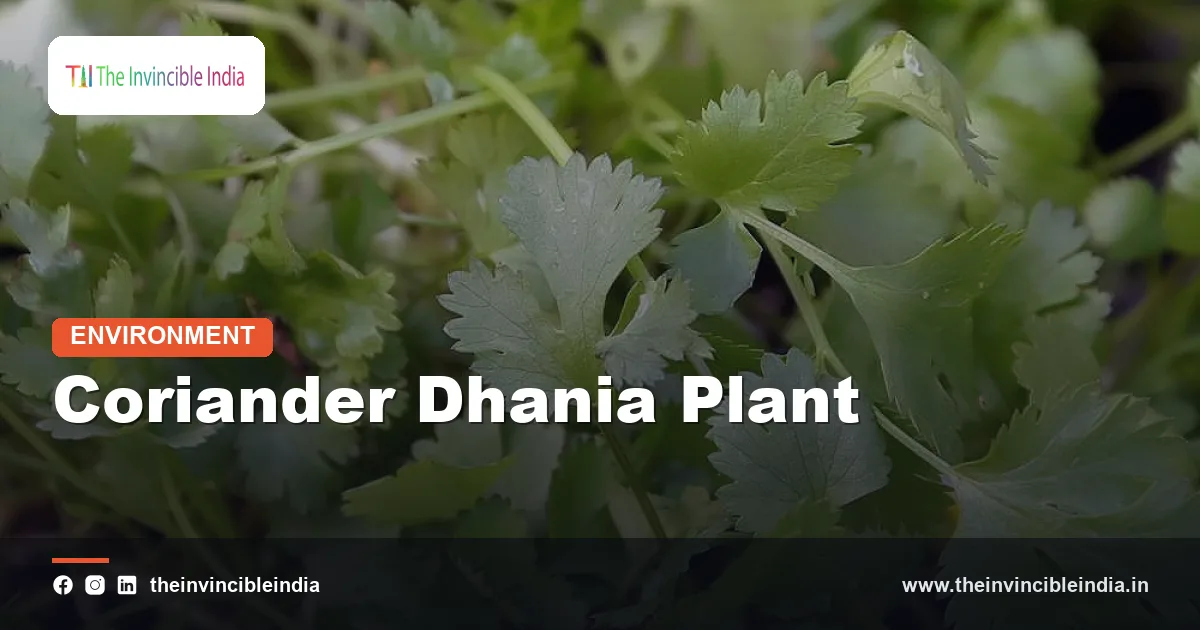
The herb coriander (Coriandrum sativum), known as dhania in Hindi, is an annual plant of the carrot family that is grown across India for two products at once: its fresh green leaves, used as a garnish and flavouring, and its dried round fruits, sold as the coriander “seed” spice. Few plants serve the Indian kitchen so completely, because the same crop supplies both a fresh herb and a staple dry spice.
The leaves are sold in bunches in every vegetable market, while the seeds are roasted, ground and added to everyday spice mixes. This explainer covers the botany of the coriander plant, where and when it grows in India, how leaf and seed crops differ, the problems farmers face, and the many ways the plant is used.
| Common names | Coriander, cilantro (American usage), dhania (Hindi), kothamalli (Tamil), kothimbir (Marathi), dhanyaka (Sanskrit) |
|---|---|
| Scientific name | Coriandrum sativum |
| Plant family | Apiaceae (the carrot or parsley family) |
| Where grown in India | Rajasthan, Madhya Pradesh and Gujarat for seed; leaf crops in nearly every state |
| Growing season | Mainly rabi (October to March); leaf crop can be sown in several months of the year |
| Parts used | Fresh leaves and tender stems; dried round fruits (seeds) |
| Products and uses | Fresh garnish, chutney, whole and ground spice, spice blends, essential oil |
| Crop duration | About 30 to 45 days for leaves; around 100 to 120 days for seed |
| Notable fact | One plant yields both a fresh herb and a dry spice, with distinctly different flavours |
Key Takeaways
- Coriander (Coriandrum sativum), called dhania in India, is an annual herb of the Apiaceae family grown for both its fresh leaves and its dried seed-like fruits.
- The leaves and the seeds of the coriander plant taste very different, with the leaves fresh and citrusy and the seeds warm, nutty and mildly sweet.
- Rajasthan, Madhya Pradesh and Gujarat are the leading coriander seed producers in India, while leaf coriander is grown near towns and cities in almost every state.
- A leaf crop of coriander is ready for cutting in roughly 30 to 45 days, whereas a seed crop needs about three to four months.
- Coriander is a cool-season plant that tends to bolt, or run quickly to flower, when temperatures rise, which is why fresh leaves become costly in the hot summer months.
- Some people perceive fresh coriander leaves as soapy, a difference linked to genetics and smell receptors rather than to the quality of the herb.
What is coriander and what makes it a dual-use plant?
Coriander is an aromatic annual herb of the Apiaceae family, and it is called a dual-use plant because both its leaves and its dried fruits are eaten as separate ingredients. The leaves are used fresh as a herb, while the ripe fruits, usually called seeds, are dried and used as a spice.
The plant is believed to have originated in the Mediterranean and south-west Asia, and it has been grown for thousands of years. It reached the Indian subcontinent in ancient times and has a Sanskrit name, dhanyaka, that appears in old texts. Today it is among the most widely grown seed spices in India and among the most widely eaten herbs.
The same species goes by different names in different places. In India it is dhania or hara dhania (green coriander) for the leaves and dhania seed for the spice. In North America the leaves are usually called cilantro and the seeds coriander. Indian English uses “coriander” for both.
What does the coriander plant look like?
The coriander plant is a delicate, soft-stemmed herb that grows about 30 to 60 centimetres tall, with lower leaves that are broad and lobed and upper leaves that are finely divided and feathery. The two leaf shapes are a useful way to recognise the plant.
Leaves and stems
The lower leaves of young coriander, which are the ones sold in bunches, are bright green and rounded with serrated edges. The tender stems are also edible and strongly aromatic. As the plant matures, the leaves become thinner and more thread-like on the flowering stalks.
Flowers and fruits
When the plant bolts, it sends up tall flowering stems carrying small umbels of white or pale pink flowers. These are visited by bees and other insects. Each flower develops into a small, nearly spherical fruit about 3 to 5 millimetres wide. The fruit splits into two halves when crushed, and each half contains a seed. This globular fruit is what is sold as dhania seed.
Aroma and chemistry
The scent of fresh leaves comes mainly from aldehyde compounds, which give the herb its bright, green aroma. The dried seeds, in contrast, are rich in an alcohol called linalool, which gives them a warm, sweetish, slightly floral fragrance. This chemical difference explains why the two parts taste so unlike each other.
Where is coriander grown in India?
Coriander is grown across India, with the largest areas of seed production in Rajasthan, Madhya Pradesh and Gujarat, and substantial plantings in Andhra Pradesh, Karnataka, Tamil Nadu and Uttar Pradesh. Leaf coriander is grown in kitchen gardens and market-garden belts near almost every town.
The Hadoti region of south-eastern Rajasthan, which includes Kota, Baran and Jhalawar districts, is well known for coriander seed, and Madhya Pradesh has major growing areas in its western and central districts. Gujarat also grows a good share of the national crop. Southern states and the hills grow the herb for fresh sale, often in smaller plots through much of the year.
| Type of crop | Main regions | Typical purpose |
|---|---|---|
| Seed (spice) crop | Rajasthan, Madhya Pradesh, Gujarat | Dried seed for grinding, blending and export |
| Leaf (herb) crop | Peri-urban belts around cities in all states | Fresh bunches for markets and kitchens |
| Dual-purpose crop | Southern and central India | Leaves cut early, plants left to seed |
Production numbers fluctuate with weather and prices, so figures for any particular year should be treated as a snapshot. What stays constant is the split between a spice belt in the dry west and centre and a scattered fresh-herb sector close to consumers.
What climate and soil suit the coriander plant?
The coriander plant grows best in a cool, dry, frost-free climate and in well-drained, fertile loamy soil, which is why it is mainly a winter crop in India. Moderate temperatures encourage strong leaf growth, while heat pushes the plant to flower and set seed prematurely.
Seed quality is best when the crop experiences cool weather in its early growth and clear, dry weather as the seeds ripen. Humid, cloudy skies promote fungal disease and reduce both seed yield and aroma. Heavy waterlogging is damaging, so well-drained black cotton soils and loams are preferred.
Why coriander bolts
Bolting is the rapid formation of a flowering stalk, and coriander is particularly prone to it in warm conditions. Once the plant bolts, its leaves become sparse and bitter and lose market value. This is why leaf growers sow in cool months or give the plants shade and regular water in warmer periods.
How is coriander cultivated in India?
Coriander is cultivated by sowing seed directly in prepared, finely tilled fields, keeping the soil lightly moist, controlling weeds, and harvesting either the young leaves or the mature seed depending on the purpose. There is no transplanting; the crop is almost always direct-sown.
Sowing
For the seed crop, the main sowing window is October to November, in the rabi season. Before sowing, the dried fruits are lightly rubbed or crushed to split them into halves, which helps them germinate more evenly and quickly. Seeds are sown in lines or broadcast and covered with a thin layer of soil.
For the leaf crop, sowing can be repeated at intervals so that fresh batches come to harvest regularly. Market gardeners often sow beds every week or two in cool months to maintain a steady supply.
Crop care
Coriander needs light, regular irrigation, especially in the early stage, and benefits from the addition of organic manure. Early weeding is important because slow-growing seedlings are easily overrun. Farmers thin the plants to leave enough room for each to grow, and leaf growers may harvest the thinnings as the first tender cuts.
Harvesting
- Leaves: plants are cut or uprooted about 30 to 45 days after sowing, when they are leafy but not yet flowering. They are bundled, washed and sent to market within a day.
- Seed: plants are left to flower and set fruit and are cut when the fruits turn from green to yellowish-brown, usually around 100 to 120 days after sowing. They are dried in the shade or sun, threshed and cleaned.
- Dual purpose: some farmers cut the leaves once or twice early and then allow the regrowth to mature for seed, though this usually lowers the seed yield.
What problems affect the coriander crop?
The main problems of the coriander crop are fungal diseases such as powdery mildew, wilt and stem gall, sucking pests such as aphids, and weather stress from heat or humidity. Because the crop is short and delicate, these issues can reduce both yield and market quality quickly.
- Powdery mildew: a white coating on leaves that spreads in cool, humid conditions and weakens the plant.
- Stem gall: a fungal disease that causes swellings and distortions on stems and fruits, causing losses in seed crops in some regions.
- Wilt and root rot: soil-borne problems that thrive in waterlogged or repeatedly cropped fields.
- Aphids: tiny insects that suck sap from tender shoots and flower heads and hinder seed formation.
Preventive practices include crop rotation, use of healthy seed, good drainage and timely sowing. For leaf crops sold fresh, farmers must be especially careful with pesticide use, because the herb is eaten raw soon after harvest. Many gardeners therefore prefer cultural and organic methods for the leaf crop.
How is coriander used in Indian food and everyday life?
Coriander is used in India both as a fresh herb to garnish and flavour finished dishes and as a dried, ground spice that forms the base of many curries and spice blends. Few Indian recipes do not use some form of the plant.
Fresh leaves
- Chopped over dal, curries, pulao, chaat and omelettes just before serving.
- Ground with green chillies, mint, lemon and salt into green chutney.
- Added to stuffings, pakoras, parathas and raita for freshness.
- Used, with tender stems, in soups and stocks for added aroma.
Dried seeds
Whole coriander seeds are dry-roasted and ground to make dhania powder, a bulk component of most curry powders and masala blends. The pairing dhania-jeera powder, a mix of ground coriander and cumin, is a familiar base for vegetable and lentil dishes. Whole seeds are used in pickles, in tempering and in garam masala, and also in some sweet and savoury preparations.
Beyond the kitchen
Coriander seed oil, obtained by steam distillation, is used as a flavouring and in perfumery. The plant also has a long place in traditional household remedies and in Ayurveda, where it is associated with digestion and cooling. Such traditional claims are widely repeated but should not replace advice from a qualified doctor.
Why do some people think coriander tastes like soap?
Some people think coriander tastes like soap because of genetic differences in the smell receptors that detect aldehyde compounds in the leaves. For these individuals the same chemicals that give the herb its fresh, green note register as a soapy or metallic odour.
Studies have linked this perception to variations in olfactory receptor genes, and it appears more common in some populations than in others. It is a matter of individual perception, not a defect in the plant. Crushing or cooking the leaves can reduce the effect for some people, because it changes the aldehyde content. Seeds, which have a different chemistry, do not usually cause the same reaction.
How does the coriander plant compare with related crops?
The coriander plant is closely related to cumin, fennel and parsley, all of which belong to the Apiaceae family, but it differs from each in the part used, season and flavour. Comparing these relatives makes it easier to place coriander among the Indian seed spices.
| Crop | Main part used | Flavour | Typical season |
|---|---|---|---|
| Coriander (dhania) | Leaves and seeds | Fresh and citrusy leaves; warm, nutty seeds | Rabi, with leaf crops through the year |
| Cumin (jeera) | Seeds | Earthy and warm | Rabi |
| Fennel (saunf) | Seeds | Sweet, liquorice-like | Rabi |
| Parsley | Leaves | Mild and grassy | Cool season |
Why does coriander matter to farmers and the economy?
Coriander matters because it provides quick cash for small farmers, supports a large domestic spice industry and contributes to India’s spice exports. As a leaf crop it pays within weeks, and as a seed crop it is a significant dryland rabi spice.
Leaf coriander is a favourite of market gardeners near cities because it grows fast and sells daily. Its price can spike during hot or rainy months when supply falls, which is why households sometimes notice sudden price jumps. Seed coriander is traded in regulated markets and supplied to grinders, masala makers and exporters, and the Spices Board of India lists it among the major seed spices.
The crop also fits well in rotation with cereals, mustard and pulses, helping to break disease cycles. Because coriander spans fresh and dry markets, farmers can choose between a quick leaf harvest and a longer, more weather-exposed seed harvest depending on prices and conditions.
Bottom Line
Coriander, or dhania, is a cool-season herb that gives India both a fresh garnish and a staple spice from a single plant. Its leaf and seed crops follow different calendars and serve different markets, but both depend on mild weather and careful management. Knowing how the plant grows explains why a bunch of green coriander can cost so little in winter and so much in summer.
Frequently Asked Questions
What is the difference between coriander and cilantro?
Coriander and cilantro come from the same plant, Coriandrum sativum. In North America, cilantro usually refers to the fresh leaves and coriander to the dried seeds, while in India and the United Kingdom coriander is used for both. The names reflect usage, not two different species.
Which part of the coriander plant is used?
Both the leaves and the seeds of the coriander plant are used. The fresh leaves and tender stems serve as a herb and garnish, while the dried round fruits, called seeds, are used whole or ground as a spice. Each part has its own distinct flavour.
Where is coriander seed mainly grown in India?
Coriander seed is grown mainly in Rajasthan, Madhya Pradesh and Gujarat. Other states such as Andhra Pradesh, Karnataka and Uttar Pradesh also contribute. Leaf coriander, in contrast, is grown near towns and cities in almost every state.
How long does coriander take to grow?
Coriander takes about 30 to 45 days to reach the leaf-harvest stage and roughly 100 to 120 days to produce mature seed. The leaf crop is therefore much faster. Cool weather helps in both cases, while heat causes early flowering.
Why does coriander become expensive in summer?
Coriander becomes expensive in summer because the plant is a cool-season herb that bolts in heat and grows poorly in heavy rain. Supply of fresh leaves falls during very hot or wet months, and prices rise as a result. Growers in cooler hill areas and protected plots help fill part of the gap.
Why does coriander taste like soap to some people?
Coriander tastes soapy to some people because of genetic differences in their smell receptors. These individuals detect the aldehyde compounds in the leaves as soapy or metallic rather than fresh. The herb itself is not at fault, and the seeds usually taste different and are rarely affected.
{“@context”:”https://schema.org”,”@graph”:[{“@type”:”FAQPage”,”mainEntity”:[{“@type”:”Question”,”name”:”What is the difference between coriander and cilantro?”,”acceptedAnswer”:{“@type”:”Answer”,”text”:”Coriander and cilantro come from the same plant, Coriandrum sativum. In North America, cilantro usually refers to the fresh leaves and coriander to the dried seeds, while in India and the United Kingdom coriander is used for both. The names reflect usage, not two different species.”}},{“@type”:”Question”,”name”:”Which part of the coriander plant is used?”,”acceptedAnswer”:{“@type”:”Answer”,”text”:”Both the leaves and the seeds of the coriander plant are used. The fresh leaves and tender stems serve as a herb and garnish, while the dried round fruits, called seeds, are used whole or ground as a spice. Each part has its own distinct flavour.”}},{“@type”:”Question”,”name”:”Where is coriander seed mainly grown in India?”,”acceptedAnswer”:{“@type”:”Answer”,”text”:”Coriander seed is grown mainly in Rajasthan, Madhya Pradesh and Gujarat. Other states such as Andhra Pradesh, Karnataka and Uttar Pradesh also contribute. Leaf coriander, in contrast, is grown near towns and cities in almost every state.”}},{“@type”:”Question”,”name”:”How long does coriander take to grow?”,”acceptedAnswer”:{“@type”:”Answer”,”text”:”Coriander takes about 30 to 45 days to reach the leaf-harvest stage and roughly 100 to 120 days to produce mature seed. The leaf crop is therefore much faster. Cool weather helps in both cases, while heat causes early flowering.”}},{“@type”:”Question”,”name”:”Why does coriander become expensive in summer?”,”acceptedAnswer”:{“@type”:”Answer”,”text”:”Coriander becomes expensive in summer because the plant is a cool-season herb that bolts in heat and grows poorly in heavy rain. Supply of fresh leaves falls during very hot or wet months, and prices rise as a result. Growers in cooler hill areas and protected plots help fill part of the gap.”}},{“@type”:”Question”,”name”:”Why does coriander taste like soap to some people?”,”acceptedAnswer”:{“@type”:”Answer”,”text”:”Coriander tastes soapy to some people because of genetic differences in their smell receptors. These individuals detect the aldehyde compounds in the leaves as soapy or metallic rather than fresh. The herb itself is not at fault, and the seeds usually taste different and are rarely affected.”}}]}]}


