

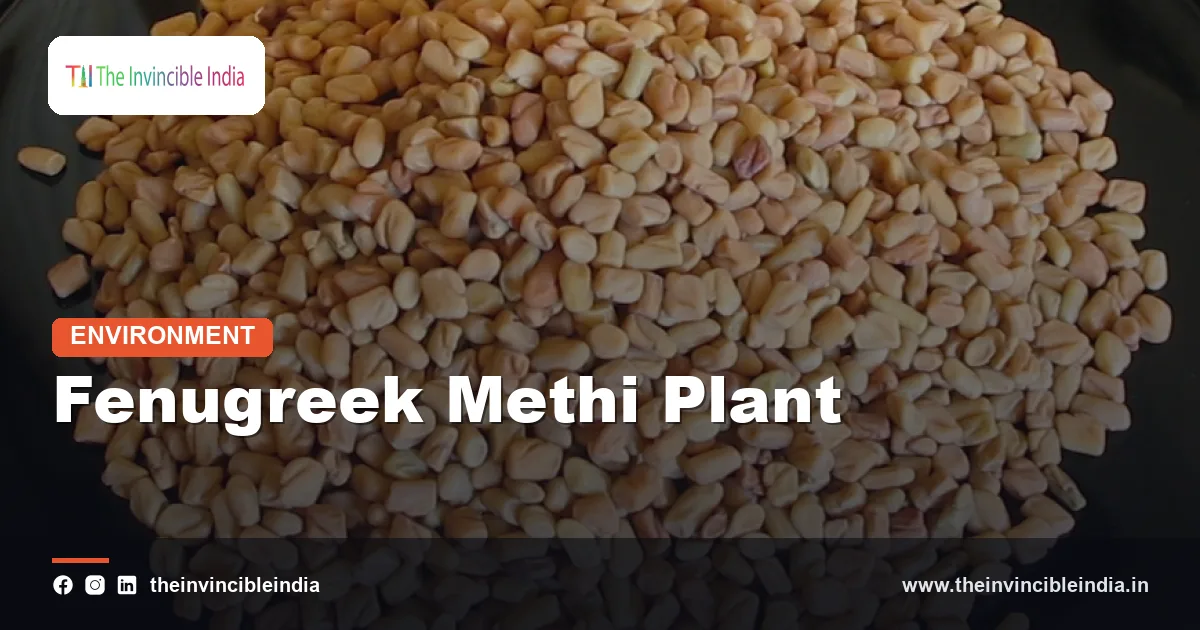
The legume fenugreek (Trigonella foenum-graecum), known as methi in India, is an annual plant of the pea family that is grown as a leafy vegetable, a seed-spice and a green fodder. Its clover-like leaves are eaten fresh or dried, its small golden seeds are used as a bitter, aromatic spice, and its green plants feed livestock, making it one of the most versatile of the winter crops of the Indian plains.
Because fenugreek belongs to the Fabaceae family, it also improves the soil in which it grows. This explainer describes the plant, the regions and seasons in which it is grown in India, how the leaf, seed and fodder crops differ, and why methi holds such a distinctive place in Indian cooking, farming and household tradition.
| Common names | Fenugreek, methi (Hindi and Marathi), venthayam (Tamil), menthulu (Telugu), uluva (Malayalam) |
|---|---|
| Scientific name | Trigonella foenum-graecum |
| Plant family | Fabaceae (the legume or pea family) |
| Where grown in India | Rajasthan is the leading state for seed; also Gujarat, Madhya Pradesh, Haryana, Uttar Pradesh and Punjab; leaves grown nearly everywhere |
| Growing season | Rabi (winter): sown October to November; leaf crops sown in cool months |
| Parts used | Fresh leaves, dried leaves (kasuri methi), seeds and the whole plant as fodder |
| Products and uses | Leafy vegetable, spice, pickles, spice blends, fodder, traditional remedies |
| Crop duration | Around 25 to 30 days for first leaf cut; roughly 120 to 150 days for seed |
| Notable fact | A nitrogen-fixing legume that enriches the soil as well as feeding people and animals |
Key Takeaways
- Fenugreek (Trigonella foenum-graecum), called methi in India, is an annual legume of the Fabaceae family used as a leafy vegetable, a seed-spice and a fodder.
- The fenugreek plant has trifoliate, clover-like leaves, small white or pale yellow flowers and long, slender, curved pods holding hard golden-brown seeds.
- Rajasthan is India’s leading fenugreek-producing state, and the crop is grown mainly as a cool-season rabi crop sown in October and November.
- Fenugreek leaves can be harvested for the first time within about a month of sowing, whereas the seed crop takes roughly four to five months.
- Kasuri methi, the dried herb used to finish curries, comes from a related species, Trigonella corniculata, and not from the common fenugreek used for seed.
- As a legume, fenugreek hosts nitrogen-fixing bacteria in its root nodules, which helps enrich the soil for the next crop.
What is fenugreek and why is it so versatile?
Fenugreek is a small annual legume that serves as three crops in one: a green leafy vegetable, a pungent seed-spice and a protein-rich fodder. It is versatile because every stage of its short life has a use, from the tender seedlings to the dry seeds.
The plant is thought to have originated around the Mediterranean and West Asia and has been cultivated since ancient times. The species name foenum-graecum means “Greek hay” in Latin, a reference to its old use as fodder. It spread to the Indian subcontinent early and became part of both daily cooking and traditional household practice.
In India the plant is known simply as methi, and the word covers the fresh leaves, the seeds (methi dana) and the dried leaves. The Spices Board of India classes fenugreek as one of the major seed spices, along with cumin, coriander, fennel and others.
What does the fenugreek plant look like?
The fenugreek plant is an erect, soft-stemmed herb about 30 to 60 centimetres tall, with leaves made of three small, oval leaflets. This three-leaflet structure resembles clover, which reflects the plant’s close relationship to the clovers and alfalfa.
Leaves and flowers
The leaflets are light to mid-green, slightly toothed near the tip and mildly aromatic when crushed. Flowers appear singly or in pairs where the leaves meet the stem. They are small, creamy white or pale yellow and shaped like typical pea-family flowers.
Pods and seeds
After flowering, the plant forms long, narrow pods that are slightly curved and end in a pointed beak. Each pod holds around ten to twenty small seeds. The seeds are hard, angular and golden-yellow to brown, with a groove on one side. They release a strong, maple-like aroma when roasted, a smell associated with a compound called sotolon.
Roots and soil benefits
Fenugreek roots carry small nodules that contain Rhizobium bacteria. These bacteria convert nitrogen from the air into a form that plants can use. After harvest, the roots and residues leave some of this nitrogen behind, which is why fenugreek is valued in rotations with cereals and other crops that draw heavily on soil nitrogen.
Where is fenugreek grown in India?
Fenugreek is grown across India, with Rajasthan the leading state for seed production, followed by states such as Gujarat, Madhya Pradesh, Haryana, Uttar Pradesh and Punjab. As a leafy vegetable it is grown in market gardens close to cities all over the country.
Within Rajasthan the crop is concentrated in the north and east of the state, in districts such as Sikar, Jhunjhunu, Nagaur and Jodhpur, though the pattern varies year to year. Madhya Pradesh and Gujarat contribute meaningful quantities, and northern states grow plenty of leaf methi during winter.
| Product | Main growing areas | Form sold |
|---|---|---|
| Fenugreek seed (methi dana) | Rajasthan, Gujarat, Madhya Pradesh | Dried whole seed and powder |
| Fresh leaves | Peri-urban belts across north, west and central India | Bunches sold in vegetable markets |
| Dried leaves (kasuri methi) | Parts of north India and Rajasthan | Dried, crushed herb for finishing dishes |
| Fodder | Dairy-farming regions of the north and west | Green cuttings for cattle |
What climate and soil does fenugreek need?
Fenugreek needs a cool, fairly dry climate and well-drained, fertile loam, and it is grown as a winter crop in most of India. The plant tolerates mild cold and some frost better than many vegetables, but it does poorly in heavy waterlogging or prolonged humidity.
Moderate temperatures encourage leafy growth, while warm weather speeds flowering and seed maturity. Seed crops benefit from dry, sunny conditions at pod-filling and harvest. Soils that are neutral or slightly alkaline and rich in organic matter work well, and the legume’s own nitrogen-fixing ability means it needs relatively little nitrogen fertiliser.
How is fenugreek cultivated, from sowing to harvest?
Fenugreek is cultivated by sowing seed directly into finely prepared beds in October or November, giving light irrigations, and harvesting leaves, seeds or green fodder depending on the farmer’s goal. The crop is simple to grow, which is one reason it is common in small kitchen gardens.
Sowing and care
The seed is sown by broadcasting or in shallow lines and covered lightly. Germination is quick, usually within a few days in cool, moist soil. A light early irrigation is common, and weeds are removed within the first month. Because the crop grows fast, it rarely needs heavy inputs, though a basal dose of organic manure helps.
Harvesting for leaves
The first leaf cutting is taken around 25 to 30 days after sowing, when the plants are tender. Many farmers take several cuttings by nipping off the upper shoots, which encourages fresh growth. After about two cuttings, plants are usually left to flower if seed is wanted, since repeated cutting delays and reduces the seed yield.
Harvesting for seed
For seed, the plants are left to flower and form pods. They are cut when the lower leaves turn yellow and the pods become dry, which is roughly four to five months after sowing. The harvested plants are dried in the sun, threshed to free the seeds and then winnowed and cleaned.
Fodder and green manure
Fenugreek can also be cut green as a nutritious fodder for cattle or ploughed back into the soil as green manure. This flexibility lets farmers match the crop to local needs, whether that is a vegetable for the market, a spice for sale or feed for animals.
What diseases and pests trouble the fenugreek crop?
The main troubles of the fenugreek crop are powdery mildew, root rot, leaf spots and aphids, and these are more serious in damp or crowded fields. The crop is generally hardy, but disease can spread fast in humid weather.
- Powdery mildew: a white, powdery fungal growth on leaves and pods that appears in cool, humid weather.
- Root rot: caused by soil fungi, it is worst in waterlogged fields and in land repeatedly planted with legumes.
- Leaf spots: fungal blemishes that reduce the market value of the leaf crop.
- Aphids: tiny sap-feeding insects that cluster on young shoots and flowers.
Rotation with cereals, good drainage and use of clean seed are the main safeguards. Because the leaves are eaten fresh, farmers who grow fenugreek for vegetable markets are generally encouraged to keep chemical sprays to a minimum and to respect waiting periods before harvest.
How is fenugreek used in Indian kitchens?
Fenugreek is used in Indian kitchens as a fresh leafy vegetable, as dried leaves to finish curries, and as whole or ground seeds in tempering, pickles and spice blends. Its distinctive bitterness is valued in balance with sweet, sour and spicy flavours.
Fresh methi leaves
- Cooked as a vegetable with potato (aloo methi) or with lentils.
- Kneaded into flatbreads such as methi paratha, thepla and missi roti.
- Added to pulao, khichdi, dumplings and fritters.
Dried leaves (kasuri methi)
Kasuri methi is the dried, crushed leaf crumbled over butter chicken, paneer dishes and gravies in the final minutes of cooking. It is traditionally associated with the Kasur region of Punjab and is made from a related species, Trigonella corniculata, rather than from common fenugreek. Its aroma is stronger and sweeter than that of the fresh leaves.
Seeds (methi dana)
The seeds are bitter when raw and nutty when lightly roasted. A pinch is used in tempering for dals, vegetables and sambar. They feature in panch phoron, the five-spice mixture of eastern India, in sambar powder and in many pickles, where they add depth and help preserve. Over-roasting turns the seeds acrid, so cooks fry them briefly.
What are the health and household uses of fenugreek?
Fenugreek is traditionally used in Indian homes for digestion, for nursing mothers and for general wellbeing, and its seeds are rich in fibre and in a gummy substance called galactomannan. These uses are long established in folk practice and Ayurveda.
The seeds contain mucilage, protein, saponins and other compounds, and they have been the subject of scientific studies, including on blood sugar and cholesterol. Such research is ongoing and its findings are not a substitute for medical treatment. Anyone managing a health condition, or who is pregnant or breastfeeding, should talk to a doctor before taking fenugreek in medicinal quantities.
Outside food, fenugreek paste and soaked seeds are used traditionally as hair and skin applications in many households. These are everyday customs rather than proven medical treatments.
How does fenugreek compare with other seed spices?
Fenugreek differs from cumin, coriander and fennel mainly in being a legume rather than a member of the carrot family, in tasting bitter rather than sweet, and in enriching the soil. Placing it beside its fellow rabi spices shows what is distinctive about the crop.
| Crop | Plant family | Flavour | Special feature |
|---|---|---|---|
| Fenugreek (methi) | Fabaceae | Bitter, maple-like aroma | Fixes nitrogen; leaf, seed and fodder uses |
| Cumin (jeera) | Apiaceae | Earthy and warm | Seed only; very weather-sensitive |
| Coriander (dhania) | Apiaceae | Citrusy leaves, nutty seeds | Dual-use leaf and seed |
| Fennel (saunf) | Apiaceae | Sweet and liquorice-like | Seed and after-meal mouth freshener |
Why does fenugreek matter to farmers and the economy?
Fenugreek matters to farmers because it is a quick, low-cost crop that earns money from leaves within weeks, from seed within months, and that improves soil fertility for the following crop. Its flexibility makes it attractive to small and marginal growers.
The leaf crop is a daily-sale vegetable near cities, while the seed crop is traded in regulated markets and supplied to spice processors, pickle makers and exporters. The dried-leaf trade adds a further value-added product. Because the plant requires little irrigation and few inputs, it suits dry regions, especially Rajasthan.
The crop’s legume nature fits sustainable farming. It reduces the nitrogen fertiliser needed by the next crop, and it breaks disease cycles when rotated with wheat, mustard or millets. Prices of seed, like those of other spices, can swing from season to season, so growers often plan area according to market signals.
Bottom Line
Fenugreek, or methi, is a hardy winter legume that gives India a bitter leafy green, a distinctive spice and a nutritious fodder from a single short-season crop. Grown mainly in Rajasthan and across the northern plains, it also enriches the soil that nurtures it. That mix of kitchen value and farm value explains why methi remains a fixture in Indian fields and homes.
Frequently Asked Questions
What is fenugreek called in India?
Fenugreek is called methi in Hindi and several other Indian languages. In the south it is venthayam in Tamil, menthulu in Telugu and uluva in Malayalam. The seeds are known as methi dana and the botanical name is Trigonella foenum-graecum.
Is fenugreek a spice, a herb or a vegetable?
Fenugreek is all three, depending on the part and use. The fresh leaves are eaten as a leafy vegetable, the dried leaves are used as a herb, and the seeds are used as a spice. The whole plant can also be fed to cattle as fodder.
Which state grows the most fenugreek in India?
Rajasthan is the leading fenugreek-growing state in India, particularly for seed. Gujarat, Madhya Pradesh, Haryana, Uttar Pradesh and Punjab also grow it. Leaf methi is cultivated near towns and cities in nearly every state.
When is fenugreek sown in India?
Fenugreek is sown mainly in October and November, in the rabi or winter season. Leaf crops can be sown repeatedly in cool months for a steady supply. The first leaf cutting is ready in about a month, and the seed crop matures in four to five months.
What is kasuri methi?
Kasuri methi is the dried leaf of a fenugreek relative, Trigonella corniculata, used to flavour curries and gravies. It is crumbled over dishes near the end of cooking for a strong, slightly sweet aroma. The name is traditionally linked to the Kasur region of Punjab.
Why does fenugreek improve the soil?
Fenugreek improves the soil because it is a legume that hosts nitrogen-fixing bacteria in its root nodules. These bacteria turn atmospheric nitrogen into a form plants can use, and some remains in the soil after harvest. This is why fenugreek is valued in crop rotations with cereals and other crops.
{“@context”:”https://schema.org”,”@graph”:[{“@type”:”FAQPage”,”mainEntity”:[{“@type”:”Question”,”name”:”What is fenugreek called in India?”,”acceptedAnswer”:{“@type”:”Answer”,”text”:”Fenugreek is called methi in Hindi and several other Indian languages. In the south it is venthayam in Tamil, menthulu in Telugu and uluva in Malayalam. The seeds are known as methi dana and the botanical name is Trigonella foenum-graecum.”}},{“@type”:”Question”,”name”:”Is fenugreek a spice, a herb or a vegetable?”,”acceptedAnswer”:{“@type”:”Answer”,”text”:”Fenugreek is all three, depending on the part and use. The fresh leaves are eaten as a leafy vegetable, the dried leaves are used as a herb, and the seeds are used as a spice. The whole plant can also be fed to cattle as fodder.”}},{“@type”:”Question”,”name”:”Which state grows the most fenugreek in India?”,”acceptedAnswer”:{“@type”:”Answer”,”text”:”Rajasthan is the leading fenugreek-growing state in India, particularly for seed. Gujarat, Madhya Pradesh, Haryana, Uttar Pradesh and Punjab also grow it. Leaf methi is cultivated near towns and cities in nearly every state.”}},{“@type”:”Question”,”name”:”When is fenugreek sown in India?”,”acceptedAnswer”:{“@type”:”Answer”,”text”:”Fenugreek is sown mainly in October and November, in the rabi or winter season. Leaf crops can be sown repeatedly in cool months for a steady supply. The first leaf cutting is ready in about a month, and the seed crop matures in four to five months.”}},{“@type”:”Question”,”name”:”What is kasuri methi?”,”acceptedAnswer”:{“@type”:”Answer”,”text”:”Kasuri methi is the dried leaf of a fenugreek relative, Trigonella corniculata, used to flavour curries and gravies. It is crumbled over dishes near the end of cooking for a strong, slightly sweet aroma. The name is traditionally linked to the Kasur region of Punjab.”}},{“@type”:”Question”,”name”:”Why does fenugreek improve the soil?”,”acceptedAnswer”:{“@type”:”Answer”,”text”:”Fenugreek improves the soil because it is a legume that hosts nitrogen-fixing bacteria in its root nodules. These bacteria turn atmospheric nitrogen into a form plants can use, and some remains in the soil after harvest. This is why fenugreek is valued in crop rotations with cereals and other crops.”}}]}]}


