

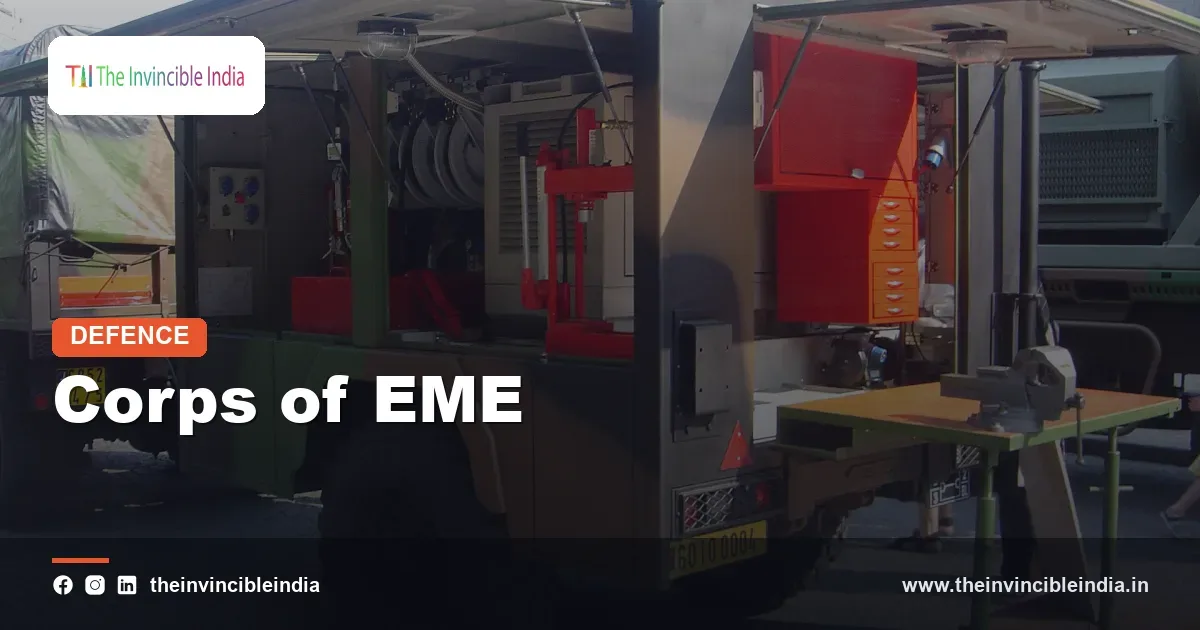
The Corps of Electrical and Mechanical Engineers (EME) is the technical maintenance arm of the Indian Army, raised in 1943, responsible for inspecting, repairing, overhauling and recovering the weapons, vehicles, tanks, radars, communication systems and other equipment that keep the Army ready for battle. The Corps of EME does not fight on the front line as an arm in itself, but combat units depend on its soldiers to keep their equipment working in the field and in the base.
The Corps of EME is a combat service support arm that works alongside the Army Ordnance Corps, which supplies stores, and the Army Service Corps, which handles supplies and transport. This explainer describes the origin, organisation, workshops, training and modern role of the Corps, together with its motto; last reviewed on 8 October 2026.
| Quick Facts: Corps of EME, Indian Army | |
|---|---|
| Full name | Corps of Electrical and Mechanical Engineers (EME) |
| Raised | 1943 (1 May is observed as Corps Day) |
| Branch of service | Indian Army, combat service support arm |
| Motto | Karm Hi Dharm, meaning “Work is Worship” |
| Core function | Maintenance, repair, overhaul and recovery of Army equipment |
| Head of the Corps | Director General of EME at Army Headquarters, a Lieutenant General |
| Training institutions | Military College of EME (Secunderabad) and EME School (Vadodara) |
| Corps centres | EME Centres at Bhopal and Secunderabad |
| Counterpart abroad | Royal Electrical and Mechanical Engineers (REME), British Army, formed in 1942 |
Key Takeaways
- The Corps of Electrical and Mechanical Engineers (EME) of the Indian Army was raised in 1943 and is responsible for the maintenance, repair and recovery of the Army’s equipment.
- The motto of the Corps of EME is Karm Hi Dharm, which means “Work is Worship”.
- The Corps of EME repairs equipment at several levels, from units and field workshops close to the front to large base workshops in the rear.
- The Corps of EME maintains a wide range of equipment, including vehicles, tanks, weapons, radars, communication sets and optronic devices.
- The Corps of EME provides technical training to its soldiers and officers at institutions such as the Military College of EME in Secunderabad and the EME School in Vadodara.
- The Corps of EME is distinct from the Army Ordnance Corps, because EME repairs equipment while the Ordnance Corps stores and supplies it.
What is the Corps of EME in the Indian Army?
The Corps of EME is the arm of the Indian Army that keeps its machines and electronic systems working, from rifles and trucks to tanks, guns and radars. Its personnel are trained technicians and engineers who serve with fighting units and in workshops, so that the Army’s equipment is serviceable when it is needed.
The role is easy to overlook because it takes place behind the fighting units, but it is essential to operational capability. A modern army has thousands of different equipment types, and a tank, aircraft or radar that cannot be repaired quickly may be as ineffective as one that has been destroyed. EME exists to reduce that time to a minimum.
Officers and soldiers of the Corps belong to the Army and are trained as soldiers as well as technicians. They go with the formations they support, including into forward areas, and carry out repairs under operational conditions.
When and why was the Corps of EME formed?
The Corps of EME was formed in 1943 during the Second World War, when the Indian Army’s growing use of vehicles, armour and electronic equipment made a unified technical repair organisation necessary. Before this, repair work was divided among different services and was a source of delay and inefficiency.
The British Army had already formed its Royal Electrical and Mechanical Engineers (REME) in 1942, merging repair functions that had been scattered across several corps. The Indian Army adopted a similar model, taking workshops and personnel from existing organisations such as the ordnance services and combining them into a single Corps.
Milestones in the history of the Corps
| Period | Development |
|---|---|
| 1942 | REME is formed in the British Army, creating the pattern for the Indian Corps |
| 1943 | The Corps of EME is raised in the Indian Army, bringing repair workshops under one organisation |
| 1947 | Independence; the Corps continues as part of the Indian Army |
| Post-Independence decades | The Corps expands its role as the Army acquires more armour, artillery and electronics |
| Recent decades | Increasing emphasis on electronics, optronics, computers and indigenisation |
The Corps has since served in every major operation of the Indian Army, keeping equipment running in difficult terrain from the deserts of Rajasthan to the high-altitude regions of the Himalayas.
What does the Corps of EME actually do?
The Corps of EME maintains, repairs, modifies and recovers the Army’s equipment so that it stays battle-ready. This covers a wide range of work, from routine servicing and inspection to full overhauls and the recovery of damaged or broken-down vehicles from the battlefield.
The main functions of the Corps can be summarised as follows:
- Inspection: checking equipment to make sure it is safe and fit for use, and advising commanders about its condition.
- Repair: fixing faults in vehicles, weapons, engines, electronics and other equipment, in the field or in a workshop.
- Overhaul: stripping down and rebuilding major equipment at set intervals so that it continues to perform to specification.
- Recovery: towing or lifting damaged and stuck vehicles, including tanks, using specialised recovery vehicles.
- Modification: carrying out technical changes and upgrades to improve performance or to adapt equipment to new tasks.
- Technical advice: guiding the Army on the selection, trials and induction of new equipment.
These tasks require a mix of mechanical, electrical and electronic skills, and the Corps trains its tradesmen accordingly.
How is repair work organised into field and base workshops?
The Corps of EME organises repair work in echelons, with simple repairs done close to the user and increasingly complex repairs done in larger workshops further back. This graded system makes sure that most faults are fixed quickly at the lowest possible level, while the most complex overhauls are carried out where the best tools and skills are available.
The levels of maintenance
| Level | Where it is done | Typical work |
|---|---|---|
| First line | With the unit, by its own users and EME detachments | Routine servicing, minor adjustments and quick fixes |
| Second line | Field workshops with brigades and divisions | Repair of faults and replacement of major assemblies |
| Third line | Advance workshops, nearer to the rear of the field area | Heavier repairs and component rebuilds |
| Fourth line | Base workshops in the rear | Complete overhauls and manufacture or refurbishment of components |
Field workshops are mobile and move with the formations they serve. They are designed to operate in the same conditions as the fighting units, including bad weather and rough terrain. Base workshops, by contrast, are large permanent facilities where complex equipment is overhauled in a more controlled setting. The exact numbering and naming of these levels may vary, but the principle of graded repair is constant.
What kinds of equipment does the Corps of EME maintain?
The Corps of EME maintains virtually all of the Army’s technical equipment apart from a few specialised items handled by other arms, such as signal equipment looked after in the first instance by the Corps of Signals. The range runs from small arms to heavy armour and electronic systems.
- Vehicles: trucks, jeeps, troop carriers and special-purpose vehicles.
- Armoured vehicles and tanks: engines, gearboxes, tracks, turrets and fire control systems.
- Weapons: rifles, machine guns, artillery pieces and associated sighting equipment.
- Electronics: radars, radios and other communication and surveillance equipment.
- Optronics: night vision devices, thermal imagers and electro-optical sights.
- Engineering equipment and generators: machinery used for construction, power supply and bridging.
The Corps includes trades such as vehicle mechanics, armourers, electricians, electronics and instrument mechanics, fitters and welders. Each trade has its own training, and tradesmen are expected to hold a technical qualification before taking on complex tasks.
How does the Corps of EME support modern warfare?
The Corps of EME supports modern warfare by maintaining the electronic, optical and computer-based systems on which contemporary armies depend, in addition to its traditional mechanical work. As weapons and vehicles have become more sophisticated, the proportion of electronic components has increased, and the skills required of EME personnel have changed accordingly.
Today the Corps looks after radar and electronic warfare equipment, surveillance and target-acquisition systems, and the optronic sights used by infantry, armour and artillery. It also supports unmanned systems and communication networks to the extent that these are fielded by the Army, working with specialised industry partners where necessary.
Another area of growing importance is indigenisation. The Corps is involved in repairing and sustaining imported equipment, and its engineers frequently develop local solutions, such as improvised or manufactured spares, to overcome shortages. This supports the national policy of self-reliance in defence, known as Atmanirbhar Bharat, and shortens the time during which equipment is out of action.
Where do EME personnel get trained?
EME personnel are trained mainly at the Military College of EME (MCEME) in Secunderabad, the EME School in Vadodara and the EME Centres at Bhopal and Secunderabad. These institutions provide the technical and military training that a member of the Corps needs, from basic trade training for recruits to degree-level engineering courses for officers.
The Military College of EME is the Corps’ senior training institution. It runs engineering courses for officers, including technical degree programmes, and specialised courses on subjects such as electronics, vehicles and weapon systems. The EME School trains tradesmen and junior leaders. The EME Centres handle recruit training and the posting of soldiers.
Officers of the Corps are mostly engineering graduates commissioned through the Army’s technical entry schemes, and they are trained at the Indian Military Academy or the Officers Training Academy before specialising in the Corps’ disciplines. Soldiers are recruited in various technical trades and trained in the same way as other soldiers before specialising in their trades.
What is the motto of the Corps of EME?
The motto of the Corps of EME is Karm Hi Dharm, which translates as “Work is Worship”. It reflects the Corps’ belief that diligent and dedicated work in the maintenance of equipment is a form of service to the nation.
The motto fits the nature of the Corps’ work. Repair and maintenance seldom attract public attention, yet an Army’s strength depends on the careful and persistent effort of its technicians. By emphasising duty and craftsmanship, the motto helps give soldiers of the Corps a sense of pride in work that is mostly done out of sight.
The Corps celebrates its raising each year on 1 May, observed as Corps Day, and the occasion is marked in units and training establishments across the country.
How is the Corps of EME different from the Army Ordnance Corps?
The Corps of EME differs from the Army Ordnance Corps in that EME repairs and maintains equipment, while the Army Ordnance Corps (AOC) procures, stores and issues it, together with ammunition and stores. The two corps work closely together, since an item that cannot be repaired by EME usually has to be replaced through the ordnance supply chain.
The division of responsibility is a standard feature of modern armies and is intended to separate the supply function from the technical function. In practice the two corps share depots and sometimes workshops, and soldiers of each rely on the other to keep operations running.
Bottom Line
The Corps of EME, raised in 1943, is the Indian Army’s repair and recovery organisation, keeping weapons, vehicles, tanks and electronics ready for use through a graded system of workshops. Guided by its motto, Karm Hi Dharm, it has adapted from a mechanical corps into one that supports electronic warfare and optronics.
Frequently Asked Questions
What is the Corps of EME?
The Corps of EME is the arm of the Indian Army responsible for maintaining, repairing and recovering its equipment. It was raised in 1943 and covers vehicles, tanks, weapons, radars and other electronic systems. Its soldiers work in workshops and with fighting units in the field.
What is the motto of the Corps of EME?
The motto of the Corps of EME is Karm Hi Dharm, meaning “Work is Worship”. It reflects the Corps’ emphasis on duty and craftsmanship. The Corps observes 1 May as its annual Corps Day.
When was the Corps of EME raised?
The Corps of EME was raised in 1943 during the Second World War. It was modelled on the British Army’s Royal Electrical and Mechanical Engineers, formed in 1942. The aim was to bring scattered repair workshops under a single technical organisation.
What equipment does the Corps of EME repair?
The Corps of EME repairs vehicles, tanks, weapons, radars, communication sets and optronic devices such as night vision equipment. It also maintains engineering machinery and generators. The work ranges from routine servicing to complete overhauls and battlefield recovery.
Where do EME officers and soldiers train?
EME personnel train at the Military College of EME in Secunderabad, the EME School in Vadodara and the EME Centres at Bhopal and Secunderabad. Officers are mostly engineering graduates commissioned through technical entry schemes. Soldiers are trained in trades such as vehicle mechanic, armourer and electronics.
What is the difference between EME and the Army Ordnance Corps?
The Corps of EME repairs and maintains equipment, while the Army Ordnance Corps procures, stores and issues stores, equipment and ammunition. The two work together, since equipment that cannot be repaired is replaced through the ordnance system. They are separate combat service support arms of the Indian Army.
{“@context”:”https://schema.org”,”@graph”:[{“@type”:”FAQPage”,”mainEntity”:[{“@type”:”Question”,”name”:”What is the Corps of EME?”,”acceptedAnswer”:{“@type”:”Answer”,”text”:”The Corps of EME is the arm of the Indian Army responsible for maintaining, repairing and recovering its equipment. It was raised in 1943 and covers vehicles, tanks, weapons, radars and other electronic systems. Its soldiers work in workshops and with fighting units in the field.”}},{“@type”:”Question”,”name”:”What is the motto of the Corps of EME?”,”acceptedAnswer”:{“@type”:”Answer”,”text”:”The motto of the Corps of EME is Karm Hi Dharm, meaning “Work is Worship”. It reflects the Corps’ emphasis on duty and craftsmanship. The Corps observes 1 May as its annual Corps Day.”}},{“@type”:”Question”,”name”:”When was the Corps of EME raised?”,”acceptedAnswer”:{“@type”:”Answer”,”text”:”The Corps of EME was raised in 1943 during the Second World War. It was modelled on the British Army’s Royal Electrical and Mechanical Engineers, formed in 1942. The aim was to bring scattered repair workshops under a single technical organisation.”}},{“@type”:”Question”,”name”:”What equipment does the Corps of EME repair?”,”acceptedAnswer”:{“@type”:”Answer”,”text”:”The Corps of EME repairs vehicles, tanks, weapons, radars, communication sets and optronic devices such as night vision equipment. It also maintains engineering machinery and generators. The work ranges from routine servicing to complete overhauls and battlefield recovery.”}},{“@type”:”Question”,”name”:”Where do EME officers and soldiers train?”,”acceptedAnswer”:{“@type”:”Answer”,”text”:”EME personnel train at the Military College of EME in Secunderabad, the EME School in Vadodara and the EME Centres at Bhopal and Secunderabad. Officers are mostly engineering graduates commissioned through technical entry schemes. Soldiers are trained in trades such as vehicle mechanic, armourer and electronics.”}},{“@type”:”Question”,”name”:”What is the difference between EME and the Army Ordnance Corps?”,”acceptedAnswer”:{“@type”:”Answer”,”text”:”The Corps of EME repairs and maintains equipment, while the Army Ordnance Corps procures, stores and issues stores, equipment and ammunition. The two work together, since equipment that cannot be repaired is replaced through the ordnance system. They are separate combat service support arms of the Indian Army.”}}]}]}


